May 18-19, 2010
Air Temperatures – The following maximum temperatures were recorded across the state of Hawaii Tuesday afternoon:
Lihue, Kauai – 81
Honolulu, Oahu – 86
Kaneohe, Oahu – 82
Kaunakakai, Molokai – 84
Kahului, Maui – 86
Hilo, Hawaii – 83
Kailua-kona – 82
Air Temperatures ranged between these warmest and coolest spots near sea level around the state – and on the highest mountains…at 5am Tuesday evening:
Port Allen, Kauai – 84F
Lihue, Kauai – 68
Haleakala Crater – 57 (near 10,000 feet on Maui)
Mauna Kea summit – 41 (near 14,000 feet on the Big Island)
Precipitation Totals – The following numbers represent the largest precipitation totals (inches) during the last 24 hours on each of the major islands, as of Tuesday afternoon:
0.07 Mount Waialaele, Kauai
0.01 Ahuimanu Loop, Oahu
0.01 Molokai
0.00 Lanai
0.00 Kahoolawe
0.07 West Wailuaiki, Maui
0.23 Kawainui Stream, Big Island
Marine Winds – Here’s the latest (automatically updated) weather map showing a 1022 millibar high pressure system to our north-northeast…iwth ridges extending both east and west from its center. The trade winds will remain moderately strong in general…increasing some into Thursday.
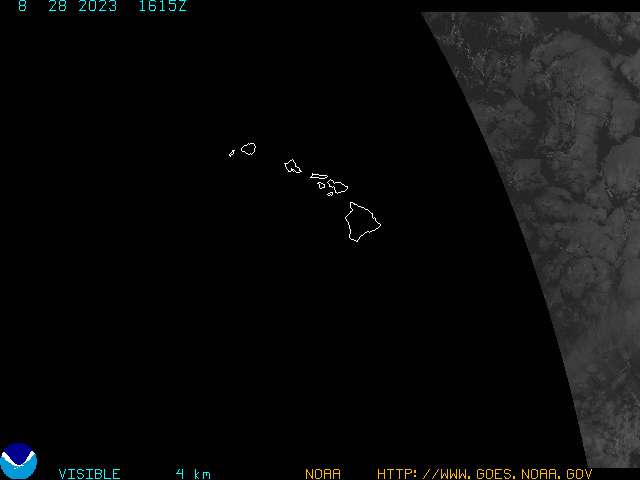
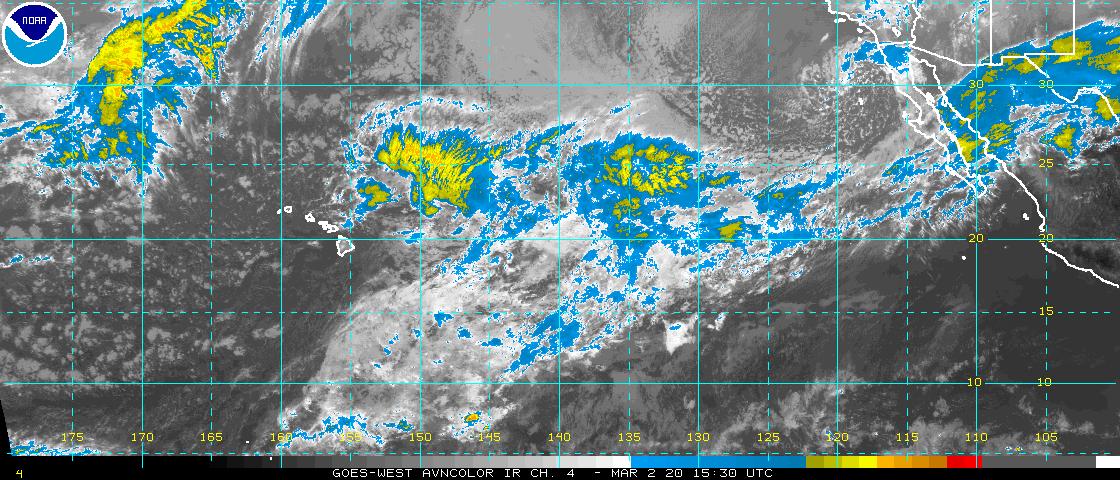
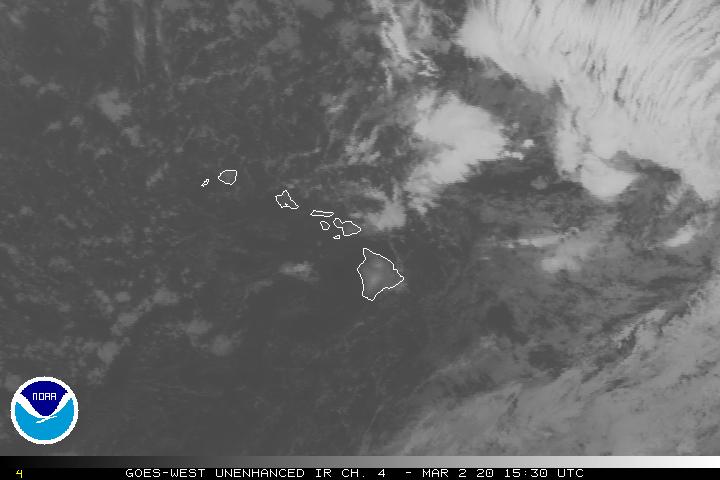
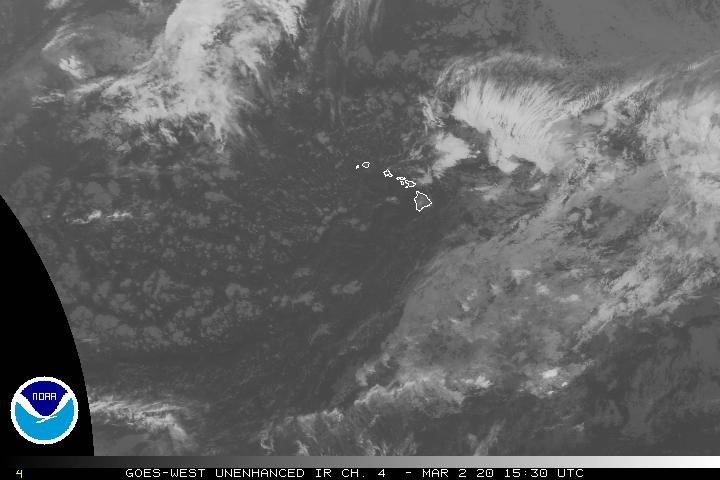
Satellite and Radar Images: To view the cloud conditions we have here in Hawaii, please use the following satellite links, starting off with this Infrared Satellite Image of the islands to see all the clouds around the state during the day and night. This next image is one that gives close images of the islands only during the daytime hours, and is referred to as a Close-up visible image. This next image shows a larger view of the Pacific…giving perspective to the wider ranging cloud patterns in the Pacific Ocean. Finally, here’s a Looping IR satellite image, making viewable the clouds around the islands 24 hours a day. To help you keep track of where any showers may be around the islands, here’s the latest animated radar image.
Hawaii’s Mountains – Here’s a link to the live webcam on the summit of near 14,000 foot Mauna Kea on the Big Island of Hawaii. The tallest peak on the island of Maui is the Haleakala Crater, which is near 10,000 feet in elevation. These two webcams are available during the daylight hours here in the islands…and when there’s a big moon rising just after sunset for an hour or two! Plus, during the nights and early mornings you will be able to see stars, and the sunrise too…depending upon weather conditions.
Tropical Cyclone activity in the eastern and central Pacific – Here’s the latest weather information coming out of the National Hurricane Center, covering the eastern north Pacific. You can find the latest tropical cyclone information for the central north Pacific (where Hawaii is located) by clicking on this link to the Central Pacific Hurricane Center. Here’s a tracking map covering both the eastern and central Pacific Ocean. A satellite image, which shows the entire ocean area between Hawaii and the Mexican coast…can be found here. Of course, as we know, our hurricane season won’t begin again until June 1st here in the central Pacific.
Aloha Paragraphs
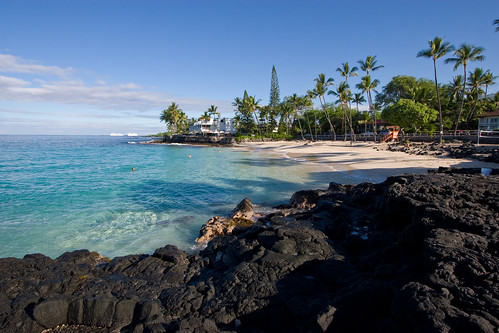
Beautiful Beach…Big Island coast
The trade winds are blowing now, just like they will be through the rest of this week, then right on into next week, so on and so forth through the rest of the spring/summer season…or at least most of it. The trade winds were actually relatively light Tuesday, barely able to gust up above the 30 mph mark at those typically windiest spots around the state. Checking out this weather map, we see a fairly light weight 1022 millibar high pressure system positioned just to the north-northeast of the islands. This (H) high pressure cell is forecast to move rather quickly to the east, towards the eastern
The overlying atmosphere remains dry and stable Tuesday night, limiting showers across the island chain…at least for the time being. The computer forecast models have been suggesting that a trough of low pressure will edge over the islands later this week. This in turn could bring an associated increase in showers. This trough would thicken the incoming clouds on the breezy trade winds, and make them more shower prone along our windward sides. Using this IR satellite image, we see a fairly normal distribution of stable clouds in all directions. Shifting over to this looping radar image, we can see just a few showers over the ocean, perhaps taking aim best on the Big Island…and then towards Maui later. Glancing at this larger satellite view, we see nothing unusual as far as the eye can see, with just a few minor thunderstorms down near the equator…and a new batch of high clouds far to the northwest. We may see a lot more high cirrus clouds by the time we reach the weekend.
It’s Tuesday evening as I begin writing this last section of today’s narrative.
The trade winds continue blowing, and at around 530pm, the strongest gust was being reported at both Kahoolawe and Maalaea Bay, Maui. There are some clouds around, although they seem rather mild mannered at the time of this writing. The main thing through the rest of this week, as noted above, is that the trade winds will be a steady presence across all the Hawaiian Islands. ~~~ Looking up towards the Haleakala Crater from down here in Kihei, it’s quite cloudy, although I don’t see any shower activity. Those clouds up there will be evaporating after the sun goes down, as will the few clouds down here by the beach. The only showers that will likely fall will be along the windward coasts and slopes, although not even that many over there. I’ll be back online again early Wednesday morning, with your next new weather narrative, I hope you have a great Tuesday night until then! Aloha for now…Glenn.
Interesting: Kudzu, an invasive vine that is spreading across the southeastern United States and northward, is a major contributor to large-scale increases of the pollutant surface ozone, according to a study published the week of May 17 in the journal Proceedings of the National Academy of Sciences. Kudzu, a leafy vine native to Japan and southeastern China, produces the chemicals isoprene and nitric oxide, which, when combined with nitrogen in the air, form ozone, an air pollutant that causes significant health problems for humans. Ozone also hinders the growth of many kinds of plants, including crop vegetation.
"We found that this chemical reaction caused by kudzu leads to about a 50 percent increase in the number of days each year in which ozone levels exceed what the Environmental Protection Agency deems as unhealthy," said study co-author Manuel Lerdau, a University of Virginia professor of environmental sciences and biology. "This increase in ozone completely overcomes the reductions in ozone realized from automobile pollution control legislation."
Lerdau and his former graduate student, lead author Jonathan Hickman — now a postdoctoral fellow at Columbia University — used field studies at three sites in Georgia to determine the gas production of kudzu. They then worked with Shiliang Wu and Loretta Mickley, atmospheric scientists at Harvard University, who used atmospheric chemistry computer models to evaluate the potential 50-year effect of kudzu invasion on regional air quality.
"Essentially what we found is that this biological invasion has the capacity to degrade air quality, and in all likelihood over time lead to increases in air pollution, increases in health problems caused by that air pollution, and decreases in agricultural productivity," Lerdau said. "This is yet another compelling reason to begin seriously combating this biological invasion. What was once considered a nuisance, and primarily of concern to ecologists and farmers, is now proving to be a potentially serious health threat."
Ozone acts as an irritant to the eyes, nose and throat, and can damage the lungs, sometimes causing asthma or worsening asthma symptoms. It also is a mutagen and can cause lung cancer. Ozone, while essential to the health of the Earth in the upper atmosphere where it shields the surface from excess ultraviolet radiation, is hazardous to human health when it forms at the earth’s surface.
This occurs most often in the summertime as plants grow and produce chemicals that react with the air. Introduced to the United States in the late 19th century, kudzu, with its unique nitrogen-fixing physiology, allows a rapid, nearly uninhibited rate of growth, about three times the rate of trees and other vegetation. The vine was cultivated more extensively in the 1920s and 1930s as a control for soil erosion and rapidly became known as "the vine that ate the South."
In recent, milder winters, Kudzu has expanded its range northward into Pennsylvania and New York. "What was once a Southern problem is now becoming an East Coast issue," Lerdau said. Various strategies are used for controlling and eradicating kudzu, including livestock grazing, burning, mowing and herbicides.
Interesting2: The U.S. could miss out on 100,000 clean energy manufacturing jobs by 2015 and 250,000 by 2030 if current industry trends continue, according to a new report by the Apollo Alliance and Good Jobs First. The report, Winning the Race: How America Can Lead the Global Clean Energy Economy, estimates that 70 percent of the nation’s renewable energy systems and components are currently being manufactured abroad.
"We are quickly losing the chance to be a leader in what will be the biggest economic opportunity of the 21st century: the global clean energy economy," Apollo Alliance Chairman Phil said in a press release announcing the report’s release. "While other countries are making massive investments in clean energy infrastructure and production-and creating tens of thousands of new jobs as a result-the United States doesn’t even have the capacity to meet its own demand for renewable energy components."
The new report comes at a time when some lawmakers are growing concerned that foreign owned clean energy manufacturing companies are receiving large sums of federal stimulus money. Senators Sherrod Brown, Bob Casey, Charles Schumer, and Jon Tester have introduced legislation designed to ensure that federal investments in clean energy under the American Recovery and Reinvestment Act go to American owned manufacturing companies.
"It is a no-brainer that stimulus funds should only go to projects that create jobs in the United States rather than overseas," Senator Schumer said in a press release posted on his website. "Our domestic clean-energy sector has the potential to emerge as a global leader and it is counterproductive to invest U.S. stimulus funds in Chinese companies rather than our own. We should not be giving China a head start in this race at our own country’s expense."
China is currently the winning the race to become the global leader of the growing clean energy manufacturing sector, according to the report. China’s rise to the top has been fueled by an investment in clean energy technology that is estimated to equal $12.6 million every hour. China isn’t alone on this front. Together, Japan and South Korea have invested more than four times as much in clean energy than the U.S.
The American Recovery and Reinvestment Act represented a $110 billion federal investment in clean energy, providing new funding for advanced batteries, energy efficiency, high-speed rail, renewable energy, and smart grid technology. Those investments may already be paying off. The report cites Obama administration statistics estimating that 826,000 clean energy jobs have already by created by the stimulus package.
The Recovery Act is also expected to create 30,000 manufacturing jobs in the clean energy sector. Even with those new jobs, America’s manufacturing sector is in serious trouble. The study notes that the U.S. economy has lost a total of 5.7 million manufacturing jobs during the past decade, 2 million of those since 2007. If clean energy is going to be the solution to the nation’s manufacturing woes, more work needs to be done.
Interesting3: A group of British explorers just back from a 60-day trip to the North Pole said Monday they had encountered unusual conditions, including ice sheets that drifted far faster than they had expected. The three-member team walked across the frozen Arctic Ocean to study the impact of increased carbon dioxide absorption by the sea, which could make the water more acidic and put crucial food chains under pressure.
Expedition leader Ann Daniels said the ice drifted so much that they eventually covered 500 nautical miles (576 miles) rather than the 268 nautical miles initially envisaged. One possible reason for the rapid drift was a lack of ice, she suggested. Satellite imagery reveals rapidly melting ice sheets in the Arctic, a region which is heating up three times more quickly than the rest of the Earth.
The first day the team was dropped off the ice moved so quickly to the south that it took the trio 10 days to make it back to their starting point. "None of us had ever experienced that amount of southerly drift on our previous expeditions, and it continued for such a long period of time. We kept expecting it to stop, we began to pray it would stop," Daniels said.
"At the end of the expedition we were losing three nautical miles a night … it was quite a major factor," she told a news conference in Ottawa. Many scientists link the higher Arctic temperatures to the greenhouse gas emissions blamed for global warming. Martin Hartley, a member of the team, said the condition of the ice was unpleasantly bad. "We spent a couple of days walking on ice that was three or four inches thick with no other thicker ice around, which was a big surprise to us," he told the news conference.
 Email Glenn James: