May 17-18, 2010
Air Temperatures – The following maximum temperatures were recorded across the state of Hawaii Monday afternoon:
Lihue, Kauai – 82
Honolulu, Oahu – 86
Kaneohe, Oahu – 82
Kaunakakai, Molokai – 84
Kahului, Maui – 85
Hilo, Hawaii – 82
Kailua-kona – 82
Air Temperatures ranged between these warmest and coolest spots near sea level around the state – and on the highest mountains…at 5pm Monday evening:
Port Allen, Kauai – 84F
Molokai airport – 77
Haleakala Crater – 59 (near 10,000 feet on Maui)
Mauna Kea summit – 45 (near 14,000 feet on the Big Island)
Precipitation Totals – The following numbers represent the largest precipitation totals (inches) during the last 24 hours on each of the major islands, as of Monday afternoon:
0.30 Mount Waialaele, Kauai
0.03 Nuuanu Upper, Oahu
0.02 Molokai
0.00 Lanai
0.00 Kahoolawe
0.19 West Wailuaiki, Maui
0.39 Kawainui Stream, Big Island
Marine Winds – Here’s the latest (automatically updated) weather map showing the bottom edge of a cold front moving by to the north of the islands, with a 1022 millibar high pressure system to our north. The trade winds will remain moderately strong…locally strong and gusty through Wednesday.
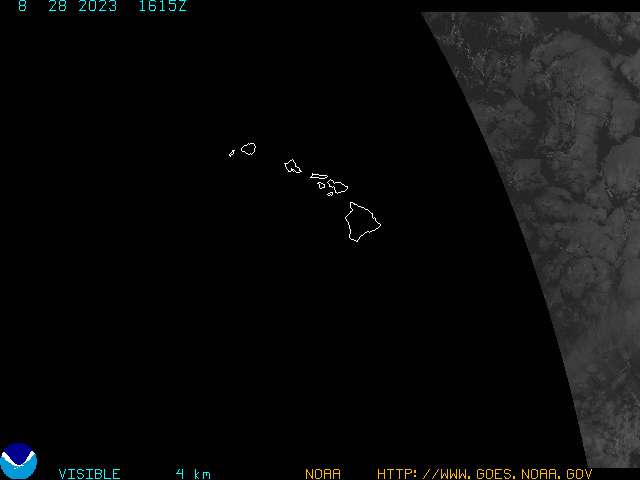
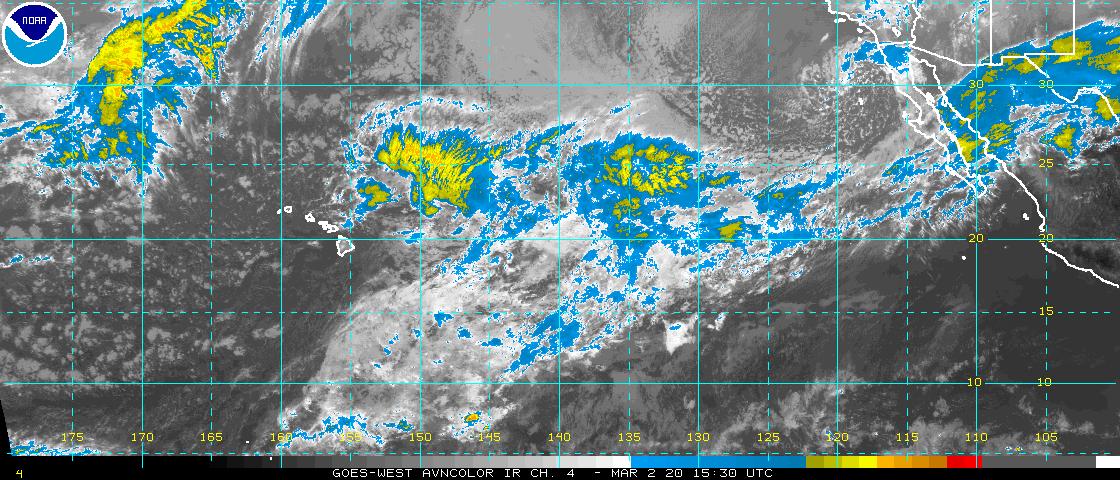
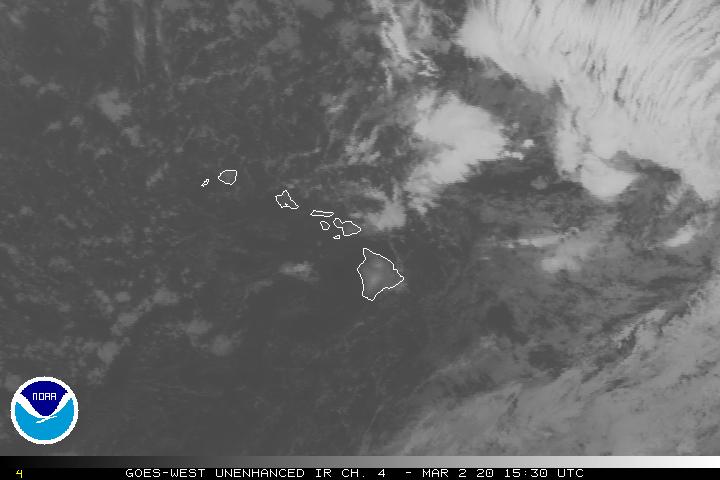
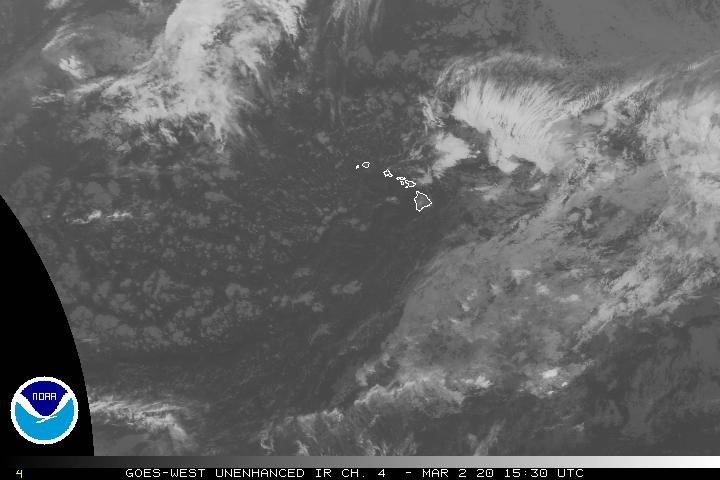
Satellite and Radar Images: To view the cloud conditions we have here in Hawaii, please use the following satellite links, starting off with this Infrared Satellite Image of the islands to see all the clouds around the state during the day and night. This next image is one that gives close images of the islands only during the daytime hours, and is referred to as a Close-up visible image. This next image shows a larger view of the Pacific…giving perspective to the wider ranging cloud patterns in the Pacific Ocean. Finally, here’s a Looping IR satellite image, making viewable the clouds around the islands 24 hours a day. To help you keep track of where any showers may be around the islands, here’s the latest animated radar image.
Hawaii’s Mountains – Here’s a link to the live webcam on the summit of near 14,000 foot Mauna Kea on the Big Island of Hawaii. The tallest peak on the island of Maui is the Haleakala Crater, which is near 10,000 feet in elevation. These two webcams are available during the daylight hours here in the islands…and when there’s a big moon rising just after sunset for an hour or two! Plus, during the nights and early mornings you will be able to see stars, and the sunrise too…depending upon weather conditions.
Tropical Cyclone activity in the eastern and central Pacific – Here’s the latest weather information coming out of the National Hurricane Center, covering the eastern north Pacific. You can find the latest tropical cyclone information for the central north Pacific (where Hawaii is located) by clicking on this link to the Central Pacific Hurricane Center. Here’s a tracking map covering both the eastern and central Pacific Ocean. A satellite image, which shows the entire ocean area between Hawaii and the Mexican coast…can be found here. Of course, as we know, our hurricane season won’t begin again until June 1st here in the central Pacific.
Aloha Paragraphs

Hanalei Heaven…Pierre Bouret
The late spring trade wind weather pattern prevails as we begin this new work week. This typical trade wind regime is forecast to remain active well into the future, certainly through the rest of this week…and not unlikely right on into next week. As this weather map shows, we find a 1022 millibar high pressure system to the north…up around 30 degrees north latitude. At the same time, we see two low pressure systems offshore from the
The dry conditions continue, right along with the winds, with just those occasional more generous precipitation totals being recorded here and there…mostly in the mountains along the windward sides. There shouldn’t be any major changes in the rainfall department this week. Although, after having written that, it should be pointed out, that the computer forecast models have been suggesting that a trough of low pressure, might edge up from the south later this week. This in turn could bring an associated increase in showers, especially around the Big Island. Moving back here to Monday evening, and using this IR satellite image for reference, we see some cloud chunks near Maui and moving in towards the
It’s Monday evening as I begin writing this last section of today’s narrative.
The trade winds remain active, and with no discernable limit to their longevity, they will be around perhaps right through the end of May…charging ahead right into June. This is good news for just about everyone, as the trade winds generally provide great weather conditions. The only problem, and this is associated with our current dry weather conditions, it increases the chance of wild fires along our very dry leeward sides. When it gets extremely dry, and the trade wind speeds reach a certain strength, the NWS office in Honolulu issues what they call a red flag watch or warning. This simply means that the danger of wild fires is a definite threat. We may see one of these watches or warnings become necessary over the next couple of days. ~~~ Here in Kihei, Maui, before I get in my car for the drive back upcountry to Kula, it looks partly cloudy out there. There are large clear patches too, especially down near the coasts. I’ll be back online again early Tuesday morning, at which point I’ll have your next new weather narrative available. I hope you have a great Monday night until then! Aloha for now…Glenn.
Interesting: Lake Tanganyika, the second oldest and the second-deepest lake in the world, could be in for some rough waters. Geologists led by Brown University have determined the east African rift lake has experienced unprecedented warming during the last century, and its surface waters are the warmest on record.
That finding is important, the scientists write in the journal Nature Geoscience, because the warm surface waters likely will affect fish stocks upon which millions of people in the region depend. The team took core samples from the lakebed that laid out a 1,500-year history of the lake’s surface temperature.
The data showed the lake’s surface temperature, 78.8°F, last measured in 2003, is the warmest the lake has been for a millennium and a half. The team also documented that Lake Tanganyika experienced its biggest temperature change in the 20th century, which has affected its unique ecosystem that relies upon the natural conveyance of nutrients from the depths to jumpstart the food chain upon which the fish survive.
"Our data show a consistent relationship between lake surface temperature and productivity (such as fish stocks)," said Jessica Tierney, a Brown graduate student who this spring earned her Ph.D. and is the paper’s lead author. "As the lake gets warmer, we expect productivity to decline, and we expect that it will affect the [fishing] industry."
The research grew out of two coring expeditions sponsored by the Nyanza Project in 2001 and 2004. Cores were taken by Andrew Cohen, professor of geological sciences at the University of Arizona and director of the Nyanza project, and James Russell, professor of geological sciences at Brown, who is also Tierney’s adviser.
Lake Tanganyika is bordered by Burundi, the Democratic Republic of Congo, Tanzania, and Zambia — four of the poorest countries in the world, according to the United Nations Human Development Index. An estimated 10 million people live near the lake, and they depend upon it for drinking water and for food.
Fishing is a crucial component for the region’s diet and livelihood: Up to 200,000 tons of sardines and four other fish species are harvested annually from Lake Tanganyika, a haul that makes up a significant portion of local residents’ diets, according to a 2001 report by the Lake Tanganyika Biodiversity Project.
Lake Tanganyika, one of the richest freshwater ecosystems in the world, is divided into two general levels. Most of the animal species live in the upper 100 meters, including the valuable sardines. Below that, the lake holds less and less oxygen, and at certain depths, it is anoxic, meaning it has no oxygen at all.
What this all means is the lake is highly stratified and depends on wind to churn the waters and send nutrients from the depths toward the surface as food for algae, which supports the entire food web of the lake. But as Lake Tanganyika warms, the mixing of waters is lessened, the scientists find, meaning less nutrients are funneled from the depths toward the surface.
Worse, more warming at the surface magnifies the difference in density between the two levels; even more wind is needed to churn the waters enough to ferry the nutrients toward the fish-dwelling upper layer. The researchers’ data show that during the last 1,500 years, intervals of prolonged warming and cooling are linked with low and high algal productivity, respectively, indicating a clear link between past temperature changes and biological productivity in the lake.
"The people throughout south central Africa depend on the fish from Lake Tanganyika as a crucial source of protein," noted Cohen, an author on the paper. "This resource is likely threatened by the lake’s unprecedented warming since the late 19th century and the associated loss of lake productivity." Climate change models show a general warming in the region, which, if accurate, would cause even greater warming of the Lake Tanganyika’s surface waters and more stratification in the lake as a whole.
"So, as you move forward, you can imagine that density gradient increasing," said Russell, an author on the paper. Some researchers have posited that the declining fish stocks in Lake Tanganyika can be attributed mainly to overfishing, and Tierney and Russell say that may be a reason. But they note that the warming in the lake, and the lessened mixing of critical nutrients is exacerbating the stocks’ decline, if not causing it in the first place. "It’s almost impossible for it not to," Russell said.
Interesting2: Four fisheries stocks, including Atlantic swordfish, have now been rebuilt to healthy levels, according to a report to Congress from NOAA’s Fisheries Service. Three stocks were removed from the overfishing list — those fished at a level that would threaten the stocks. For the first time since the report was issued in 1997, no stocks were added to the overfishing list. In Status of U.S. Fisheries, NOAA scientists reported that 85 percent of the stocks examined (212 of 250 stocks) were free from overfishing, or not fished at too high a level.
The report also examined whether stocks are overfished — a fish population too low to ensure a maximum sustainable harvest — and found that 77 percent of the stocks examined (157 of 203 stocks) were not overfished. "By working with our regional fishery councils and commercial and recreational fishermen, we are getting closer every year to ending overfishing in our waters," said Eric Schwaab, NOAA assistant administrator for NOAA’s Fisheries Service.
"With annual catch limits coming into effect this year, we expect our progress to accelerate." The report shows a continuing trend of year-over-year national improvements. This year’s report matches last year’s for the most stocks reported rebuilt — Atlantic scup, Atlantic black sea bass, and St. Matthew’s Island, Alaska, blue king crab and Atlantic swordfish. Four more stocks — Winter skate and sailfish in the Atlantic, and bocaccio and dark blotched rockfish in the Pacific — had populations at an overfished level in 2008, but began rebuilding in 2009.
Atlantic scup, Gulf of Maine thorny skate, and Gulf of Mexico pink shrimp, which were previously fished at too high a level, were found to be free from overfishing now. Two stocks of Alaskan king crab with a previously unknown status were also found to be free from overfishing. Canary rockfish, two stocks of coho salmon, and petrale sole populations, all found in the Pacific, declined in 2009 and are now considered overfished.
Fish stocks defined as overfished may be struggling due to causes other than fishing pressure, such as habitat loss or predator-prey interactions. Under the Magnuson-Stevens Fishery Conservation and Management Act, NOAA and the eight regional fishery management councils are required to end overfishing and prevent future overfishing through annual catch limits and accountability measures.
Annual catch limits are required to be put in place by 2010 for stocks with unsustainable fishing, and by 2011 for all stocks. To complete the annual report, NOAA examines a variety of sources, including landings data and log books, and conducts its own surveys.
Interesting3: Portrayed throughout history as a villainous critter that wastefully kills, the wolf’s reputation precedes it. The traditional image, however, is unwarranted and incorrect. Wolves are highly intelligent social animals. They are a critically important predator in the Western food chain.
When wolves eat, so too do a host of other animals including wolverines, lynx, bobcats, mink, weasels, hares, porcupines, squirrels, mice, voles, shrews and ravens. Wolves’ ancestry dates back to about 15 million years ago. They are related to foxes and domesticated dogs.
There are two species in North America, the gray or timber wolf, and the red wolf. Wolves have the largest natural range of any animal on our continent and their main predator is human beings. Hence, they have been hunted and poisoned, at one point to near extinction. Thankfully, they are survivors.
The translation of the wolf’s Latin name is literally "dog wolf," and for good reason. Wolves and dogs share common features. They both have a similar gestation time of about two months. And they both molt in the spring and grow winter coats in response to season differences in temperatures. Wolves, however, do have distinct features.
Their ears are relatively shorter, broad at the base and less pointy at the tip than those of most dogs. They have large heads with wide and heavy skulls that curve downward and blend into a broad but tapering muzzle that ends with a black nose. Their jaws have tremendous biting power.
They have longer legs than most dogs, with paws that are longer and wider in the front compared to the back. They have five frontal and four back toes. The fifth frontal toe is actually called a dewclaw and is used to help secure, hold and bring down prey. Because they are not necessary for locomotion, many dog owners have dewclaws removed.
Big springy feet assist wolves in attaining a top end speed of about 40 mph. More usually though, they travel at 5 to 6 mph while tracking prey for hours on end. Wolves are large critters, ranging in size from 5 to 6 feet in length with an average weight of 88 pounds. Females are about 15 percent smaller than males.
One of the most remarkable aspects about wild animals, particularly in North Country, is how they manage with cold winter temperatures. It has to do with their winter coats. Wolves have an exquisite, two-layered coat. The outer layer consists of guard hairs that shed moisture, keeping the coat free of dirt and burs because of the hard, smooth, slippery hairs. Their thick under fur contains an oily substance similar to sheep’s lanolin, helping make it impermeable to cold temperatures.
 Email Glenn James: