











May 16-17, 2010
Air Temperatures – The following maximum temperatures were recorded across the state of Hawaii Sunday afternoon:
Lihue, Kauai – 81
Honolulu, Oahu – 86
Kaneohe, Oahu – 82
Kaunakakai, Molokai – 82
Kahului, Maui – 84
Hilo, Hawaii – 80
Kailua-kona – 80
Air Temperatures ranged between these warmest and coolest spots near sea level around the state – and on the highest mountains…at 4pm Sunday afternoon:
Port Allen, Kauai – 84F
Princeville, Kauai – 75
Haleakala Crater – 61 (near 10,000 feet on Maui)
Mauna Kea summit – 48 (near 14,000 feet on the Big Island)
Precipitation Totals – The following numbers represent the largest precipitation totals (inches) during the last 24 hours on each of the major islands, as of Sunday afternoon:
0.36 Mount Waialaele, Kauai
0.57 Manoa Valley, Oahu
0.15 Molokai
0.00 Lanai
0.00 Kahoolawe
0.49 Puu Kukui, Maui
1.37 Kawainui Stream, Big Island
Marine Winds – Here’s the latest (automatically updated) weather map showing the bottom edge of a cold front moving by to the north of the islands, with a 1025 millibar high pressure system pushing it eastward…to our northwest. The trade winds will remain moderately strong…locally strong and gusty through Tuesday.
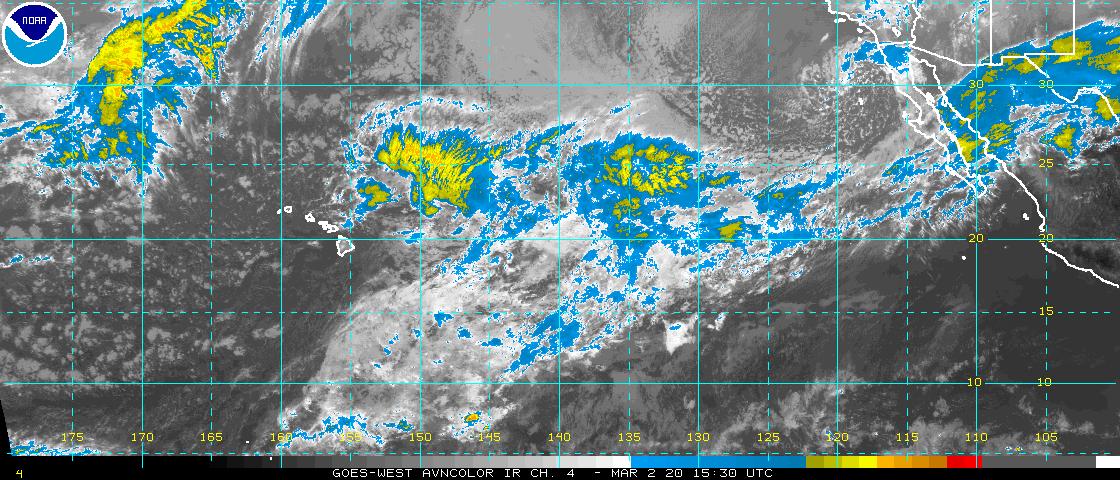
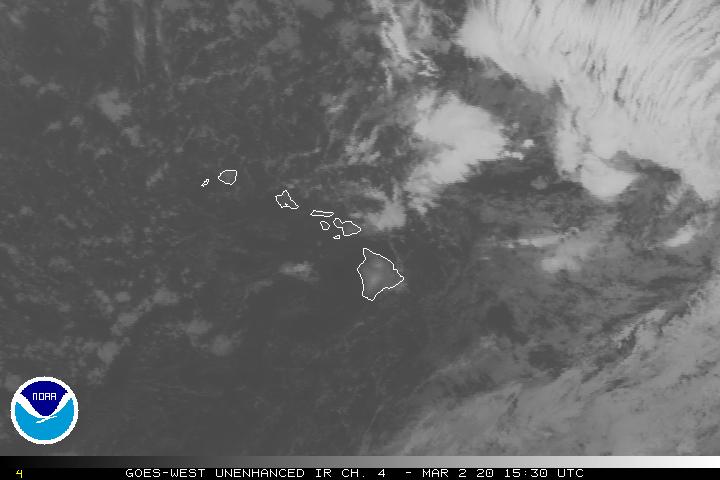
Satellite and Radar Images: To view the cloud conditions we have here in Hawaii, please use the following satellite links, starting off with this Infrared Satellite Image of the islands to see all the clouds around the state during the day and night. This next image is one that gives close images of the islands only during the daytime hours, and is referred to as a Close-up visible image. This next image shows a larger view of the Pacific…giving perspective to the wider ranging cloud patterns in the Pacific Ocean. Finally, here’s a Looping IR satellite image, making viewable the clouds around the islands 24 hours a day. To help you keep track of where any showers may be around the islands, here’s the latest animated radar image.
Hawaii’s Mountains – Here’s a link to the live webcam on the summit of near 14,000 foot Mauna Kea on the Big Island of Hawaii. The tallest peak on the island of Maui is the Haleakala Crater, which is near 10,000 feet in elevation. These two webcams are available during the daylight hours here in the islands…and when there’s a big moon rising just after sunset for an hour or two! Plus, during the nights and early mornings you will be able to see stars, and the sunrise too…depending upon weather conditions.
Tropical Cyclone activity in the eastern and central Pacific – Here’s the latest weather information coming out of the National Hurricane Center, covering the eastern north Pacific. You can find the latest tropical cyclone information for the central north Pacific (where Hawaii is located) by clicking on this link to the Central Pacific Hurricane Center. Here’s a tracking map covering both the eastern and central Pacific Ocean. A satellite image, which shows the entire ocean area between Hawaii and the Mexican coast…can be found here. Of course, as we know, our hurricane season won’t begin again until June 1st here in the central Pacific.
Aloha Paragraphs

Tropical art…Warren Keating
The trade winds will prevail as we move through all of the upcoming new week ahead. The small craft wind advisory has been taken down statewide, which leaves us with no advisories or warnings. There will be some fluctuation in the wind speeds, although generally ranging between 10-25 mph…with some stronger gusts at times locally. Winds will be lightest at night, and most gusty during the late mornings through late afternoon hours.
The windward sides will find some showers…with the leeward sides remaining generally dry. Looking at this IR satellite image, we see just scattered clouds upstream of the windward sides of the islands. These clouds will bring a few showers, although nothing overbearing in the lowlands. In order to get a better look at what’s happening, we can check out this even larger satellite picture, which shows some high cirrus clouds streaming up from the deep tropics. This area of cirrus is edging right up to the Big Island.
It’s Sunday evening as I begin writing this last section of today’s narrative.
The trade winds will remain with us well into the future. As noted above, a few of the wetter places around the state got some decent showers recently, although most of those gauges were up in the mountains. As we move into the new week ahead, it looks like a pretty typical late spring weather pattern. I don’t see anything unusual on the horizon, although the computer forecast models have been rather insistent that we might see some increase in showers around next weekend. This would be a good thing, although I’m hesitant to get too excited about this long range prospect just yet. ~~~ I had a very relaxing day Sunday, just hanging around the house, reading, and eating some nice food, doing a few chores. Late this afternoon my neighbor stopped by, and we got talking about bikes and biking. In the end we decided to put the bikes in the back of his pickup, and head up the slope of the Haleakala Crater. We started riding the bikes at around 4,000 feet, and then from there on up to the 5,000 foot elevation. That was a 1,000 foot gain in altitude, riding on switch back roads, until we reached the fog level, which was cool…both literally and figurately. We hung out there for a while, enjoying the quiet, and then rode down quickly. It was fun to go down fast over the terrain that we had just huffed and puffed, at least I did, getting up as high as we did. I feel excerised, and ready to go downstairs and fix dinner. I’ll catch up with you early Monday morning, when I’ll be back online with your next new weather narrative. I hope you have a great Sunday night until then! Aloha for now…Glenn.
Extra: Honda’s new mobility vehicle
 Email Glenn James: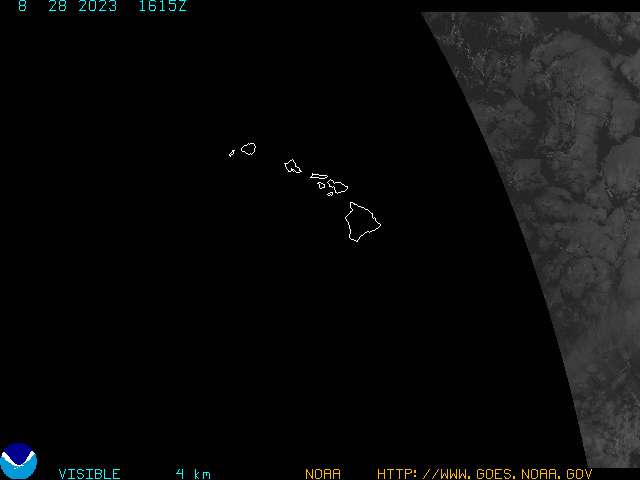

Andrew Holenchuk Says:
Aloha Glenn, My family and I are coming to your neck of the woods this Tuesday for a week. Fist time ever coming to Maui and we’re staying at the Westin Resort and Spa, Lahaina. We have everything packed and we are very excited! But I’ve been checking the forecast and all I see is rain, rain, and more rain … 🙁 A few of my friends tell me not to worry as it only rains for a bit, then it’s sunny for the rest of the day. Could you give me your thoughts on what you think we should expect for the week we’re staying there please. Thanks in advance! Andrew~~~Hi Andrew, that you are staying in Lahaina, pretty much ensures that you will have warm to very warm weather, with lots of sunshine. I wouldn’t worry about rain, and am not sure where you are getting that type of forecast, could it be weather.com? At any rate, come ahead, you will need to worry more about sunburns, than getting wet! Aloha, Glenn.
Dave Says:
Hi – We are at the Hilton in waikaloa. Any chance we will get a break from these high clouds? Thanks!~~~Hi Dave, if you click here: http://www.ssd.noaa.gov/goes/west/hi/ir4.jpg ~~~ you will see that the bulk of this thin line of high cirrus is over the Big Island Sunday afternoon. I think by Monday you should see much less of this, hang in there for a while longer. The positive side of this may be a great colorful sunset this evening. Aloha, Glenn