











May 11-12, 2010
Air Temperatures – The following maximum temperatures were recorded across the state of Hawaii Tuesday afternoon:
Lihue, Kauai – 81
Honolulu, Oahu – 86
Kaneohe, Oahu – 83
Kaunakakai, Molokai – 83
Kahului, Maui – 87
Hilo, Hawaii – 83
Kailua-kona – 83
Air Temperatures ranged between these warmest and coolest spots near sea level around the state – and on the highest mountains…at 4pm Tuesday afternoon:
Kahului, Maui – 84F
Molokai airport – 78
Haleakala Crater – 63 (near 10,000 feet on Maui)
Mauna Kea summit – 45 (near 14,000 feet on the Big Island)
Precipitation Totals – The following numbers represent the largest precipitation totals (inches) during the last 24 hours on each of the major islands, as of Tuesday afternoon:
0.32 Kilohana, Kauai
0.34 Punaluu Stream, Oahu
0.00 Molokai
0.00 Lanai
0.00 Kahoolawe
0.07 Hana airport, Maui
0.51 Glenwood, Big Island
Marine Winds – Here’s the latest (automatically updated) weather map showing a 1034 millibar high pressure system far to the northeast of the islands. This high’s ridge has moved fairly close to Kauai, due to the presence of a very late season cold front to our northwest. The trade winds will remain moderately strong.
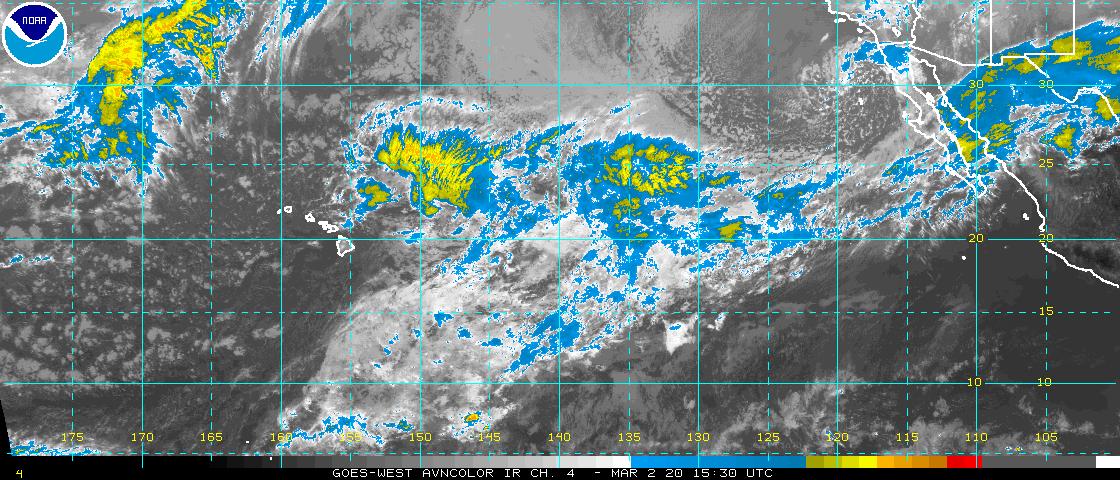
Satellite and Radar Images: To view the cloud conditions we have here in Hawaii, please use the following satellite links, starting off with this Infrared Satellite Image of the islands to see all the clouds around the state during the day and night. This next image is one that gives close images of the islands only during the daytime hours, and is referred to as a Close-up visible image. This next image shows a larger view of the Pacific…giving perspective to the wider ranging cloud patterns in the Pacific Ocean. Finally, here’s a Looping IR satellite image, making viewable the clouds around the islands 24 hours a day. To help you keep track of where any showers may be around the islands, here’s the latest animated radar image.
Hawaii’s Mountains – Here’s a link to the live webcam on the summit of near 14,000 foot Mauna Kea on the Big Island of Hawaii. The tallest peak on the island of Maui is the Haleakala Crater, which is near 10,000 feet in elevation. These two webcams are available during the daylight hours here in the islands…and when there’s a big moon rising just after sunset for an hour or two! Plus, during the nights and early mornings you will be able to see stars, and the sunrise too…depending upon weather conditions.
Tropical Cyclone activity in the eastern and central Pacific – Here’s the latest weather information coming out of the National Hurricane Center, covering the eastern north Pacific. You can find the latest tropical cyclone information for the central north Pacific (where Hawaii is located) by clicking on this link to the Central Pacific Hurricane Center. Here’s a tracking map covering both the eastern and central Pacific Ocean. A satellite image, which shows the entire ocean area between Hawaii and the Mexican coast…can be found here. Of course, as we know, our hurricane season won’t begin again until June 1st here in the central Pacific.
Aloha Paragraphs

A very lovely Hawaiian Hibiscus flower
Despite the best efforts of the computer forecast models to dampen our local trade wind speeds, it turns out that climatology has won out. This time of year it’s difficult to slow the easterly air flow down very much, although it has been known to happen…like this past weekend! As this latest weather map shows, we still have that moderately strong 1034 millibar high pressure system far to our northeast. This high’s ridge extends southwest from its center, stopping to the north of
So then, rather than having our trade winds slowing way down, as previously thought, or veering to the southeast…they will continue to truck right along. Wind speeds currently aren’t strong enough, lets call then light to moderately strong, to trigger a small craft wind advisory anywhere in the state. The forecast models show another very late season cold front tracking by to our north this weekend, which could potentially put a minor dent in our local trade wind speeds again then. The long and short of all this is that the trade winds will carry forth well into the future, with some fairly minor up and downs in strength. As the winds are coming in directly from the east, this is putting some leeward areas in a wind shadow, especially on the larger islands of Maui and the
It’s Tuesday evening as I begin writing this last section of today’s narrative. As noted above, after all the hype of lighter winds, possible volcanic haze, and hot and muggy weather…all of that is down the tubes now. The models had advertised light ESE to southeast winds the first part of this week, although that didn’t pan out. As a matter of fact, the winds remain easterly, and are blowing in the moderately strong category Tuesday. At around 5pm Tuesday evening winds were gusting up to 30 mph on Molokai, Maui and the Big Island, with 35 mph reported on Kahoolawe…far from light I’d say. At any rate, the winds will remain in action through the rest of this week. The easterly orientation of the winds will keep some of the leeward areas in a wind shadow, promoting afternoon cloud buildups. The overlying air mass is quite dry and stable however, so rainfall will be limited. ~~~ As I look out the window here in Kihei, Maui, before I take the drive home to Kula, it’s partly cloudy, grading towards mostly cloudy in some areas. I don’t see any afternoon showers falling up on the slopes of the Haleakala Crater, although there were some light ones yesterday evening…before the clouds evaporated into the night. I’ll be getting up well before dawn on Wednesday, to prepare your next new weather narrative. I hope you have a great Tuesday night until then! Aloha for now…Glenn.
Interesting: Why were the sauropod dinosaurs able to get so much larger than today’s terrestrial animals? A research group led by the University of Bonn seems to have solved this puzzle. According to this research Jurassic fast food culture was a key to gigantism. The giant dinosaurs did not chew their food — they just gulped it down.
The results of the researchers’ years of work are now being published in the journal Biological Reviews. There is a simple rule of thumb. The larger an animal is, the more time it spends eating. This means an elephant hardly has time to sleep. It spends 18 hours every day satisfying its huge appetite.
"This led us to one of the many riddles that gigantism of dinosaurs puts before us," Professor Martin Sander from the University of Bonn explains. "They were just so large that a day would have had to have 30 hours so that they were able to meet their energy demands." Martin Sander is a spokesman for an international research group which is looking for explanations for this and other paradoxes.
The Deutsche Forschungsgemeinschaft (German Research Foundation) has funded the project to date with three million euros. Now the scientists involved have presented the fruits of their work on more than 30 pages in Biological Reviews. For the first time, their research is offering a plausible answer to the question which the group sought to answer six years ago: why the giant long-neck dinosaurs were even able to exist.
The researchers also explain why today’s terrestrial animals are nowhere near reaching the Jurassic size record. One reason is that we chew. Giant dinosaurs gulped. Chewing helps to digest the food faster. By the grinding process it is broken down and at the same time its surface is enlarged. This way the digestive enzymes are able to attack the food more easily. "Chewing is a property of prototheria which no large herbivorous terrestrial mammal has got rid of," Martin Sander says.
But chewing requires time — a resource that becomes scarce with increasing size. At the same time the following is true: the ones that chew need a large head, since molars and muscles have to be put somewhere. Not without reason elephants are quite big-headed. However, the herbivorous giant dinosaurs had relatively small, light skulls.
Only this fact enabled them to grow extremely long necks. And these again helped them to make food intake as efficient as possible. So they did not constantly have to heave their 80-ton body over the Jurassic savanna while looking for their greens. They just remained on the spot and used their agile neck to browse their surroundings. This was particularly relevant for the heavy-weights. Smaller dinos simply had far smaller necks compared to their body length.
New teeth every month
Horsetails were part of the sauropods’ diet. For, according to research by the group, they are exceptionally nutritious. However, only a few animals feed off them today. A reason for this is presumably that horsetails are bad for the teeth. They contain a lot of silicate, which acts like sandpaper. But as long as you do not chew them but just pluck them and simply gulp them down, that is no big problem.
Scientists from the US have recently discovered that sauropods renewed their teeth exceptionally often, some even in a monthly cycle. The digestion process itself probably took several days with the giant dinosaurs, due to the missing molars. However, their stomachs were so large that they still provided them with enough energy round the clock. Moreover, the metabolism of these giant animals was incredibly powerful.
They possessed amazingly sophisticated lungs, which were far more effective than those of humans. The large number of air sacs which permeated the body cavity and vertebra of the dinosaurs played an important role in their function. Combined with a nifty system of valves they ensured that a gas exchange could take place while breathing in as well as while breathing out. A nice side effect was that the neck got significantly lighter this way.
This was important for the statics of the animals. "In the history of species the lungs of today’s birds and of the giant dinosaurs have the same origin," Martin Sander says. "This effective air exchange principle was invented about 230 million years ago." This is consistent with the fact that the earth passed through an oxygen trough at the time.
The concentration only 12 to 15 per cent, i.e. a third less than today. So being able to pick out the few oxygen molecules in the thin air as rapidly and well as possible was a huge advantage. In their article, the scientists also deal in detail with further factors, without which the huge herbivores would not have existed.
These include the high reproduction rate which enabled animals even to survive under adverse conditions. As Martin Sander says: "200 million years ago, an unparalleled combination developed of primitive traits, which were new in the history of evolution. This combination made these fascinating giants possible."
 Email Glenn James: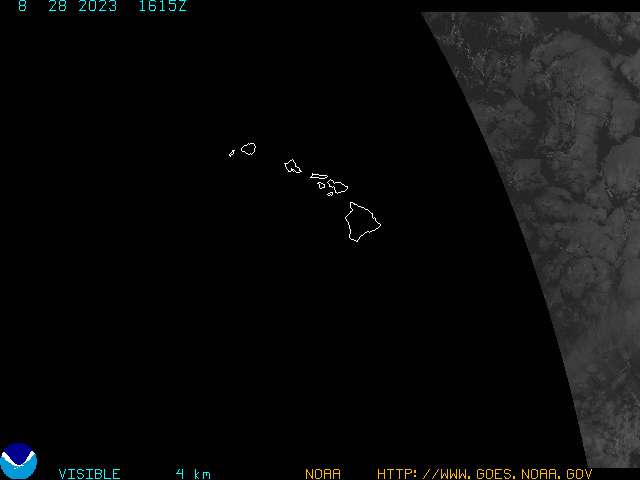


Josefina Pierre Says:
If I had a penny for each time I came to http://www.hawaiiweathertoday.com.. Great writing!~~~Thanks Josefina, Aloha, Glenn
Jennifer Says:
Hi Uncle Glenn, I was just thinking about you and wanted to drop you a line and say hello. Hope your doing good. Love you xoxo~~~Hi Jen, how nice to hear from you, here’s a big hi back to you there in southern California. Love, Glenn