May 10-11, 2010
Air Temperatures – The following maximum temperatures were recorded across the state of Hawaii Monday afternoon:
Lihue, Kauai – 81
Honolulu, Oahu – 85
Kaneohe, Oahu – 82
Kaunakakai, Molokai – 85
Kahului, Maui – 87
Hilo, Hawaii – 82
Kailua-kona – 83
Air Temperatures ranged between these warmest and coolest spots near sea level around the state – and on the highest mountains…at 4pm Monday afternoon:
Kahului, Maui – 85F
Hilo, Hawaii – 77
Haleakala Crater – 61 (near 10,000 feet on Maui)
Mauna Kea summit – 48 (near 14,000 feet on the Big Island)
Precipitation Totals – The following numbers represent the largest precipitation totals (inches) during the last 24 hours on each of the major islands, as of Monday afternoon:
0.16 Mount Waialaele, Kauai
0.65 Manoa Valley, Oahu
0.00 Molokai
0.00 Lanai
0.00 Kahoolawe
0.35 West Wailuaiki, Maui
0.50 Kawainui Stream, Big Island
Marine Winds – Here’s the latest (automatically updated) weather map showing a 1030 millibar high pressure system far to the northeast of the islands…moving eastward. This high is moving eastward due to the approach of a very late season cold front. The trade winds will be slowing down Tuesday into Wednesday.
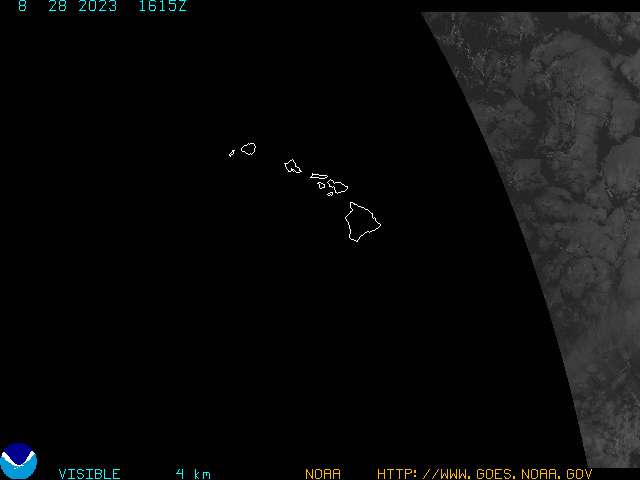
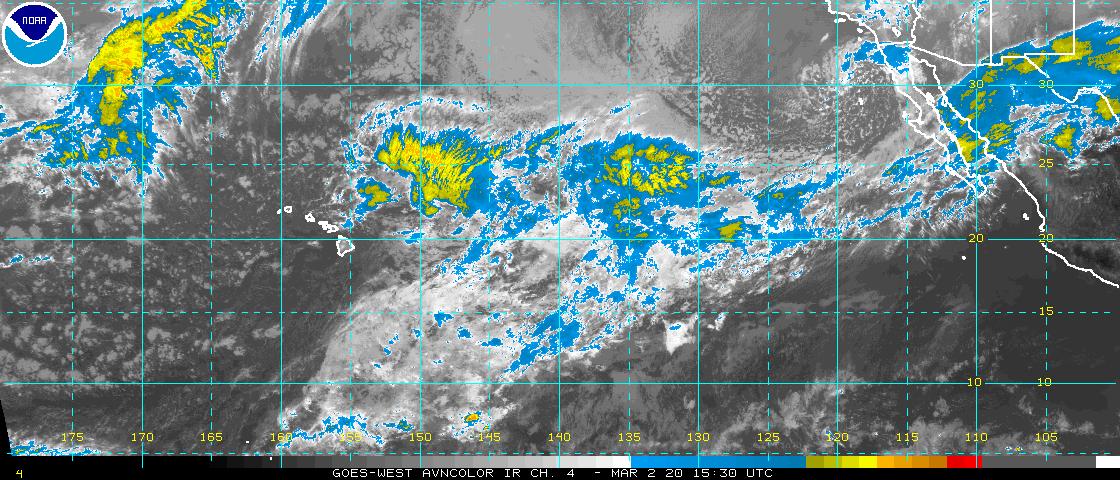
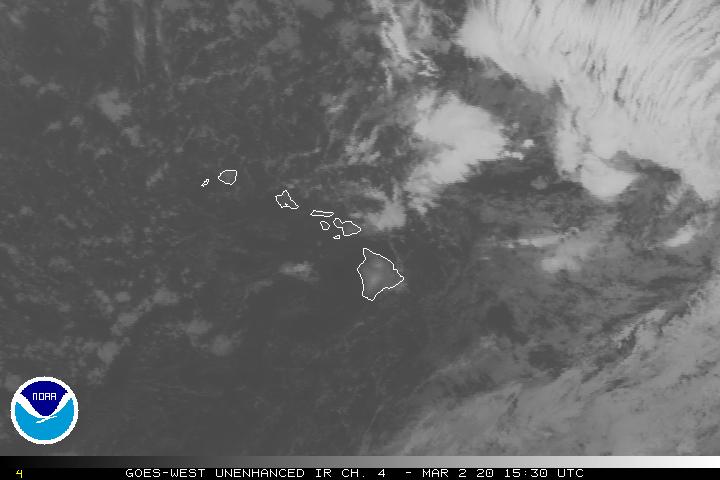
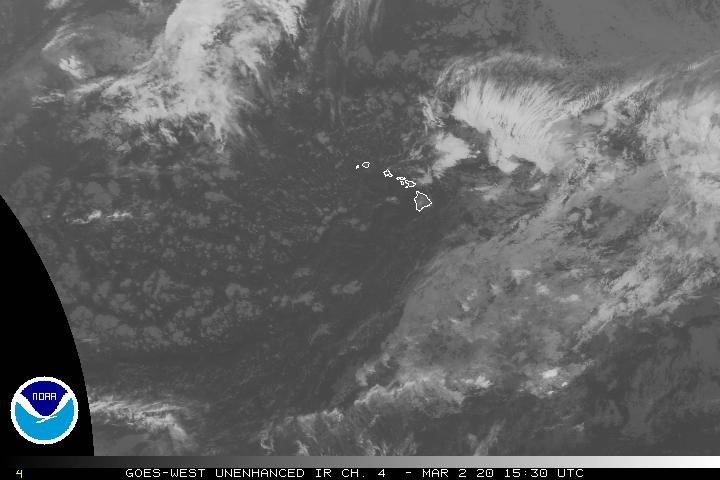
Satellite and Radar Images: To view the cloud conditions we have here in Hawaii, please use the following satellite links, starting off with this Infrared Satellite Image of the islands to see all the clouds around the state during the day and night. This next image is one that gives close images of the islands only during the daytime hours, and is referred to as a Close-up visible image. This next image shows a larger view of the Pacific…giving perspective to the wider ranging cloud patterns in the Pacific Ocean. Finally, here’s a Looping IR satellite image, making viewable the clouds around the islands 24 hours a day. To help you keep track of where any showers may be around the islands, here’s the latest animated radar image.
Hawaii’s Mountains – Here’s a link to the live webcam on the summit of near 14,000 foot Mauna Kea on the Big Island of Hawaii. The tallest peak on the island of Maui is the Haleakala Crater, which is near 10,000 feet in elevation. These two webcams are available during the daylight hours here in the islands…and when there’s a big moon rising just after sunset for an hour or two! Plus, during the nights and early mornings you will be able to see stars, and the sunrise too…depending upon weather conditions.
Tropical Cyclone activity in the eastern and central Pacific – Here’s the latest weather information coming out of the National Hurricane Center, covering the eastern north Pacific. You can find the latest tropical cyclone information for the central north Pacific (where Hawaii is located) by clicking on this link to the Central Pacific Hurricane Center. Here’s a tracking map covering both the eastern and central Pacific Ocean. A satellite image, which shows the entire ocean area between Hawaii and the Mexican coast…can be found here. Of course, as we know, our hurricane season won’t begin again until June 1st here in the central Pacific.
Aloha Paragraphs

A rocky beach on Maui
The trade winds continue to blow at a pretty good clip Monday, despite the forewarnings of lighter winds by the computer forecast models. Several locations around mid-day, were showing the winds gusting up past the 30 mph mark…topping out at 35 mph at
There’s a late season cold front coming out of one of these low pressure cells, which is edging in our direction, as we start this new work week. A new high pressure system following closely behind this eastward moving frontal boundary, is pushing it along. As this front weakens the ridge of high pressure to your north, our winds will continue their tumbling motion. This light wind episode won’t last long however, as the trade winds are expected to fill back into our Hawaiian Island weather picture after mid-week, and probably last for a good long time…at least that’s what climatology would have us believe.
We’re still involved in the tail-end of this trade wind weather pattern. This will be changing, most notably on the Kauai and
Meanwhile, down to the south of our islands, we see a large area of those icy high cirrus clouds, which seem to be edging up northward towards the
It’s Monday evening as I begin writing this last section of today’s narrative. As noted above, our trade winds are having a bit of difficulty in slowing down, at least as much as previously expected. As of early evening Monday, there were still gusts to near 30 mph at a few locations. Skies were quite cloudy, especially over and around the mountains, although not many showers were falling. I’d expect clearing skies overnight, with another cloud build up around the mountains Tuesday and Wednesday afternoons…with at least a few showers. Looking out the window here in Kihei, Maui, before I head back upcountry to Kula, it’s all cloudy towards the slopes of the Haleakala Crater. It got dark up there during the afternoon hours, although those clouds didn’t do much showering. Those clouds sure did stretch all the way down to the beaches however, limiting late in the day sun tanning sessions. I’ll be back early Tuesday morning with your next new weather narrative, be well until then! Aloha for now…Glenn.
Interesting: In the coming decades, climate change is set to produce worldwide changes in the living conditions for plants, whereby major regional differences may be expected to occur. Thus today’s cool, moist regions could in future provide habitats for additional species, and in arid and hot regions the climatic prerequisites for a high degree of plant diversity will deteriorate. This is the conclusion reached in a new study by scientists at the Universities of Bonn, Göttingen and Yale, and published in the Proceedings of the Royal Society London.
Dr. Jan Henning Sommer of Bonn University´s Nees Institute for Biodiversity of Plants asserts, "climate change could bring great confusion to the existing pattern of plant diversity, with scarcely predictable consequences for our ecosystems and mankind." The potential impact of climate change on global plant diversity has now, for the first time, been quantified and modeled on a regional basis.
The researchers have investigated the numbers of plant species to be found in different regions under current climatic conditions, and the subsequent interrelationship they uncovered has now been applied to 18 different climate change scenarios for the year 2100.
However, the study does not permit any predictions regarding the degree to which the biodiversity of any given region will, in fact, adapt to new conditions or, in other words, whether additional species will migrate into favoured regions, or whether disadvantaged areas will in reality suffer mass losses of species.
"That would be fortune-telling. The adaptability of species and their interactions in the ecosystem can, like human landuse, exert great influence on their distribution. This is a field about which we still know far too little," Sommer explains. Nevertheless, the published results do provide an important pointer to the likelihood of the scales of immigration or losses to be expected in given areas.
It is possible that the worst effects of global warming on plant species numbers could be felt in the tropical Amazonian rain forests in South America. For Germany and other temperate regions worldwide, on the other hand, scientists are expecting future climatic conditions which will promote the provision of habitat space for an increased number of species.
"But this can scarcely be described as a gain as the intensified redistribution of plant species will promote worldwide uniformity in the regional composition of species at the expense of unique species which have adapted to special habitat conditions," says Sommer. And as a result, globalization would also come to the plant kingdom.
In their study, the researchers have emphasized the clear division of our planet into two parts as regards the impact of climate change on plant diversity. "Additional capacity for plants species richness could be created everywhere where today cool and moist climatic conditions prevail," says Dr. Holger Kreft, the young research scientist from Bonn and co-author of the study, who has meanwhile assumed an appointment as junior professor at Göttingen University."
On the other hand, in areas which today have a hot tropical or sub-tropical climate the prerequisites for high species numbers will deteriorate." This division also has a political dimension: favored areas coincide largely with the industrialized nations, who are responsible for the majority of global warming due to their high amount of greenhouse gas emissions.
The study also points clearly to the consequences of a half-hearted climate policy. Should the global temperature rise by 1.8°C with respect to the year 2000, then the proportion of favored and disadvantaged regions in terms of species richness would still remain in balance. "Even if the climate protection goals agreed in Copenhagen are achieved, we would still tend to be heading for a rise in temperature of up to 4°C," says Sommer.
In this case, the projected losses of capacity for plant species richness would considerably exceed possible gains in other regions. "Politicians throughout the world should be paying greater attention to the impact of climate change on biodiversity as this is the basis of our human existence," demands Professor Dr. Wilhelm Barthlott, Director of the Nees Institute and co-author of the study. He and his study group have been investigating global plant diversity for 15 years. Barthlott welcomes the fact that the United Nations has declared 2010 to be the year of biodiversity. "This was an important signal."
Interesting2: The National Oceanic and Atmospheric Administration (NOAA) continues to monitor water conditions in the part of the Gulf of Mexico that is being impacted by the huge oil spill from the Deepwater Horizon sinking. NOAA has recently modified and expanded the boundaries of the closed fishing area to better reflect the current location of the BP oil spill, and is extending the fishing restriction until May 17.
The closed area now represents slightly less than 4.5 percent of Gulf of Mexico federal waters. The original closure boundaries, which took effect last Sunday, encompassed less than three percent. This leaves many areas that are still available for fishing. The vast majority of Gulf waters has not been affected by the oil spill and continues to support productive fisheries and tourism activities.
NOAA Administrator Dr. Jane Lubchenco and her staff will continue to meet with fishermen in the oil-affected area to listen to their concerns and share with them what NOAA scientists have learned so far about how the oil might be affecting their potential seafood catch. "NOAA scientists are on the ground in the area of the oil spill taking water and seafood samples in an effort to ensure the safety of the seafood and fishing activities."
Lubchenco said. The federal and state governments have strong systems in place to test and monitor seafood safety and to prohibit harvesting from affected areas and keep oiled products out of the marketplace. NOAA Fisheries continues to work closely with the U.S. Food and Drug Administration and the states to ensure seafood safety, by assessing whether seafood is tainted or contaminated to levels that pose a risk to human health.
According to NOAA, there are 3.2 million recreational fishermen in the Gulf of Mexico region who took 24 million fishing trips in 2008. Commercial fishermen in the Gulf harvested more than 1 billion pounds of finfish and shellfish in 2008.
Interesting3: Mosquitoes can develop a resistance to substances used to repel them. This has been shown for the first time in laboratory tests at the Swedish University of Agricultural Sciences (SLU) and associates in the UK. It is the yellow fever mosquito that has developed a resistance to the mosquito repellent DEET, a substance used in mosquito repellents all over the world. In Sweden it is found in the products MyggA and Djungelolja (Jungle Oil).
The capacity of mosquitoes to develop resistance has been shown to be hereditary. "Through testing, we have found that yellow fever mosquitoes no long sense the smell of DEET and are thereby not repelled by it. This is because a certain type of sensory cell on the mosquito’s antenna is no longer active" says Rickard Ignell, a researcher at the Division for Chemical Ecology at SLU in Alnarp.
Rickard Ignell performed the research in collaboration with Rothamstead Research in the UK. The findings were recently published in the scientific journal Proceedings of National Academy of Sciences (PNAS). The scientists have thus seen that the sensory cell on the mosquito’s antenna has stopped reacting to DEET.
This have many explanations, such as the protein that binds in to DEET having mutated. "More research is needed to find out what the mechanism is," says Rickard Ignell. The researchers are now urging restrictiveness in the use of DEET and others.
Interesting4: A spike in urban wildlife such as coyotes poses a serious public health concern because they can transmit rabies, said Paul Curtis, an urban wildlife expert at Cornell University. "People really don’t expect to see coyotes in Manhattan," Curtis told LiveScience. "But coyotes have been in Central Park several times before, and they will be again."
There are many ways for wildlife to commute into Manhattan, said Curtis. The most common is for the coyotes in Westchester County, N.Y. — about 40 miles to the north of the city — to follow natural travel corridors such as power lines, train tracks, or greenways into New York City.
Birds are among the most adaptable urban creatures. Migrating song birds love New York parks. Canada geese are so prevalent — a flock of them forced the river landing of US Airways flight 1549 last year — that city officials slaughter geese routinely around the major airports. Urban wildlife are not confined to Manhattan either.
Curtis said coyotes will roam up to 70 miles from home, and they have been spotted in Brooklyn and Queens as well. The recent spike in coyotes has prompted the New York City Department of Environmental Protection and the New York City Department of Parks and Recreation to begin working on a new policy to handle urban wildlife.
 Email Glenn James: