











April 8-9, 2010
Air Temperatures – The following maximum temperatures were recorded across the state of Hawaii Thursday afternoon:
Lihue, Kauai – 79
Honolulu, Oahu – 85
Kaneohe, Oahu – 80
Kaunakakai, Molokai – 81
Kahului, Maui – 85
Hilo, Hawaii – 81
Kailua-kona – 81
Air Temperatures ranged between these warmest and coolest spots near sea level around the state – and on the highest mountains…at 4pm Thursday afternoon:
Kahului, Maui – 81F
Hilo, Hawaii – 76
Haleakala Crater – 46 (near 10,000 feet on Maui)
Mauna Kea summit – 41 (near 14,000 feet on the Big Island)
Precipitation Totals – The following numbers represent the largest precipitation totals (inches) during the last 24 hours on each of the major islands, as of Thursday afternoon:
10.32 Mount Waialaele, Kauai
4.81 Palehua, Oahu
0.00 Molokai
0.00 Lanai
0.00 Kahoolawe
3.30 Puu Kukui, Maui
1.65 Piihonua, Big Island
Marine Winds – Here’s the latest (automatically updated) weather map showing a strong 1039 millibar high pressure system located far to the northeast of the islands…moving southeast. This pressure configuration will strengthen the trade winds Friday into Saturday.
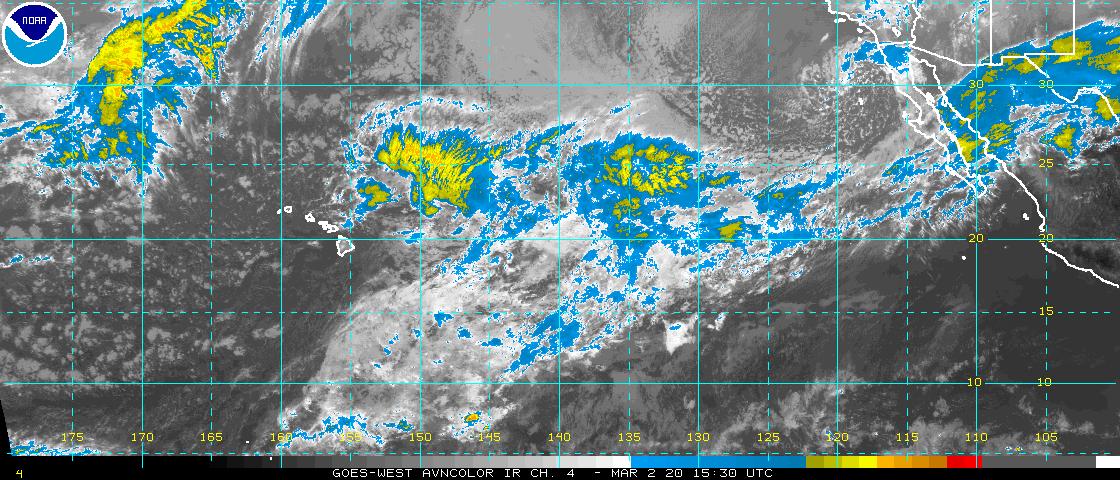
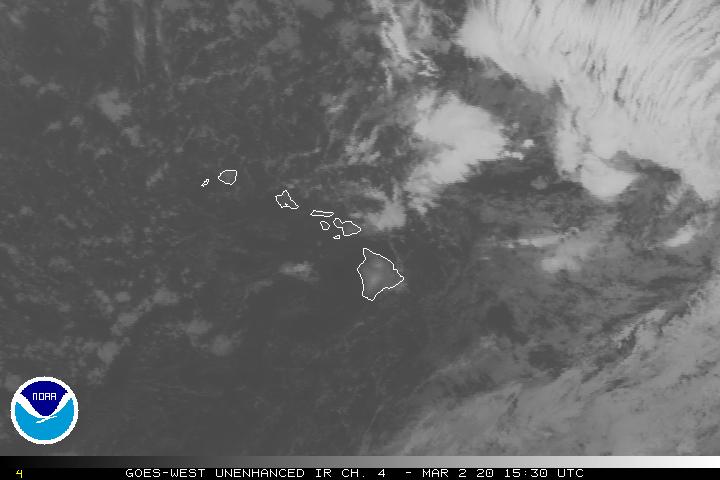
Satellite and Radar Images: To view the cloud conditions we have here in Hawaii, please use the following satellite links, starting off with this Infrared Satellite Image of the islands to see all the clouds around the state during the day and night. This next image is one that gives close images of the islands only during the daytime hours, and is referred to as a Close-up visible image. This next image shows a larger view of the Pacific…giving perspective to the wider ranging cloud patterns in the Pacific Ocean. Finally, here’s a Looping IR satellite image, making viewable the clouds around the islands 24 hours a day. To help you keep track of where any showers may be around the islands, here’s the latest animated radar image.
Hawaii’s Mountains – Here’s a link to the live webcam on the summit of near 14,000 foot Mauna Kea on the Big Island of Hawaii. The tallest peak on the island of Maui is the Haleakala Crater, which is near 10,000 feet in elevation. These two webcams are available during the daylight hours here in the islands…and when there’s a big moon rising just after sunset for an hour or two! Plus, during the nights and early mornings you will be able to see stars, and the sunrise too…depending upon weather conditions.
Tropical Cyclone activity in the eastern and central Pacific – Here’s the latest weather information coming out of the National Hurricane Center, covering the eastern north Pacific. You can find the latest tropical cyclone information for the central north Pacific (where Hawaii is located) by clicking on this link to the Central Pacific Hurricane Center. Here’s a tracking map covering both the eastern and central Pacific Ocean. A satellite image, which shows the entire ocean area between Hawaii and the Mexican coast…can be found here.
Aloha Paragraphs

Kaneohe Bay…Oahu
The heavy rainfall trough of low pressure is moving away, taking the threat of locally heavy showers with it…for the most part. The flash flood watch that was in effect over Kauai and Niihau during the day, has been dropped now. Taking a quick look at this IR satellite image, we see that lots of clouds that had been present earlier, are dissipating, leaving clear to partly cloudy skies. As the threat of heavy rain tapers off, the bulk of the showers will begin taking aim on our windward coasts and slopes…carried our way on the increasing trade winds into Friday. The NWS forecast office is keeping a small craft wind advisory in force in those windier areas around Maui and the Big Island…which may extend further up the island chain over the next few days.
As noted above, the trade winds will become our primary weather influence here in the islands, lasting through the rest of this week…into next week. As this weather map shows, we see a strong 1039 millibar high pressure system, far to the northeast of our islands Thursday night. This high pressure cell will settle into that area, spinning out moderate to fresh trade winds through the rest of this week. As that high pressure cell gets nice and comfortable over the ocean, it may be able to increase our trade wind speeds another notch over the next few days. Looking ahead, there really isn’t any end to this trade wind flow across our island chain. This of course isn’t all that unusual this time of year, when the trade winds are a common visitor to our Hawaiian Island weather picture.
It’s Thursday evening as I begin writing this last section of today’s narrative. The heavy rain producing trough of low pressure continues to move by to our north. However, at the same time, we’ve seen freshening trade winds blowing into the state today. This in turn has lowered our inversion, which caps the vertical depth of our local clouds quite a bit. Thus, the threat of heavy rains is retreating at this point, not to mean that we won’t see a few brief pounding showers falling along our windward sides overnight into Friday. Looking at that satellite image two paragraphs up this page, it looks as if the most showery islands might be the Big Island, and perhaps Maui. As we move into the weekend time frame, showers should ease back into what we could consider fairly normal for this time of year. There’s still that chance that around the middle of next week, we could see another trough of low pressure edging in our direction, causing another round of heavy rains then…this is still a question for the time being. ~~~ I’m about ready to head into Kahului, where I’ll stop into the new Whole Foods store for the first time. I need do a shopping for food, and I’d rather not deal with the traffic going into Paia this evening. I’ll be back early Friday morning with your next new weather narrative, I hope you have a great Thursday night until then! Aloha for now…Glenn.
Interesting: There’s a plan afoot among evolutionary scientists to launch a big new project — to look back in time and find out how climate change over millions of years affected human evolution. A panel of experts from the National Academy of Sciences in Washington, D.C., has given its blessing to the plan. They say it could unveil a whole new side of human history. Anthropologist Rick Potts, who heads the human origins department at the Smithsonian Museum of Natural History, has been pushing the idea that "climate made us" for years. Lately, he’s been putting together an exhibit called "What Does It Mean to Be Human?"
Among cabinets displaying dozens of skulls of human ancestors, and bronze statues of Neanderthals and other evolutionary experiments, there are displays suggesting the novel idea that climate change influenced how we evolved. "The explanations that we’ve had tied human origins back to an African savannah or to a European ice age," Potts says, "and it was never really adequate to understand the plasticity, the versatility of the human species." Habitats Kept Changing, And So Did The Humans Darwin’s idea was that living things adapt to a place — a habitat.
But Potts says habitats kept changing because climates kept changing. Centuries of drought, for example, would shift to centuries of monsoons, over and over. Which raises a question, Potts says: "Not how did humans become adapted to a specific ancestral environment, but how did we become adaptable?" Extraordinarily adaptable to so many different environments. "And that’s a totally new question," he says, "one that Darwin never really addressed." Potts is one of the authors of the National Academy of Sciences report, and proposes that it was flip-flopping climate that sparked some of our biggest evolutionary adaptations — the invention of better tools, for example, or a bigger brain.
Interesting2: Thawing permafrost in the Northern Hemisphere releases "large amounts" of greenhouse gas nitrous oxide, according to a new study from the journal Nature Geoscience. The study found that under certain conditions thawed permafrost can release as much nitrous oxide as tropical forests, one of the main sources of the gas. Nitrous oxide, also known as "laughing gas," is ranked third behind carbon dioxide and methane in contributing to global warming, and is regulated under the Kyoto Protocols.
According to the EPA, the gas is 310 times more effective in trapping heat than carbon dioxide. Sixty percent of the nitrous in the atmosphere is produced naturally. Twenty-five percent of the land surface in the Northern Hemisphere is underlain by permafrost, and as it thaws it could create a feedback loop that accelerates global warming, because it releases greenhouse gases, like methane and carbon dioxide, which in turn increase warming, spurring more thawing. Scientists had thought only a little nitrous oxide was released during this process, but the journal study suggests otherwise.
Interesting3: NASA, U.S. Navy and university researchers have successfully demonstrated the first robotic underwater vehicle to be powered entirely by natural, renewable, ocean thermal energy. The Sounding Oceanographic Lagrangrian Observer Thermal RECharging (SOLO-TREC) autonomous underwater vehicle uses a novel thermal recharging engine powered by the natural temperature differences found at different ocean depths. Scalable for use on most robotic oceanographic vehicles, this technology breakthrough could usher in a new generation of autonomous underwater vehicles capable of virtually indefinite ocean monitoring for climate and marine animal studies, exploration and surveillance.
Researchers at NASA’s Jet Propulsion Laboratory, Pasadena, Calif.; and the Scripps Institution of Oceanography, University of California, San Diego, completed the first three months of an ocean endurance test of the prototype vehicle off the coast of Hawaii in March. "People have long dreamed of a machine that produces more energy than it consumes and runs indefinitely," said Jack Jones, a JPL principal engineer and SOLO-TREC co-principal investigator.
"While not a true perpetual motion machine, since we actually consume some environmental energy, the prototype system demonstrated by JPL and its partners can continuously monitor the ocean without a limit on its lifetime imposed by energy supply." "Most of Earth is covered by ocean, yet we know less about the ocean than we do about the surface of some planets," said Yi Chao, a JPL principal scientist and SOLO-TREC principal investigator. "This technology to harvest energy from the ocean will have huge implications for how we can measure and monitor the ocean and its influence on climate."
SOLO-TREC draws upon the ocean’s thermal energy as it alternately encounters warm surface water and colder conditions at depth. Key to its operation are the carefully selected waxy substances known as phase-change materials that are contained in 10 external tubes, which house enough material to allow net power generation. As the float surfaces and encounters warm temperatures, the material melts and expands; when it dives and enters cooler waters, the material solidifies and contracts.
The expansion of the wax pressurizes oil stored inside the float. This oil periodically drives a hydraulic motor that generates electricity and recharges the vehicle’s batteries. Energy from the rechargeable batteries powers the float’s hydraulic system, which changes the float’s volume (and hence buoyancy), allowing it to move vertically. So far, SOLO-TREC has completed more than 300 dives from the ocean surface to a depth of 500 meters (1,640 feet).
Its thermal recharging engine produced about 1.7 watt-hours, or 6,100 joules, of energy per dive, enough electricity to operate the vehicle’s science instruments, GPS receiver, communications device and buoyancy-control pump. The SOLO-TREC demonstration culminates five years of research and technology development by JPL and Scripps and is funded by the Office of Naval Research.
JPL developed the thermal recharging engine, building on the buoyancy engine developed for the Slocum glider by Teledyne Webb Research, Falmouth, Mass. Scripps redesigned the SOLO profiling float and performed the integration. The 84-kilogram (183-pound) SOLO-TREC prototype was tested and deployed by the JPL/Scripps team on Nov. 30, 2009, about 161 kilometers (100 miles) southwest of Honolulu.
The performance of underwater robotic vehicles has traditionally been limited by power considerations. "Energy harvesting from the natural environment opens the door for a tremendous expansion in the use of autonomous systems for naval and civilian applications," said Thomas Swean, the Office of Naval Research program manager for SOLO-TREC.
"This is particularly true for systems that spend most of their time submerged below the sea surface, where mechanisms for converting energy are not as readily available. The JPL/Scripps concept is unique in that its stored energy gets renewed naturally as the platform traverses ocean thermal gradients, so, in theory, the system has unlimited range and endurance. This is a very significant advance."
 Email Glenn James: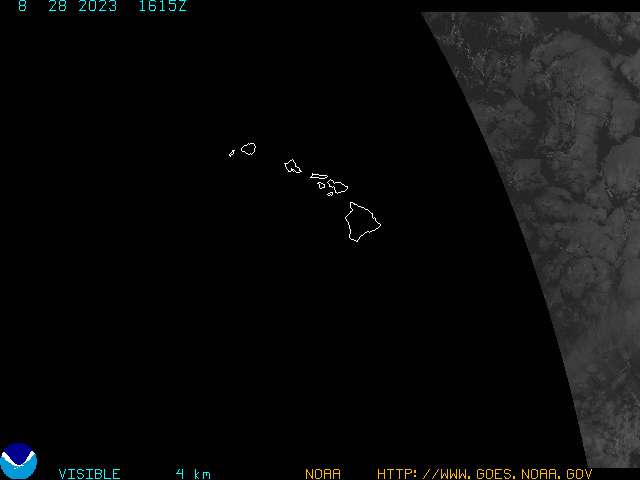


Calvin Says:
Aloha Glenn, got here to West Maui yesterday, and the weather is awesome as promised on your website–mahalo! “Baby come back” by Player also brings back some fond memories for me…Calvin~~~Hi Calvin, good to hear that you are here on island now, I trust you will have a great time! Yeah, that old music reminds me of the old days for sure. Aloha, Glenn