











April 7-8, 2010
Air Temperatures – The following maximum temperatures were recorded across the state of Hawaii Wednesday afternoon:
Lihue, Kauai – 75
Honolulu, Oahu – 81
Kaneohe, Oahu – 80
Kaunakakai, Molokai – 83
Kahului, Maui – 87
Hilo, Hawaii – 80
Kailua-kona – 81
Air Temperatures ranged between these warmest and coolest spots near sea level around the state – and on the highest mountains…at 5pm Wednesday evening:
Kahului, Maui – 79F
Princeville, Kauai – 73
Haleakala Crater – 45 (near 10,000 feet on Maui)
Mauna Kea summit – 34 (near 14,000 feet on the Big Island)
Precipitation Totals – The following numbers represent the largest precipitation totals (inches) during the last 24 hours on each of the major islands, as of Wednesday afternoon:
4.88 Mount Waialaele, Kauai
9.16 Wilson Tunnel, Oahu
0.03 Molokai
0.11 Lanai
0.00 Kahoolawe
2.75 Puu Kukui, Maui
1.05 Glenwood , Big Island
Marine Winds – Here’s the latest (automatically updated) weather map showing a strong 1041 millibar high pressure system located far to the north-northeast of the islands…moving eastward. This pressure configuration will strengthen the trade winds Thursday into Friday.
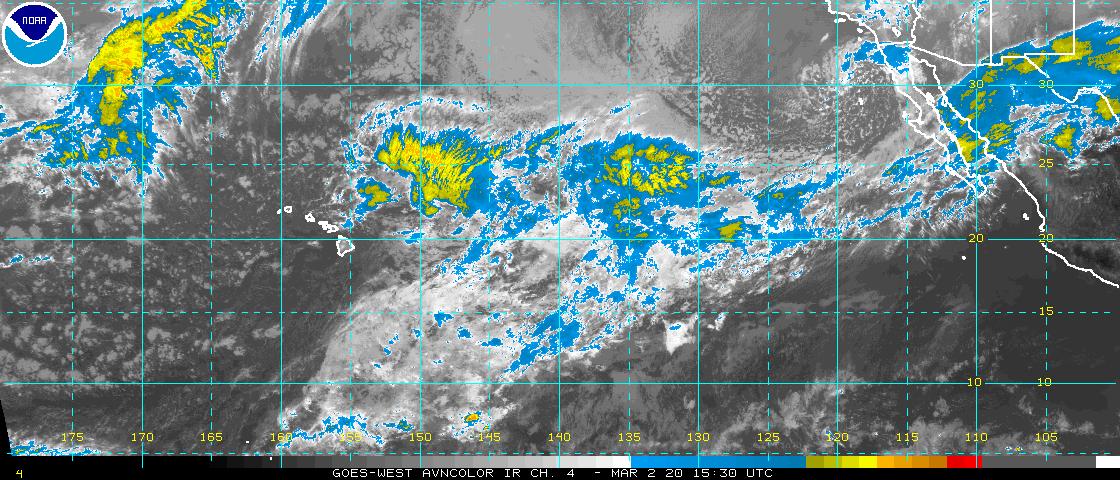
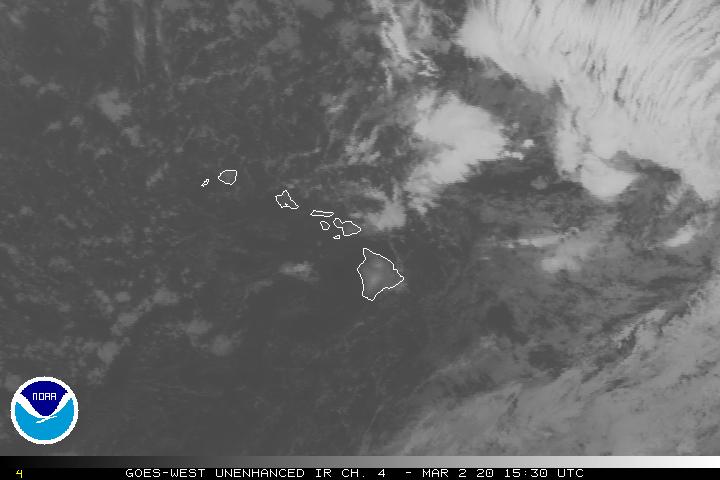
Satellite and Radar Images: To view the cloud conditions we have here in Hawaii, please use the following satellite links, starting off with this Infrared Satellite Image of the islands to see all the clouds around the state during the day and night. This next image is one that gives close images of the islands only during the daytime hours, and is referred to as a Close-up visible image. This next image shows a larger view of the Pacific…giving perspective to the wider ranging cloud patterns in the Pacific Ocean. Finally, here’s a Looping IR satellite image, making viewable the clouds around the islands 24 hours a day. To help you keep track of where any showers may be around the islands, here’s the latest animated radar image.
Hawaii’s Mountains – Here’s a link to the live webcam on the summit of near 14,000 foot Mauna Kea on the Big Island of Hawaii. The tallest peak on the island of Maui is the Haleakala Crater, which is near 10,000 feet in elevation. These two webcams are available during the daylight hours here in the islands…and when there’s a big moon rising just after sunset for an hour or two! Plus, during the nights and early mornings you will be able to see stars, and the sunrise too…depending upon weather conditions.
Tropical Cyclone activity in the eastern and central Pacific – Here’s the latest weather information coming out of the National Hurricane Center, covering the eastern north Pacific. You can find the latest tropical cyclone information for the central north Pacific (where Hawaii is located) by clicking on this link to the Central Pacific Hurricane Center. Here’s a tracking map covering both the eastern and central Pacific Ocean. A satellite image, which shows the entire ocean area between Hawaii and the Mexican coast…can be found here.
Aloha Paragraphs

Increasing trade winds…localized heavy showers
Cold air aloft, destabilizing the lower layers of the atmosphere…continues to make our overlying air mass shower prone. The vertical extent of some of the clouds, is prompting localized heavy showers, or rain. The most pronounced precipitation is falling over the
As move through Wednesday night into Thursday, we’re apt to see more showery clouds forming over the islands…aided by the returning trade winds. These clouds will build to tall levels, into what we call towering cumulus clouds, or perhaps even a cumulonimbus cloud. The difference between the two is that the cumulonimbus, or better known as a thunderstorm, has an anvil top…and is a very heavy rain producer. These clouds, both types actually, can drop serious flooding rainfall. As the upper air becomes even colder through the night, into Thursday morning…we could continue to see this kind of problematic rainfall. On the one hand, it may be a temporary problem, like for flooding and dangerous driving conditions. Although on the other hand, it is just what we need…as our prolonged drought conditions still exist.
The trade winds were down today, although not completely gone…but lighter than they will be Thursday. We could safely call them light to moderately strong, although there are no small craft wind advisories in effect at the moment. As this weather map shows, we have that trough of low pressure, the dashed lines to the west and northwest of
It’s Wednesday evening as I begin writing this last section of today’s narrative. There have been some very active showers falling here and there, especially over and around Kauai and Oahu during the day Wednesday. Case in point: Mount Waialaele on Kauai has received 4.88" during the last 24 hours. That is a big number, although not nearly as large as the amazing 9.16" that has fallen at Wilson Tunnel…in the Koolau Mountains on Oahu! At the time of this writing Wednesday evening, there was a flood advisory active over parts of Oahu. ~~~ This is all good, as the islands need this moisture, to help push back the ongoing drought conditions that exist. We’d like to see some of this precipitation make its way over into the leeward sides…which may happen between now and Thursday morning. ~~~ Here in Kihei, Maui, we’ve had lots of heavy duty cumulus clouds around during the day, although not a lot of rain. The winds have been east-southeast, which has kept Maui County in a relatively dry slot. The other islands have had much better luck in attracting the downpours, at least so far. There’s still a chance that a few heavier showers will find their way to Maui County before too long. As the trade winds return Thursday, the moisture upstream of the island will keep the windward sides showery on all the islands, which could last for several days. ~~~ I’m about ready to take the drive back upcountry to Kula, getting back in time to take my early evening walk. Tuesday evening’s walk had me putting on my raincoat, which may or may not happen today. I’ll be back early Thursday morning with your next new weather narrative, I hope you have a great Wednesday night until then! Aloha for now…Glenn.
Interesting: New research suggests the volcanic birth of the Northwest’s Columbia Plateau happened much more quickly than previously thought and with an intensity that may have changed the earth’s climate and caused some plants and animals to go extinct. "What you’re looking at are lava flows that repeat fairly quickly," said Steve Reidel, research professor of geology at Washington State University Tri-Cities. "Not decades or centuries, but months or years."
Reidel is a co-author of a paper in the recent issue of the journal Lithos refining the time frame of the Grande Ronde lava flows, which produced enough molten basalt to sink the earth’s crust and created the vast Columbia River Plateau of Washington, Oregon and Idaho. Just one of the 100 or so lava flows would have blanketed much of Washington State in 10,000 cubic kilometers of lava — 10,000 times the volume of ash produced by the 1980 eruption of Mount St. Helens.
The flows moved at walking speed, enough time for the horses and other animals of the region to get out of their path. But a single flow could reach as far as Portland, be more than 2,000 degrees Fahrebheit and take half a century to cool. In the process, it would have generated monsoons across the Northwest and emitted enough heat and sulfur to alter the earth’s climate, said Reidel. Substantial evidence has implicated other lava flows in the extinction of species.
Siberian flows coincided with the epic Permian-Triassic "mass dying" that wiped out 96 percent of the earth’s marine species 250 million years ago. A mass extinction at the end of the Triassic Period 200 million years ago coincided with lava coming out of the Central Atlantic Magmatic Province between what is now northeastern South America and eastern North America.
Gases from flows on India’s Deccan plateau started a mass extinction some 65 million years ago, with the dinosaur-killing coup de grâce coming from a meteoroid that hit Mexico’s Yucatán Peninsula. To date the Grande Ronde flows, lead author Tiffany Barry of Britain’s Open University obtained basalt samples from Hanford, Wash., and outcrops between Vantage, Wash., and Lewiston, Idaho.
With some of the most precise equipment in the world, she compared argon isotopes in the oldest, deepest levels and younger, shallower levels and used the element’s decay rate to determine the rocks’ relative ages. Barry, Reidel, WSU Professor Emeritus Peter Hooper and other colleagues estimated the Grande Ronde flows took place between 15.6 and 16 million years ago, give or take 150,000 to 200,000 years. The youngest and oldest rock samples were only 420,000 years apart at the most.
With a margin of error of 180,000 years, the rock may have been created over an even faster time frame of 240,000 years. With less accurate equipment, Reidel and others previously estimated the flows occurred over a period of 1.5 to 2 million years. And because the Grande Ronde had so many flows, with some much larger than others, they likely had a far greater impact on the climate of their era than previously thought. Some flows, wrote the researchers, "may have, at times, been simultaneous and, if confirmed, would have significant implications for potential environmental effects."
"It’s an interesting piece of work and definitely a contribution," said John Wolff, a WSU professor in the School of Earth and Environmental Sciences, who was not involved in the paper. Both Wolff and the paper’s authors note that the argon dating conflicts with dates established by looking at how changes in the earth’s magnetic field affected the rock.
Interesting2: For the first time in 10 years Americans are more likely to say the United States should give more priority to developing oil, natural gas and coal than to protecting the environment, according to a poll on Tuesday. The poll was conducted a few weeks before President Barack Obama announced he would open offshore oil drilling in some parts the U.S. East Coast, Alaska and the Gulf of Mexico. Half of 1,014 U.S. adults, who were surveyed March 4-7 by Gallup, said the country should give more priority to developing and producing the fossil fuels.
Only 43 percent said protection of the environment should be given priority, even at the risk of limiting the amount of energy supplies. It was the first time in the 10 years that Gallup has been asking the question that energy production was favored over environment.
The poll was released a few weeks before Senators John Kerry, a Democrat, Lindsey Graham, a Republican and Joe Lieberman, an independent, hope to unveil a compromise climate bill that would effectively put fees on fuels such as gasoline and coal to reduce emissions of gases blamed for warming the planet.
The bill would also seek to increase incentives for offshore drilling and nuclear power. According to the poll, 52 percent of Americans favored greater energy conservation while only 36 percent favored greater production of oil, natural gas, and coal as a means of solving the country’s energy problems.
Interesting3: A newly discovered asteroid, 2010 GA6, will safely fly by Earth April 8th at 4:06 p.m. Pacific (23:06 U.T.C.). At the time of the closest approach 2010 GA6 will be about 223,000 miles away from Earth – about 9/10ths the distance to the moon. The asteroid, approximately 71 feet wide, was discovered by the Catalina Sky Survey located in Tucson, Arizona. Asteroids, sometimes called minor planets or planetoids, are small Solar System bodies in orbit around the Sun; they are smaller than planets but larger than meteoroids.
Such an object, if it hit the Earth, would have a major impact. Space is nearly empty but in many ways it is filled with flying junk of which asteroids, meteors, and comets are examples. "Fly bys of Near Earth objects within the moon’s orbit occur every few weeks," said Don Yeomans of NASA’s Near Earth Object Office at the Jet Propulsion Laboratory in Pasadena, Calif. NASA detects and tracks asteroids and comets passing close to Earth using both ground and space based telescopes.
The Near Earth Object Observations Program, commonly called "Spaceguard," discovers these objects, characterizes a subset of them and plots their orbits to determine if any could be potentially hazardous to our planet. The vast majority of known asteroids orbit within the main asteroid belt between the orbits of Mars and Jupiter, generally in relatively low eccentricity (i.e., not very elongated) orbits. This belt is currently estimated to contain between 1.1 and 1.9 million asteroids larger than 0.6 mile in diameter, and millions of smaller ones.
It is thought that these asteroids are remnants of the protoplanetary disk, and in this region the accretion of planetesimals into planets during the formative period of the solar system was prevented by large gravitational perturbations by Jupiter. Although fewer Trojan asteroids sharing Jupiter’s orbit are currently known, it is thought that there are as many as there are asteroids in the main belt. Various classes of asteroid have been discovered outside the main asteroid belt.
Near Earth asteroids have orbits in the vicinity of Earth’s orbit. Trojan asteroids are gravitationally locked into synchronization with Jupiter, either leading or trailing the planet in its orbit. A couple Trojans have been found orbiting with Mars. A group of asteroids called Vulcanoids are hypothesized by some to lie very close to the Sun, within the orbit of Mercury, but none has so far been found.
The Apollo asteroids are a group of near-Earth asteroids named after 1862 Apollo, the first asteroid of this group to be discovered by Karl Wilhelm Reinmuth. They are asteroids that cross the Earth orbital path. Some can get very close to the Earth, making them a potential threat to our planet. The largest known Apollo asteroid is 1866 Sisyphus, with a diameter of about 10 km.
 Email Glenn James: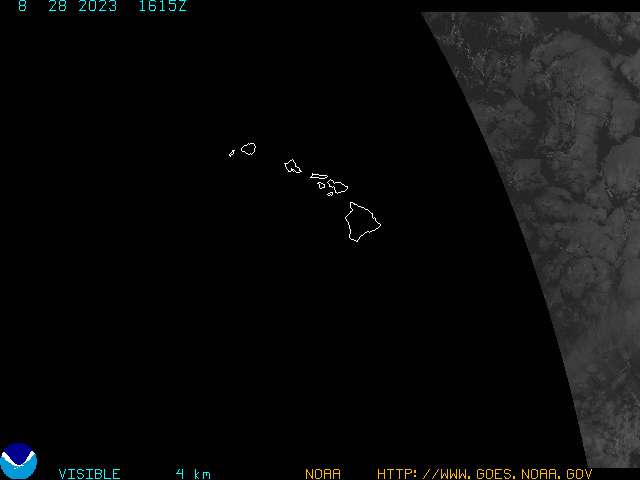



Liz Says:
“Localized heavy showers” is sure right! We’ve been getting downpours all day here in Pahoa. Wish we could share some of this abundance with the dry side! Thanks for keeping us posted Glenn 🙂 ~Liz~~~Hi Liz, hit and miss, glad you are getting some showers…no rain, as both you and our friend Jack mentioned earlier today. Here on Maui, it’s been threatening, although I haven’t seen anything like what you’re describing…yet. Thanks for your on the spot report from the Big Island! Aloha, Glenn
jack weber Says:
Rain, rain, rain here for days…all the fruit trees are in bloom, the bamboo has restored it’s foliage to about 60%, and the perennial peanut in the orchard is growing quickly. Thanks for keeping us up to speed, Glenn…or slowed down, so to speak, when the trades slacken, as they have! Aloha-mai. J*~~~Hi Jack, great news…hearing about the drought breaking, or at least pushing back the very dry conditions that you’ve suffered through much of this year so far. Let the plants grow! Aloha, Glenn