











April 28-29, 2010
Air Temperatures – The following maximum temperatures were recorded across the state of Hawaii Wednesday afternoon:
Lihue, Kauai – 82
Honolulu, Oahu – 84
Kaneohe, Oahu – 81
Kaunakakai, Molokai – 82
Kahului, Maui – 85
Hilo, Hawaii – 81
Kailua-kona – 81
Air Temperatures ranged between these warmest and coolest spots near sea level around the state – and on the highest mountains…at 5pm Wednesday afternoon:
Barking Sands, Kauai – 83F
Kapalua, Maui – 77
Haleakala Crater – 46 (near 10,000 feet on Maui)
Mauna Kea summit – 34 (near 14,000 feet on the Big Island)
Precipitation Totals – The following numbers represent the largest precipitation totals (inches) during the last 24 hours on each of the major islands, as of Wednesday afternoon:
0.42 Mount Waialaele, Kauai
0.81 Moanalua RG, Oahu
0.02 Molokai
0.00 Lanai
0.00 Kahoolawe
0.19 Mount Waialaele, Maui
0.03 Hilo airport, Big Island
Marine Winds – Here’s the latest (automatically updated) weather map showing a 1031 millibar high pressure system to the northeast of the islands…moving eastward. The trade winds remain locally strong and gusty into Thursday, then become lighter from the ESE to southeast Friday.
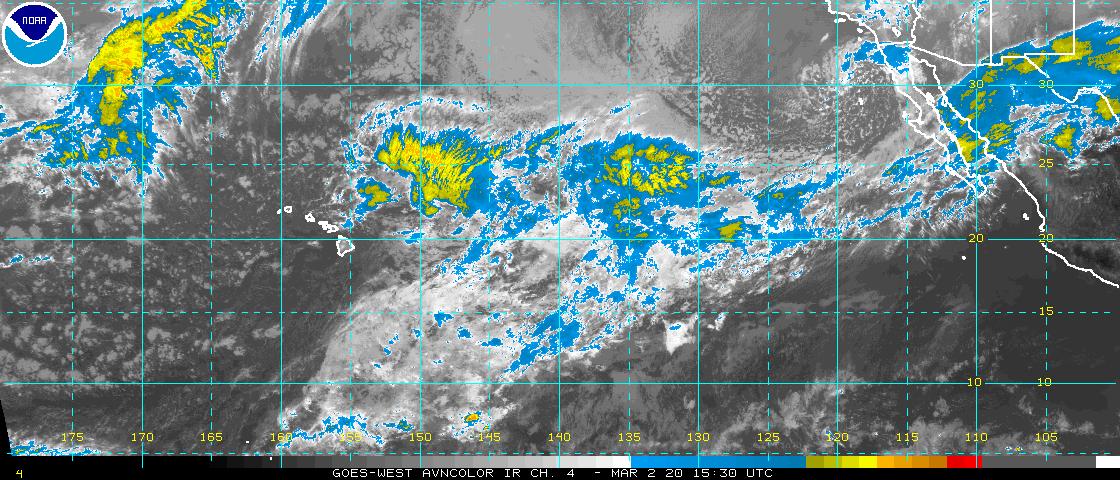
Satellite and Radar Images: To view the cloud conditions we have here in Hawaii, please use the following satellite links, starting off with this Infrared Satellite Image of the islands to see all the clouds around the state during the day and night. This next image is one that gives close images of the islands only during the daytime hours, and is referred to as a Close-up visible image. This next image shows a larger view of the Pacific…giving perspective to the wider ranging cloud patterns in the Pacific Ocean. Finally, here’s a Looping IR satellite image, making viewable the clouds around the islands 24 hours a day. To help you keep track of where any showers may be around the islands, here’s the latest animated radar image.
Hawaii’s Mountains – Here’s a link to the live webcam on the summit of near 14,000 foot Mauna Kea on the Big Island of Hawaii. The tallest peak on the island of Maui is the Haleakala Crater, which is near 10,000 feet in elevation. These two webcams are available during the daylight hours here in the islands…and when there’s a big moon rising just after sunset for an hour or two! Plus, during the nights and early mornings you will be able to see stars, and the sunrise too…depending upon weather conditions.
Tropical Cyclone activity in the eastern and central Pacific – Here’s the latest weather information coming out of the National Hurricane Center, covering the eastern north Pacific. You can find the latest tropical cyclone information for the central north Pacific (where Hawaii is located) by clicking on this link to the Central Pacific Hurricane Center. Here’s a tracking map covering both the eastern and central Pacific Ocean. A satellite image, which shows the entire ocean area between Hawaii and the Mexican coast…can be found here. Of course, as we know, our hurricane season won’t begin again until June 1st here in the central Pacific.
Aloha Paragraphs

The beautiful island of Kauai
The current blustery trade winds will be shifting to the east-southeast and southeast by Friday…becoming light and variable into the weekend. The NWS forecast office is keeping the limited small craft wind advisory restricted to only those windiest locations around Molokai down through the Big Island Wednesday night. The windy conditions will remain active atop the Haleakala Crater on
The atmosphere will remain on the dry side for the moment, although there will be a weather change coming up as we push into the weekend. The first signs of this change will occur in the wind department, as the trade winds slow down beginning later Thursday into Friday. The computer models show the winds veering around to the southeast Friday into the weekend. The winds may become light and variable as a ridge of high pressure gets forced down over the islands with time. While the southeast winds are blowing, they will pick up volcanic haze from the vents on the
Along with this shifting around of the winds, and their becoming lighter, we’ll begin to see the increased chance of showers…some of which may be locally heavy. The approach of an upper level trough of low pressure, with its cold air aloft, will begin to destabilize our overlying air mass this weekend. There will be a couple of different sources of moisture arriving, which will help to feed these potentially heavy showers. There remains a degree or two of uncertainty in exactly how all of this will pan out, although at least some of the computer models are suggesting heavy rainfall, with even the chance of some flash flooding happening here and there. Perhaps periods during the days, when the sun is hottest will trigger some of the heaviest showers in the upcountry areas. Some weather information sources are hinting at runoff problems at some point during this episode.
It’s Wednesday evening as I begin writing this last section of today’s narrative. The paragraphs above paint a pretty clear picture of what we have coming up during the next week. This will include more of the good weather conditions Thursday, perhaps even into Friday, although the winds will be coming down in strength…and veering in direction. This will cause muggy weather, with increasing haze into the weekend. As we get into the weekend, that will bring our greatest chance of tropical showers arriving, especially during the afternoon hours. There is that chance too of a few locally heavy downpours, which could spark some flash flood activity…too early to know for sure just yet…although not out of the question. We may see these showers extend into Monday, although as the trade winds return by Tuesday, our weather will snap back to a more favorably inclined nature. ~~~ Here in Kihei, Maui, before I take the drive back upcountry to Kula, it’s geneally nice and clear out. There are some partly cloudy patches, although according to this looping radar image, not much is happening in terms of precipitation. This week is flying by, and already tomorrow will be Thursday, which is getting closer and closer to the weekend. At any rate, I’ll be back with your next new weather narrative from paradise early in the morning. I hope you have a great Wednesday night, still well lit by the just past full moon! Aloha for now…Glenn.
Interesting: In another display of the sea change that has occurred at the US Environmental Protection Agency under the current administration, a new report was issued yesterday regarding indicators of climate change. The report, entitled "Climate Change Indicators in the United States," measures 24 separate indicators showing how climate change affects the health and environment of US citizens.
The report represents another step in a series of actions/statements taken on the climate change by the EPA. This EPA has certainly proved to be more active than previous administrations on this issue. They have labeled CO2 as a gas that can be regulated under the Clean Air Act because it is a significant greenhouse gas. New vehicle emissions standards have been established as well as greenhouse gas standards for such vehicles.
On April 15, the EPA published the National US Greenhouse Gas Inventory. The Climate/Energy Bill currently working its way through the Senate has been heavily influenced by EPA actions and consultations. And now a report is issued regarding the indicators of climate change.
"These indicators show us that climate change is a very real problem with impacts that are already being seen," said Gina McCarthy, assistant administrator for EPA’s Office of Air and Radiation. "The actions Americans are taking today to save energy and reduce greenhouse gas emissions will help us solve this global challenge."
The following are some of the key climate change indicators. – Greenhouse gas emissions from human sources are increasing. From 1990 to 2008, emissions have grown by 14 percent in the US.
– Average temperatures are rising. Seven of the top ten warmest years on record for the continental US have occurred since 1990.
– Tropical cyclone intensity has increased in recent decades. Of the ten most active hurricane seasons, six have happened since the mid 1990’s.
– Sea levels have risen between 1993 and 2008 at twice the rate of the long-term trend.
– Glaciers are melting and their loss of volume has accelerated over the last decade.
– The frequency of heat waves has steadily risen since the 1960’s. The percentage of the US population experiencing heat waves has also increased.
Collecting and analyzing environmental indicators can help in understanding the causes of climate change as well as predict what the future will bring. Understanding this is critical in devising strategies to avoid the worst effects of climate change as well as devising strategies for adapting to a different climate.
The EPA’s report primarily describes trends within the United States but also includes global trends to provide a basis for comparison. The report includes some very sobering statistics of how climate change is affecting a range of things like temperature, precipitation, sea levels, and extreme weather. Knowing these trends now can greatly help in the future as we grade ourselves on efforts that we undertake to address climate change.
Interesting2: The ice cover in the Arctic has decreased dramatically in recent years. Norwegian researchers have discovered that changes in air circulation patterns create winds that push away the ice. In recent years, satellite images have shown large variations in the ice cover around the North Pole. The images have also shown that the ice cover in the Arctic has diminished considerably over the past 30 years, with the most drastic reductions occurring in recent years.
Many experts believe that it is now only a matter of decades before climate change results in a totally ice-free Arctic during parts of the year. For instance, the UN Intergovernmental Panel on Climate Change (IPCC) projects that this may occur by the end of this century.
How much of the change in ice cover is caused by dramatic changes in the climate, and how much is the result of other factors? And what is causing the ice cover in the Arctic to disappear even faster than the climate models project?
The Arctic climate paradox
A few years ago, US researchers discovered what they termed the "Arctic climate paradox." Since 1980, the researchers had been observing a decrease in ice cover. They explained this through a slow process of climate change combined with fluctuations in patterns of atmospheric pressure and air currents over the Arctic. It was believed that the positive phase of the Arctic Oscillation (AO) was a major cause of the receding ice cover.
The AO is normally influenced by three pressure systems located over the Azores, Iceland and the Northern Pacific Ocean. Since 2000 the AO has been in a negative phase. As a result, researchers predicted that the pace of reduction in the ice cover would slow down.
Instead it accelerated.
Unknown factor
"The US researchers argued that the ice was responding to something else, another factor that nobody had considered," explains Asgeir Sorteberg, Associate Professor at the Geophysical Institute at the University of Bergen. He has been investigating this phenomenon along with his colleagues in the project entitled the Norwegian Component of the Ecosystem Studies of Sub-Arctic Seas (NESSAS).
When the Norwegian researchers began their work, they noticed in particular a dramatic change in the weather pattern in the Arctic beginning about the year 2000. The change corresponded to the point in time when the reduction of ice cover in the Arctic began to accelerate.
The researchers began to analyze the circulation patterns over the Arctic.
"We found that these patterns can explain in large part why the ice cover decreased so much more rapidly after 2000. Wind patterns depend on the position of major high-pressure and low-pressure systems. We discovered that months with very little ice cover and high temperatures corresponded with crucial variations in the wind patterns," explains Mr Sorteberg.
"Up until 2000, the Arctic Oscillation (AO) had the greatest impact on the winter ice cover in the Arctic. But the change around 2000 meant that more of the weather and wind over the Arctic after that year was determined by high-pressure and low-pressure systems in northern Russia. In other words, the AO, which was usually so crucial, played a much less important role."
Ice is pushed away
"We have now managed to document what has occurred in connection with this change," says Mr Sorteberg. The changed wind direction pushes large ice masses away from the Arctic and down along the eastern coast of Greenland. At the same time, less ice forms when the winds over the Arctic are determined by the pressure systems in northern Russia rather than those over the North Atlantic and the Pacific Ocean, as is normally the case.
The conclusion from this research is that we should be cautious about using the extent of the ice cover as an indicator of the ice’s climatic "state of health." The extent of the ice cover is highly dependent on the wind direction, and short-term changes in the ice cover give very little indication of whether climate change is occurring in the Arctic.
"The dramatic changes in the extent of Arctic sea ice in recent years have mainly been caused by atmospheric circulation patterns that have tended to reduce ice cover, combined with a slow process of climate change. Variations in the circulation patterns are part of the natural fluctuations in the weather. In certain periods these fluctuations will reinforce human-made changes, while at other times they will mask them," says Mr Sorteberg.
Climate change leads to thinner ice
Mr Sorteberg believes we should be cautious about interpreting the dramatic decrease in Arctic ice cover in the past decade as an indication that the Arctic will be ice free in 10 to 20 years. However, he emphasizes that he and his colleagues do not reject the assertion that climate change is affecting Arctic ice cover or that the IPCC is wrong when it states that the Arctic may be nearly ice free in summer towards the end of this century.
"There is no doubt that the Arctic sea ice has become thinner in recent years. The thickness of the sea ice is a much better indicator than the extent of the ice cover if we want to study how climate change may affect the ice in the Arctic," says Mr Sorteberg.
Interesting3: Everyone wants to live in the nicest possible house, ideally with regular upgrades. A recent study by biologists at Tufts University’s School of Arts and Sciences and the New England Aquarium reveals that hermit crabs may locate new and improved housing using previously unknown social networking skills.
The scientists combined field studies, lab experiments and computer models to uncover some surprising new tricks that could lead to better house-hunting strategies for humans and hermit crabs alike. Their research, published in the May/June 2010 issue of the journal Behavioral Ecology, reveals that, contrary to their name, hermit crabs often find the best new shells when they gather together.
Hermit crabs have an unusual lifestyle because they require empty snail shells for shelter. They need to regularly seek new shells as they grow bigger throughout their lives. "Hermit crabs are really picky about real estate because they’re constantly getting thrown back into the housing market," says Randi Rotjan, leader of the research team and a co-author with Sara Lewis, professor of biology at Tufts University’s School of Arts and Sciences.
Rotjan studied with Lewis to earn her Ph.D. from Tufts Graduate School of Arts and Sciences in 2007 and is now a research scientist at the New England Aquarium. Starting during Rotjan’s graduate school days, Rotjan and Lewis have collaborated to gain a better understanding of social interactions among hermit crabs.
Often there aren’t enough suitable shells to go around and some hermit crabs have to go naked. The soft, exposed abdomen of these homeless crabs makes them more vulnerable to predators. "I’ve seen hermit crabs dragging around in bottle caps and even ballpoint pen tops. It’s pathetic," says Lewis, senior author on the Behavioral Ecology paper.
So, how do hermit crabs win this life-or-death shell game? One previously identified strategy that apparently helps each hermit crab find the very best shell is joining a lively group activity known as a synchronous vacancy chain. When a new shell becomes available, crabs gather around it and queue up in a line from largest to smallest.
Once the largest crab moves into the vacant shell, each crab in the queue swiftly switches into the newly vacated shell right in front of them. As a result, a single vacant shell kicks off an entire chain of shell vacancies that ultimately leads to many crabs getting new, and generally improved, housing.
 Email Glenn James: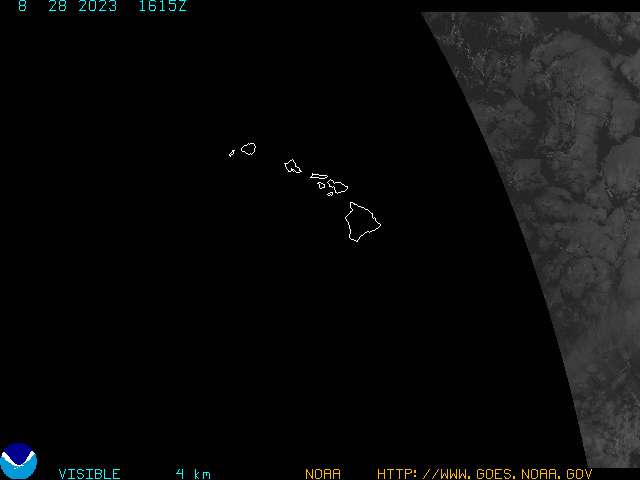

Andy Rosenblum Says:
Dear Glenn,
I was watching the news this morning (mainland/Michigan) and it appears that some of your meteorological colleagues feel that the current “hoopla” about climate change has been “hyped up” and that the changes we are seeing (frequent El Nino’s, glaciers disappearing, drought and deluge, etc) are predominantly part of a cyclical process that Mother Earth has initiated rather than Homo sapiens. May I ask where you stand on this issue?
SIncerely,
Andy Rosenblum~~~Hi Andy, my stand on this issue is that we do have something happening with our climate, as we always have. Global climate change is nothing new, fluctuating between global warming or global cooling…on a very long time frame. We are currently seeing the global warming phase in full swing. I anticipate that we will see more extreme weather events, along with associated side effects on our earth moving forward. Aloha, Glenn
Roz Says:
So Glenn, it looks like we’re arriving just in time for some “inclement weather.” I know what that means here around LAX, but do we need rain gear or just an umbrella? And Monday we’re taking the Hana Road trip (overnighting in Hana)– is this road worse with lots of rain? OR I could just chill and enjoy whatever comes our direction…after all vacation is vacation.~~~Roz, I think you are right on the mark, we are expecting some weather changes, and it would be wise to just go along with where the seat takes you…in regards to life. You will not have constant rainfall, and likely you will be able to stay out of its way most of the time. That you are going to Hana, and spending the night, what a great thing to do! I honestly believe that you will love being here, and not go away disappointed by how the weather has treated you. Best of luck, Aloha, Glenn