











April 22-23, 2010
Air Temperatures – The following maximum temperatures were recorded across the state of Hawaii Thursday afternoon:
Lihue, Kauai – 80
Honolulu, Oahu – 83
Kaneohe, Oahu – 80
Kaunakakai, Molokai – 78
Kahului, Maui – 85
Hilo, Hawaii – 79
Kailua-kona – 80
Air Temperatures ranged between these warmest and coolest spots near sea level around the state – and on the highest mountains…at 4pm Thursday afternoon:
Port Allen, Kauai – 82F
Hilo, Hawaii – 72
Haleakala Crater – 48 (near 10,000 feet on Maui)
Mauna Kea summit – 32 (near 14,000 feet on the Big Island)
Precipitation Totals – The following numbers represent the largest precipitation totals (inches) during the last 24 hours on each of the major islands, as of Thursday afternoon:
1.64 Mount Waialaele, Kauai
2.61 Manoa Valley, Oahu
0.26 Molokai
0.00 Lanai
0.00 Kahoolawe
1.83 West Wailuaiki, Maui
2.08 Kawainui Stream, Big Island
Marine Winds – Here’s the latest (automatically updated) weather map showing a 1031 millibar high pressure system far to the northeast of the islands. This pressure configuration will keep our trade winds blowing into Friday.
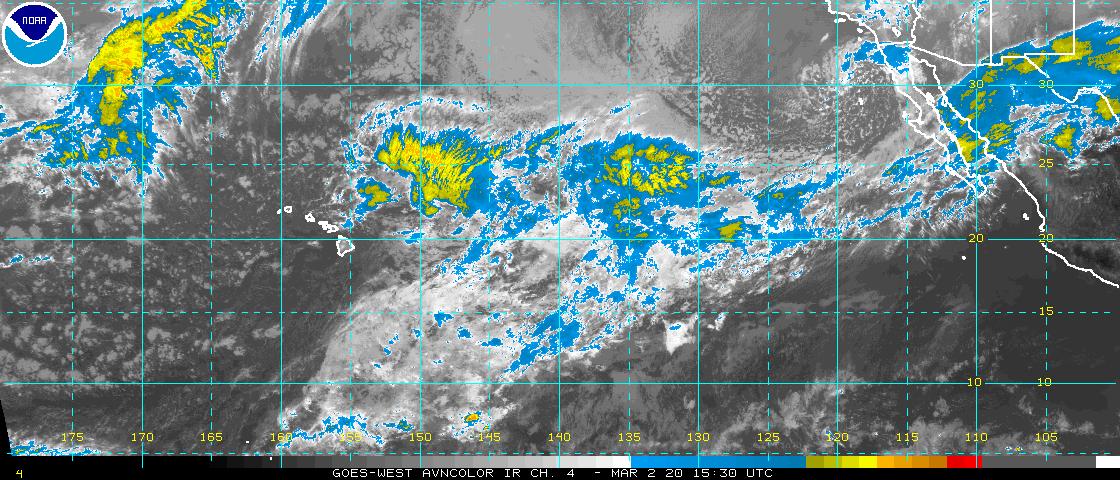
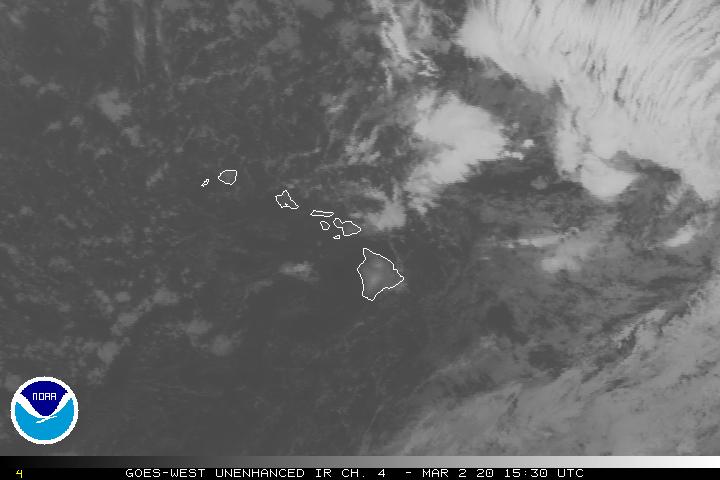
Satellite and Radar Images: To view the cloud conditions we have here in Hawaii, please use the following satellite links, starting off with this Infrared Satellite Image of the islands to see all the clouds around the state during the day and night. This next image is one that gives close images of the islands only during the daytime hours, and is referred to as a Close-up visible image. This next image shows a larger view of the Pacific…giving perspective to the wider ranging cloud patterns in the Pacific Ocean. Finally, here’s a Looping IR satellite image, making viewable the clouds around the islands 24 hours a day. To help you keep track of where any showers may be around the islands, here’s the latest animated radar image.
Hawaii’s Mountains – Here’s a link to the live webcam on the summit of near 14,000 foot Mauna Kea on the Big Island of Hawaii. The tallest peak on the island of Maui is the Haleakala Crater, which is near 10,000 feet in elevation. These two webcams are available during the daylight hours here in the islands…and when there’s a big moon rising just after sunset for an hour or two! Plus, during the nights and early mornings you will be able to see stars, and the sunrise too…depending upon weather conditions.
Tropical Cyclone activity in the eastern and central Pacific – Here’s the latest weather information coming out of the National Hurricane Center, covering the eastern north Pacific. You can find the latest tropical cyclone information for the central north Pacific (where Hawaii is located) by clicking on this link to the Central Pacific Hurricane Center. Here’s a tracking map covering both the eastern and central Pacific Ocean. A satellite image, which shows the entire ocean area between Hawaii and the Mexican coast…can be found here. Of course, as we know, our hurricane season won’t begin again until June 1st here in the central Pacific.
Aloha Paragraphs

Celebrating Earth Day 2010
The trade winds will be on a gradual decline in strength into the weekend. Since it’s our spring season, and the trade winds are difficult to hold down this time of year, they won’t remain in this lighter aspect of their typical moderate to locally strong and gusty nature for long. As a matter of fact, the computer models suggest that right after the weekend, they will be rebounding, at least for a couple of days. Thereafter, they may ease up again for a short time…before once again winding up. This up and down motion isn’t all that unusual for April, although would be more so during the upcoming month of May. As this weather map shows, we still have that more or less moderately strong 1031 millibar high pressure system, stationed far to the northeast of our islands. The storm low pressure system, moving by the north of this high pressure system, will motivate it to move further eastward. This in turn will allow the pressure gradient to weaken across our tropical latitudes…thus the expected lighter winds locally. The winds today are still on the moderately strong side of the spectrum, with the following strongest gusts noted early Thursday afternoon.
There have been some pretty good rainfall totals on each of the islands during the last 24 hours, at least on the larger islands in the chain. This trend is expected to continue into Friday, with the most notable precipitation totals along our windward coasts and slopes. This IR satellite image shows that an area of high cirrus clouds covers part of the
It’s Thursday evening as I begin writing this last section of today’s narrative. Everything seems to be dropping into place nicely, as far as the weather forecasting business goes. The heaviest showers should fall during the night into Friday, before conditions begin to improve this weekend. At the time of this writing, the central islands where receiving the most generous showers. ~~~ Today is Earth Day 2010, a day to remember how much we love this large round globe that supports our every movement. Earth Day, which occurs every April 22nd, got its beginning way back in 1970. I join you in respecting our planet Earth, by taking care of it, by doing our part to keep it clean…in all those small ways that we can as individuals! I want to live in a world filled with love. ~~~ Looking out the window here in Kihei before I take the drive back upcountry to Kula, it’s at least partly cloudy. It looks a lot like there are passing showers over on the windward sides, almost definitely! It’s breezy over here in Kihei too, with leaves rustling around all over the place. I anticipate more showers, especially along the windward sides through Friday, then it should get better, just in time for the weekend. I’ll be back early Friday morning, and I hope you can join me again then! Aloha for now…Glenn.
Extra: Icelandic volcano pictures
Interesting: Iceland’s main airport will close tomorrow because of an ash cloud for the first time since a volcano erupted there last week, closing much of European air space, officials said today. "It seems like ash will be going into the area and Keflavik will be closed for air traffic," Hjordis Gudmundsdottir, spokeswoman for the Civil Aviation Authority, said not specifying when the airport would be closing.
She did not know how long airspace there would remain closed, but said the island country would remain open to the outside world because the Icelandair airline would use alternative airports. A shift in wind, blowing ash in a low cloud across the country to the west coast, was responsible, Ms Gudmundsdottir said. Keflavik Airport just outside the capital Reykjavik has remained open ever since the eruption last week that clogged Europe’s air space with ash and shut down airports across the continent.
The shutdown came as European airports began to return to normal after massive disruptions. "This is the first time we are closing the airport which is amazing. The wind has done us a favor until now and not Europe. You could say it’s our turn now," Ms Gudmundsdottir said.
She said that two smaller airports in the north and east of Iceland would now handle flights. Icelandair, the main carrier for Iceland, said that until Keflavik reopens it would send passengers from the alternative airports to nearby Glasgow in Scotland and from there to further destinations.
"Plan B is to basically move our hub from Kevlavik to Glasgow Airport and then have flights from Glasgow up to Iceland on a regular basis," Gudjon Arngrimsson, spokesman for Icelandair, said. "We have to play this by ear really as time goes on. We don’t know how long it will be," he said. "The aim is to keep the country open."
Interesting2: The International Whaling Commission (IWC) has unveiled a compromise proposal to resolve longstanding rifts under which Japan would cut its annual Antarctic catch by three-quarters in five years. The proposal, which will be voted on at a June meeting in Morocco, sets a 10-year plan under which all whaling in the world would be brought under the control of the divided IWC.
The commission, which led months of negotiations among major nations, said the package represented a "delicate balance of concessions" and that "no one can be said to have won or lost". Under the proposal, Japan’s Antarctic catch would go down to 410 whales next season and then 205 whales in the 2015-2016 season. Japan’s annual Antarctic hunt has infuriated Australia, which has threatened legal action.
Japan currently targets to kill 765-935 whales each season in the Antarctic, although its latest catch was down to 507 whales due to sustained high-seas harassment by environmentalists. The compromise would also allow whaling during the 10-year period by Norway and Iceland and by Japan’s fleet in the Pacific Ocean. But it would bar any new countries from entering whaling.
The IWC imposed a moratorium on commercial whaling in 1986. Japan employs a loophole that allows "lethal research" on the ocean giants, while Norway and Iceland defy the moratorium altogether. The United States has helped spearhead the compromise but withheld a final judgment on the proposal, anticipating further negotiations through the June meeting in Morocco. Monica Medina, the US commissioner to the IWC, said the bottom line for the United States was to save whales.
"The important thing here is that the IWC isn’t working right now," Professor Medina told AFP. "Even with the moratorium in place, the number of whales being killed is increasing and if we can turn that around and decrease the number of whales being killed, that would be a good thing." Advocates for the compromise say that IWC negotiations have been so consumed by arguments that the body has not taken action on growing threats to whales such as climate change, ship strikes and entanglement in fishing gear.
But environmentalists have harshly criticised the proposal, saying it rewards Iceland, Japan and Norway for skirting the 1986 moratorium and risks reviving the dwindling worldwide markets for whale meat. "This is probably the biggest threat to the ban on commercial whaling that we’ve faced since it came into force," said Nicolas Entrup of the Munich-based Whale and Dolphin Conservation Society. "This is a critical moment for the conservation movement."
Interesting3: Scientists call for more risk-based facility design and improved prevention, response planning Hurricane Katrina was the cause of more than 200 onshore releases of petroleum and other hazardous materials, a new study funded by the National Science Foundation has found. According to comprehensive research using government incident databases, about 8 million gallons of petroleum releases were reported as a result of Katrina hitting the U.S. Gulf coast in 2005, nearly 75 percent of the total volume of the 1989 Exxon Valdez oil spill in Alaska.
The releases were largely due to storage tank failure and the shut down and restart of production processes. Storm surge floods were the primary cause, but some incidents occurred as a result of hurricane and tropical storm strength winds where no surge was present, according to the authors. The study appears in the April issue of the journal Risk Analysis. The authors include consultant Nicholas Santella, Laura Steinberg of Syracuse University, and Hatice Sengul of the Turkish Scientific and Technological Research Council.
Ten onshore releases of petroleum products were greater than 10,000 gallons each, primarily made up of crude oil that leaked from storage tanks. Fewer and smaller releases were reported from chemical and manufacturing industries handling hazardous materials. Of the releases from onshore facilities and storage tanks, 76 percent were petroleum, 18 percent were chemicals and six percent were natural gas.
Many refineries and other facilities shut down in anticipation of large storms to minimize damage and prevent process upsets and are required to do so for safety purposes. However, shutdowns and restarts have the disadvantage of leading to potentially large emissions of volatile organic compounds, particulate matter, and other chemicals.
Interesting4: The oil rig that exploded, caught fire and then sank 36 hours later could lead to a major oil spill, officials said Thursday, and as a result a remotely operated vehicle is surveying the seas and assets ranging from aircraft to containment booms are ready to be deployed. At a press conference, the officials also said hope was running out for 11 workers still missing after the blast Tuesday night off the coast of Louisiana. The Coast Guard said its search would probably continue for another 12 hours or so. Officials had previously said the environmental damage appeared minimal, but new challenges have arisen now that the platform has sunk.
The well could be spilling up to 8,000 barrels of crude oil a day, the Coast Guard said, and the rig carried 700,000 gallons of diesel fuel. Coast Guard Rear Adm. Mary Landry added that crews saw a one mile by five mile sheen of what appeared to be a crude oil mix on the surface of the water. Boats that skim oil from the top of water are working in the area, she said. Oil giant BP, which was finishing an exploration well when the explosion happened, said it has mobilized four aircraft that can spread chemicals to break up the oil as well as 32 vessels, including a big storage barge, that can suck more than 171,000 barrels of oil a day from the surface.
Landry did not have an estimate for when videotape from the remotely operated vehicle would be available to show if crude was spilling from the wellhead. Survivors were earlier reunited with their families at a suburban New Orleans hotel. About 100 workers had made it to a supply boat after Tuesday night’s explosion, then were plucked from the Gulf of Mexico by Coast Guard rescuers. After a slow-moving trek across the waters, the workers finally made it ashore at Port Fourchon earlier Thursday where they were checked by doctors and brought to a hotel in suburban New Orleans to awaiting relatives.
"I’ve seen a lot of things, but I’ve never seen anything like that," said a visibly tired worker, who declined to give his name as he got in a car to leave. The rig, where exploratory drilling was being done about 50 miles off the coast of Louisiana, exploded late Tuesday, sending workers scurrying for safety. Seventeen people were injured in the blast and taken to hospitals, four critically, in what could be one of the nation’s deadliest offshore drilling accidents of the past half-century.
Coast Guard crews in two cutters have been searching around the clock for the missing, said Coast Guard Lt. Sue Kerver. The air search, which had been called off for the night, resumed Thursday morning. Carolyn Kemp said Thursday that her grandson, Roy Wyatt Kemp, 27, was among the missing. She said he would have been on the drilling platform when it exploded. "They’re assuming all those men who were on the platform are dead," Kemp said. "That’s the last we’ve heard."
The rig is owned by Transocean Ltd. and was under contract to BP. Authorities could not say when the flames might die out on the 400-by-250-foot rig, which is roughly twice the size of a football field, according the Transocean’s website. A column of boiling black smoke rose hundreds of feet over the Gulf of Mexico as fireboats shot streams of water at the blaze. Officials said the damage to the environment appeared minimal so far.
Adrian Rose, vice president of Transocean, said the explosion appeared to be a blowout, in which natural gas or oil forces its way up a well pipe and smashes the equipment. But precisely what went wrong was under investigation. A total of 126 workers were aboard. Seventy-nine were Transocean workers, six were BP employees and 41 were contracted.
The Coast Guard said the 17 taken by air or sea to hospitals suffered burns, broken legs and smoke inhalation. A lawsuit filed Thursday, claimed the companies involved in the blast were negligent. The lawsuit was filed in New Orleans on behalf of a Mississippi man who worked on the rig and is one of 11 people still missing. The lawsuit claims Shane Roshto, of Amite County, Miss., was thrown overboard in the explosion and is feared dead.
A Transocean spokesman did not immediately respond to a request for comment and BP wouldn’t discuss the suit. One of the deadliest U.S. offshore drilling accidents was in 1964, when a catamaran-type drilling barge operated by Pan American Petroleum Corp. near Eugene Island, about 80 miles off Louisiana, suffered a blowout and explosion while drilling a well. Twenty-one crew members died. The deadliest offshore drilling explosion was in 1988 about 120 miles off Aberdeen, Scotland, in which 167 men were killed.
Rose said the Deepwater Horizon crew had drilled the well to its final depth, more than 18,000 feet, and was cementing the steel casing at the time of the explosion. "They did not have a lot of time to evacuate. This would have happened very rapidly," he said. According to Transocean’s website, the rig was built in 2001 in South Korea and is designed to operate in water up to 8,000 feet deep, drill 5½ miles down, and accommodate a crew of 130. It floats on pontoons and is moored to the sea floor by several large anchors.
Workers typically spend two weeks on the rig at a time, followed by two weeks off. Offshore oil workers typically earn $40,000 to $60,000 a year — more if they have special skills. Working on offshore oil rigs is a dangerous job but has become safer in recent years thanks to improved training, safety systems and maintenance, said Joe Hurt, regional vice president for the International Association of Drilling Contractors.
Since 2001, there have been 69 offshore deaths, 1,349 injuries and 858 fires and explosions in the Gulf, according to the federal Minerals Management Service. Stanley Murray of Monterey, La., was reunited with his son, Chad, early Thursday morning. His son, an electrician aboard the rig, had ended his shift just before the explosion. "If he had been there five minutes later, he would have been burned up," a relieved Stanley Murray said.
 Email Glenn James: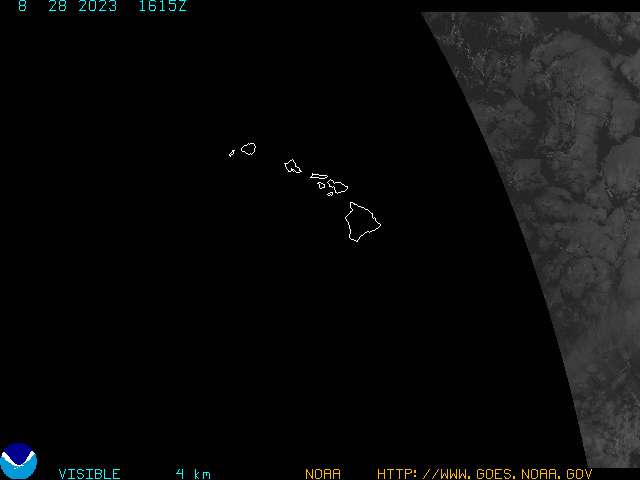


Eliza Says:
Perhaps I missed it in your notes above, Glenn, yet who gets credit for the lovely Hawaiian Earth Day image on the page? Mahalo! Eliza~~~Hi Eliza, it was a poster from last years Maui Earth Day 2009. Aloha, Glenn