











April 20-21, 2010
Air Temperatures – The following maximum temperatures were recorded across the state of Hawaii Tuesday afternoon:
Lihue, Kauai – 78
Honolulu, Oahu – 83
Kaneohe, Oahu – 79
Kaunakakai, Molokai – 79
Kahului, Maui – 83
Hilo, Hawaii – 76
Kailua-kona – 81
Air Temperatures ranged between these warmest and coolest spots near sea level around the state – and on the highest mountains…at 4pm Tuesday afternoon:
Kalaeloa, Oahu – 80F
Princeville, Kauai – 75
Haleakala Crater – 50 (near 10,000 feet on Maui)
Mauna Kea summit – 36 (near 14,000 feet on the Big Island)
Precipitation Totals – The following numbers represent the largest precipitation totals (inches) during the last 24 hours on each of the major islands, as of Tuesday afternoon:
1.60 Mount Waialaele, Kauai
0.60 Manoa Valley, Oahu
0.03 Molokai
0.00 Lanai
0.00 Kahoolawe
0.22 West Wailuaiki, Maui
0.51 Kawainui Stream, Big Island
Marine Winds – Here’s the latest (automatically updated) weather map showing a 1034 millibar high pressure system to the northeast of the islands. This pressure configuration will keep our moderate to locally strong and gusty trade winds blowing through Thursday.
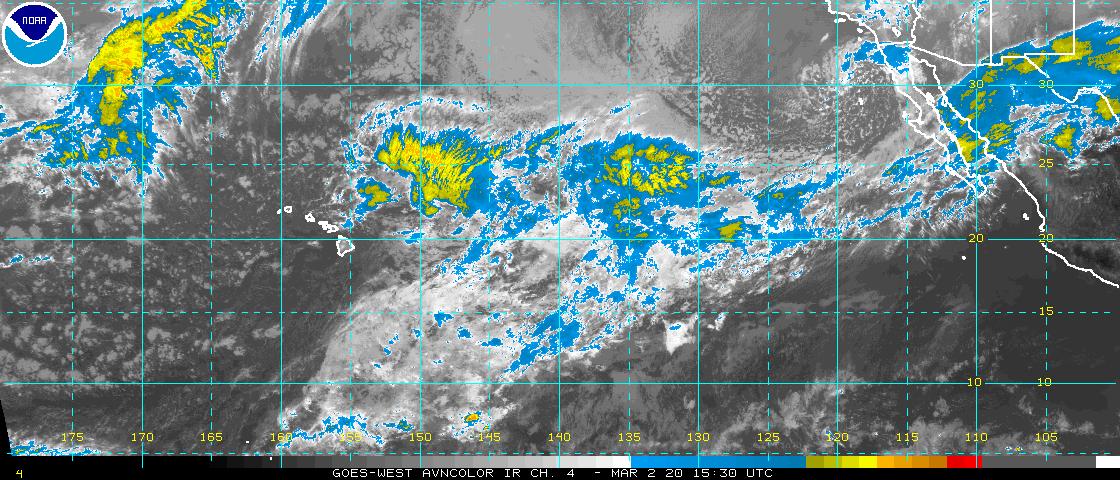
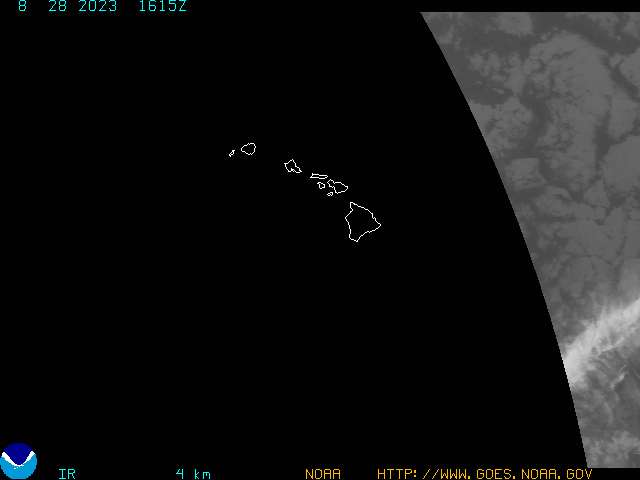
Satellite and Radar Images: To view the cloud conditions we have here in Hawaii, please use the following satellite links, starting off with this Infrared Satellite Image of the islands to see all the clouds around the state during the day and night. This next image is one that gives close images of the islands only during the daytime hours, and is referred to as a Close-up visible image. This next image shows a larger view of the Pacific…giving perspective to the wider ranging cloud patterns in the Pacific Ocean. Finally, here’s a Looping IR satellite image, making viewable the clouds around the islands 24 hours a day. To help you keep track of where any showers may be around the islands, here’s the latest animated radar image.
Hawaii’s Mountains – Here’s a link to the live webcam on the summit of near 14,000 foot Mauna Kea on the Big Island of Hawaii. The tallest peak on the island of Maui is the Haleakala Crater, which is near 10,000 feet in elevation. These two webcams are available during the daylight hours here in the islands…and when there’s a big moon rising just after sunset for an hour or two! Plus, during the nights and early mornings you will be able to see stars, and the sunrise too…depending upon weather conditions.
Tropical Cyclone activity in the eastern and central Pacific – Here’s the latest weather information coming out of the National Hurricane Center, covering the eastern north Pacific. You can find the latest tropical cyclone information for the central north Pacific (where Hawaii is located) by clicking on this link to the Central Pacific Hurricane Center. Here’s a tracking map covering both the eastern and central Pacific Ocean. A satellite image, which shows the entire ocean area between Hawaii and the Mexican coast…can be found here. Of course, as we know, our hurricane season won’t begin again until June 1st here in the central Pacific.
Aloha Paragraphs

South Maui, breaking waves…sunset colors
A well established trade wind weather pattern will keep the locally strong and gusty winds blowing across the Aloha state…into Wednesday. Winds are strong enough to warrant small craft advisories over those windiest areas from Oahu down through the
The latest computer forecast models keep the trade winds on the strong side through Thursday, which seems fitting…considering the major high pressure system remaining more or less in our area. Starting Friday, the cold front associated with that deep low (mentioned in the paragraph above) will swing by to our north, weakening the pressure gradient across the state. At the same time, the models show an upper trough of low pressure aloft, edging into our area. This trough up high, may dig down towards the surface, which would add to the diminishing winds Friday into the weekend. Since it’s the spring season, this faltering of the trade winds won’t last long, nor get too soft in the process. Already, we’ll have a new trade wind generating high pressure, moving into range as we get into the new week ahead.
As far as rainfall goes, as influenced first by the trade winds, and then the trough Friday and Saturday…it will be changeable. The atmosphere at the moment remains limited in terms of passing showers. Checking out this IR satellite image, we see a fairly minimum amount of clouds, although there’s quite a few high cirrus clouds to our south…carried along in the subtropical jet stream down there. In order to see the large thunderstorms down to the south of the jet stream, nearer the equator, we can shift to this even larger IR satellite image. We’ll likely have to wait until closer to Thursday before we see any more substantial rainfall arriving along our windward sides. As we move into Friday and Saturday, with the coldest air overhead then…this would be the time for the heaviest showers to fall. We’d like to see them land over our leeward sides, where the driest areas are located, although if the trade winds remain active, this prospect diminishes.
It’s Tuesday evening as I begin writing this last section of today’s narrative. The weather will remain quite nice, that is if you don’t mind the gusty trade winds. These strongest gusts were being reported late Tuesday afternoon:
Kauai – 35 mph
Oahu – 32 mph
Molokai 36 mph
Maui – 38 mph
Kahoolawe – 39 mph
Big Island – 35 mph
As noted above there won’t be too much difference in what we see Wednesday, compared to what we saw during the first two days of this week. We should begin to find some modest increase in windward showers, which will increase further later Thursday into the weekend. It’s still a question about the rainfall potential coming up through the period Thursday through Saturday. The wild cards continue to be: how much moisture will be available to feed the showery clouds then, and how light or strong the trade winds will be then too. Both of these factors, and how they turn out, will help determine the final outcome. My feeling is that we need the precipitation, so lets trust that it will come to us. ~~~ I’m about ready to leave Kihei, for the drive back home to Kula. Looking out the window before I jump in my white car, it is clear to partly cloudy, with very little wind where I am, up above Kihei a little ways. There’s some clouds up towards Haleakala, although that is very typical. I can hardly wait to get home, change out of my work clothes, and get my walking shoes on. Do you know that feeling, having been inside an air conditioned office all day, and chomping on the bit to get outside and breathe some real air, some nice gentle tropical air at that. I hope you have a great Tuesday night, and that we can meet here again on Wednesday! Aloha for now…Glenn.
Interesting: For all the worldwide chaos that Iceland’s volcano has already created, it may just be the opening act. Scientists fear tremors at the Eyjafjallajokull volcano could trigger an even more dangerous eruption at the nearby Katla volcano — creating a worst-case scenario for the airline industry and travelers around the globe.
A Katla eruption would be 10 times stronger and shoot higher and larger plumes of ash into the air than its smaller neighbor, which has already brought European air travel to a standstill for five days and promises severe travel delays for days more. The two volcanos are side by side in southern Iceland, about 12 miles (20 kilometers) apart and thought to be connected by a network of magma channels.
Katla, however, is buried under ice 550 yards (500 meters) thick — the massive Myrdalsjokull glacier, one of Iceland’s largest. That means it has more than twice the amount of ice that the current eruption has burned through — threatening a new and possibly longer aviation standstill across Europe. Katla showed no signs of activity Tuesday, according to scientists who monitor it with seismic sensors, but they were still wary.
Pall Einarsson, professor of geophysics at the Institute of Earth Sciences at the University of Iceland, said one volcanic eruption sometimes causes a nearby volcano to explode, and Katla and Eyjafjallajokull have been active in tandem in the past. In fact, the last three times that Eyjafjallajokull erupted, Katla did as well.
Katla also typically awakens every 80 years or so, and having last exploded in 1918 is now slightly overdue. That notion is frightening for nearby villagers, who would have to quickly evacuate to avoid the flash floods that would rip down Katla’s slopes. Even last week’s eruption generated spectacular cascades of melted water and ice chunks the size of houses when burning gases and molten earth carved through the glacier.
Svenn Palsson, the 48-year-old mayor of the coastal village of Vik, said residents are going over evacuation plans now just in case. With a population of 300, Vik has been covered in 3 millimeters (0.12 inches) of ash from the Eyjafjallajokull eruption, but the real concern is Katla. Residents would have two to three hours to reach the safety of a shelter if the volcano erupted and caused the ice to melt quickly.
"We have practiced and can do it in 30 minutes," Palsson said. Other areas around the mountain, however, would have no more than 20 minutes to evacuate, he said. Katla’s substantial ice cap is a major worry because it’s that mixture of melting cold water and lava that causes explosions and for ash to shoot into high altitudes.
Strong winds can then carry it on over Europe. So far there have been minor tremors at Katla, which scientists believe to be movements in the glacier ice, but the activity from Eyjafjallajokull is making measurements more difficult to read and an eruption more tricky to predict. "It is more difficult to see inside Katla," said Kristin Vogfjord, geologist at the Icelandic Met Office.
Her team of geophysicists, based in the capital of Reykjavik, use seismometers and GPS units planted around volcanoes to monitor quakes and the swelling of the land, which can indicate magma reservoirs that are pushing up through the crust. The area around Eyjafjallajokull rose up as much as 3 inches (8 centimeters) in recent months and then contracted slightly following the latest eruption.
Vogfjord says Katla’s sensitivity to eruptions at Eyjafjallajokull may have to do with pressure shifts in the Earth’s crust that are caused by an eruption’s magma flow. There are no clear answers, however, and even fewer predictions about what the future may hold. Volcano eruptions, like earthquakes, are difficult to predict. "Katla can start tomorrow or in 100 years, you don’t know," said Palsson. "All we can do is be ready."
Interesting2: Imagine an electrical storm larger than the continental United States in which the lightning bolts are more than 1,000 times stronger than conventional lightning, and you’ll have a good idea of what can transpire on Saturn. NASA’s Cassini spacecraft has recently captured images of lightning on Saturn.
The images have allowed scientists to create the first movie showing lightning flashing on another planet. After waiting years for Saturn to dim enough for the spacecraft’s cameras to detect bursts of light, scientists were able to create the movie, complete with a soundtrack that features the crackle of radio waves emitted when lightning bolts struck.
Saturn is the sixth planet from the Sun and the second largest planet in the Solar System, after Jupiter. Saturn is famous for its rings but also has raging lightning storms. The NASA supplied movie and radio data suggest extremely powerful storms with lightning that flashes as bright as the brightest super bolts on Earth, according to Andrew Ingersoll, a Cassini imaging science subsystem team member at the California Institute of Technology in Pasadena.
"What’s interesting is that the storms are as powerful — or even more powerful – at Saturn as on Earth," said Ingersoll. "But they occur much less frequently, with usually only one happening on the planet at any given time, though it can last for months." Since early 2005, scientists have been tracking lightning on Saturn, primarily found by Cassini. Saturn has powerful lightning storms, 10,000 times stronger than on Earth, that occur in huge, deep thunderstorms columns nearly as large as the entire Earth.
The storms occasionally burst through to the planet’s visible cloud tops. The 2009 thunderstorm that began in January on Saturn is the ninth that has been measured since Cassini swung into orbit around Saturn in July 2004. Lightning discharges in Saturn’s atmosphere emit very powerful radio waves, which are measured by the antennas and receivers of Cassini.
These radio waves are about 10,000 times stronger than their terrestrial counterparts and originate from huge Saturnian thunderstorms. To make a video, scientists needed more pictures with brighter lightning and strong radio signals. The necessary data was collected during a shorter storm, which occurred from November through mid-December 2009. The frames in the video were obtained over 16 minutes on Nov. 30, 2009.
The flashes lasted less than one second. The images show a cloud as long as 1,900 miles across and regions illuminated by lightning flashes about 190 miles in diameter. When lightning strikes on Earth and on Saturn, it emits radio waves at a frequency that can cause static on an AM radio. The sounds in the video approximate that static sound, based on Saturn electrostatic discharge signals detected by Cassini’s radio and plasma wave science instrument.
Since Cassini’s arrival at Saturn in 2004, it has been difficult to see the lightning because the planet is very bright and reflective. Sunlight shining off Saturn’s enormous rings made even the night side of Saturn brighter than a full moon night on Earth. Equinox, the period around August 2009 when the sun shone directly over the planet’s equator, finally brought the needed planetary darkness. During equinox, the sun lit the rings edge on only and left the bulk of the rings in shadow.
Interesting3: Eyjafjallajökull: We can’t pronounce it, but it sure has gotten our attention. Okay, it is pronounceable with help: ay-yah-FYAH’-tlah-yer-kuh-duhl. Before last month, this relatively unknown volcano, located along Iceland’s southwest coast about 75 miles from Reykjavik, had been fairly quiet.
The first rumblings of activity began in March, but at the time the eruption was little more than a volcanologist’s curiosity and an Icelander’s worry. Then on April 14 the location of the eruption changed to beneath the glacier, and the explosive phase began pumping plumes of smoke and ash almost a mile into the atmosphere — grabbing international headlines, as I’m sure you’ve heard, as planes across Europe were grounded and thousands of travelers stranded.
Its location along the spreading ridge of the mid-Atlantic, where new ocean crust is formed, makes volcanism a common occurrence in Iceland. Still, before this month, Eyjafjallajökull had not erupted for more than a century. As it turns out, this recent volcanic belch has produced a whopper of an ash plume.
Melt water from the glacier sitting atop the volcano mixing with the magma may have contributed to the eruption’s explosiveness. Eventually those volcanic ash clouds found themselves over Europe raining ash onto windshields and grinding European air travel to a halt. The situation has reportedly cost airlines nearly $1 billion.
And while stranded travelers who took out travel insurance should be covered, that coverage, according to the New York Times, will cost insurance companies millions of dollars in claims. Then there are the pet owners who’ve had to scramble to the rescue of their furry companions which often take different travel routes.
The ripples of Europe’s hamstrung air travel have quickly spread in a world run on the global economy. In Kenya, some two million pounds of produce normally shipped daily to European markets sit rotting in "eight-feet tall heaps" with nowhere to go. The cost: $3 million a day to Kenya’s top exporting industry and an untold number of jobs. (On a much smaller scale, the volcano’s impact even hit me when a Russian colleague I was expecting for a meeting last weekend had to cancel because he couldn’t get a flight out of Europe.)
There’s a good chance this whole volcanic ash thing will end in a few more days, flights will resume, and a year from now we’ll look back on this whole incident with a nostalgic "remember when"? But the bad news is that we really don’t know what Eyjafjallajökull has in store. The last time the little-Iceland-volcano-that-could erupted was in the 19th century — from December 1821 through January 1823.
That’s right: it coughed up its ash plumes for more than a year. Imagine disrupted European air travel for that long? Even if the ash plumes only affect, say, 25-50 percent of European flights, it would mean big problems for the industry, the travelers who depend on it, and the businesses reliant on imports and exports (are there any left that aren’t at least indirectly affected by the global economy?).
Some might think such disruptions wouldn’t be that bad because they’d be periodic — on when the plume drifts over European airspace and off when it doesn’t. Actually, I suspect that such an on again-off again situation would be almost as bad a complete grounding, as it would inject an unacceptable level of uncertainty to all involved. There’s also a related unknown on the horizon.
Every time Eyjafjallajökull has erupted, rumblings from neighboring Katla have followed, and typically Katla’s eruptions have been much more violent and disruptive. Between 1783 and 1784, for example, Katla’s explosions spewed an estimated (subscription required) 95 million metric tons of sulfur dioxide (SO2) into the atmosphere leading to reports in Europe, Alaska, and China of what was at the time called "dry fog" — which, in scientific terms, is part and parcel with acidic precipitation.
One of the most severe winters on record in Europe and North America followed the event, quite possibly due to the volcano and the havoc its plume wrought on the jet stream. Such occurrences can serve as a useful reality check.
Sometimes it’s argued that scientific uncertainty about an environmental problem means we shouldn’t take action until we’re absolutely sure we must mitigate against it — think global warming or emerging pollutants. Here’s an example of a scientific uncertainty about the environment related not to human actions but to simple planetary plumbing.
Interesting4: Activity is picking up on a volcano in Vanuatu’s north and may force the evacuation of nearly 3000 people. The Gaua volcano, in the Torbo Province of the South Pacific nation, began erupting in September last year. But mud flow, ash fall and explosions have increased in the last couple of weeks, Radio New Zealand International reported today.
"During the past days we saw some very big, huge, dark plumes of clouds going up in to the air about 10,000 feet high," a spokesman for the Vanuatu Disaster Management Office said. The water level in the crater lake had been rising and there are fears mud could flow into populated areas, according to reports.
Smoke and ash had blown to the western side of the island, forcing the evacuation of about 300 people at the end of last year, but no further plans had been made. "No one is living in the western part of the island at the moment," he said.
"There are rumors going around that we have decided to evacuate some people, but I’m confirming now we are not yet at the stage of evacuating them. "At the moment we are still monitoring the situation in Gaua. "This week we’re having a meeting and we’re looking at if it (is) affecting more parts of the island – then we might evacuate.
Interesting5: The year of the earthquake has suddenly become the year of the volcano. The eruption in Iceland is not large as volcanoes go, but the cloud over Europe has shed light on the awkward overlay of human commerce and a hot, churning, unpredictable Earth. It raises the question of what governments can do to prepare for — and adapt to — wild-card geological events that not only affect airliners but can also potentially alter the planet’s climate for years at a stretch.
The volcano with the difficult name of Eyjafjallajokull is not powerful enough to change climate — it has ejected material only as high as about 20,000 feet, and would need to launch the ash at least 33,000 feet to have global climatic effects, according to the National Oceanic and Atmospheric Administration (NOAA). Now airports are beginning to open again in Britain and the Netherlands, but no one can be entirely sure what will happen next in Iceland.
Eyjafjallajokull could potentially incite an eruption of its larger neighbor, Katla, which hasn’t erupted since 1918 and might be ready to rumble. In all three historically recorded eruptions of Eyjafjallajokull — in 920, 1612 and 1821 — Katla erupted soon thereafter. "The eruption that’s going on right now is small in comparison to what we expect Katla would be like," said Jay Miller, a volcanologist at Texas A&M University.
Events in recent days have demonstrated the inherent uncertainties of volcano science. Although volcanoes are far more predictable than earthquakes, they remain quirky, with each one having its own personality. Scientists rely primarily on past performance to predict future activity for any given location. The Iceland volcano initially produced little ash, but a new vent opened beneath a glacier and the situation turned explosive.
What precisely happened is still being researched, but it appears that melt water and magma produced steam quite suddenly and the volcano popped its top like a shaken soda bottle. No one knows how much material will be ejected, or how high into the atmosphere it will travel. Scientists with computer models are frantically trying to track plumes of ash that become widely and chaotically dispersed even as new plumes shoot from the volcano.
No one knows whether the ash will reach the airspace over the United States and affect domestic travel, though that doesn’t seem to be an imminent threat. The ash has reached the eastern portion of Canada, however. "I think there might be some nicer sunsets by the end of this week over North America," said Stan Benjamin, director of NOAA’s Forecast Research Branch of its Global Systems Division.
One National Weather Service scientist, Gary Hufford, told reporters in a conference call Tuesday that it can be difficult to tell with satellite imagery how much ash is in the air and whether the airspace is safe for jetliners. "The volcanic ash science still has many limitations," he said. Asked whether he would be comfortable flying in Europe, Hufford paused and said, "I would be cautious." The lengthy shutdown of many European airports continues to surprise travelers and scientists.
 Email Glenn James: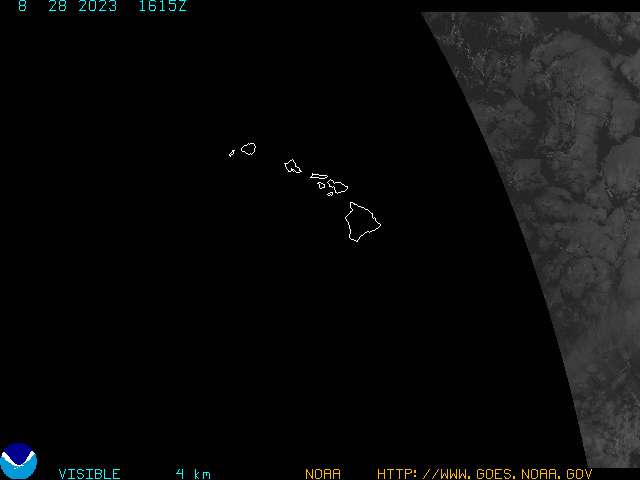


Peter Sanderson Says:
Aloha e Glenn, Hope all is well with your recent medical procedure and you are getting out and about more. We’re arriving in Kona Thursday morning for a short 6 day stay. Looks like we might expect some rain and wind through Saturday per your narrative. What do you see as possible weather Sunday through Wednesday next week. Mahalo nui for all you do and especially the interesting items of late about what Mme. Pele is up to in the North Atlantic. Peter from Santa Rosa, CA~~~Hi Peter, good to hear from you again. Glad to hear that you are squeezing in a short near week long vacation to Kona. I anticipate that you will have lovely weather, as Kona should be pretty far from most of the rainfall action we may see. Kauai and Oahu will likely be the best place to see precipitation, although I’d continue to follow the details until you arrive. Thanks for your positive comments, and I hope you have a wonderful week of warm sunshine. BTW, I love the Santa Rosa area, what a great place to live! Aloha, Glenn