April 15-16, 2010
Air Temperatures – The following maximum temperatures were recorded across the state of Hawaii Thursday afternoon:
Lihue, Kauai – 75
Honolulu, Oahu – 77
Kaneohe, Oahu – 78
Kaunakakai, Molokai – 74
Kahului, Maui – 81
Hilo, Hawaii – 77
Kailua-kona – 81
Air Temperatures ranged between these warmest and coolest spots near sea level around the state – and on the highest mountains…at 5pm Thursday evening:
Kailua-kona – 78F
Molokai airport – 69
Haleakala Crater – 45 (near 10,000 feet on Maui)
Mauna Kea summit – 32 (near 14,000 feet on the Big Island)
Precipitation Totals – The following numbers represent the largest precipitation totals (inches) during the last 24 hours on each of the major islands, as of Thursday afternoon:
0.03 Kokee, Kauai
0.00 Oahu
0.00 Molokai
0.00 Lanai
0.00 Kahoolawe
0.18 Kaupo Gap, Maui
0.54 Kawainui Stream, Big Island
Marine Winds – Here’s the latest (automatically updated) weather map showing a 1037 millibar high pressure system located far to the northwest of the islands. At the same time, we have low pressure cells positioned our northeast. This pressure configuration will keep our winds north to northeast through Saturday.
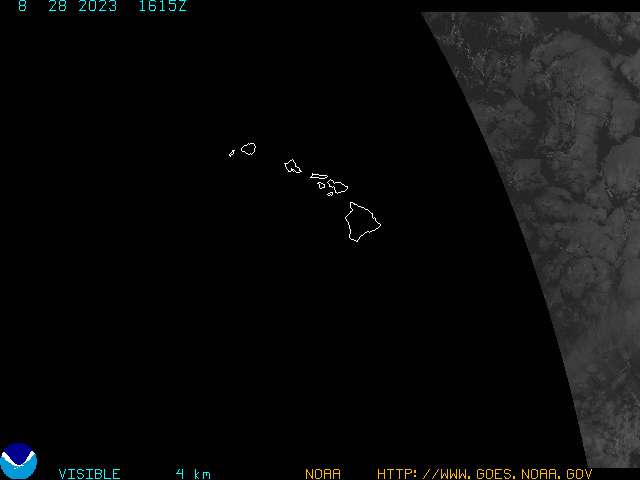
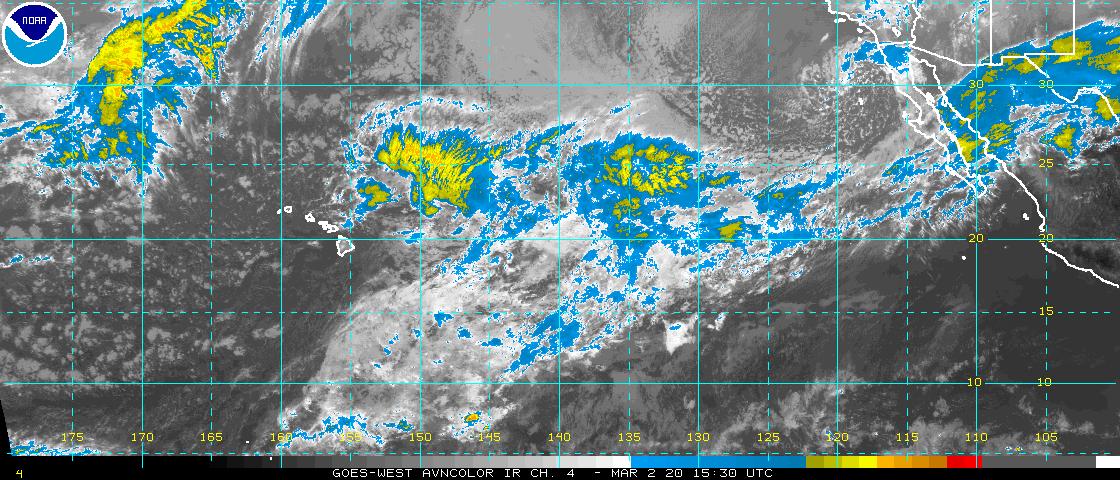
Satellite and Radar Images: To view the cloud conditions we have here in Hawaii, please use the following satellite links, starting off with this Infrared Satellite Image of the islands to see all the clouds around the state during the day and night. This next image is one that gives close images of the islands only during the daytime hours, and is referred to as a Close-up visible image. This next image shows a larger view of the Pacific…giving perspective to the wider ranging cloud patterns in the Pacific Ocean. Finally, here’s a Looping IR satellite image, making viewable the clouds around the islands 24 hours a day. To help you keep track of where any showers may be around the islands, here’s the latest animated radar image.
Hawaii’s Mountains – Here’s a link to the live webcam on the summit of near 14,000 foot Mauna Kea on the Big Island of Hawaii. The tallest peak on the island of Maui is the Haleakala Crater, which is near 10,000 feet in elevation. These two webcams are available during the daylight hours here in the islands…and when there’s a big moon rising just after sunset for an hour or two! Plus, during the nights and early mornings you will be able to see stars, and the sunrise too…depending upon weather conditions.
Tropical Cyclone activity in the eastern and central Pacific – Here’s the latest weather information coming out of the National Hurricane Center, covering the eastern north Pacific. You can find the latest tropical cyclone information for the central north Pacific (where Hawaii is located) by clicking on this link to the Central Pacific Hurricane Center. Here’s a tracking map covering both the eastern and central Pacific Ocean. A satellite image, which shows the entire ocean area between Hawaii and the Mexican coast…can be found here.
Aloha Paragraphs

Cooler Friday, breezy…some showers
Our spell of cooler than normal weather conditions aren’t through with us just yet, with likely the coolest weather to come Friday into Saturday. The good part of all this Thursday, was that our atmosphere was dry and stable, limiting the incoming precipitation, carried our way by the locally blustery north-northeast winds. The down side of this dry weather on the other hand, was the increased wild fire danger. Looking at the dew point temperature readings Thursday evening, we find them to be abnormally low. All stations were in the 50F’s…with even one high 40F degree reading on the Big Island. These types of conditions, coupled with the gusty winds, has triggered a red flag warning along all our leeward sections. This simply means that wild fires are a definite threat for the time being.
While we’re referring to temperatures, we find that the local thermometers were almost all reading in the 70F’s Thursday afternoon. The two exceptions were the 81 degree observations at Kahului, Maui, and Kailua-kona on the
As we know, the northeasterly winds have kept us chilly this week so far, and with the northerly winds now coming our way…it could begin to feel even cooler! North winds of course come from further north in latitude, and remain chilled, as they rush over the colder sea water surface to our north as well. The high temperature at
Speaking of clouds and showers…they do seem to be increasing already ahead of the approaching cold front. If we look upwards, into the upper atmosphere, up above 20,000 feet and beyond, we do see some high cirrus clouds up there. If we look at this satellite image, we can see long streaks of those icy cirrus clouds. The bulk of these sun dimming cirrus clouds are noted over parts of
It’s Thursday evening as I begin writing this last section of today’s narrative. Most of the day Thursday was pretty good, although the clouds have started to increase around sunset. These clouds will remain around ahead of the quickly approaching cold front. This frontal band shouldn’t be a big rainfall producer, although will drop some showers when it barrels through the state on Friday. Here’s a looping radar image, so we can keep track of the showers. The cooler north winds, noted in the paragraphs above, have already arrived, blowing right on through the cold front to our north. The next few days may be the last tropical cool snap of the spring season, at least likely. We will definitely be feeling this cooler air mass over the next two days, before conditions begin warming later this weekend. The big difference will be the shifting of the winds away from the current northerlies, back to the more common easterly trade winds late this weekend, and certainly going into next week. ~~~ Here in Kula, Maui, at around 530pm, it’s cloudy, with a light misty drizzle falling. It’s cool too, with the breezy north winds whipping around, as my thermometer reads 59.7F degrees at the time of this writing. At the same time, both Kahului and Hilo were showing a relatively cool 73 degrees, while Lihue and Princeville, Kauai, were running 72 degrees…with Molokai airport down to 69 degrees. I’ll be back with more weather news of the islands early Friday morning, having it prepared and available between 530 and 545am in the mornin’. I hope you have a great Thursday night until then! Aloha for now…Glenn.
Interesting: The Iceland volcano isn’t likely to significantly affect the climate or weather. Volcanic eruptions are capable however, of significantly cooling the climate for 1 – 2 years after a major eruption spews sulfur dioxide gas forcefully enough, so that it reaches the stratosphere. Once in the stratosphere, the gas reacts to form highly reflective sulfuric acid droplets mixed with water (sulfate aerosol particles). Let’s examine recent volcanic eruptions that have had a significant cooling effect on the climate. In the past 200 years, Mt. Pinatubo in the Philippines (June 1991), El Chichon (Mexico, 1982), Mt. Agung (Indonesia, 1963), Santa Maria (Guatemala, 1902) Krakatoa (Indonesia, 1883), and Tambora (1815) all created noticeable cooling.
The Mt. Pinatubo and El Chichon eruptions caused a greater than 10% drop in sunlight reaching the surface. The eruption of Tambora in 1815 had an even greater impact, triggering the famed Year Without a Summer in 1816. You’ll notice from the list of eruptions above that all of these climate-cooling events were from volcanoes in the tropics. Above the tropics, the stratosphere’s circulation features rising air, which pulls the sulfur-containing volcanic aerosols high into the stratosphere. Upper-level winds in the stratosphere tend to flow from the Equator to the poles, so sulfur aerosols from equatorial eruptions get spread out over both hemispheres. These aerosol particles take a year or two to settle back down to earth, since there is no rain in the stratosphere to help remove them.
However, if a major volcanic eruption occurs in the mid-latitudes or polar regions, the circulation of the stratosphere in those regions generally features pole-ward-flowing, sinking air, and the volcanic aerosol particles are not able to penetrate high in the stratosphere or get spread out around the entire globe. There have been at least two exceptions to the tropics-only rule. Realclimate.org discusses the eruption of the Laki volcano in Iceland, between 1783-1784. The eruption was probably not able to inject much sulfur into the stratosphere. However, since the eruption was sustained for so long, significantly elevated sulfur concentrations were seen in the lower atmosphere over much of the Atlantic and European regions, which had a pronounced cooling effect on the region.
The 1912 eruption of Alaska’s Mt. Novarupta, located in the same chain of volcanoes as Mt. Redoubt. According to a NASA computer model, Novarupta’s climate-cooling aerosols stayed north of 30°N latitude, and did not cause global cooling. However, the model indicates that the eruption may have indirectly weakened India’s summer monsoon, producing an abnormally warm and dry summer over northern India. It does not appear that the current eruption of the Eyjafjallajökull volcano on Iceland was large enough to alter the atmospheric circulation of the Northern Hemisphere and cause a change in the late spring/early summer weather patterns.
A series of several major eruptions over the next few weeks would be required for that to happen. The volcano is also too far north for the cooling effect of its ash cloud to affect the sea surface temperatures in the tropical Atlantic for the coming hurricane season. However, the ash could should bring spectacular sunsets to Europe over the next week, and to North America by sometime next week, as the jet stream wraps the ash cloud eastwards across the Northern Hemisphere.
 Email Glenn James: