











March 8-9, 2010
Air Temperatures – The following maximum temperatures were recorded across the state of Hawaii Monday afternoon:
Lihue, Kauai – 75
Honolulu, Oahu – 78
Kaneohe, Oahu – 77
Kaunakakai, Molokai – 75
Kahului, Maui – 79
Hilo, Hawaii – 75
Kailua-kona – 85
Air Temperatures ranged between these warmest and coolest spots near sea level around the state – and on the highest mountains…at 4pm Monday afternoon:
Kailua-kona – 81F
Hilo, Hawaii – 68
Haleakala Crater – 46 (near 10,000 feet on Maui)
Mauna Kea summit – 37 (near 14,000 feet on the Big Island)
Precipitation Totals – The following numbers represent the largest precipitation totals (inches) during the last 24 hours on each of the major islands, as of Monday afternoon:
1.66 Mount Waialaele, Kauai
1.37 Oahu Forest NWR, Oahu
1.30 Molokai
0.01 Lanai
0.14 Kahoolawe
3.34 Puu Kukui, Maui
1.59 Kawainui, Big Island
Marine Winds – Here’s the latest (automatically updated) weather map showing strong high pressure systems to the north and northeast Hawaii. The winds will be strong and gusty…gradually veering around from the NE to the ENE and east into mid-week.
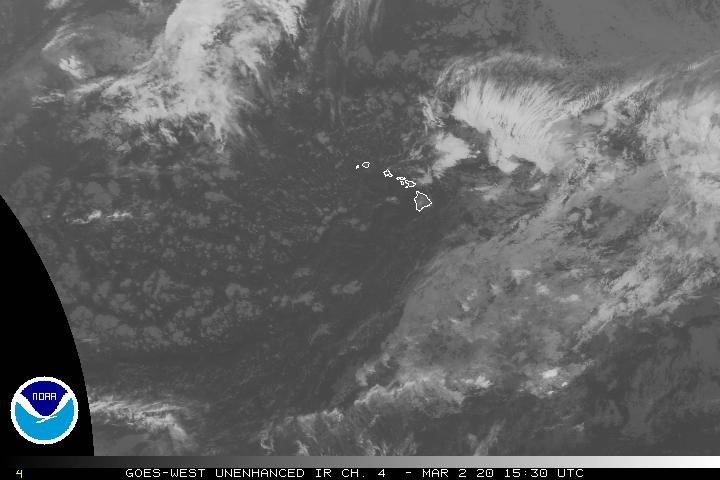
Satellite and Radar Images: To view the cloud conditions we have here in Hawaii, please use the following satellite links, starting off with this Infrared Satellite Image of the islands to see all the clouds around the state during the day and night. This next image is one that gives close images of the islands only during the daytime hours, and is referred to as a Close-up visible image. This next image shows a larger view of the Pacific…giving perspective to the wider ranging cloud patterns in the Pacific Ocean. Finally, here’s a Looping IR satellite image, making viewable the clouds around the islands 24 hours a day. To help you keep track of where any showers may be around the islands, here’s the latest animated radar image.
Hawaii’s Mountains – Here’s a link to the live webcam on the summit of near 14,000 foot Mauna Kea on the Big Island of Hawaii. The tallest peak on the island of Maui is the Haleakala Crater, which is near 10,000 feet in elevation. These two webcams are available during the daylight hours here in the islands…and when there’s a big moon rising just after sunset for an hour or two! Plus, during the nights and early mornings you will be able to see stars, and the sunrise too…depending upon weather conditions.
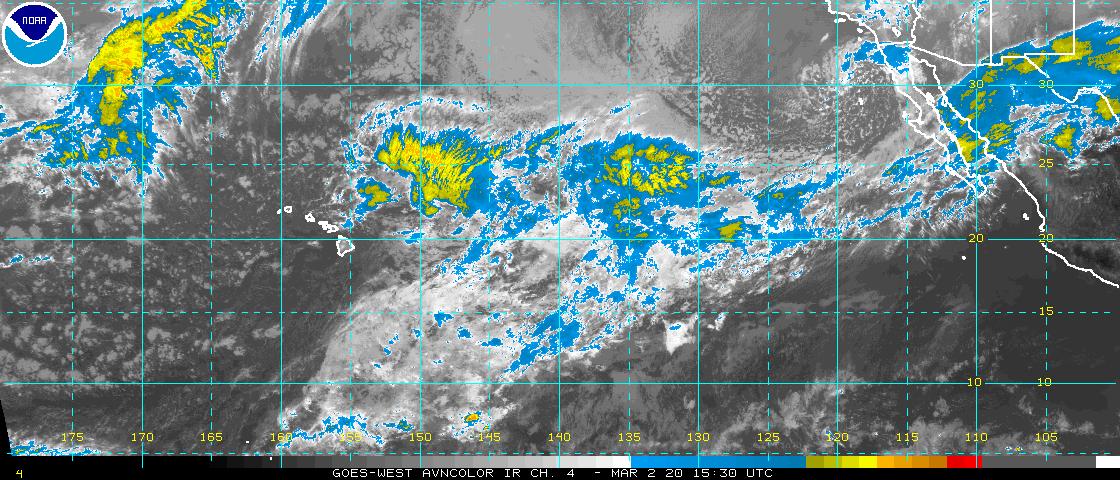
Tropical Cyclone activity in the eastern and central Pacific – Here’s the latest weather information coming out of the National Hurricane Center, covering the eastern north Pacific. You can find the latest tropical cyclone information for the central north Pacific (where Hawaii is located) by clicking on this link to the Central Pacific Hurricane Center. Here’s a tracking map covering both the eastern and central Pacific Ocean. A satellite image, which shows the entire ocean area between Hawaii and the Mexican coast…can be found here.
Aloha Paragraphs

High surf advisory…east facing beaches
A couple of relatively strong high pressure systems, located to the north and northeast of
All this wind is carrying moisture in our direction, mostly generously along the north and east facing coasts and slopes. The winds are strong enough locally though, that some showers were taking a free ride over into the leeward sides…at least on the smaller islands. The trough of low pressure mentioned in the paragraph above, with its instability factor, has enhanced some of those showers during the day. Here’s a satellite image of that area of thunderstorms to our northeast. This trough, with its cold air aloft, is pretty far away, although not so far that it hasn’t influenced our weather a bit on the
It’s Monday evening, as I begin writing this last section of today’s narrative. As noted in the paragraphs above, we have locally strong and gusty winds blowing. These breezes kept winds a bit lighter along the north and northeast to easterly areas Monday. They were able to funnel through some valley’s though, bringing gusty winds into some leeward areas. Monday evening finds a Gale Warning placed in the Alenuihaha Channel between Maui and the Big Island, and in the Pailolo Channel…between Maui and Molokai. Small Craft Wind Advisories are active across all of Hawaii’s coastal waters too. All the windy weather, with low relative humidities, has also necessitated a NWS issued Red Flag Warning…for increased fire danger in the leeward areas. Meanwhile, those windiest locations around Maui County and the Big Island, have an active Wind Advisory, for sustained winds of 30 mph, with higher gusts up towards 50 mph. ~~~ While I was at lunch today in Kihei, Maui, the winds were gusting up over 40 mph, with people actually having a difficult time walking along the sidewalks along South Kihei Road. Looking out the window here in Kihei at around 530pm, it’s still blustery out there. As the winds turn more easterly over the next couple of days, the winds will become more pronounced along the windward sides, and less so along the leeward sides. ~~~ I’m going to be driving through this windy weather back upcountry to Kula now. I’m pretty sure it was a windy day up there, and am going home to find out myself. I’ll be out there on the road for my walk, and then dinner and bed. I will however, be back early Tuesday morning with your next new weather narrative from paradise, I hope you have a great Monday night until then! Aloha for now…Glenn.
Extra: I have recently learned that all computer screens on the inside are covered with bacteria, dust, germs, etc. that can be dangerous to your health.
This is caused by a variety of reasons and it can prove to be a health hazard for everyone that uses the computer. Some at the CDC in Atlanta have recently said that this problem can be as dangerous as cigarette smoking because of the time that most of us are now spending on computers for work and personal reasons.
Click on this link to clean the inside of your screen.
Interesting: China’s western Qinghai Province, containing major deposits of the country’s "combustible ice," will see increased explorations for this emerging clean energy, Provincial Governor Luo Huining said. The plateau province plans to allow large energy companies along with researchers to tap this new source of energy while minimizing environmental threats, Luo said on the sidelines of the annual session of the National People’s Congress (NPC), China’s top legislature.
"Combustible ice," or natural gas hydrate, is mainly found in deep seas and atop plateaus. Approximately one cubic meter of "combustible ice" equals 164 cubic meters of regular natural gas. At a time of energy bottlenecks, the new energy resource has drawn interest from many countries. Additional attention has focused on the "ice" having a low proportion of impurities, resulting in it generating almost no pollutants when burned.
More than 100 countries around the world have found deposits of "combustible ice." The deposits in Qinghai Province, home to one-quarter of China’s total reserve on the Qinghai-Tibet Plateau, were discovered in September 2009. "Combustible ice" reserves on the Qinghai-Tibet Plateau are estimated to equal at least 35 billion tons of oil, which could supply energy to China for 90 years. Luo said tapping this new energy resource should be given high priority in China’s energy strategy.
Interesting2: U.S. Energy Secretary Steven Chu said that the United States needs to come up with a better system for storing or disposing of radioactive nuclear waste than a planned repository near Las Vegas. "The president has made it very clear that we are going to go beyond Yucca mountain. You should go beyond Yucca mountain," Chu said. "But instead of wringing my hands, let’s go forward and do something better."
The Obama administration, in January, announced it was stopping the license application for a long-planned multi-billion dollar nuclear waste storage site at Yucca Mountain near Las Vegas, which is opposed by environmental groups.
The Energy Department formally asked the Nuclear Regulatory Commission this week to withdraw the application. Chu said when the waste site was first started, there were conditions put in the requirements for the repository that didn’t really mesh with what scientists knew even back then.
"Long, long ago, it began looking less and less ideal," he said. "As time wore on, it’s got to be one of those things: ‘oops this might have happen, oops the Supreme Court says this…’," "Wouldn’t it be nice to step back and take a fresh look?" he asked.
Interesting3: Garlic is known in legend as great against vampires and it is quite nice in many delicious recipes. Researchers have now designed a urine test that can simultaneously measure the extent of a potential carcinogenic process and a marker of garlic consumption in humans. In a small pilot study, the test suggested that the more garlic people consumed, the lower the levels of the potential carcinogenic process were.
In some studies garlic has been found to have antibacterial, antiviral, and antifungal activity. However, these actions are less clear in humans. Garlic is also claimed to help prevent heart disease (including atherosclerosis, high cholesterol, and high blood pressure). Perhaps the most indispensable of herbs (or vegetables) garlic has a long and distinguished history that gives credence to its reputation as a one of the most valuable and seasoning and medicinal herbs in existence.
Garlic is mentioned by name in the Old Testament and the Muslim Quran as one of the foods the Israelites missed most during their years of wandering. Garlic was also considered sacred among the ancient Egyptians who buried it in the tombs of their deceased kings. It is not surprising that the ancients ascribed many properties to the very strong smelling garlic. It was alluded to drive away evil spirits, protect against werewolves and vampires, protect from evil and to bring good luck. The ancient Egyptians used garlic to treat many different conditions.
The ancient Greeks credited it for repelling scorpions and treating dog bites. During the course of history, garlic has been touted as a cure for everything from the common cold to the plague. Garlic has powerful antibiotic properties due to the presence of several sulfur compounds. The present research is all about body processes associated with nitrogen containing compounds. These processes include nitrosation, or the conversion of some substances found in foods or contaminated water into carcinogens.
“What we were after was developing a method where we could measure in urine two different compounds, one related to the risk for cancer, and the other, which indicates the extent of consumption of garlic,” said Earl Harrison, Dean’s Distinguished Professor of Human Nutrition at Ohio State and senior author of the study. “Our results showed that those were inversely related to one another — meaning that the more we had the marker for garlic consumption, the less there was of the marker for the risk of cancer.”
Ultimately, the scientists hope to find that a nutritional substance could be a way to control at least some body carcinogens. About 20 percent of nitrates that are consumed convert to nitrites. A cascade of events can convert these compounds into what are called nitrosamines, and many, but not all, nitrosamines are linked to cancer. Vegetables also contain nitrates, but previous research has suggested that the vitamin C in vegetables lowers the risk that those nitrates will convert to something toxic.
Researchers suspected that nutrients in garlic could have a similar antioxidant effects as does vitamin C. The study is published in a recent issue of the journal Analytical Biochemistry. The present research began with the small human study based at Penn State University. Researchers there fed participants a week long diet lacking any nitrates or garlic.
They then gave the participants a dose of sodium nitrate — in a formulation that would not become toxic, but which would show a marker in the urine of the potentially toxic process. “What this research does suggest is that garlic may play some role in inhibiting formation of these nitrogen based toxic substances.
This was a very small pilot study, so it’s also possible that the more garlic you have, the better it would be." When the urine samples were analyzed, it showed that the participants who had taken garlic had lower concentrations of the marker for nitrosation than did those who took no garlic.
Though the differences were slight, the consumption of 5 grams (1 clove) of garlic per day was associated with the lowest level of the marker for potential carcinogens. “What this research does suggest, however, is that garlic may play some role in inhibiting formation of these nitrogen based toxic substances.
This was very small pilot study, so it’s also possible that the more garlic you have, the better it would be. “So if you like garlic and you like garlic containing foods, go out and have as much as you want. There’s no indication it’s going to hurt you, and it may well help you.”
Interesting4: What if space held the key to producing alternative energy crops on Earth? That’s what researchers are hoping to find in a new experiment on the International Space Station. The experiment, National Lab Pathfinder-Cells 3, is aimed at learning whether microgravity can help jatropha curcas plant cells grow faster to produce biofuel, or renewable fuel derived from biological matter.
Jatropha is known to produce high quality oil that can be converted into an alternative energy fuel, or biofuel. By studying the effects of microgravity on jatropha cells, researchers hope to accelerate the cultivation of the plant for commercial use by improving characteristics such as cell structure, growth and development.
This is the first study to assess the effects of microgravity on cells of a biofuel plant. "As the search for alternate energy sources has become a top priority, the results from this study could add value for commercialization of a new product," said Wagner Vendrame, principal investigator for the experiment at the University of Florida in Homestead.
"Our goal is to verify if microgravity will induce any significant changes in the cells that could affect plant growth and development back on Earth." Launched on space shuttle Endeavour’s STS-130 mission in February, cell cultures of jatropha were sent to the space station in special flasks containing nutrients and vitamins.
The cells will be exposed to microgravity until they return to Earth aboard space shuttle Discovery’s STS-131 mission targeted for April. For comparison studies of how fast the cultures grow, a replicated set of samples are being maintained at the University of Florida’s Tropical Research and Education Center in Homestead.
"Watching the space shuttle go up carrying a little piece of my work is an indescribable experience," said Vendrame. "Knowing that my experiment could contribute to creating a sustainable means for biofuel production on Earth, and therefore making this a better world adds special value to the work."
 Email Glenn James: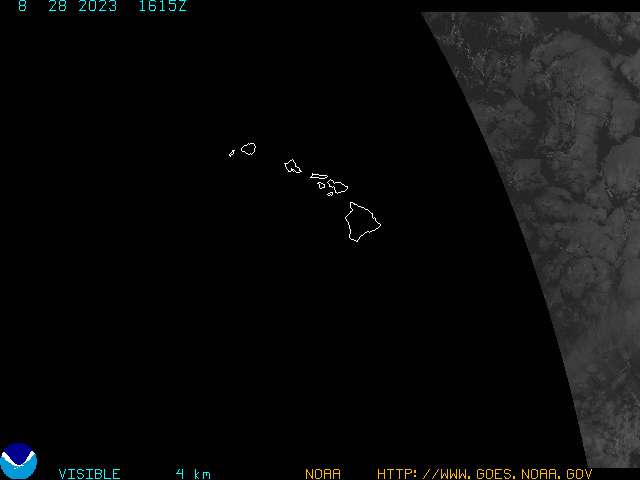


Peter Sanderson Says:
Glenn,
Would Nancy from Sonoma County happen to be Nancy L. of Graton? If so, I used to play uke and dance with her here. I’m not at all surprised if she came up with that screen cleaner.~~~Hi Peter, that would be the Nancy you are referring to! She’s got a great sense of humor! Aloha, Glenn
Jerry Price Says:
Jerry Says:
Aloha Glenn;
A couple of years ago when we were here we always caught you in the mornings on TV.
Do you still do that program?
Always enjoy your humor and great reports!!
Aloha (can’t produce the hang loose sign) So thanks and take care.~~~Hi Jerry, yes, the TV weather show was great, I retired from doing that after 18 years. I’m glad that you have turned to this website, and that you like it! Aloha, Glenn
Peter Sanderson Says:
Glenn,
Love your sense of humor, it made my day. Also nice to see you are getting some welcome rain there on water deprived Maui. Hope the same can be said for Hawaii moku where I have farming friends from Sonoma County living.
Peter from Santa Rosa~~~Hi Peter, you’re are the second person that I’ve heard from in Sonoma County today, the first…my friend Nancy, who provided the computer screen video. Yes, it’s 745pm Monday evening, and my wind chimes are still clanging…and it’s lightly raining here in Kula. Thanks for your positive note! Aloha, Glenn
Helen Says:
Yippee it is still raining in Olinda.:)
PS Hey thanks Glenn for the screen cleaning tip in the Aloha Paragraphs. I did not realize that was so crucial.~~~Hi Helen, I can see those showers up your way from here in Kihei…nice. It’s super windy here on the south coast, maybe some 40-50 mph gusts! I trust that link was adequate to clean your screen…its amazing how efficient it works! Aloha, Glenn
Helen Says:
Aloha Glenn,
Well we are getting a wonderful ,much needed downpour up here in Olinda. I hope it continues for a while.
Aloha ,Helen~~~Hi Helen, good for you! Those showers wrapped into Kula last night into early this morning as well. Yeah, thanks for your on the spot report! Aloha, Glenn