March 27-28, 2010
Air Temperatures – The following maximum temperatures were recorded across the state of Hawaii Saturday afternoon:
Lihue, Kauai – 78
Honolulu, Oahu – 82
Kaneohe, Oahu – 79
Kaunakakai, Molokai – 75
Kahului, Maui – 80
Hilo, Hawaii – 79
Kailua-kona – 82
Air Temperatures ranged between these warmest and coolest spots near sea level around the state – and on the highest mountains…at 4pm Saturday afternoon:
Barking Sands, Kauai – 81F
Kapalua, Maui – 73
Haleakala Crater – 57 (near 10,000 feet on Maui)
Mauna Kea summit – 43 (near 14,000 feet on the Big Island)
Precipitation Totals – The following numbers represent the largest precipitation totals (inches) during the last 24 hours on each of the major islands, as of Saturday afternoon:
0.02 Mount Waialaele, Kauai
0.03 Oahu Forest NWR , Oahu
0.03 Molokai
0.03 Lanai
0.00 Kahoolawe
0.67 West Wailuaiki, Maui
0.50 Kawainui Stream, Big Island
Marine Winds – Here’s the latest (automatically updated) weather map showing a 1024 millibar high pressure system located far to the northeast, and another 1025 millibar high to the northwest of the Hawaiian Islands. At the same time, a cold front is moving by to the north of the state. This pressure configuration will keep light to moderately strong trade winds blowing Sunday...increasing Monday.
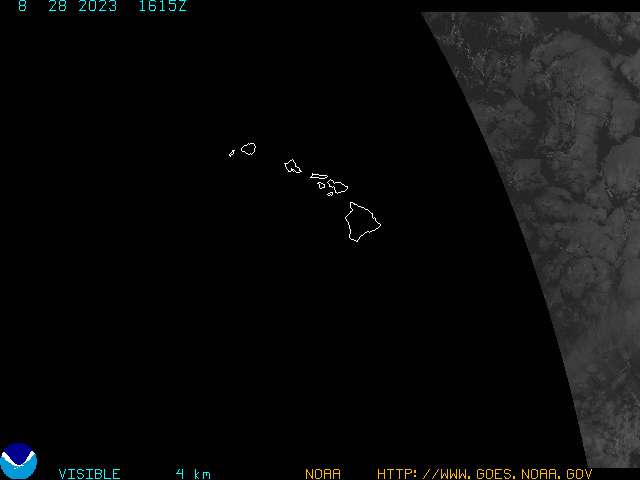
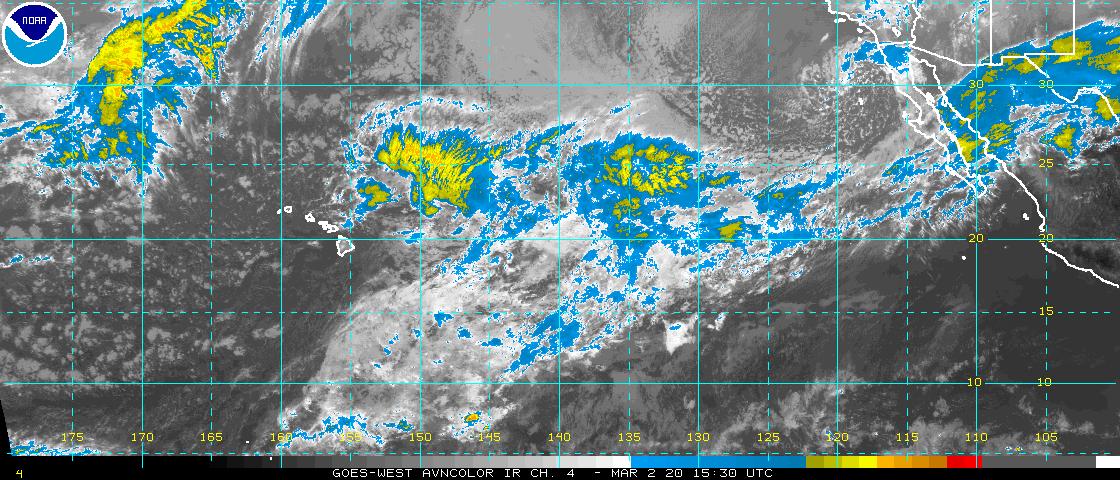
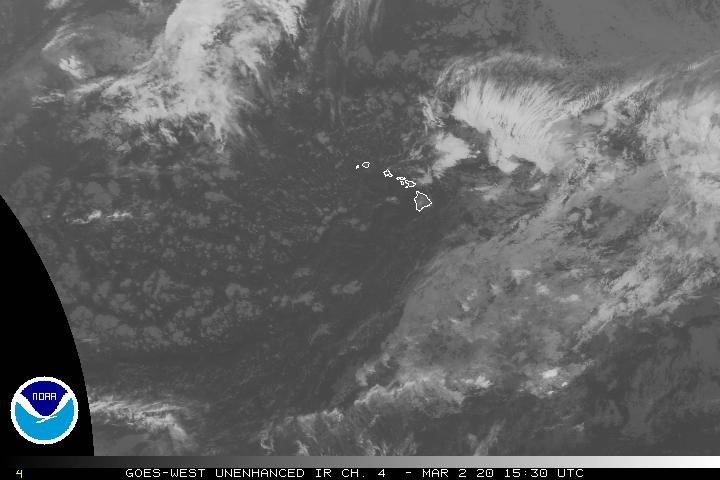
Satellite and Radar Images: To view the cloud conditions we have here in Hawaii, please use the following satellite links, starting off with this Infrared Satellite Image of the islands to see all the clouds around the state during the day and night. This next image is one that gives close images of the islands only during the daytime hours, and is referred to as a Close-up visible image. This next image shows a larger view of the Pacific…giving perspective to the wider ranging cloud patterns in the Pacific Ocean. Finally, here’s a Looping IR satellite image, making viewable the clouds around the islands 24 hours a day. To help you keep track of where any showers may be around the islands, here’s the latest animated radar image.
Hawaii’s Mountains – Here’s a link to the live webcam on the summit of near 14,000 foot Mauna Kea on the Big Island of Hawaii. The tallest peak on the island of Maui is the Haleakala Crater, which is near 10,000 feet in elevation. These two webcams are available during the daylight hours here in the islands…and when there’s a big moon rising just after sunset for an hour or two! Plus, during the nights and early mornings you will be able to see stars, and the sunrise too…depending upon weather conditions.
Tropical Cyclone activity in the eastern and central Pacific – Here’s the latest weather information coming out of the National Hurricane Center, covering the eastern north Pacific. You can find the latest tropical cyclone information for the central north Pacific (where Hawaii is located) by clicking on this link to the Central Pacific Hurricane Center. Here’s a tracking map covering both the eastern and central Pacific Ocean. A satellite image, which shows the entire ocean area between Hawaii and the Mexican coast…can be found here.
Aloha Paragraphs

Sea Turtle…black sand beach on the Big Island
High pressure systems located far to the northeast and northwest, will keep our trade winds blowing through Sunday…before getting quite a bit stronger Monday through Wednesday. As we move into Monday, a new high pressure system moving into the area northwest and north of the state, will increase the trade winds markedly for several days. The computer models continue to show that the trade winds will become strong and gusty, with perhaps wind advisories here and there over the islands…and even gale warnings in the major channels around Maui and the Big Island for a few days. The models go on to show another cold front passing by to our north later in the week, which should work to mellow out the strong winds some after mid-week. The newest computer model output now shows that the strong and gusty trade winds may return again next weekend.
The windward sides will continue to see some generally light showers falling at times…while the leeward sides remain generally dry. A high pressure ridge aloft, and to the north of the state, will shield us from any significant areas of precipitation well into the future. Looking at this satellite imagery, there are just the normal amount of clouds upstream of the islands, being carried our way on the trade wind flow. There’s that same area of high clouds (those brighter white clouds) to the southwest and west of the state, whose eastern edge remains to the west of the state as we move into Saturday night. This looping radar image shows that there are some showers arriving along the windward sides as noted…most actively around Maui at the time of this writing
It’s Saturday evening as I begin writing this last section of today’s narrative. Trade winds remain active across the islands this this evening. Looking at the strongest gusts around the state at around 5pm, as usual the strongest gust was occurring at Maalaea Bay, Maui…with a 35 mph report. The rest of the state had considerably lighter winds. We should find light to moderately strong trade winds blowing in most areas again Sunday. The big news will be the substantially stronger trade winds arriving between Monday and Wednesday. I would anticipate that wind speeds will be active in the 15-30 mph range in general, although with gusts in those windiest areas topping 40 mph…and perhaps edging up towards 50 mph at times. These are the kinds of winds that require some battening down of the hatches, in terms of securing lawn furniture and things like that. Dust will be flying around, the coconut palm trees will be leaning over, and of course the surface of the ocean will be filled with extensive white caps. ~~~ My neighbors and I went out for breakfast this morning, and were enthused once again with our selections. The coffee at this French restaurant is great too…not to mention the wonderfully fresh pastries. We came home after that, before one of my neighbors and I took a drive down to Baldwin beach for a short visit. It was lightly sprinkling, breezy and on the cool side too. I must admit that I almost talked myself out of getting wet, although the sun did come out for long enough, that I finally forced myself to take a plunge for a little swimming. We then went shopping at the health food store in Paia, before heading out along the Hana Highway to Huelo. My friend had his pickup truck out there, so it needed to be returned back here to Kula. Wow, what a place we went to, hanging out there for quite a while, enjoying the jungle, and all the Buddha statues, and many other things from southeast Asia. This person is a collector, and sells this fine art. Then I drove his car home, and am now here in Kula finishing up this last big paragraph. I would imagine that we’ll all take a long walk now, before coming back and perhaps having dinner together. This feels like Sunday, although its only Saturday evening, since Friday was a holiday from work. I hope you had a great day too, and that you will have the chance to check back in tomorrow, when I’ll have more information on the upcoming windy episode starting Monday. Aloha for now…Glenn.
Interesting: The Asian monsoon spreads industrial pollution from China and India around the world by lofting it high into the atmosphere where it may affect the global climate, a study showed on Thursday. "This is a vivid example of pollutants altering our atmosphere in subtle and far-reaching ways," said William Randel of the U.S. National Center for Atmospheric Research, who led the study in the journal Science.
It said the mid-year Asian monsoon sucks pollutants — such as black carbon, sulphur dioxide and nitrogen oxides — from the earth’s surface into the stratosphere about 20 to 25 miles high. Strong stratospheric winds then spread fast-growing amounts of pollution from countries such as China, India and Indonesia around the planet, where it can linger for years before falling to earth or breaking down.
"It’s as if there’s a hole that sucks the pollution from the ground and rapidly injects it into the lower stratosphere," said Professor Peter Bernath of the University of York in England who was among the authors. "People suspected it before but this shows that it happens," he told Reuters of the finding by researchers in Canada, Britain and the United States.
It was unclear what impact the Asian stratospheric pollution might have on the climate. Some particles could have a cooling effect by reflecting sunshine back into space while others might trap heat. "Overall you don’t know which way it could go," Bernath said. And pollution might also affect the ozone layer, which protects the planet from harmful ultraviolet rays.
Some scientists have proposed short-cut solutions to climate change known as geo-engineering — among them schemes to dim sunlight by spewing sulphur dioxide high into the atmosphere. Others say it is too risky, with possible damaging side effects. In the past, volcanoes have been shown to spew particles into the stratosphere and giant forest fires can also have the same impact.
But industrial pollution has been typically viewed as a local problem, low in the atmosphere. The study said a projected rise in economic growth, including the opening of many coal-fired power plants in China and India, could mean more pollution sucked up and spread by the Asian monsoon.
Climate change, blamed mainly on a build-up of heat-trapping carbon dioxide in the atmosphere, might also alter the monsoon alongside other impacts projected by the U.N. panel of climate scientists such as droughts, floods and rising sea levels. The researchers used satellites to monitor hydrogen cyanide — largely released from burning trees and other vegetation. Flows of hydrogen cyanide exposed how air currents were wafting pollution upwards.
Interesting2: What has been called the worst drought for China’s Yunnan Province in nearly a century will persist, as there is little prospect for meaningful rainfall until May. Between six and seven months of dry winter weather is characteristic of the Yunnan Province of China, but an early end to last year’s rainy season is causing the current drought to be much worse than in previous years.
A villager drives a bullock cart across a dried-up pond in Luliang, in southwest China’s Yunnan province, Monday, March 22, 2010. The worst drought in decades in China’s southern provinces of Yunnan, Guizhou, and Sichuan, as well as the Guangxi Autonomous Region and the city of Chongqing, has forced local governments to tap underground water sources and use cloud seeding to produce rain for agricultural production.
Yunnan has felt unusually high temperatures and unusually low rainfall since the beginning of September, when conditions usually dry out for the start of the winter’s dry season. May is expected to be the first month for heavier rainfall, when 4 inches is normal for the region during this time. The seasonal rainy weather usually begins in April or May for the province, with the dry season moving in after October.
The peak month of the rainy season is July, when over 8 inches of rain is normal. The drought is badly affecting the planting of crops, and reservoirs in serious shortage of water will make it even harder for planting to be sustained. The first round of crops this year failed, but there are hopes for a successful summer corn crop.
BBC estimated that over 50 million people in the province have been affected by the water shortage, deepening the poverty there. The dry conditions are being felt as far away as Beijing, where the first big dust storm of the season shrouded the city in orange grit last weekend.
Interesting3: The yellow haze descended across Nigeria, blotting out the sun, canceling airline flights and coating everything with a fine layer of dust. The sudden storm sparked frightened text messages about supposedly killer acid rain, but meteorologists say the weather comes from the harmattan, a yearly trade wind that brings dust from the Sahara Desert through Nigeria and the rest of West Africa.
This year, however, the harmattan has come at an abnormal time, a possible result of global warming. Experts say it may delay the rainy season in Africa’s most populous nation and there are worries it may even throw off future seasonal changes. "It is part of the changes of the climate," said Temi Ologunorisa, a professor of climatology at Osun State University. "With the coming of this dust, you cannot have rain."
The harmattan, caused by shifting weather patterns, means "tears your breath apart" in Twi, a West African language. The harmattan season typically begins in late November, as Nigeria’s dry season begins to end. The winds carry the sands and dust of the Sahara southward, and pick up the loose crop soil of Nigeria’s arid northern Sahel with it. This year, the harmattan briefly appeared in January.
It typically ends by February, said Sampson Wilson, a deputy general manager at the government-run Nigerian Meteorological Agency. But it blew back into Nigeria without warning last weekend, first enveloping the country’s north in dust and dropping visibility to almost zero, according to Wilson, and forcing many airlines to cancel flights in the country of 150 million people.
As it reached south, the storm encased the megacity of Lagos in a yellow fog that made the setting sun give off no more light than the moon. Northern Nigeria is experiencing growing desertification as rising temperatures allow the edge of the Sahara Desert to creep closer to the country. That additional dust adds fuel for the harmattan winds, said Ologunorisa, an expert on climate change.
"The more dust you have, it shows we have more desertification," he said. The harmattan has made it hard to breathe in Lagos, whose air already is polluted by swarms of beat-up cars navigating potholed streets and by electrical generators that provide power during frequent blackouts. Health authorities warned the public to cover faces with wet cloth and stay indoors, but many had to take to the streets to earn a living in a country where most live on less than $1 a day.
Doctors expected the late harmattan to bring colds, flu and asthma attacks, as the kicked-up dust in the air inflames lungs and nostrils. Changing patterns in the trade winds also affect when the harmattan will arrive, Ologunorisa said. The disruption of those patterns throws off Nigeria’s rainy and dry seasons as well — timing long relied on by farmers to know when to plant across the country’s fertile middle belt. Forecasters predict this harmattan will slowly lift across the country in the coming week. But fears over Nigeria’s changing weather patterns will linger.
 Email Glenn James: