











March 22-23, 2010
Air Temperatures – The following maximum temperatures were recorded across the state of Hawaii Monday afternoon:
Lihue, Kauai – 79
Honolulu, Oahu – 84
Kaneohe, Oahu – 78
Kaunakakai, Molokai – 75
Kahului, Maui – 80
Hilo, Hawaii – 78
Kailua-kona – 80
Air Temperatures ranged between these warmest and coolest spots near sea level around the state – and on the highest mountains…at 5pm Monday evening:
Barking Sands – 80F
Honolulu, Oahu – 73
Haleakala Crater – 43 (near 10,000 feet on Maui)
Mauna Kea summit – 41 (near 14,000 feet on the Big Island)
Precipitation Totals – The following numbers represent the largest precipitation totals (inches) during the last 24 hours on each of the major islands, as of Monday afternoon:
0.77 Wailua, Kauai
0.26 Maunawili, Oahu
0.32 Molokai
0.01 Lanai
0.17 Kahoolawe
3.26 Kaupo Gap, Maui
4.96 Laupahoehoe, Big Island
Marine Winds – Here’s the latest (automatically updated) weather map showing high pressure systema far to the northeast and northwest. Meanwhile, we have low pressure aloft and near the surface to the west of Kauai. This pressure configuration will cause lighter east-southeast to southeast breezes winds Tuesday...with returning trade winds Wednesday.
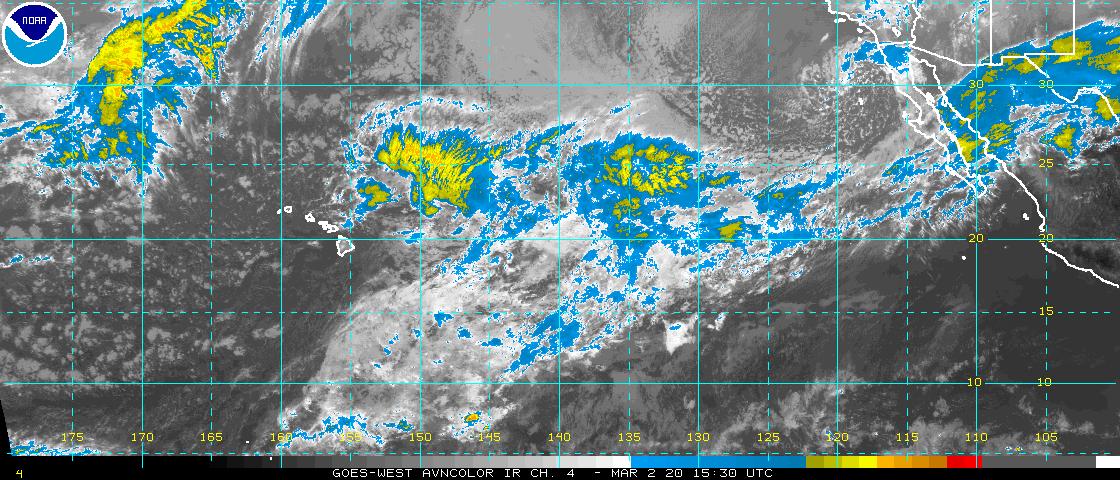
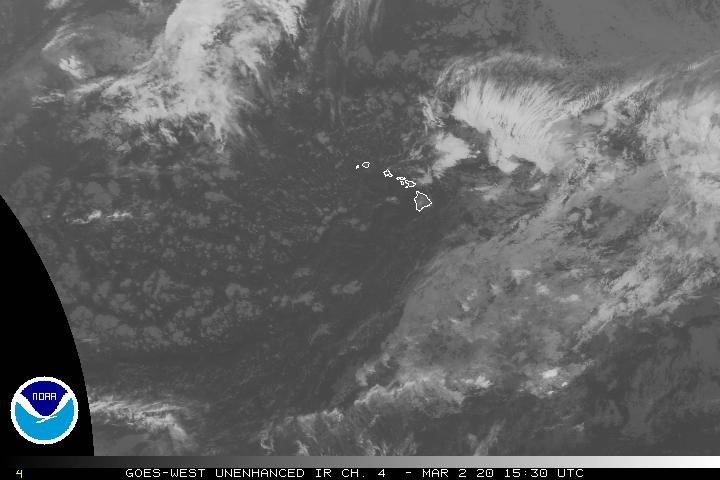
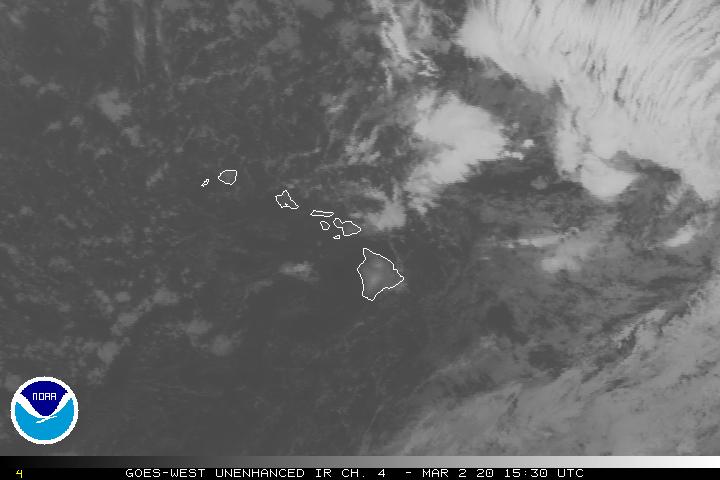
Satellite and Radar Images: To view the cloud conditions we have here in Hawaii, please use the following satellite links, starting off with this Infrared Satellite Image of the islands to see all the clouds around the state during the day and night. This next image is one that gives close images of the islands only during the daytime hours, and is referred to as a Close-up visible image. This next image shows a larger view of the Pacific…giving perspective to the wider ranging cloud patterns in the Pacific Ocean. Finally, here’s a Looping IR satellite image, making viewable the clouds around the islands 24 hours a day. To help you keep track of where any showers may be around the islands, here’s the latest animated radar image.
Hawaii’s Mountains – Here’s a link to the live webcam on the summit of near 14,000 foot Mauna Kea on the Big Island of Hawaii. The tallest peak on the island of Maui is the Haleakala Crater, which is near 10,000 feet in elevation. These two webcams are available during the daylight hours here in the islands…and when there’s a big moon rising just after sunset for an hour or two! Plus, during the nights and early mornings you will be able to see stars, and the sunrise too…depending upon weather conditions.
Tropical Cyclone activity in the eastern and central Pacific – Here’s the latest weather information coming out of the National Hurricane Center, covering the eastern north Pacific. You can find the latest tropical cyclone information for the central north Pacific (where Hawaii is located) by clicking on this link to the Central Pacific Hurricane Center. Here’s a tracking map covering both the eastern and central Pacific Ocean. A satellite image, which shows the entire ocean area between Hawaii and the Mexican coast…can be found here.
Aloha Paragraphs

Locally wet weather…light winds
A shower prone atmosphere overlies the Hawaiian Islands Monday night…some of which will likely be locally heavy. There are lots of clouds hanging over the state now, which could pose some localized flooding problems. This IR satellite image shows the abundant nature of these showery clouds. There are still those areas of high cirrus clouds all over the islands too. If we take a look at this closer view, we can discern partly to mostly cloudy skies, although its difficult to see through the high overcast. There have been showers falling in an off and on manner across the island chain. Here’s a looping radar image, so we can keep an eye on the many showers that will likely be around through Tuesday. This won’t be a widespread rain event, although many areas locally will be getting generous rainfall.
We have an upper level trough of low pressure to the west of the state…with its surface reflection near Kauai. This area of low pressure will prompt light winds through Tuesday, generally from the southeast. This is bringing up some volcanic haze (vog) from the
It’s Monday evening as I begin writing the last section of today’s narrative. The weather here in Hawaii has turned unstable and shower prone now. The culprit for this wet beginning to the week is the presence of an upper level trough of low pressure near the state, with its surface reflection. This cold air aloft, with warmer moist air below, is acting as a trigger to thicken the clouds, with higher than normal cloud tops too. In addition, we have light winds, which are generally from the southeast, which promote the growth of tall rain bearing clouds too. The air mass over the islands will remain fertile for locally heavy showers through Tuesday. The trough of low pressure will lose some influence over the islands by Wednesday, with the trade winds returning then. ~~~ We have some interesting weather happening now, with even a water spout (a funnel cloud over the ocean) being reported near Oahu Monday afternoon. The upper clouds kept any sign of sunshine out of the picture Monday, and will continue to do so Tuesday. Looking out the window from here in Kihei, before I take the drive back upcountry to Kula, it’s totally cloudy, along with thick vog too. There are a few light shower areas that I can see, although most of the precipitation is falling over the ocean to the north and south of the central islands early Monday evening. I’ll be back early Tuesday morning with your next new look at our weather here in Hawaii, I hope you have a great Monday night until then! Aloha for now…Glenn.
Interesting: Scotland has approved ten marine energy projects that leaders predict could provide electricity for one-third of the nation’s homes by 2020 and make Scotland the world leader in wave energy. The government awarded leases to companies to construct six wave energy projects and four tidal projects off the Scottish coast in what experts say would be the first developments of their kind on a large commercial scale. Construction would cost £4 billion ($6.1 billion) and require another £1 billion ($1.53 billion) in government funding to upgrade the national electric grid.
But First Minister Alex Salmond said tapping into the resources of Pentland Firth, a strait north of Scotland that is known for its strong tides, can make the country the "powerhouse of Europe." If successful, experts predict, the projects could power 750,000 of Scotland’s 2.3 million homes and generate four times as much electricity as a former Scottish nuclear power station in Caithness. "Leading international energy companies and innovators continue to be drawn to Scottish waters, which boast as much as a quarter of Europe’s tidal and offshore wind resource and a tenth of the continent’s potential wave capacity," Salmond said.
Interesting2: To the average person, the weather this winter, especially in February, has certainly been a departure from those winters of the past few years. There has been record snowfall in the mid-Atlantic region, bitter cold in the Deep South, and remarkably mild weather for the Pacific Northwest and New England. However, if the United States can be taken as a whole, some more modest trends appear.
NOAA, the National Oceanic and Atmospheric Administration, has conducted a study of winters going back to 1895. This "State of the Climate" report for winter 2010 states that temperatures were below normal for the contiguous United States. The winter was wetter than normal; however, precipitation in February alone was only slightly above average. First, let’s analyze the temperatures in the United States.
About 63% of the country had below average temperatures, the biggest exception being Maine which had its third warmest winter. The average temperature in the US for February was 32.4 degrees F, 2.2 degrees below the long-term average. These dipping temps could be most clearly felt in the Deep South, Plains states, and the mid-Atlantic which were hit by several frigid Arctic air masses.
Precipitation this winter has been quite varied for different regions. For those of us on the East Coast, we know all too well this year’s departure from the norm. The winter wallop became a February fury, and eventually a Snowmageddon. Major snowstorms on February 4-7 and 9-11 dumped record setting snow on the DC area and spread from North Carolina up to Maine. These were followed up by a third major storm which hit southern New England on February 23-28.
The following cities shattered their previous record seasonal snowfalls:
Baltimore: 79.9 inches (62.5 inches, 1995-96)
Washington (Dulles): 72.8 inches (61.9 inches, 1995-96)
Wilmington, DE: 66.7 inches (55.9 inches, 1898-99)
Philadelphia: 71.6 inches (65.5 inches, 1995-96)
Areas in the southeast and southwest also experienced above average precipitation. On the other hand, as a whole, the US had only slightly above average precipitation in February due to the below average precipitation in the northwest, from Washington to Wyoming as well as the lower Mississippi valley, and the Ohio valley north to Michigan. Wyoming and Idaho had their eighth and ninth driest winters, respectively.
This winter’s bizarre weather, especially on the east coast, has had significant negative economic impacts. Many workweeks were cut short, businesses were closed, and deliveries delayed. Airlines, already facing economic troubles, had to cancel flights and then struggle to get back to normal.
Emergency crews worked overtime to restore downed power lines and trees, as well as other weather-related accidents. Cleanup efforts also proved quite costly to those areas with little expectations of heavy snowfall. Local and state governments scrambled to get a federal disaster declaration to help ease the financial burden.
New York City Mayor, Michael Bloomberg has said the blizzards cost taxpayers $1 million for each inch of show that fell. Virginia exhausted its $79 million snow removal funds plus a $25 million emergency reserve. Maryland’s $26 million snow budget dried up after snow in December alone.
In Washington DC, the snow made for some obvious shovel-ready projects, but provided little stimulus. Taxpayers not only footed the bill for the cleanup effort, but also for the over 230,000 federal employees who stayed home for days in a row. The snow also became a political football for those on either side of the climate change issue (that is another article altogether).
However, not all impacts were negative. Supermarkets could barely keep their shelves stocked with staple items. Hardware stores did well selling shovels, snow blowers, and ice melt. Private snow removal companies such as landscapers and anybody with a snow plow made out with higher profits.
Snowboard and ski resorts had a great winter. As can be expected for any natural disaster, alcohol sales went through the roof. But the biggest winners were probably the millions of adults and children who were able to stay home from work and school and experience a truly beautiful winter wonderland.
Interesting3: Cutting back on consumption of meat and dairy products will not have a major impact in combating global warming — despite repeated claims that link diets rich in animal products to production of greenhouse gases. That’s the conclusion of a report presented at the 239th National Meeting of the American Chemical Society in San Francisco. Air quality expert Frank Mitloehner, Ph.D., who made the presentation, said that giving cows and pigs a bum rap is not only scientifically inaccurate, but also distracts society from embracing effective solutions to global climate change.
He noted that the notion is becoming deeply rooted in efforts to curb global warming, citing campaigns for "meatless Mondays" and a European campaign, called "Less Meat = Less Heat," launched late last year. "We certainly can reduce our greenhouse-gas production, but not by consuming less meat and milk," said Mitloehner, who is with the University of California-Davis. "Producing less meat and milk will only mean more hunger in poor countries."
The focus of confronting climate change, he said, should be on smarter farming, not less farming. "The developed world should focus on increasing efficient meat production in developing countries where growing populations need more nutritious food. In developing countries, we should adopt more efficient, Western-style farming practices to make more food with less greenhouse gas production," Mitloehner said.
Developed countries should reduce use of oil and coal for electricity, heating and vehicle fuels. Transportation creates an estimated 26 percent of all greenhouse gas emissions in the U.S., whereas raising cattle and pigs for food accounts for about 3 percent, he said.
 Email Glenn James: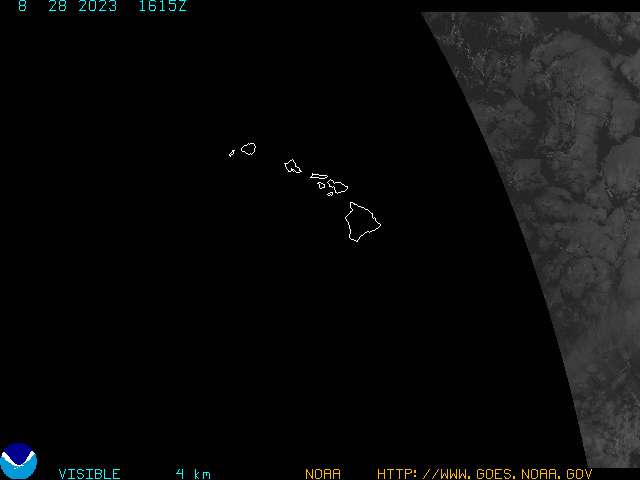

Janet Says:
Thanks, as usual, Glenn.~~~You’re welcome of course Janet…Aloha, Glenn
Eliza Says:
Aloha Glenn from Kailua Kona on BI – wow, what did I do, bring Maui’s rains here? They need moisture so very very much here. Will keep you posted… but I wish I had a rain gauge! Oh, there’s a coqui frog in the neighborhood I’m staying in. OMI! They are here, too! – Eliza~~~Hi Eliza, down in Kona, nice, hope it isn’t too voggy. Keep us informed about what’s going on there, hope you folks get some much needed rain! Aloha, Glenn