











March 18-19, 2010
Air Temperatures – The following maximum temperatures were recorded across the state of Hawaii Thursday afternoon:
Lihue, Kauai – 74
Honolulu, Oahu – 78
Kaneohe, Oahu – 75
Kaunakakai, Molokai – 74
Kahului, Maui – 76
Hilo, Hawaii – 73
Kailua-kona – 80
Air Temperatures ranged between these warmest and coolest spots near sea level around the state – and on the highest mountains…at 4pm Thursday afternoon:
Barking Sands, Kauai – 78F
Hilo, Hawaii – 66
Haleakala Crater – 45 (near 10,000 feet on Maui)
Mauna Kea summit – 45 (near 14,000 feet on the Big Island)
Precipitation Totals – The following numbers represent the largest precipitation totals (inches) during the last 24 hours on each of the major islands, as of Thursday afternoon:
2.89 Wainiha, Kauai
2.35 Punaluu Stream, Oahu
1.30 Molokai
0.16 Lanai
0.00 Kahoolawe
4.21 West Wailuaiki, Maui
2.31 Honokaa, Big Island
Marine Winds – Here’s the latest (automatically updated) weather map showing a cold front to the southeast of the Big Island. At the same time, we find a 1030 millibar high pressure system far to the northwest, moving eastward. The winds will be gusty from the northeast…gradually becoming trade winds Friday into Saturday.
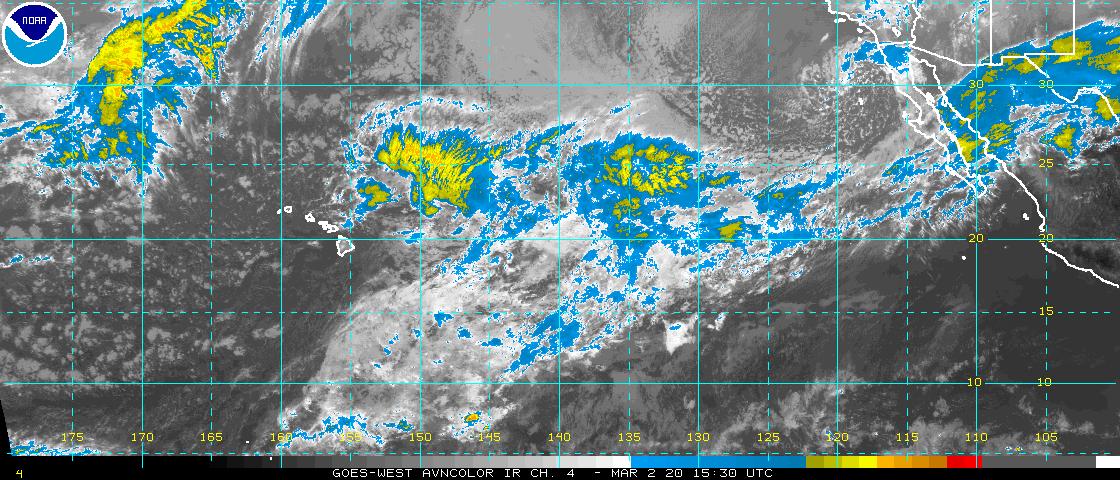
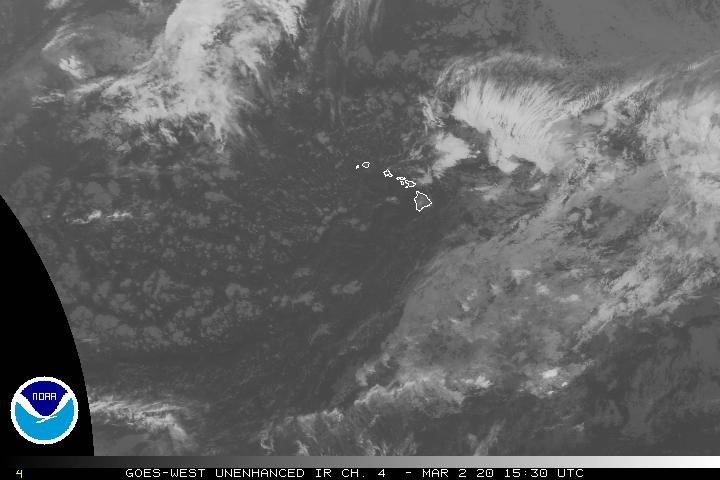
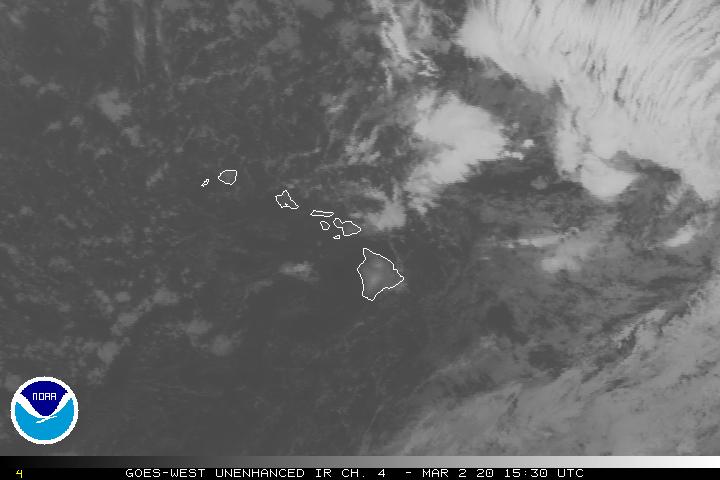
Satellite and Radar Images: To view the cloud conditions we have here in Hawaii, please use the following satellite links, starting off with this Infrared Satellite Image of the islands to see all the clouds around the state during the day and night. This next image is one that gives close images of the islands only during the daytime hours, and is referred to as a Close-up visible image. This next image shows a larger view of the Pacific…giving perspective to the wider ranging cloud patterns in the Pacific Ocean. Finally, here’s a Looping IR satellite image, making viewable the clouds around the islands 24 hours a day. To help you keep track of where any showers may be around the islands, here’s the latest animated radar image.
Hawaii’s Mountains – Here’s a link to the live webcam on the summit of near 14,000 foot Mauna Kea on the Big Island of Hawaii. The tallest peak on the island of Maui is the Haleakala Crater, which is near 10,000 feet in elevation. These two webcams are available during the daylight hours here in the islands…and when there’s a big moon rising just after sunset for an hour or two! Plus, during the nights and early mornings you will be able to see stars, and the sunrise too…depending upon weather conditions.
Tropical Cyclone activity in the eastern and central Pacific – Here’s the latest weather information coming out of the National Hurricane Center, covering the eastern north Pacific. You can find the latest tropical cyclone information for the central north Pacific (where Hawaii is located) by clicking on this link to the Central Pacific Hurricane Center. Here’s a tracking map covering both the eastern and central Pacific Ocean. A satellite image, which shows the entire ocean area between Hawaii and the Mexican coast…can be found here.
Aloha Paragraphs

Cool breezy winds…in the wake of the recent cold front
The rather diffuse, at least in terms of a crisp and clearly defined cloud band, moved quickly through the island chain late Wednesday, through the night…into Thursday. The current location of this dissipating frontal boundary is to the southeast of the
The winds behind this frontal passage quickly took on a north to northeast orientation, prompted by a near 1030 millibar high pressure system…located far to the northwest of
The computer forecast models are showing another cold front approaching the state around the middle of next week. The first influence here will be the slacking-off of the trade winds Sunday, as they rotate around to the east-southeast, and southeast. This will likely bring up another round of volcanic haze (vog) from the
It’s Thursday evening, as I begin writing the last section of today’s narrative.
As noted above, the latest cold front swung completely through the entire island chain during the last 24 hours. Thursday was a winter day, no doubt about it, in that it was cooler than normal, with chilly breezes blowing…along with windward showers at times. High temperatures were all in the cool 70F’s today at sea level, with only Kailua-kona, sheltered from the north winds…able to rise to 80 degrees. It’s now around 530pm Thursday, and up here in Kula, Maui, it’s a cool 58 degrees, with chilly winds blowing…and a very light mist still being blown over from the windward sides…like it did all day. By the way, I anticipate a colorful sunset this evening, as the high cirrus clouds light up at sunset! I anticipate that Friday will warm up some, although will remain breezy, with a few showers sticking around too.
~~~ My visiting friend Bob, seems to be feeling a little better, after coming down with something yesterday. I’m just hoping that I will remain above these cold symptoms myself. At any rate, I’ll be back early Friday morning with your next new weather narrative. I’m planning on having it be a vacation day, like I tried to do today. I worked from home today instead, while Bob hung out here and relaxed. I hope you have a great Thursday night, and can visit again on Friday! Aloha for now…Glenn.
Interesting: A new assessment of the Arctic’s biodiversity reports a 26 per cent decline in species populations in the high Arctic. Populations of lemmings, caribou and red knot are some of the species that have experienced declines over the past 34 years, according to the first report from The Arctic Species Trend Index (ASTI), which provides crucial information on how the Arctic’s ecosystems and wildlife are responding to environmental change.
While some of these declines may be part of a natural cycle, there is concern that pressures such as climate change may be exacerbating natural cyclic declines. In contrast, population levels of species living in the sub-Arctic and low Arctic are relatively stable and in some cases, increasing. Populations of marine mammals, including bowhead whales found in the low Arctic, may have benefited from the recent tightening of hunting laws.
Some fish species have also experienced population increases in response to rising sea temperatures. "Rapid changes to the Arctic’s ecosystems will have consequences for the Arctic that will be felt globally. The Arctic is host to abundant and diverse wildlife populations, many of which migrate annually from all regions of the globe. This region acts as a critical component in the Earth’s physical, chemical, and biological regulatory system," says lead-author Louise McRae from the Zoological Society of London (ZSL).
Data collected on migratory Arctic shorebirds show that their numbers have also decreased. Further research is now needed to determine whether this is the result of changes in the Arctic or at other stopover sites on their migration. Louise McRae adds: "Migratory Arctic species such as brent goose, dunlin and turnstone are regular visitors to the UK’s shores. We need to sit up and take notice of what’s happening in other parts of the world if we want to continue to experience a diversity of wildlife on our own doorstep."
The ASTI includes almost 1,000 datasets on Arctic species population trends, including representation from 35 per cent of all known vertebrate species found in the Arctic. Co-author Christoph Zöckler from the UNEP-World Conservation Monitoring Centre says: "The establishment of these results comes at a crucial time for finding accurate indicators to monitor global biodiversity as governments strive to meet their targets of reducing biodiversity loss."
Interesting2: In a world first an international team of researchers have successfully extracted ancient DNA from the eggshells of various species of extinct birds. The research, published in scientific journal Proceedings of the Royal Society B, shows that fossil eggshell is a previously unrecognized source of ancient DNA and can provide exceptional long-term preservation of DNA in warmer climates.
The findings will boost research in archaeology and biology where species identifications can add significantly to our understanding of biodiversity, evolutionary processes, past environmental change and dispersal of animal and human populations. The research, published in scientific journal Proceedings of the Royal Society B, shows that fossil eggshell is a previously unrecognized source of ancient DNA and can provide exceptional long-term preservation of DNA in warmer climates.
The findings will boost research in archaeology and biology where species identifications can add significantly to our understanding of biodiversity, evolutionary processes, past environmental change and dispersal of animal and human populations. The study includes samples of Aepyornis sp, the giant Madagascan elephant bird collected by Dr Jean-Luc Schwenninger, a Quaternary geochronologist based at the Research Laboratory for Archaeology and the History of Art (RLAHA) at Oxford University.
The bird looked like an outsized ostrich, standing about three meters high and weighing in excess of half a ton. It was the heaviest bird to have ever existed and produced eggs with a capacity of 11L (equivalent to over two hundred chicken eggs or seven ostrich eggs). Its eggs are the largest eggs ever known. Since 1991, Schwenninger and a team from Sheffield University, the University of Colorado, and Antananarivo’s National Museum of Art and Archaeology in Madagascar have conducted large scale archaeological surveys of the Southern region of Madagascar and studied the timing of extinction of these giant flightless birds.
Whilst scouring the coastal dunes of Southern Madagascar they have found evidence of many of the bird’s former nesting sites from concentrations of eggshell debris. They have also excavated archaeological sites which document the rise and fall of a lost civilization with long-distance trade contacts to Africa’s Swahili coast, the Persian Gulf and China.
Dr Schwenninger and his colleague Professor Michael Parker Pearson, from the University of Sheffield, believe that by the time this civilization flourished, from the 11th to the 13th century, the population of elephant birds was in serious decline. The precise cause of extinction is not yet fully understood but it is probably linked to the arrival of humans.
Interesting3: Tropical Cyclone Ului has continued to slowly weaken over the open Coral Sea on Thursday as it makes ready for a late-week landfall upon northeastern Australia. As of Thursday morning, EDT, the storm held highest sustained winds of about 90 mph, or those of a strong Category 1 hurricane, as it drifted over open seas well south of the western Solomon Islands. After drifting slowly through Thursday, Ului will accelerate towards the southwest and the west on Friday.
Landfall is now forecast to happen on Saturday or Saturday night, EDT, between Mackay and Cairns, Queensland, Australia, possibly at the city of Townsville. Flooding rain along and near the direct path of Ului will rank as the greatest threat to life and property. Damaging winds will also be a threat.
Ulia formed one week ago and quickly became a severe, potentially catastrophic Category 5 during the weekend. At that time, highest sustained winds were reckoned by the Joint Typhoon Warning Center to be at least 160 mph, or above the 156-mph threshold for Category 5 status. Luckily, the storm’s severe wind and rain steered clear of land.
Interesting4: Do we really need all the regulatory programs at the federal and state levels of government? Do they really work to improve the quality of our air and water? Are they worth their cost in terms of regulatory burden and costs of compliance? In short, yes! To some extent, our regulatory programs are a trial and error affair. We can’t always know the ultimate effectiveness of a new program nor its ultimate costs.
We can’t always predict the economic benefits of new regulations either since they invariably lead to innovation and generate new inventions and jobs. The US has been monitoring the quality of our air and water for decades, so we can track the effectiveness of our programs. The U.S. Environmental Protection Agency (EPA) is making the most recent data available. Air pollution impacts public health, the environment, and the Earth’s climate, and understanding these impacts are important priorities for the agency.
EPA regulatory actions and voluntary efforts have led to cleaner cars, industries and consumer products, that in turn have contributed to improvements in the nation’s air. They have also led to developments of new pollution control systems for power plants and other major sources such as Selective Catalytic Reduction, a technology that removes Nitrogen Oxides from emissions by converting it to Nitrogen and water. Since 1990, nationwide air quality has improved significantly for the six common air pollutants: ground-level ozone, particle pollution, lead, nitrogen dioxide, carbon monoxide, and sulfur dioxide.
Emissions of toxic air pollutants, such as benzene, have declined about 40 percent nationwide between 1990 and 2005. These reductions are helping to improve public health by decreasing the number of emergency room visits, respiratory illnesses, and premature deaths. Positive impacts can also be seen in the environment, with regional haze decreasing. Despite this progress, about 127 million Americans live in counties violating at least one of the national air quality standards.
The agency has taken recent actions to tighten air quality standards to help ensure improvements in air quality for everyone. EPA’s most recent evaluation of air pollution, Our Nation’s Air, Status and Trends Through 2008, presents trends in air quality measurements, analyzes national emissions from key industrial sectors and takes a look at the relationship between air quality and climate change.
 Email Glenn James: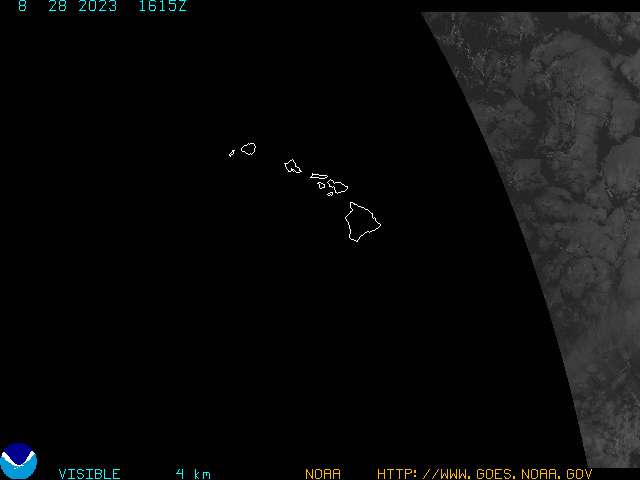

Laura Says:
Wow, what a quick response. Thanks so much for the re-assurances. We are so looking forward to it. Only 12 more days!~~~Hi Laura, I always try and response back as soon as I can…appreciate hearing from everyone who takes the time to write. Have a great vacation! Aloha, Glenn
Laura Says:
Hi from Calgary Glenn! We are coming to Maui on March 31st, staying in Kaanapali so are checking the forecast almost obsessively at this point! Really appreciate the detail you put into your forecasts. Just one quick question. Is this a lot of rain for this time of year or is this quite normal? The showers don’t bother me personally but I have little kids who will want to spend the entire day at the pool. Maybe the rain looks worse in the forecast than it actually is in person? Thanks and great job!~~~Hi Laura, I understand your excitement! The showers are falling generally along the windward sides. Lahaina is dry I’m quite sure, as is Kihei. Kaanapali today probably has some light mist, maybe not. Generally speaking, the rain you are seeing in the forecast, will fall up near Kapalua and Napili. So, I’d say don’t worry, I’m very sure the kids will have lots and lots of sunny pool time! Come ahead, you will have a blast. Aloha, Glenn