March 17-18, 2010
Air Temperatures – The following maximum temperatures were recorded across the state of Hawaii Wednesday afternoon:
Lihue, Kauai – 78
Honolulu, Oahu – 81
Kaneohe, Oahu – 82
Kaunakakai, Molokai – 80
Kahului, Maui – 82
Hilo, Hawaii – 81
Kailua-kona – 80
Air Temperatures ranged between these warmest and coolest spots near sea level around the state – and on the highest mountains…at 5pm Wednesday evening:
Port Allen, Kauai – 82F
Lihue, Kauai – 71
Haleakala Crater – 39 (near 10,000 feet on Maui)
Mauna Kea summit – 37 (near 14,000 feet on the Big Island)
Precipitation Totals – The following numbers represent the largest precipitation totals (inches) during the last 24 hours on each of the major islands, as of Wednesday afternoon:
3.10 Wainiha, Kauai
0.83 St. Stephens, Oahu
0.00 Molokai
0.00 Lanai
0.00 Kahoolawe
1.29 Kula, Maui
0.84 Puu Waawaa, Big Island
Marine Winds – Here’s the latest (automatically updated) weather map showing a 1031 millibar high pressure system to the northwest of Hawaii…moving eastward. At the same time we have a new cold front approaching from the northwest. The winds will strengthen from the north to northeast in the wake of the cold front.
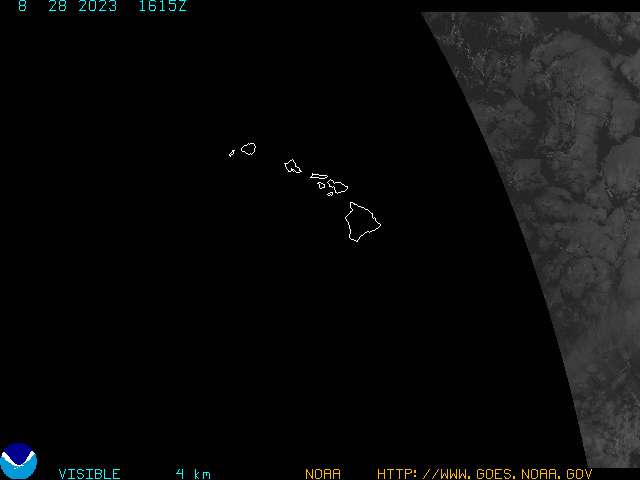
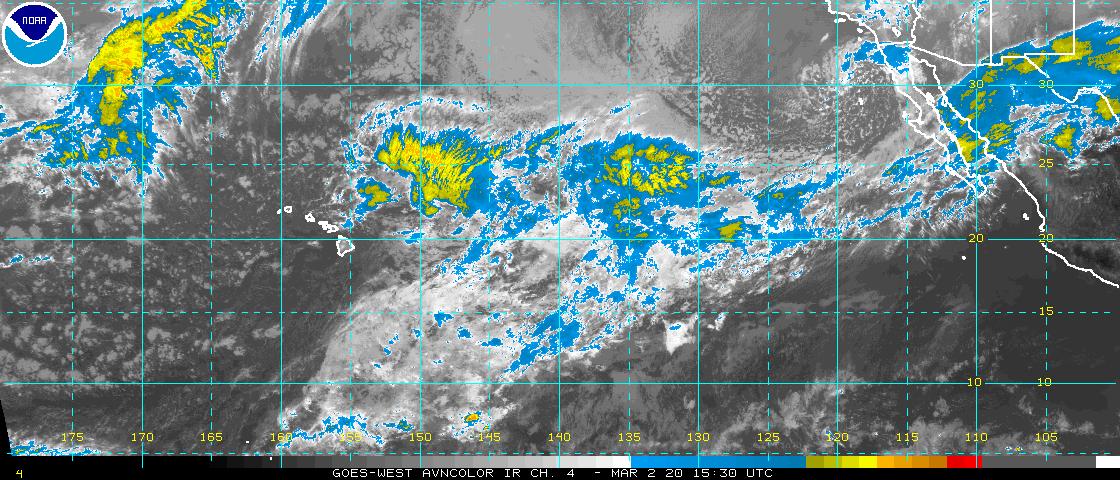
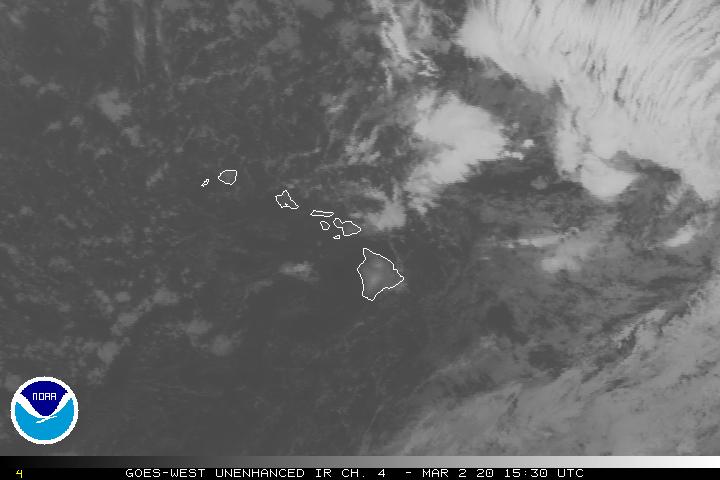
Satellite and Radar Images: To view the cloud conditions we have here in Hawaii, please use the following satellite links, starting off with this Infrared Satellite Image of the islands to see all the clouds around the state during the day and night. This next image is one that gives close images of the islands only during the daytime hours, and is referred to as a Close-up visible image. This next image shows a larger view of the Pacific…giving perspective to the wider ranging cloud patterns in the Pacific Ocean. Finally, here’s a Looping IR satellite image, making viewable the clouds around the islands 24 hours a day. To help you keep track of where any showers may be around the islands, here’s the latest animated radar image.
Hawaii’s Mountains – Here’s a link to the live webcam on the summit of near 14,000 foot Mauna Kea on the Big Island of Hawaii. The tallest peak on the island of Maui is the Haleakala Crater, which is near 10,000 feet in elevation. These two webcams are available during the daylight hours here in the islands…and when there’s a big moon rising just after sunset for an hour or two! Plus, during the nights and early mornings you will be able to see stars, and the sunrise too…depending upon weather conditions.
Tropical Cyclone activity in the eastern and central Pacific – Here’s the latest weather information coming out of the National Hurricane Center, covering the eastern north Pacific. You can find the latest tropical cyclone information for the central north Pacific (where Hawaii is located) by clicking on this link to the Central Pacific Hurricane Center. Here’s a tracking map covering both the eastern and central Pacific Ocean. A satellite image, which shows the entire ocean area between Hawaii and the Mexican coast…can be found here.
Aloha Paragraphs

Cold front into Thursday…with showers
The light winds of the last couple of days, with the localized heavy showers from Kauai down through Maui County…will give way to an approaching cold front into Thursday. This IR satellite image shows the fragmented cold front now pushing into the state. The prefrontal clouds extend down as far as about Molokai at the time of this writing. The cold front, and these clouds out ahead of the frontal band, will move down the island chain towards the Big Island overnight into Thursday. These clouds will be the source of the showery weather taking aim on our island chain now…a few of which could be locally heavy.
This rather diffuse cold front, which is a bit difficult to make out exactly, continues to move southeast into the islands. The leading edge of this front was still to the northwest of Kauai late Wednesday afternoon, and is moving towards us at 15-20 mph. The frontal band itself was about 150-200 miles wide, and had some thunderstorms to the north of the islands. This front is forecast to arrive over
As this cold front arrives, it will usher in another of those tropical cool snaps, with chilly north to northeast winds blowing in behind the frontal boundary. The source of this wind will be the 1031 millibar high pressure system, moving in behind the cold front. The winds will remain cool Thursday, although as the high progresses eastward, our winds will take on a more easterly direction, with warmer trade winds continuing into the weekend. These winds trailing the cold front may contain quite a bit of moisture, so that wet trade winds may continue for several days along the windward sides, blowing perhaps even into the leeward sides at times. The computer models are now showing yet another cold front will approach, bringing our local wind speeds down a notch or two after the weekend.
It’s Wednesday evening, as I begin writing the last section of today’s narrative.
As noted above, we have some rather distinct weather changes taking aim on our islands now. Cloud have moved over Kauai, Oahu, and were over Molokai. Some of these associated showers have been rather generous. As a matter of fact, moderate to heavy showers were falling near Molokai as we got into the sunset hour. The rest of the islands will find clouds and showers arriving this evening, continuing into Thursday. Speaking of showers, we should keep this looping radar image handy. ~~~ Looking a bit further ahead, the moisture brought into the state with the front will keep the prospect of showery weather in the forecast into Friday, and perhaps into the weekend. Showers will keep the windward sides off and on wet, with even some showers being carried over to the leeward sides on the gusty winds.
Warmer trade winds will arrive by Friday, and remain in place through the upcoming weekend. ~~~ Everything seems to be unfolding as expected this evening, with the cold front moving through the island chain into Thursday. I just talked to my friend Bob, who is visiting from California, and he’s had a big day on the ocean. He took a whale watching trip out from Maalaea Bay, and said he saw tons of whales out there! I’m about ready to leave Kihei at the moment, and will meet him upcountry in Kula. I’ll be taking a walk, and then we may go out to dinner, or have it at my place. The main thing is that I’ll be taking a two day vacation from my work at the Pacific Disaster Center, and then have a weekend too, so he and I will be having some fun! I’ll be back here on Thursday morning with more news about the cold front, and other things too. I hope you have a great Wednesday night until then! Aloha for now…Glenn.
Interesting: The Atlantic blue fin tuna is one of the largest, fastest, and most gorgeously colored of all the world’s fishes. Their torpedo shaped, streamlined bodies are built for speed and endurance. Their coloring (metallic blue on top and silver white on the bottom) helps camouflage them from above and below. They have an average size of 6.5 feet and 550 pounds. Unfortunately for them they are also delicious and may be on the brink of extinction due to overfishing.
European Union ambassadors agreed to propose protecting blue fin tuna as an endangered species on March 10, a move that would effectively ban international trade in the species. Blue fin tuna have been eaten by humans for centuries. However, in the 1970s, demand and prices for large blue fins soared worldwide, particularly in Japan, and commercial fishing operations found new ways to find and catch these tuna.
As a result, blue fin stocks, especially of large, breeding age fish, have plummeted, and international conservation efforts and concerns have increased. This tuna is one of the most highly prized fish used in Japanese raw fish dishes. Blue fin tuna sashimi is a particular delicacy in Japan where at one auction, a single giant tuna sold for more than $100,000 on the Tsukiji fish market in Tokyo.
In January 2009, a 440 pounds blue fin sold for $173,000. The very highest prices in the Japanese market have tended to be from Pacific blue fin tuna caught in Japanese waters, but high grade Atlantic blue fin, particularly those from Canada and Boston, also fetch high prices.
Prices were highest in the late 1970s and 1980s. The entry of many North African Mediterranean countries, such as Tunisia and Libya, into the blue fin tuna market in the 1990s, along with the increasingly widespread practice of tuna farming in the Mediterranean and other areas such as southern Australia has brought down prices.
Atlantic blue fin populations probably remained stable until the 1960s. Prior to that period, blue fin fisheries were relatively small in scale. The decline became precipitous after the 1970’s. The EU agreement came ahead of a meeting of the Convention on International Trade in Endangered Species (CITES) that will take place from March 13 to March 25 to consider a number of species, including blue fin tuna, elephants and polar bears.
The ambassadors attached a number of conditions to the EU’s support, including a one year delay to the ban on fishing that normally follows an endangered listing, and an opt out for fishermen using small boats to supply local markets.
Governments also promised to consider paying financial compensation to EU fishermen affected by a possible ban on catching the fish which is used mainly in sushi – a concession designed to win the support of countries with domestic tuna fisheries.
Malta voted against the proposed ban while Sweden and Austria abstained, EU sources said. Environmental groups said the EU had not done enough to reduce over sized blue fin tuna fishing fleets, and had even subsidized expansion.
"Over eight years the EU blue fin tuna fishing industry received subsidies totaling 34.5 million euros. Of this, 33.5 million euros was for the construction and modernization of vessels, with only a tiny proportion for decommissioning," said Markus Knigge of the Pew Environment Group.
Opposition grew shortly after the proposed trade ban with several Arab countries joining Japan in arguing it would hurt poor fishing nations and was not supported by sound science. Supporters of the ban, including the European Union and the United States, say it is necessary because the Atlantic blue fin is a migratory species that swims from the western Atlantic to the Mediterranean — putting it beyond any one country’s border. Compounding the tuna’s plight is the growing threat from illegal fishing fleets and the failure of existing measures to keep the population sustainable.
Interesting2: The rollout of the highly touted Smart Grid ran into another buzz saw this week, this time in Texas, when a hundreds of consumers showed up at a town hall meeting, and the Grand Prairie City Hall, in the Dallas-Fort Worth area, complaining that their recently installed wireless Smart Meters were responsible for higher electric bills. That led state senator Troy Fraser to get involved, asking the Texas Public Utility Commission to halt installation of the meters and to initiate an investigation. The meters were installed by the Texas utility Oncor Electric Delivery, which services roughly three million customers in the area.
The company has installed nearly 800,000 of these meters and insists that they are highly accurate. They are now running a side by side verification study, where smart meters have been installed alongside the previously used mechanical meters and show little difference thus far.
That doesn’t placate folks like Tricia Lambert, one of the hundreds who have complained, claiming, "My bills average between 1,500 and 2,000 kilowatt-hours, and it goes up a little more in the summer," she said. "That’s pretty much where I stayed.
The first month with the smart meter was 4,383 kilowatt-hours." In some cases, like that of John Colbert, there were errors made by meter readers. An audit of his meter found that the smart meter was off by about 2000 kWh. Apparently, the meters are not read automatically. "Any time you’ve got humans involved in the process, there’s always an opportunity for errors to take place," said Oncor spokesman Chris Schein.
This experience closely parallels an earlier story in Bakersfield, CA, where PG&E customers voiced similar complaints. Bakersfield residents believe their new smart meters are malfunctioning because their bills are much higher than before and they have filed a class-action lawsuit against the utility.
An independent evaluator will be appointed by the California Public Utilities Commission some time this week. PG&E claims higher bills are due to rate hikes, an unusually warm summer, and customers not shifting demand to off-peak times when rates are lower. Likewise, in Texas, this past winter was unusually cold.
Interesting3: New analysis released today at a symposium on "Climate, Mind and Behavior" reveals that Americans can reduce U.S. carbon pollution by 15 percent — or one billion tons of global warming pollution — through collective personal actions that require little to no cost. The analysis released by NRDC and the Garrison Institute’s Climate Mind Behavior (CMB) Project is part of a larger collaboration that seeks to integrate emerging research findings about what drives human behavior into new thinking on climate solutions.
"While our nation develops clean energy strategies to reduce large-scale industrial pollution, this study empowers individual Americans with the knowledge that they can take action today in their daily lives," said Peter Lehner, Executive Director of the Natural Resources Defense Council. "We all have an opportunity to significantly reduce climate change pollution and cut costs at the same time."
Focusing exclusively on simple and affordable behavioral changes, the research indicates that Americans can reduce our nation’s annual carbon emissions by one billion metric tons below business-as-usual emission levels by 2020 through small modifications in the sectors of home energy use, transportation, food consumption and waste.
One billion metric tons is equivalent to 15% of the United States’ 7 billion tons of annual greenhouse gas emissions and roughly equivalent to the total annual emissions of the United Kingdom and Saudi Arabia combined.
Suggested behavioral changes in the study include: reducing unwanted catalog subscriptions, decreasing vehicle idling, using a programmable thermostat, replacing seven light bulbs with CFLs, setting computers to hibernate mode, shutting off unused lights, and eating poultry in place of red meat two days per week.
All of the recommendations offered in the study are available to be adopted immediately, at little or no cost, and will reduce not only emissions, but home energy, transportation and food costs as well.
 Email Glenn James: