











February 9-10, 2010
Air Temperatures – The following maximum temperatures were recorded across the state of Hawaii Tuesday afternoon:
Lihue, Kauai – 78
Honolulu, Oahu – 82
Kaneohe, Oahu – 79
Kaunakakai, Molokai – 80
Kahului, Maui – 83
Hilo, Hawaii – 82
Kailua-kona – 80
Air Temperatures ranged between these warmest and coolest spots near sea level around the state – and on the highest mountains…at 4pm Tuesday afternoon:
Poipu, Kauai – 82F
Kapalua, Maui – 75
Haleakala Crater – 61 (near 10,000 feet on Maui)
Mauna Kea summit – 46 (near 14,000 feet on the Big Island)
Precipitation Totals – The following numbers represent the largest precipitation totals (inches) during the last 24 hours on each of the major islands, as of Tuesday afternoon:
0.01 Poipu, Kauai
0.00 Oahu
0.00 Molokai
0.00 Lanai
0.00 Kahoolawe
0.01 West Wailuaiki, Maui
0.02 Pohakuloa Keamuku, Big Island
Marine Winds – Here’s the latest (automatically updated) weather map showing a 1027 millibar high pressure system located to the northeast, with an associated ridge extending back close to the island of Kauai. This will keep trade winds blowing, although lighter Wednesday…strengthening again Thursday.
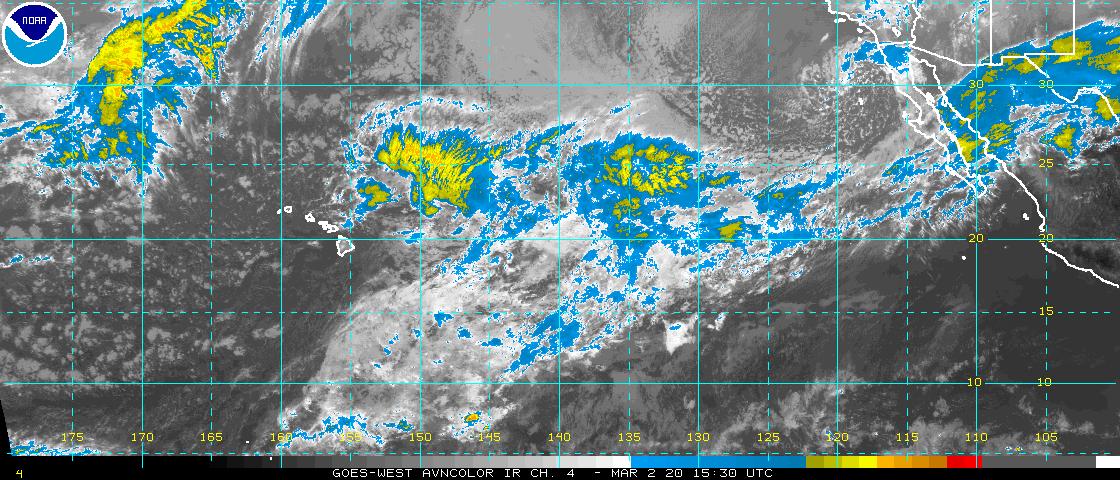
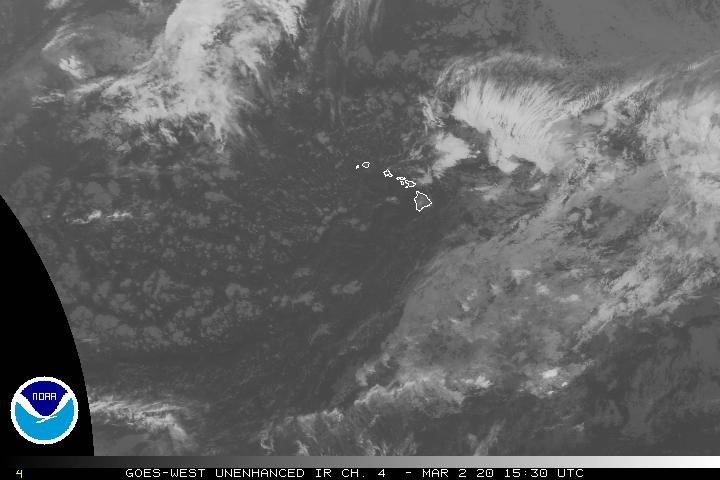
Satellite and Radar Images: To view the cloud conditions we have here in Hawaii, please use the following satellite links, starting off with this Infrared Satellite Image of the islands to see all the clouds around the state during the day and night. This next image is one that gives close images of the islands only during the daytime hours, and is referred to as a Close-up visible image. This next image shows a larger view of the Pacific…giving perspective to the wider ranging cloud patterns in the Pacific Ocean. Finally, here’s a Looping IR satellite image, making viewable the clouds around the islands 24 hours a day. To help you keep track of where any showers may be around the islands, here’s the latest animated radar image.
Hawaii’s Mountains – Here’s a link to the live webcam on the summit of near 14,000 foot Mauna Kea on the Big Island of Hawaii. The tallest peak on the island of Maui is the Haleakala Crater, which is near 10,000 feet in elevation. These two webcams are available during the daylight hours here in the islands…and when there’s a big moon rising just after sunset for an hour or two! Plus, during the nights and early mornings you will be able to see stars, and the sunrise too…depending upon weather conditions.
Tropical Cyclone activity in the eastern and central Pacific – Here’s the latest weather information coming out of the National Hurricane Center, covering the eastern north Pacific. You can find the latest tropical cyclone information for the central north Pacific (where Hawaii is located) by clicking on this link to the Central Pacific Hurricane Center. Here’s a tracking map covering both the eastern and central Pacific Ocean. A satellite image, which shows the entire ocean area between Hawaii and the Mexican coast…can be found here.
Aloha Paragraphs

Much larger surf Wednesday-Thursday…north and west shores
The trade winds were blowing today, which were gusting up to 35 mph on both Kahoolawe and South Point on the
This quickly weakening cold front has been quite a challenge for the computer models, varying between sweeping all the way down through the island chain…to stalling before arriving on
The trade winds will become slightly lighter Wednesday, and then pick up again through most of the rest of this week. This slight easing up in strength of the trade winds will be prompted by the approach of this cold front. Following this weak front, we’ll find strengthening trade winds Thursday. Our local weather will remain on the good side though, with just those windward showers. As we move into Friday and the upcoming weekend we’ll see the trade winds continuing. This is a change, as previously the models had suggested that we’d find another cold front approaching, weakening our trade winds then. As we move into early next week, the computer models are showing yet another cold front approaching, which may turn out to be somewhat of a better rainfall producer by mid-week…although we can’t count on that just yet.
The big news soon will be the large to very large swell, which will begin breaking along our north and west facing shores tonight into Wednesday. This northwest swell will be large enough,that we already find high surf warnings up for these shores. This should be a signal to our residents and visitors alike, to use caution when getting near the beaches on these sides of the islands. Interestingly enough, the south shores too will begin to see rising surf later Wednesday into Thursday as well. The swells arriving along those leeward beaches will come up from the southern hemisphere. This surf may be large enough to trigger high surf advisory flags, which would be unusual for the winter season. So, folks should be careful along our south and west facing leeward beaches too. This higher than normal surf along our north and west shores will be somewhat rough and choppy due to the increasing trade wind speeds by Thursday.
It’s Tuesday evening, as I begin writing the last section of today’s narrative. As noted in the paragraphs above, the main thing that will catch our eye here in the islands over the next several days, will be the rough surf on all shores, except the eastern beaches. Besides that aspect of our natural environment, the fact that the trade winds are hanging on through the rest of this week…is a bit unusual too. Most sea level locations today got up above 80F degrees, with the Kahului airport leading the charge, with a toasty, at least for winter…83 degrees. Air temperatures will be a little cooler Wednesday morning, as the trade winds slack off ahead of this soon to be dissipating cold front. ~~~ Looking out the window here in Kihei, before I take the drive back upcountry to Kula, it seems quite a bit like summer, rather than the winter season that we still find ourselves in. I can’t wait to get home actually, as I so much feel like getting out for a brisk walk. My lower back was tweaked last week, but is healing fast, and I’m anxious to get fully back into my normal exercise schedule! I’m about 90% there, which is big relief. Ok, I’m on the road, or will be very soon. Although, before I jump in the car, I want to thank you for stopping by, and to invite you back again on Wednesday! Aloha for now…Glenn.
Interesting: A new Chinese government survey of the country’s environmental problems has shown water pollution levels in 2007 were more than twice the government’s official estimate, largely because agricultural waste was ignored. The data, presented by Vice Environment Protection Minister Zhang Lijun, revives persistent questions about the quality of Chinese official statistics and the effectiveness of a government push for cleaner growth after decades of unbridled expansion.
The first national census on pollution sources found that discharge of "chemical oxygen demand" (COD) — a measure of water pollution — in wastewater was 30.3 million metric tons, Zhang said. The government had said in an official paper published two years ago that 2007 was the first year it managed to reduce water pollution, with COD falling 3 percent to 13.8 million metric tons.
The census has been years in the making, in part because it was extremely comprehensive, but possibly also because the contents include painful revelations like this one. Zhang played down the difference between the totals. He said it was explained by the survey’s expanded scope, the inclusion of agricultural sources of wastewater — which contributed some 13.2 million metric tons — and different calculation methods.
Interesting2: Let’s get one thing perfectly clear: hydrogen is not a energy resource. Hydrogen does not exist naturally in any sufficient quantities to make it a viable energy source, at least on this planet. To get hydrogen in any useful quantities, it must be extracted from natural gas, water or biomass, and all of these results in a net loss of energy.
It is more efficient to use these fuels in their original forms. Hydrogen is more like a battery, an energy storage medium. Unfortunately, (for practical purposes) it is a very impractical battery, with an extremely low energy-to-volume ratio.
According to Wikipedia, “The energy density per unit volume of both liquid hydrogen and compressed hydrogen gas at any practicable pressure is significantly less than that of traditional fuel sources, although the energy density per unit fuel mass is higher.”
To be fair, fossil fuels are only energy storage mediums as well, but their energy was accumulated over millions of years, and is readily extracted now in a compact form. Neither hydrogen nor fossil fuels are energy sources, because the energy does not come from them, it came from the sun, the only real energy source we have.
Interesting3: Health authorities should emphasize the positive message that the most successful method used by most ex-smokers is unassisted cessation, despite the promotion of cessation drugs by pharmaceutical companies and many tobacco control advocates, according to a new article. The dominant messages about smoking cessation contained in most tobacco control campaigns, which emphasize that serious attempts at quitting smoking must be pharmacologically or professionally mediated, are critiqued in an essay in PLoS Medicine by Simon Chapman and Ross MacKenzie from the School of Public Health at the University of Sydney, Australia.
This overemphasis on quit methods like nicotine replacement therapy (NRT) has led to the "medicalisation of smoking cessation," despite good evidence that the most successful method used by most ex-smokers is quitting "cold turkey" or reducing-then-quitting. Reviewing 511 studies published in 2007 and 2 008 the authors report that studies repeatedly show that two-thirds to three-quarters of ex-smokers stop unaided and most ex-smokers report that cessation was less difficult than expected.
The medicalisation of smoking cessation is fuelled by the extent and influence of pharmaceutical support for cessation intervention studies, say the authors. They cite a recent review of randomized controlled trials of nicotine replacement therapy (NRT) that found that 51% of industry-funded trials reported significant cessation effects, while only 22% of non-industry trials did.
Many assisted cessation studies — but few if any unassisted cessation studies — involve researchers who declare support from a pharmaceutical company manufacturing cessation products. The authors conclude that "public sector communicators should be encouraged to redress the overwhelming dominance of assisted cessation in public awareness, so that some balance can restored in smokers’ minds regarding the contribution that assisted and unassisted smoking cessation approaches can make to helping them quit smoking."
Interesting4: Young people who have experienced threats and violence feel more insecure than others in urban public spaces, especially when alone. This is one conclusion from researchers at the University of Gothenburg, Sweden. Gabriella Sandstig, researcher at the Faculty of Social Sciences has explored how people perceive threats and risks in urban public places.
More exactly, her research focuses on how a city’s physical environment — for example buildings and streets — interacts with the social environment and people’s perceptions of sharing the city with others. For example, a desolate parking garage in the night hours feels more threatening than the same place during the day when there are lots of people around.
The feeling of being alone is a strong factor behind people’s feelings of insecurity. People feel the most secure when they are together with friends or acquaintances, but being around many strangers, for example on a busy street, also makes people feel secure. In addition, her research shows that cities can be made more secure by creating a sense of community and togetherness.
‘We need to populate public spaces and make it evident that nobody is alone and that somebody cares about our public environment. It may be more effective to invest in more street lights — and make sure they are in working condition — than to pay for crime prevention measures,’ says Sandstig.
The most common reason people feel insecure is personal experience of threats and serious risks, which includes both having been victimized personally and having seen somebody else become a victim. Contrary to previous studies, Sandstig found that young people feel more insecure than old people.
 Email Glenn James: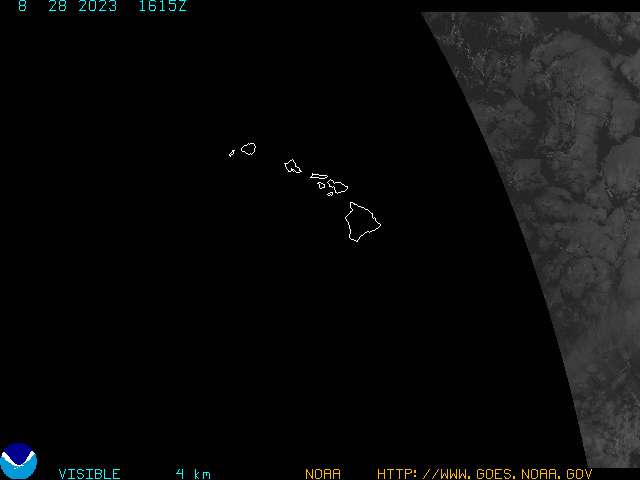



jack weber Says:
Glad your back is healing up…J*~~~Thanks Jack! Aloha, Glenn
Dave wesener Says:
Hi Glenn,
Enjoy being able to get my daily weather updates from you before we head to the beaches each morning. Enjoyed day 10 of 14 today here in Kihei Maui. Sure looked dark up by you at sunset this evening. Foder should put your site in his Maui book as a service to all of us visitors to the island. Keep up the nice work.
Dave~~~Hi Dave, sounds like you are having a great time here on vacation, great! It was cloudy in Kula when I got home from work, with a couple of sprinkles, no more. Yeah, that would be wonderful if Foder would add me to his book service. I trust that you will enjoy the rest of your vacation, thanks for your note! Aloha, Glenn