February 8-9, 2010
Air Temperatures – The following maximum temperatures were recorded across the state of Hawaii Monday afternoon:
Lihue, Kauai – 78
Honolulu, Oahu – 83
Kaneohe, Oahu – 79
Kaunakakai, Molokai – 79
Kahului, Maui – 81
Hilo, Hawaii – 81
Kailua-kona – 81
Air Temperatures ranged between these warmest and coolest spots near sea level around the state – and on the highest mountains…at 5pm Monday afternoon:
Honolulu, Oahu – 80F
Lihue, Kauai – 75
Haleakala Crater – 48 (near 10,000 feet on Maui)
Mauna Kea summit – 41 (near 14,000 feet on the Big Island)
Precipitation Totals – The following numbers represent the largest precipitation totals (inches) during the last 24 hours on each of the major islands, as of Monday afternoon:
0.06 Mount Waialaele, Kauai
0.00 Oahu
0.00 Molokai
0.00 Lanai
0.00 Kahoolawe
0.00 Maui
0.03 Glenwood, Big Island
Marine Winds – Here’s the latest (automatically updated) weather map showing three high pressure systems located north to the northeast, with an associated ridge extending back to the northwest of Kauai. This will keep trade winds blowing into Tuesday, lighter from the southeast Wednesday.
Satellite and Radar Images: To view the cloud conditions we have here in Hawaii, please use the following satellite links, starting off with this Infrared Satellite Image of the islands to see all the clouds around the state during the day and night. This next image is one that gives close images of the islands only during the daytime hours, and is referred to as a Close-up visible image. This next image shows a larger view of the Pacific…giving perspective to the wider ranging cloud patterns in the Pacific Ocean. Finally, here’s a Looping IR satellite image, making viewable the clouds around the islands 24 hours a day. To help you keep track of where any showers may be around the islands, here’s the latest animated radar image.
Hawaii’s Mountains – Here’s a link to the live webcam on the summit of near 14,000 foot Mauna Kea on the Big Island of Hawaii. The tallest peak on the island of Maui is the Haleakala Crater, which is near 10,000 feet in elevation. These two webcams are available during the daylight hours here in the islands…and when there’s a big moon rising just after sunset for an hour or two! Plus, during the nights and early mornings you will be able to see stars, and the sunrise too…depending upon weather conditions.
Tropical Cyclone activity in the eastern and central Pacific – Here’s the latest weather information coming out of the National Hurricane Center, covering the eastern north Pacific. You can find the latest tropical cyclone information for the central north Pacific (where Hawaii is located) by clicking on this link to the Central Pacific Hurricane Center. Here’s a tracking map covering both the eastern and central Pacific Ocean. A satellite image, which shows the entire ocean area between Hawaii and the Mexican coast…can be found here.
Aloha Paragraphs

The beauty of the Hawaiian Islands
A ridge of high pressure is northwest of the Hawaiian Islands Monday night, with the trade winds continuing through the next several days…along with dry weather conditions. As we have high pressure at the surface to our north, and overhead as well, our local weather will be just fine. We’ll find this week generally quite nice, with the trade winds bringing pleasantly warm air temperatures. There will be just a few windward showers, while the leeward sides remain mostly clear and dry.
The trade winds will gradually become lighter, and perhaps turn to the southeast later Wednesday. This swinging around of the winds, and their easing up in strength, will be prompted by the approach of our next cold front. The computer models are showing this front stalling somewhere near Kauai or Oahu Wednesday evening into Thursday morning. Following in the wake of the frontal boundary, will be NE and ENE trade winds. We could see some showers arriving into Thursday, providing the windward sides with some moisture for a day or two.
As we move into Friday and the upcoming weekend, we’ll see another cold front approaching the Aloha state. This cold front is expected to be even weaker than the one we see brushing Kauai at mid-week. It may cause another temporary easing up of the trade winds, but likely not much else. There seems to be a change going on here, with even less influential cold fronts coming our way, and more well established trade winds coming into play…as we move further into this winter month of February.
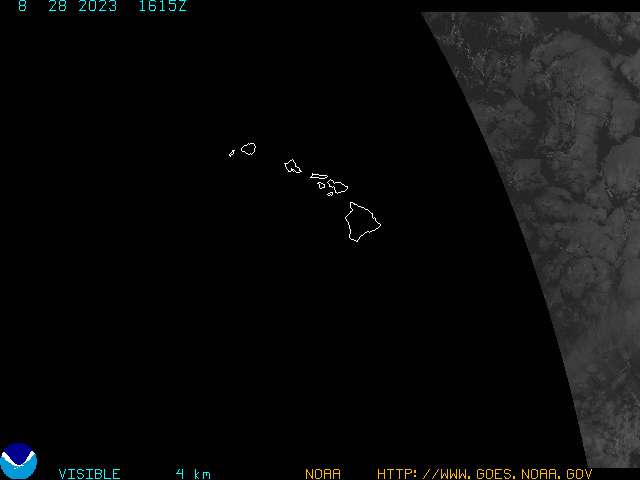
It’s Monday evening, as I begin writing the last section of today’s narrative. Monday was a lovely day, just like Sunday, and very likely…similar to what we’ll find Tuesday. The day was almost absolutely dry, with lots of generally clear skies. As we can see using this satellite image, there are hardly any clouds around at the moment. It appears that the next week will remain rather benign, in terms of any significant rainfall. Winter isn’t over with us yet though, so that we’ll be having more wet weather, although I don’t see on the weather horizaon at this time. ~~~ Thanks to the trade winds, our air temperatures have come back up to more normal levels. Most of the airport weather stations rose up into the low 80F’s today, with the highest temperature being reported in the big city of Honolulu…with 83 degrees. I expect fairly warm, or what we could consider seasonable air temperatures near sea level overnight, with most coastal areas rising into the lower 80’s again Tuesday afternoon. Just nice weather, and more nice weather is happening now, which most of us appreciate very much. The only draw back to this dry weather is the ongoing drought conditions that plague many areas, especially around Maui County, and the Big Island. ~~~ I hope that you have a great Monday night, wherever you happen to be spending it! I’ll be back early Tuesday morning with your next new weather narrative. Aloha for now…Glenn.
Interesting: The chemical composition of our oceans is not constant but has varied significantly over geological time. In a study published in Science, researchers describe a novel method for reconstructing past ocean chemistry using calcium carbonate veins that precipitate from seawater-derived fluids in rocks beneath the seafloor. The research was led by scientists from the University of Southampton’s School of Ocean and Earth Science (SOES) hosted at the National Oceanography Centre, Southampton (NOCS).
"Records of ancient seawater chemistry allow us to unravel past changes in climate, plate tectonics and evolution of life in the oceans. These processes affect ocean chemistry and have shaped our planet over millions of years," said Dr Rosalind Coggon, formerly of NOCS now at Imperial College London.
"Reconstructing past ocean chemistry remains a major challenge for Earth scientists, but small calcium carbonate veins formed from warm seawater when it reacts with basalts from the oceanic crust provide a unique opportunity to develop such records," added co-author Professor Damon Teagle from SOES.
Calcium carbonate veins record the chemical evolution of seawater as it flows through the ocean crust and reacts with the rock. The composition of past seawater can therefore be determined from suites of calcium carbonate veins that precipitated millions of years ago in ancient ocean crust.
The researchers reconstructed records of the ratios of strontium to calcium (Sr/Ca) and magnesium to calcium (Mg/Ca) over the last 170 million years. To do this, they analyzed calcium carbonate veins from basaltic rocks recovered by several decades of scientific deep-ocean drilling by the Integrated Ocean Drilling Program (IODP) and its predecessors.
"The carbonate veins indicate that both the Sr/Ca and Mg/Ca ratios of seawater were significantly lower than at present prior to about 25 million years ago. We attribute the increases in seawater Sr/Ca and Mg/Ca since then to the long-term effects of decreased seafloor volcanism and the consequent reduction in chemical exchange between seawater and the ocean crust," said Professor Teagle.
Interesting2: Republican politicians and conservative activists are launching a ballot campaign to suspend California’s landmark global-warming law, in what they hope will serve as a showcase for a national backlash against climate regulations. Supporters say they have "solid commitments" of nearly $600,000 to pay signature gatherers for a November initiative aimed at delaying curbs on the greenhouse gas emissions of power plants and factories until the state’s unemployment rate drops. GOP gubernatorial candidates and Tea Party organizers paint the 2006 law, considered a model for other state and federal efforts, as a job-killing interference in the economy.
Talk radio is flailing at what John Kobylt and Ken Chiampou, drive-time hosts on a Los Angeles radio station, call "the global-warming final solution act" promoted by "fascist, Nazi" officials. "We are on fire," said GOP Assemblyman Dan Logue, a sponsor of the proposed initiative. "People are calling from all over the country. This will be the most intense campaign the state has seen in 50 years."
Interesting3: "Rises and falls in sea level over relatively short periods do not testify to a long-term trend. It is early yet to conclude from the short-term increases in sea level that this is a set course that will not take a change in direction," explains Dr. Sivan.
The rising sea level is one of the phenomena that have most influence on humankind: the rising sea not only floods the littoral regions but also causes underground water salinization, flooded effluents, accelerated coastal destruction, and other damage.
According to Dr. Sivan, the changing sea level can be attributed to three main causes: the global cause — the volume of water in the ocean, which mirrors the mass of ice sheets and is related to global warming or cooling; the regional cause — vertical movement of the earth’s surface, which is usually related to the pressure placed on the surface by the ice; and the local cause — vertical tectonic activity. Seeing as Israel is not close to former ice caps and the tectonic activity along the Mediterranean coast is negligible over these periods, it can be concluded that drastic changes in Israel’s sea levels are mainly related to changes in the volume of water.
Interesting4: Climate change is transforming the Arctic environment faster than expected and accelerating the disappearance of sea ice, scientists said in giving their early findings from the biggest-ever study of Canada’s changing north. The research project involved more than 370 scientists from 27 countries who collectively spent 15 months, starting in June 2007, aboard a research vessel above the Arctic Circle.
It marked the first time a ship has stayed mobile in Canada’s high Arctic for an entire winter. "(Climate change) is happening much faster than our most pessimistic models expected," said David Barber, a professor at the University of Manitoba and the study’s lead investigator, at a news conference in Winnipeg.
Models predicted only a few years ago that the Arctic would be ice-free in summer by the year 2100, but the increasing pace of climate change now suggests it could happen between 2013 and 2030, Barber said. Scientists link higher Arctic temperatures and melting sea ice to the greenhouse gas emissions blamed for global warming.
The Arctic is considered a type of early-warning system of climate change for the rest of the world. "We know we’re losing sea ice — the world is all aware of that," Barber said. "What you’re not aware of is that it has impacts on everything else that goes on in this system."
Interesting5: The new record-holder for the most precise timekeeper could tick off the 13.7-billion-year age of the universe to within 4 seconds. The optical clock monitors the oscillation of a trapped atom of aluminium-27. It is more than twice as precise as an earlier version, reported in 2008, and was built at the National Institute of Standards and Technology in Boulder, Colorado.
"It’s extremely impressive," says Patrick Gill of the UK’s National Physical Laboratory, who was not involved with the work. The second is currently defined by caesium atomic clocks, but optical clocks promise higher precision because their atoms oscillate at the frequencies of light rather than in the microwave band, so they can slice time into smaller intervals. Such clocks could help spot tiny changes in physical constants over time.
Interesting6: China has an estimated 50 or fewer tigers left living in the wild, but efforts to stabilize one population in the bleak northeast are starting to pay off, a conservationist said on Monday. Tigers once roamed huge swathes of China, right up to the now booming east coast. Their population has collapsed due to habitat destruction on the back of rapid economic development and poaching for tiger products to use in traditional medicine.
About 10 still live in the southwestern province of Yunnan, some 15 in Tibet, and 20 or so in northwestern Jilin and Heilongjiang provinces, said Xie Yan, China Country Program Director of the Wildlife Conservation Society. The South China Tiger is probably already extinct, she told the Foreign Correspondents Club of China, ahead of the Chinese Lunar New Year of the Tiger, which starts on Sunday.
"The number of wild tigers left in China is very depressing," Xie said. "We have less than 50 individuals in the wild. The populations in Tibet and in the south are still dropping. "The northeast tiger is now stable, and maybe increasing a little, but the number is still very small," she added.
Conservationists say the trade in skin and bones is booming in countries such as China, which has banned the use of tiger parts in medicine but where everything from fur and whiskers to eyeballs and bones are still used. Skins sell as rugs and cloaks on the black market, fetching up to $20,000 for a single pelt.
Interesting7: As the promise of electric cars grows, so too does the potential of electric planes. These aircraft, whose motors are far more efficient, reliable and quiet than internal combustion engines, could help transform how we fly – if a few problems could be solved. Electric motors are three to four times better than internal combustion engines at driving an airplane propeller.
And the reliability of electric motors is "perhaps 10 times or even 20 times that of a piston engine," said Brien Seeley, president of the Comparative Aircraft Flight Efficiency (CAFE) Foundation, an independent flight test agency which hosts NASA’s Centennial Challenges for Aeronautics. Because electric motors could be up to 95 percent efficient – compared to the 18 to 23 percent efficiency of regular engines – means they waste much less energy in the form of heat.
As such, "they don’t need anywhere near the same amount of cooling air flowing over them that internal combustion engines do, which is a very big deal with airplanes" and accounts for a significant part of the drag they experience that can slow them down, Seeley said. Their boosted efficiency also means electric planes could be much quieter than regular planes.
As such, the military is pursuing them for stealth applications, Seeley said. "Military contractors are spending significant investment in investigating electric-powered unoccupied air vehicles." Quieter planes also means civilian airports can be located much closer to where people want to go without bothering local residents. Weaning planes off fossil fuels is also good for the environment.
"You have the climate change issue, the air quality issue from smog, and the energy independence issue," Seeley said. The one great Achilles’ heel of electric airplanes, however, is battery life. Airplanes need to be light in order to stay up in the air, but batteries are notorious for being heavy for the amount of energy they carry.
As a result, many engineers and materials scientists are experimenting with radical aircraft and designs and new, lightweight materials. "We’re seeing truly extraordinary sailplane designs with 70-to-1 lift-drag ratios, which can greatly reduce the amount of power needed, and super-lightweight carbon fiber construction techniques, all of which means that even modest battery packs can take you potentially 100 or 200 miles on a flight," Seeley said.
A San Jose-based company called Nanosolar is also experimenting with thin and flexible solar panels that could be applied to the wing surfaces of airplanes to allow for recharging during flights or when on the ground. "There are major breakthroughs coming with the limitations of battery energy density as well," Seeley told TechNewsDaily.
"Nanotechnology may be able to increase their potential maybe 10- or 20-fold." Seeley doesn’t expect all planes to shift to electric. Military fighter aircraft will still rely on jet engines over electric motors in the future, given how they need to remain small, fast and maneuverable. Jet engines will likely also be the way to go when it comes to long flights or ones with many passengers, due to their range and weight constraints.
Still, Seeley sees electric planes offering major advantages when it comes to travel of 250 miles or less. "If we look at statistics for door-to-door travel times, in current aviation, for trips of under 250 miles, the speed is below 55 mph, and that’s much worse for certain metro areas or if traffic jams happen," Seeley explained.
"So you have a 525 mph airliner on a 250-mile trip with a net speed of 55 mph, and that isn’t good. The obvious implication then is, you then drive a car to get there just as fast, but the truth is that due to gridlock, the car door-to-door trip speed is on the order of 30 mph." The solution for these jaunts is to go electric, he suggested.
The unprecedented quietness of electric planes means airports can be built closer to destinations, and they are capable of extremely short takeoffs since they don’t have to gradually accelerate to liftoff speeds. "We’re exploring the concept of pocket airports, maybe lots of them, each just two acre parcels, that you can take, say, at 150 mph to another pocket airport," Seeley said.
"It’s a transformative concept." The crossover with the automotive world, "which is going to transition to electric cars and thus process enormous numbers of battery sets and motors and so forth, could be a game changer for electric planes," he added. Today’s gas engines become less efficient the smaller they are, but electric motors don’t suffer from this limitation.
As a result, electric planes could use several small motors mounted at the edge of wings that blow air directly over them, "potentially leading to much greater efficiency," said NASA aerospace engineer Mark Moore. Internationally, there is growing interest in electric planes, CAFE’s Seely said.
"The company Yuneec just constructed a 260,000 square foot factory in China to build electric-powered aircraft—really, the first large production of such aircraft." NASA’s annual Green Flight Challenge, which is managed by CAFE, is also pushing planes to fly faster than 100 mph while exceeding a fuel efficiency of 200 passenger miles per gallon or that equivalent in electricity. "This event now has nine very high-quality teams enrolled, drawing on the latest technology from around the world," Seeley said. "The goal of the challenge also meets the sweet spot of the 250-mile range or so one would want for electric planes."
 Email Glenn James: