











February 24-25, 2010
Air Temperatures – The following maximum temperatures were recorded across the state of Hawaii Tuesday afternoon:
Lihue, Kauai – 79
Honolulu, Oahu – 80
Kaneohe, Oahu – 79
Kaunakakai, Molokai – 81
Kahului, Maui – 84
Hilo, Hawaii – 83
Kailua-kona – 82
Air Temperatures ranged between these warmest and coolest spots near sea level around the state – and on the highest mountains…at 6am Wednesday morning:
Kailua-kona – 68F
Lihue, Kauai – 61
Haleakala Crater – 48 (near 10,000 feet on Maui)
Mauna Kea summit – 39 (near 14,000 feet on the Big Island)
Precipitation Totals – The following numbers represent the largest precipitation totals (inches) during the last 24 hours on each of the major islands, as of Wednesday morning:
0.01 Poipu, Kauai
0.05 Hawaii Kai, Oahu
0.00 Molokai
0.00 Lanai
0.00 Kahoolawe
0.01 Kula, Maui
0.02 Kapapala Ranch, Big Island
Marine Winds – Here’s the latest (automatically updated) weather map showing a 1024 millibar high pressure system far to the east-northeast of Hawaii. This high has an elongated ridge of high pressure extending westward, located near Kauai. This pressure configuration will keep our wind speeds light Wednesday.…becoming trade winds Thursday.
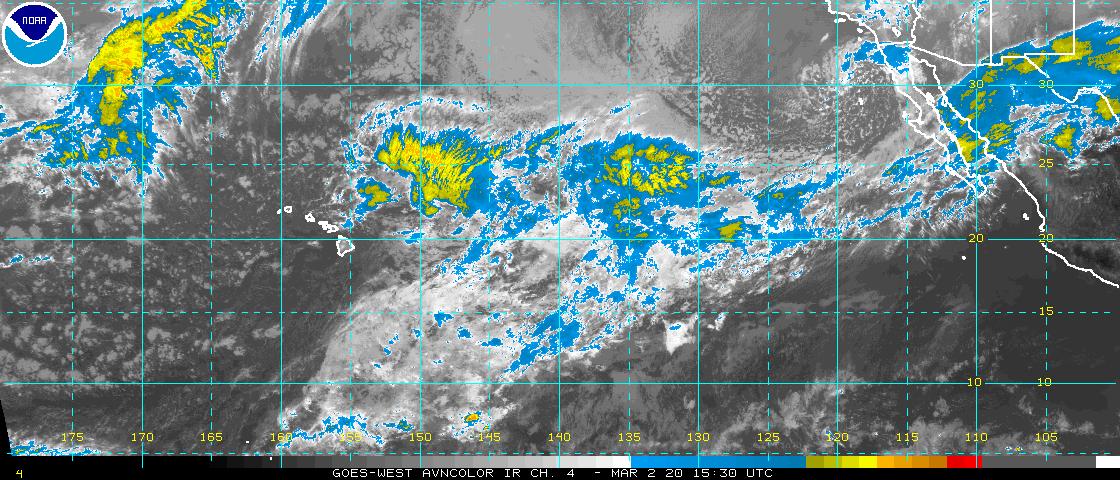
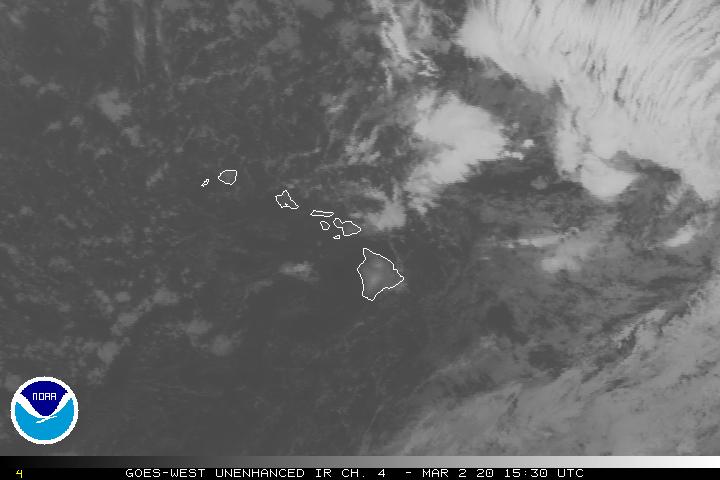
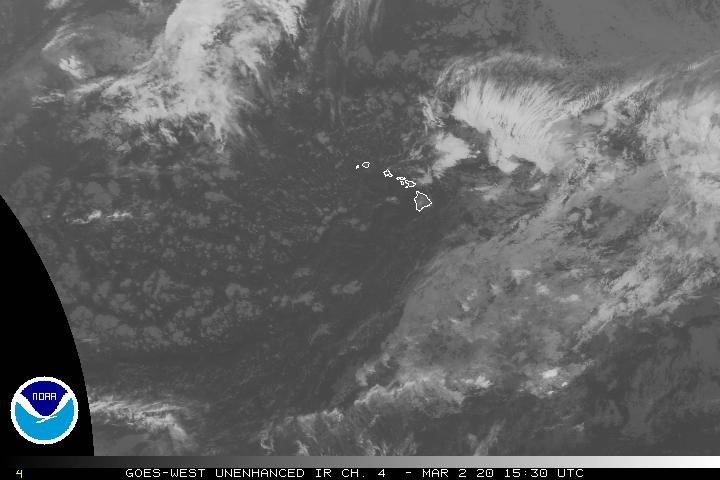
Satellite and Radar Images: To view the cloud conditions we have here in Hawaii, please use the following satellite links, starting off with this Infrared Satellite Image of the islands to see all the clouds around the state during the day and night. This next image is one that gives close images of the islands only during the daytime hours, and is referred to as a Close-up visible image. This next image shows a larger view of the Pacific…giving perspective to the wider ranging cloud patterns in the Pacific Ocean. Finally, here’s a Looping IR satellite image, making viewable the clouds around the islands 24 hours a day. To help you keep track of where any showers may be around the islands, here’s the latest animated radar image.
Hawaii’s Mountains – Here’s a link to the live webcam on the summit of near 14,000 foot Mauna Kea on the Big Island of Hawaii. The tallest peak on the island of Maui is the Haleakala Crater, which is near 10,000 feet in elevation. These two webcams are available during the daylight hours here in the islands…and when there’s a big moon rising just after sunset for an hour or two! Plus, during the nights and early mornings you will be able to see stars, and the sunrise too…depending upon weather conditions.
Tropical Cyclone activity in the eastern and central Pacific – Here’s the latest weather information coming out of the National Hurricane Center, covering the eastern north Pacific. You can find the latest tropical cyclone information for the central north Pacific (where Hawaii is located) by clicking on this link to the Central Pacific Hurricane Center. Here’s a tracking map covering both the eastern and central Pacific Ocean. A satellite image, which shows the entire ocean area between Hawaii and the Mexican coast…can be found here.
Aloha Paragraphs

Generally good weather Wednesday
Our weather will remain quite nice most of the day Wednesday…with a frontal cloud band arriving late into Thursday morning. The leeward sides will find generally fine weather, with little if any rainfall through the occurrence of this weak frontal event. The windward sides will have generally dry weather, although the cloud band will carry some showers perhaps to Kauai…and maybe even Oahu. This IR satellite image shows partly cloudy skies over the state Wednesday, with high cirrus clouds stretching down over Kauai…although pulling up to the north at the time of this writing. If we look at an even larger view of the central Pacific, using this IR satellite picture, we can see the cloud band…extending out of the high clouds to our north.
A high pressure ridge remains nearly stationary near
It’s Wednesday, as I begin writing the last section of this morning’s narrative. Our weather will remain generally quite nice for the next couple of days. As mentioned above, we’ll find a weak frontal boundary edging up close to Kauai this evening or by early Thursday morning, ushering in some clouds and a few showers. Looking a bit further ahead, we’ll find this weekend’s cold front bringing a good amount of showers to the state. We could sure use the moisture, as the state of Hawaii is much drier than normal. We may find rather gusty winds ahead of the cold front, coming up from the south and southeast, which could easily carry some volcanic haze up over the smaller islands…from the vents on the Big Island. In the wake of the cold front, we’ll find a windy period arriving too. The computer models are now showing winds strong enough that we’ll certainly see small craft wind advisories in all coastal areas. The latest thought is that perhaps we’ll even see gale warnings going up in the southern channels, and perhaps even wind advisories over those windiest parts of the state, as we move into early next week! ~~~ I’m in Honolulu, where I’m participating in a hurricane workshop, sponsored by both FEMA, and the Central Pacific Hurricane Center. The meeting is taking place at the NWS forecast office, which is located on the Manoa campus of the University of Hawaii. ~~~ I’ve had some problems with this laptop computer this morning, like getting this new narrative just about sent out, and then the computer did a weird thing, and I had to completely start over! I’m sure most of us know that feeling, and then having to begin again…its frustrating to say the least. So, I’m nervous that that will happen again now, so I want to push this out to you right now! I’ll be back later in the day hopefully. I hope you have a great Wednesday until then. Aloha for now…Glenn.
Extra: Yike bike from New New Zealand
Interesting: Although global warming could cause the number of tropical cyclones to decrease around the world by the end of the century, the storms that do form probably will be more intense, a study in the journal Nature Geoscience finds. "Tropical cyclones" is an umbrella term that encompasses all tropical storms, hurricanes, typhoons and cyclones. The study’s authors, led by Thomas Knutson of the Geophysical Fluid Dynamics Laboratory in Princeton, N.J., base their findings on an analysis of past storm data as well as computer models that project future storm activity out to the year 2100.
Based on the analysis, Knutson says, the number of tropical cyclones around the world can be expected to decrease 6% to 34% by the end of the century. On average, about 87 tropical cyclones form each year globally. So by 2100, there could be as few as 57 storms each year. But just as the overall numbers decrease, the study finds that the intensity of the strongest storms is forecast to increase, from 2% to 11%, by the end of the century. Why the decrease in overall storms yet an increase in stronger storms?
Although the study does not address that, Knutson cites one of his studies in the journal Science in January that found that increased wind shear in a warmer world could tear apart developing Atlantic hurricanes, which would decrease the overall number that form. But the study theorized that those storms that do survive the wind-shear weeding-out process would gain in strength because of warmer sea-surface temperatures.
Nature Geoscience study co-author Christopher Landsea of the National Hurricane Center in Miami, who has been skeptical of a link between global warming and hurricane activity, calls the research "very useful. It brings together different folks with different beliefs." Landsea says the potential increase in strong hurricanes is "pretty tiny. We’re not looking at any drastic increase by 2100."
For example, he says, a 150-mph hurricane might increase only to a 157-mph hurricane. "In my perspective, that’s a little change, a long ways in the future." He says the focus should be more on societal effects of hurricanes. He notes that damage costs for each hurricane are doubling in the USA every 10 to 15 years: "Societal changes are much more important than the changes due to global warming.
Interesting2: As Mongolia cowers under the brutal thrall of its worst winter in decades, questions are being asked as to whether the country should end its reliance on nomadic herders and dig deeper into its mineral reserves instead. Some 800 years ago, Mongolia’s nomadic herdsmen were surging across the steppe under the leadership of Genghis Khan and conquering China, Tibet and much of central Asia.
Today, most of their descendents are at the mercy of the hostile Mongolian weather or crammed in the capital, Ulan Bator, where they struggle to make a living even though the country sits on some of the world’s richest mineral reserves. Mongolia has been extremely cautious about developing its huge but untapped reserves of coal, copper, gold and uranium, and it recently announced it would cancel an auction for the world’s biggest coking coal reserve at Tavan Tolgoi.
However, the government’s hand might be forced by massive fiscal debt, coupled with a crippling humanitarian problem as nomadic herders, fleeing a freezing winter that is killing their herds, overwhelm the capital. The ruling Mongolian People’s Revolutionary Party needs cash quickly to relieve the strain on Ulan Bator and provide jobs and an education for a million struggling nomads. The cash can only come from opening up its mining sector to foreign firms.
Interesting3: Fallout from a loss of public confidence in climate science is affecting other fields of research, a top US academic claimed. American opinion polls point to a general deterioration in people’s faith in science, according to Dr Ralph Cicerone, president of the National Academy of Sciences. It came after two major public relations setbacks for the global warming gurus. One was the "climategate" scandal involving leaked emails from the Climatic Research Unit at the University of East Anglia, which led to accusations that scientists manipulated and suppressed data.
The other was an admission by the United Nations’ influential climate change body that it issued flawed data about the rate at which Himalayan glaciers were melting. Two years ago the Intergovernmental Panel on Climate Change (IPCC) reported that the mountain range could lose all its glaciers by 2035.
In fact the claim had no valid scientific backing. Speaking about "transparency and integrity in science" today at the world’s biggest science conference in San Diego, California, Dr Cicerone said there had been a loss of public trust in climatology that appeared to be spreading.
 Email Glenn James: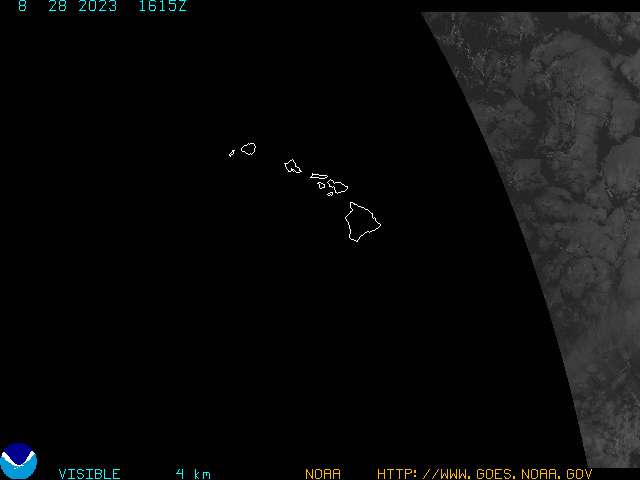

Sandy Says:
Glen are you out there??? We are leaving on Saturday and are really worried about the winds and rain. We’ll be in Kaanapali. What can you tell us?~~~Hi Sandy, yes I’m out here, but was without a computer on Oahu until just now, Thursday evening. It will be getting windy, but likely not until Sunday…so I think you will be fine on Saturday. Aloha, Glenn
Janet Says:
Hi Glen,
Couldn’t see Kahoolawe from S. Kihei today – really bad vog.~~~Hi Janet, I just got back from Oahu, and it was lightly voggy over there too. Thanks for your report. Aloha, Glenn