











February 17-18, 2010
Air Temperatures – The following maximum temperatures were recorded across the state of Hawaii Wednesday afternoon:
Lihue, Kauai – 73
Honolulu, Oahu – 74
Kaneohe, Oahu – 74
Kaunakakai, Molokai – 73
Kahului, Maui – 77
Hilo, Hawaii – 75
Kailua-kona – 82
Air Temperatures ranged between these warmest and coolest spots near sea level around the state – and on the highest mountains…at 5pm Wednesday evening:
Honolulu, Oahu – 77F
Princeville, Kauai – 68
Haleakala Crater – 46 (near 10,000 feet on Maui)
Mauna Kea summit – 36 (near 14,000 feet on the Big Island)
Precipitation Totals – The following numbers represent the largest precipitation totals (inches) during the last 24 hours on each of the major islands, as of Wednesday afternoon:
0.25 Kokee, Kauai
0.07 Makaha Stream, Oahu
0.10 Molokai
0.00 Lanai
0.00 Kahoolawe
0.07 Wailuku, Maui
0.12 Kawainui Stream, Big Island
Marine Winds – Here’s the latest (automatically updated) weather map showing a cold front dissipating to the southeast of the Big Island. A new high pressure system is moving into the area northwest of Kauai. This pressure configuration will keep NE to ENE winds blowing through Friday.
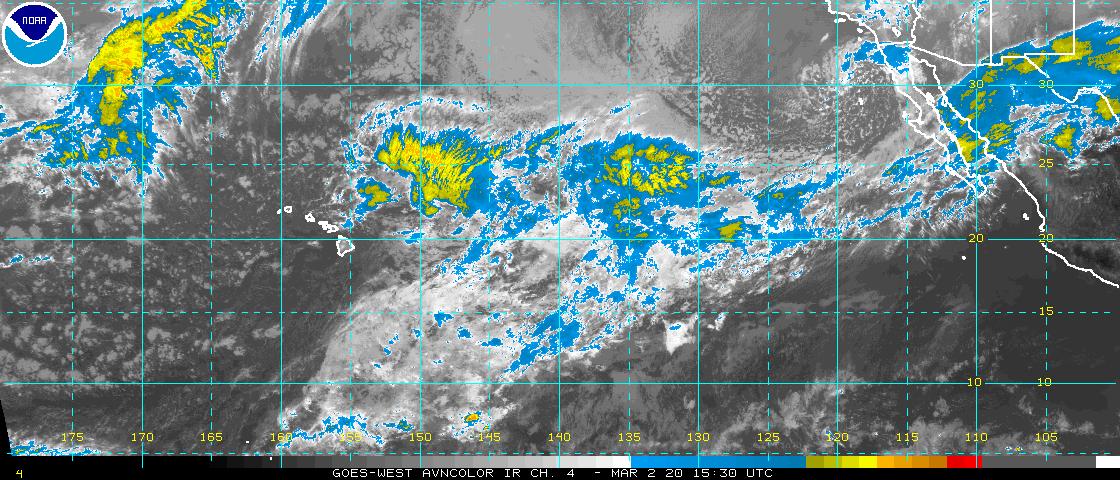
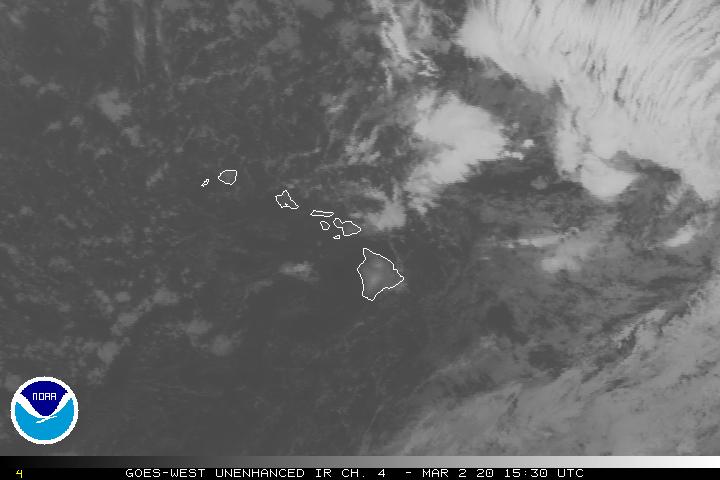
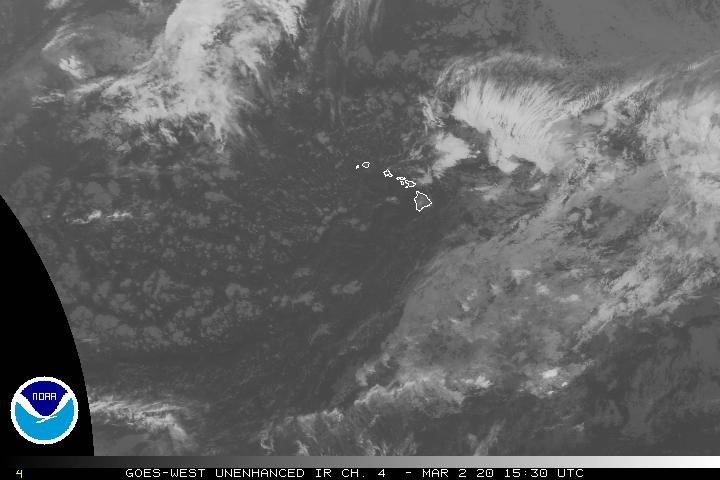
Satellite and Radar Images: To view the cloud conditions we have here in Hawaii, please use the following satellite links, starting off with this Infrared Satellite Image of the islands to see all the clouds around the state during the day and night. This next image is one that gives close images of the islands only during the daytime hours, and is referred to as a Close-up visible image. This next image shows a larger view of the Pacific…giving perspective to the wider ranging cloud patterns in the Pacific Ocean. Finally, here’s a Looping IR satellite image, making viewable the clouds around the islands 24 hours a day. To help you keep track of where any showers may be around the islands, here’s the latest animated radar image.
Hawaii’s Mountains – Here’s a link to the live webcam on the summit of near 14,000 foot Mauna Kea on the Big Island of Hawaii. The tallest peak on the island of Maui is the Haleakala Crater, which is near 10,000 feet in elevation. These two webcams are available during the daylight hours here in the islands…and when there’s a big moon rising just after sunset for an hour or two! Plus, during the nights and early mornings you will be able to see stars, and the sunrise too…depending upon weather conditions.
Tropical Cyclone activity in the eastern and central Pacific – Here’s the latest weather information coming out of the National Hurricane Center, covering the eastern north Pacific. You can find the latest tropical cyclone information for the central north Pacific (where Hawaii is located) by clicking on this link to the Central Pacific Hurricane Center. Here’s a tracking map covering both the eastern and central Pacific Ocean. A satellite image, which shows the entire ocean area between Hawaii and the Mexican coast…can be found here.
Aloha Paragraphs

Hawaiian Hula Dancer
A weakening cold front has passed down the island chain…and is dissipating to the southeast of the Big Island Wednesday evening.
The cold front brought a few showers, although as expected, not many. The mountains on Kauai and Oahu got the most rainfall, although even there, it ended up being around a quarter of an inch at most. This IR satellite image shows the rather extensive low stratus clouds, which are covering most of the windward areas…having swept in behind the cold front. These clouds diminished quite a bit during the day, although often thicken again during the night. If we look at an even larger view of the central Pacific, using this IR satellite picture, we can see a vast area of high cirrus clouds to our south-southwest as well. These cirrus clouds are associated with a large area of disturbed weather in the deeper tropics to Hawaii’s south.
The overlying atmosphere is dry and stable now, limiting precipitation…despite the low clouds that will be around locally. These low stratus clouds will likely bring only small drop rainfall (drizzle and mist) to the windward sides. There might be a few light showers sneaking over into the leeward areas…on the cool NE winds. Here’s a looping radar image so we can see where any of these drizzles or mists are occurring.
These winds will warm up and slow down, as they become easterly trade winds Friday into the weekend. Our winds will become lighter from the southeast late this coming Sunday into next Monday…ahead of the next cold front around next Wednesday. The current idea is that next week’s cold front, will act a lot like the one we’ve just seen passing through, followed by more chilly winds.
It’s Wednesday evening, as I begin writing the last section of today’s narrative. As noted in the paragraphs above, there will be clouds, and cool winds, although not very many showers to speak of. Wednesday was a relatively cool day, as air temperatures were restricted to the 70F’s. As if often the case when cool north breezes are blowing however, the Kona coast is sheltered from these winds, by the tall mountains on the Big Island…thus the warmer 82 degrees there this afternoon. Speaking of these winds, they were locally quite gusty today, approaching 40 mph locally at times. At the 5pm hour, winds were still gusting up above 30 mph in a few locations. ~~~ Looking out the window here in Kihei, before I take the drive back home to Kula, it’s generally clear. The Haleakala Crater, or at least the whole western slope of the mountain, was completely cloud free. Looking over towards the windward sides, there are those low clouds that I wrote about above. Kihei is windy, a cool breezy reality, as it has been all day. I talked to my neighbors during the day, up in Kula, and they said that there was a chill wind blowing up there too…with temperatures barely making it into the lower 60’s. I’m going up there right now, to either take a walk, or to take a bike ride, which ever I have time for. I’ll be back early Thursday morning with your next new narrative, I hope you can join me again then! Aloha for now…Glenn.
Interesting: What a difference a rain makes. The nationwide drought that had farmers, communities and entire states fighting to conserve water has reversed in the most dramatic turnaround since federal scientists began keeping records. More than 92% of the country is drought-free — the nation’s best showing since 1999.
"The lack of drought is extraordinary," said Douglas Le Comte, a meteorologist with the federal Climate Prediction Center. At the worst of the USA’s most recent drought — in August 2007 — almost 50% of the country was involved. Currently, about 7% of the country is in a drought, according to federal scientists.
The only part of the USA in "extreme" drought is a small fraction of Hawaii. In 2007, gigantic portions of the Southeast were in the worst drought in more than a century, sparking water wars among Georgia, Alabama and Florida. "It was horrid," said Teresa Hammack of Mars Hill, N.C., whose springs ran dry in August 2007 at the height of the Southeast drought.
Hammack’s home relies entirely on underground springs as a source of water. "Our springs are running rampant, with clean, fresh water," she said. There have been less than half a dozen occasions since the late 1800s when drought has been as sparse as it is now, Le Comte said.
Even before this month’s massive snowfall totals, relief has come in a number of different ways:
• The West has been helped this winter by a Pacific train of storm systems laden with ample moisture. The storms, caused by the ongoing El Niño climate pattern, brought lots of rain and snow to the Southwest, including the normally arid deserts of Southern California and eastern Arizona, according to the U.S. Drought Monitor.
• The southern drought (across Texas, Louisiana and Florida) was eased by a very wet fall and winter, said David Miskus, a meteorologist with the Climate Prediction Center.
• Drought relief in the Southeast started a year or two ago, Miskus said. A number of wet weather systems, including Tropical Storm Fay in August 2008, chipped away at the drought, Le Comte said. By the spring of 2009, a number of soaking weather systems ended the drought in the Georgia area, he said. "I guess it was time for Mother Nature to make up for the long-term subnormal precipitation with deluges," Miskus said.
In drought-plagued California, the "meteorological drought is pretty much over," said Le Comte. However, hydrological drought – meaning a shortfall in water supply – remains a concern in the Golden State. The state is still "looking at a deficit in soil moisture," reports hydrologist Mike Mierzwa of the California Department of Water Resources. "We’re still not caught up yet."
According to the federal Drought Monitor, California reservoir levels, after being down from several consecutive years of subnormal rain and snow, have started to recover, although most reservoirs have not reached normal capacity. "We’ve gone from a very scary situation to an OK situation," said Jeffrey Kightlinger, general manager of the Metropolitan Water District of Southern California. "If it stays wet, we’ll stay in an OK situation."
Interesting2: Chile’s Chaiten volcano has been placed under red alert due to an increase in seismic activity for three weeks, the Chilean government said. The volcano in southern Chile became active in May 2008 after being dormant for more than 9,000 years. Volcanic activity was on the decline in the past few months until picking back up January 21, the Chilean Interior Ministry said in a news release Monday.
The red alert, which indicates activity is above normal levels and an eruption could be imminent, was enacted in large part to protect tourists in the area, said Carmen Fernandez, director of Chile’s National Emergency Office. Underground seismic rumblings 1.2 to 5 miles deep in the area around the volcano and constant gas eruptions in the dome indicate "a high grade of instability," the National Emergency Office said.
Interesting3: Yemeni water trader Mohammed al-Tawwa runs his diesel pumps day and night, but gets less and less from his well in Sanaa, which experts say could become the world’s first capital city to run dry. "My well is now 1,300 feet deep and I don’t think I can drill any deeper here," said Tawwa, pointing to the meager flow into tanks that supply water trucks and companies.
From dawn, dozens of people with yellow jerricans collect water from a special canister Tawwa has set aside for the poor. "Sometimes we don’t have any water for a whole week, sometimes for two days and then it stops again," said Talal al-Bahr, who comes almost daily to supply his family of six.
The West frets that al Qaeda will exploit instability in Yemen to prepare new attacks like the failed December 25 bombing of a U.S. airliner, but this impoverished Arabian peninsula country faces a catastrophe that poses a far deadlier long-term threat. Nature cannot recharge ground water to keep pace with demand from a population of 23 million expected to double in 20 years.
Interesting4: What if it were possible to go to the store and buy a kit to quickly and accurately diagnose cancer, similar to a pregnancy test? A University of Missouri researcher is developing a tiny sensor, known as an acoustic resonant sensor, that is smaller than a human hair and could test bodily fluids for a variety of diseases, including breast and prostate cancers.
"Many disease-related substances in liquids are not easily tracked," said Jae Kwon, assistant professor of electrical and computer engineering at MU. "In a liquid environment, most sensors experience a significant loss of signal quality, but by using highly sensitive, low-signal-loss acoustic resonant sensors in a liquid, these substances can be effectively and quickly detected — a brand-new concept that will result in a noninvasive approach for breast cancer detection."
Kwon’s real-time, special acoustic resonant sensor uses micro/nanoelectromechanical systems (M/NEMS), which are tiny devices smaller than the diameter of a human hair, to directly detect diseases in body fluids. The sensor doesn’t require bulky data reading or analyzing equipment and can be integrated with equally small circuits, creating the potential for small stand-alone disease-screening systems.
Kwon’s sensor also produces rapid, almost immediate results that could reduce patient anxiety often felt after waiting for other detection methods, such as biopsies, which can take several days or weeks before results are known. "Our ultimate goal is to produce a device that will simply and quickly diagnose multiple specific diseases, and eventually be used to create ‘point of care’ systems, which are services provided to patients at their bedsides," Kwon said.
"The sensor has strong commercial potential to be manifested as simple home kits for easy, rapid and accurate diagnosis of various diseases, such as breast cancer and prostate cancer."
Interesting5: NASA tracks asteroids all the time. They are difficult or impossible for the rest of us to ever glimpse. Now, the most prominent asteroid in the sky can be seen with binoculars — and perhaps even the naked eye, if you are in an area with reasonably dark skies at night. Tonight, Wednesday, February 17, Vesta, the second most massive object in the asteroid belt, reaches what astronomers like to call "opposition."
An asteroid (or planet or comet) is said to be "in opposition" when it is opposite to the sun as seen from Earth. In other words, if you were to stand outside with the sun directly above you at high noon, Vesta would be directly below your feet some 131,700,000 miles away. With Vesta at opposition, the asteroid is at its closest point to Earth in its orbit. The asteroid is expected to shine at magnitude 6.1.
That brightness should make it visible to interested parties brandishing telescopes or binoculars, and even those blessed with excellent vision and little or no light pollution or clouds in their vicinity. Vesta will be visible in the eastern sky in the constellation Leo. What makes this space rock so prominent these days? Along with its relative proximity at this point, a full half of the asteroid is being bathed by sunlight when seen from Earth, making it appear brighter.
Another attribute working in the observer’s favor is that Vesta has a unique surface material that is not as dark as most main belt asteroids – allowing more of the sun’s rays to reflect off its surface. If spotting Vesta in the night sky has whetted your appetite for mega-rocks, all we can say is, stay tuned. NASA’s Dawn spacecraft, currently motoring its way through the asteroid belt, will begin its exploration of Vesta in the summer of 2011.
 Email Glenn James: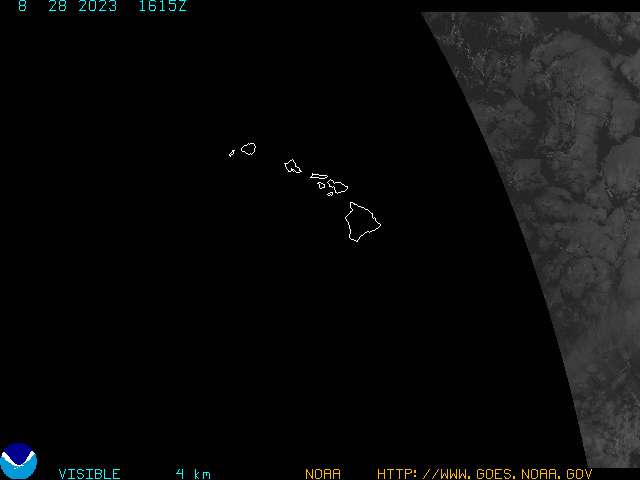

Glenn Says:
Peter’s Tonga link should read http://www.tongacharter.com/cyclone-rene.htm
Glenn~~~thanks for the clarification Glenn, Aloha, Glenn
peter milbourn Says:
Some pix of cyclone rene from our friends in tonga. http://wwwtongacharter.com click amazing photos.~~~Thanks Peter, looks like that storm hit hard, with another trying to spin up near you again soon. Aloha, Glenn