February 16-17, 2010
Air Temperatures – The following maximum temperatures were recorded across the state of Hawaii Tuesday afternoon:
Lihue, Kauai – 77
Honolulu, Oahu – 84
Kaneohe, Oahu – 78
Kaunakakai, Molokai – 75
Kahului, Maui – 81
Hilo, Hawaii – 82
Kailua-kona – 80
Air Temperatures ranged between these warmest and coolest spots near sea level around the state – and on the highest mountains…at 5pm Tuesday evening:
Kailua-kona – 79F
Lihue, Kauai – 72
Haleakala Crater – 50 (near 10,000 feet on Maui)
Mauna Kea summit – 39 (near 14,000 feet on the Big Island)
Precipitation Totals – The following numbers represent the largest precipitation totals (inches) during the last 24 hours on each of the major islands, as of Tuesday afternoon:
0.01 Port Allen, Kauai
0.04 Waimanalo, Oahu
0.00 Molokai
0.00 Lanai
0.00 Kahoolawe
0.01 Mahinahina, Maui
0.24 Waiakea Uka, Big Island
Marine Winds – Here’s the latest (automatically updated) weather map showing a cold front moving into the state from the northwest. A new high pressure system will move into place by Wednesday. This pressure configuration will bring stronger northerly to NE winds, bringing rough ocean conditions…and larger waves along the north shores.
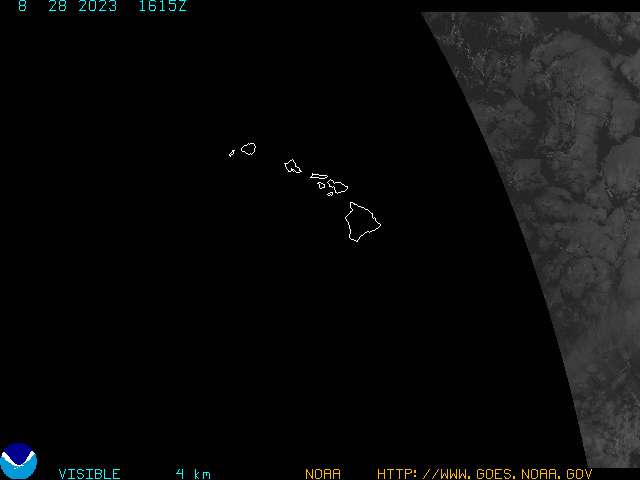
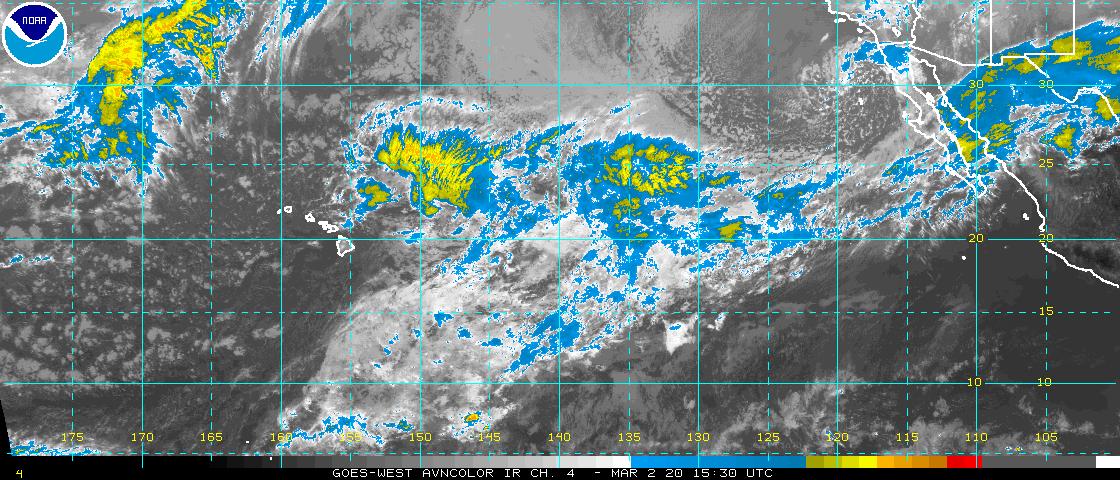
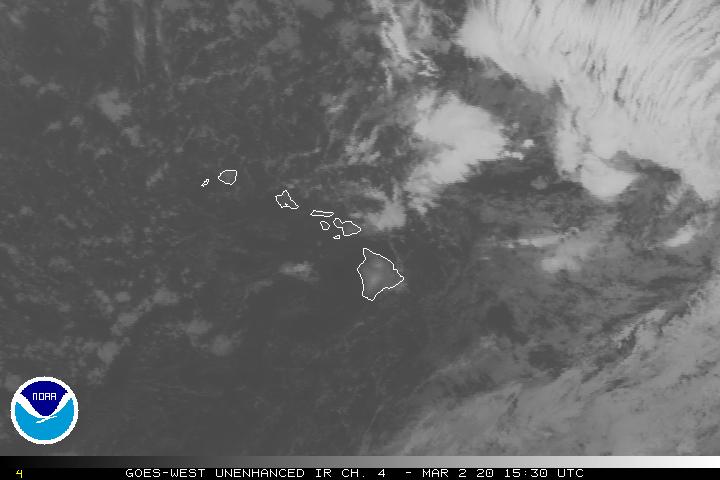
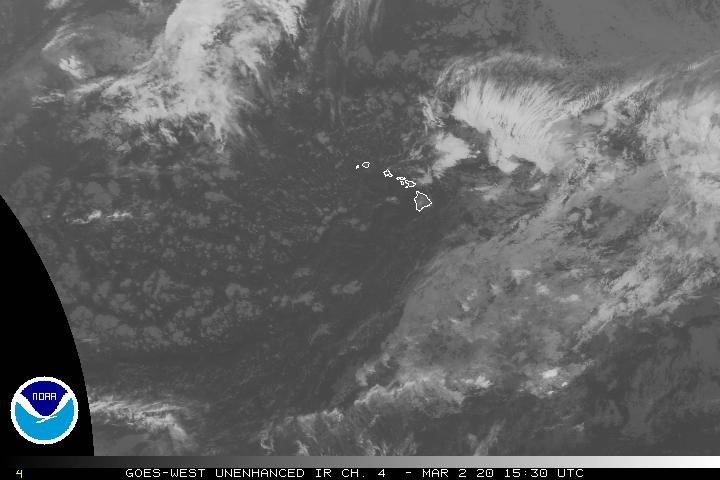
Satellite and Radar Images: To view the cloud conditions we have here in Hawaii, please use the following satellite links, starting off with this Infrared Satellite Image of the islands to see all the clouds around the state during the day and night. This next image is one that gives close images of the islands only during the daytime hours, and is referred to as a Close-up visible image. This next image shows a larger view of the Pacific…giving perspective to the wider ranging cloud patterns in the Pacific Ocean. Finally, here’s a Looping IR satellite image, making viewable the clouds around the islands 24 hours a day. To help you keep track of where any showers may be around the islands, here’s the latest animated radar image.
Hawaii’s Mountains – Here’s a link to the live webcam on the summit of near 14,000 foot Mauna Kea on the Big Island of Hawaii. The tallest peak on the island of Maui is the Haleakala Crater, which is near 10,000 feet in elevation. These two webcams are available during the daylight hours here in the islands…and when there’s a big moon rising just after sunset for an hour or two! Plus, during the nights and early mornings you will be able to see stars, and the sunrise too…depending upon weather conditions.
Tropical Cyclone activity in the eastern and central Pacific – Here’s the latest weather information coming out of the National Hurricane Center, covering the eastern north Pacific. You can find the latest tropical cyclone information for the central north Pacific (where Hawaii is located) by clicking on this link to the Central Pacific Hurricane Center. Here’s a tracking map covering both the eastern and central Pacific Ocean. A satellite image, which shows the entire ocean area between Hawaii and the Mexican coast…can be found here.
Aloha Paragraphs

Cooler weather into Wednesday…locally windy
Tuesday was a generally clear day, with light winds on most islands.
This favorably inclined weather reality will be changing soon however, as a quickly weakening cold front is moving through the state from the northwest. This IR satellite image shows both the generally clear skies ahead of the front, and frontal cloud band too. This cold front will be trying to move through the entire state, although its still a coin toss to know exactly how far it will get…during the night. If we look at an even larger view of the central islands, using this IR satellite picture, we can see a large area of high cirrus clouds far to our southwest as well. These cirrus clouds are associated with a giant area of thunderstorms, with cloud tops all the way up to 55,000+ feet!
Meanwhile, our weather was near perfect Tuesday…ahead of the cold front that is. We saw clouds increase over Niihau and Kauai today, reaching
It’s Tuesday evening, as I begin writing the last section of today’s narrative. As noted in the paragraphs above, our weather is changing now, going through another one of those tropical cooler phases. The winds will become locally rather blustery too, along with some fairly minor showers…most of which will end up along the windward sides. It may in fact be time to remember where that extra blanket is, although Monday night wasn’t exactly not cold was it! Many places near sea level dipped into the 50F’s early Tuesday morning, and into the mid 40’s upcountry in places. ~~~ Looking out the windows here in Kihei, Maui, it’s near totally clear, with both the West Maui Mountains, and the Haleakala Crater…both cloudless just before sunset! Looking at radar, we see some showers associated with the cold front, as evidenced by this looping radar image. The cold front was over Oahu at the time of this writing, and will pass over Maui County tonight…hopefully bringing a few showers to the Big Island Wednesday morning. Speaking of which, I’ll be back early in the morning with your next new weather narrative. I hope you have a great Tuesday night until then! Aloha for now…Glenn.
Interesting: Electric cars have many merits: They are quieter and require less maintenance than cars with internal combustion engines. A network of smartly located charging stations covering the entire Harz region in Germany is designed to make electric cars a regional feature. The Harz region is banking on electric cars.
Electric cars will soon be rolling through Quedlinburg, Werningerode and other cities in the region. Seventeen partners from research, academia and industry have committed themselves to this with their project Harz. ErneuerbareEnergien-mobility or Harz.EE-mobility for short. The success of electric cars will stand or fall with the power supply.
The ability to charge vehicles with green power anytime and anywhere will boost acceptance of this technology. Hence, charging stations will have to be located astutely enough that electric cars will even be able to reach a city sixty kilometers away without any problem. Researchers at the Fraunhofer Institute for Factory Operation and Automation IFF in Magdeburg are determining the optimal locations for charging stations.
Interesting2: Plans to use concentrating solar power plants in the Sahara to generate and export electricity have been on the table for years. Now, it looks as though political will might help move things forward. The logic of the idea would seem obvious to a child: the human race needs to wean itself off fossil fuels, so why don’t we build solar power plants in the world’s deserts, to give us all the energy we need?
This concept has long been promoted by Desertec, a European network of scientists and engineers, which argues that just 1 per cent of the surface area of the world’s deserts could generate as much electricity as the world is now using.
Desertec envisages a massive deployment of solar technology in Middle Eastern and North African countries, exporting electricity to Europe. The vision may seem idealistic, but there have been signs recently that politicians and industry are starting to take the Desertec proposals seriously.
Interesting3: Less than two months after it was hastily drafted to stave off a fiasco, the Copenhagen Accord on climate change is in a bad way, and some are already saying it has no future. The deal was crafted amid chaos by a small group of countries, led by the United States and China, to avert an implosion of the UN’s December 7-18 climate summit.
Savaged at the time by green activists and poverty campaigners as disappointing, gutless or a betrayal, the Accord is now facing its first test in the political arena — and many views are caustic. Veterans say the document has little traction and cannot pull the 194-nation UN Framework Convention on Climate Change (UNFCCC) towards a new global pact by year’s end.
Political momentum is so weak that so far only two negotiating rounds have been rostered in 2010, one among officials in Bonn in mid-year, the other in Mexico at ministerial level in December. Worse, the Accord itself already seems to have been quietly disowned by China, India and other emerging economies just weeks after they helped write it, say these sources.
The Accord’s supporters say it is the first wide-ranging deal to peg global warming to 3.6F and gather rich and poor countries in specific pledges for curbing carbon emissions. And it promises money: 30 billion dollars for climate-vulnerable poor countries by 2012, with as much as 100 billion dollars annually by 2020.
Critics say there is no roadmap for reaching the warming target and point out the pledges are voluntary, whereas the Kyoto Protocol — which took effect five years ago next Tuesday — has tough compliance provisions for rich polluters.
Interesting4: A surprising new study finds that during the past century the frequency of fog along California’s coast has declined by approximately three hours a day. Published in the Proceedings of the National Academy of Sciences the researchers are concerned that this decrease in fog threatens California’s giant redwoods and the unique ecosystem they inhabit.
"As fog decreases, the mature redwoods along the coast are not likely to die outright, but there may be less recruitment of new trees; they will look elsewhere for water, high humidity and cooler temperatures," explains coauthor Todd E. Dawson, professor of integrative biology and University of California, Berkeley professor of integrative biology with the Department of Environmental Science, Policy and Management (ESPM).
"What does that mean for the current redwood range and that of the plants and animals with them?" he adds. Evaluating data from airports along the northern California coast, researchers were able to find a steady link in the occurrence of coastal fog and large temperature differences between coast and inland areas.
Then by examining temperature data from 114 stations up and down the Pacific Coast, the researchers found that the temperature contrasts between coast and inland areas had shrunk over the past century leading to a decline in fog. "Since 1901, the average number of hours of fog along the coast in summer has dropped from 56 percent to 42 percent," explains study leader James A. Johnstone, a postdoctoral scholar at UC Berkeley’s Department of Environmental Science, Policy and Management (ESPM).
"A cool coast and warm interior is one of the defining characteristics of California’s coastal climate, but the temperature difference between the coast and interior has declined substantially in the last century, in step with the decline in summer fog." This drop in fog occurrence along with the change in temperature contrasts means that "coast redwood and other ecosystems along the U.S. West Coast may be increasingly drought-stressed, with a summer climate of reduced fog frequency and greater evaporative demand," adds Dawson.
"Fog prevents water loss from redwoods in summer, and is really important for both the tree and the forest. If the fog is gone, we might not have the redwood forests we do now." Johnstone and his colleagues are uncertain whether the temperature changes, and thereby the decline in fog, is apart of a natural cycle or linked to human impacts such as climate change.
But in order to find the answer they plan to next look at redwood tree ring data and stable isotopes from redwood cellulose to construct the past climate of the coast. "Redwoods live for more than 2,000 years, so they could be a very important indicator of climate patterns and change along the coast," Dawson says. Only 5 percent of primary growth redwood forests survive today; the rest has been logged or developed.
According to Save the Redwoods League, eighteen percent of the remaining coastal redwood forests are protected, the rest lies either on private land or in natural forests, which could be logged in the future. Save the Redwoods League, along with Berkeley Atmospheric Sciences, funded the study.
Interesting5: The U.N. panel of climate experts overstated how much of the Netherlands is below sea level, according to a preliminary report on Saturday, admitting yet another flaw after a row last month over Himalayan glacier melt. A background note by the Intergovernmental Panel on Climate Change (IPCC) said a 2007 report wrongly stated that 55 percent of the country was below sea level since the figure included areas above sea level, prone to flooding along rivers.
The United Nations has said errors in the 2007 report of about 3,000 pages do not affect the core conclusions that human activities, led by burning fossil fuels, are warming the globe. "The sea level statistic was used for background information only, and the updated information remains consistent with the overall conclusions," the IPCC note dated February 12 said.
Skeptics say errors have exposed sloppiness and over-reliance on "grey literature" outside leading scientific journals. The panel’s reports are a main guide for governments seeking to work out costly policies to combat global warming. The 2007 report included the sentence: "The Netherlands is an example of a country highly susceptible to both sea level rise and river flooding because 55 percent of its territory is below sea level."
"A preliminary analysis suggests that the sentence discussed should end with: ‘because 55 percent of the Netherlands is at risk of flooding’," the IPCC note said. The Netherlands Environmental Assessment Agency, the original source of the incorrect data, said on February 5 that just 26 percent of the country is below sea level and 29 percent susceptible to river flooding.
Interesting6: An examination of mineral deposits in a coastal cave on the Spanish island of Mallorca shows evidence of rapid rises and declines in sea level as the planet warmed and cooled. Reporting in the journal Science, University of Iowa researchers said that studies of the mineral, calcite — deposited by sea water on the inside of a seaside cave, like rings on a bathtub — showed that roughly 81,000 years ago sea levels jumped by more than 6 feet a century during a warm period, and then dropped during a subsequent cooling cycle at a similar rate — 66 feet per 1,000 years.
CO2 levels during that period were lower than they are today, but temperatures rose because the Earth’s orbit placed it in a position where it received more of the sun’s energy, the study said. Jeffrey Dorale, a geoscientist at the University of Iowa and the lead author of the paper, said that his study underscored similar findings from other researchers about the volatility of sea level rise as the Earth’s ice sheets form and melt.
"It’s fair to say that this means glaciers may change somewhat faster than we once inferred," said Dorale. "It does suggest there can be very fast melting and very fast ice building at times when CO2 levels were lower than now."
Interesting7: Most Americans like the idea of conservation, but few practice it in their everyday lives, according to the results of a national survey released February 16 by researchers at Yale and George Mason universities. A majority of Americans say that it is "very important" or "somewhat important" to turn off unneeded lights (92 percent), to lower the thermostat in winter (83 percent), and to use public transportation or a carpool (73 percent), among other conservation behaviors.
Yet the study found that:
• 88 percent of Americans say it is important to recycle at home, but only 51 percent "often" or "always" do-
• 81 percent say it is important to use re-usable shopping bags, but only 33 percent "often" or "always" do-
• 76 percent say it is important to buy locally grown food, but only 26 percent "often" or "always" do-
• 76 percent say it is important to walk or bike instead of drive, but only 15 percent "often" or "always" do-
• 72 percent of Americans say it is important to use public transportation or carpool, but only 10 percent say they "often" or "always" do.
"There are many possible explanations for the gap between people’s attitudes and their actual behavior," said Anthony Leiserowitz, director of the Yale Project on Climate Change. "For example, public transportation may not be locally available or convenient. Overcoming barriers such as these will make it much easier for people to act in ways consistent with their values."
The survey also found that approximately 33 percent of Americans in the past year rewarded companies that are taking steps to reduce global warming by buying their products, while slightly less refused buying the products of companies that they perceive to be recalcitrant on the issue. Finally, 11 percent of Americans have contacted government officials in the past year about global warming, with seven in 10 urging officials to take action to reduce it.
"When it comes to taking a stand against global warming, concerned Americans are much more likely to take action through consumer purchases rather than as citizens," said Edward Maibach, director of the Center for Climate Change Communication at George Mason University. "This lack of citizen engagement may help to explain why Congress is being so timid in addressing climate change."
The results come from a nationally representative survey of 1,001 American adults, age 18 and older. The sample was weighted to correspond with U.S. Census Bureau parameters. The margin of sampling error is plus or minus 3 percent, with 95 percent confidence. The survey was designed by researchers at Yale and George Mason universities and conducted from December 24, 2009, to January 3, 2010, by Knowledge Networks, using an online research panel of American adults.
 Email Glenn James: