











February 10-11, 2010
Air Temperatures – The following maximum temperatures were recorded across the state of Hawaii Wednesday afternoon:
Lihue, Kauai – 79
Honolulu, Oahu – 82
Kaneohe, Oahu – 79
Kaunakakai, Molokai – 79
Kahului, Maui – 81
Hilo, Hawaii – 80
Kailua-kona – 82
Air Temperatures ranged between these warmest and coolest spots near sea level around the state – and on the highest mountains…at 4pm Wednesday afternoon:
Kailua-kona – 81F
Lihue, Kauai – 70
Haleakala Crater – 57 (near 10,000 feet on Maui)
Mauna Kea summit – 43 (near 14,000 feet on the Big Island)
Precipitation Totals – The following numbers represent the largest precipitation totals (inches) during the last 24 hours on each of the major islands, as of Wednesday afternoon:
0.01 Hanalei River, Kauai
0.03 Waimanalo, Oahu
0.00 Molokai
0.00 Lanai
0.00 Kahoolawe
0.12 Oheo Gulch, Maui
0.02 Glenwood, Big Island
Marine Winds – Here’s the latest (automatically updated) weather map showing high pressure systems located far to the east-northeast and west-northwest. At the same time, a weakening cold front will be dissipating near Maui County Thursday. This will keep trade winds blowing…strengthening Thursday into Friday.
Satellite and Radar Images: To view the cloud conditions we have here in Hawaii, please use the following satellite links, starting off with this Infrared Satellite Image of the islands to see all the clouds around the state during the day and night. This next image is one that gives close images of the islands only during the daytime hours, and is referred to as a Close-up visible image. This next image shows a larger view of the Pacific…giving perspective to the wider ranging cloud patterns in the Pacific Ocean. Finally, here’s a Looping IR satellite image, making viewable the clouds around the islands 24 hours a day. To help you keep track of where any showers may be around the islands, here’s the latest animated radar image.
Hawaii’s Mountains – Here’s a link to the live webcam on the summit of near 14,000 foot Mauna Kea on the Big Island of Hawaii. The tallest peak on the island of Maui is the Haleakala Crater, which is near 10,000 feet in elevation. These two webcams are available during the daylight hours here in the islands…and when there’s a big moon rising just after sunset for an hour or two! Plus, during the nights and early mornings you will be able to see stars, and the sunrise too…depending upon weather conditions.
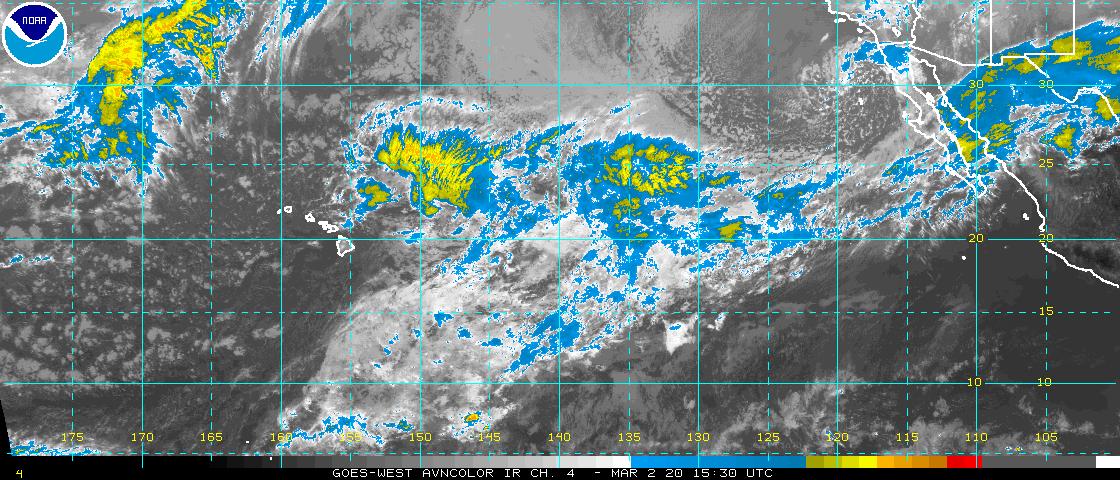
Tropical Cyclone activity in the eastern and central Pacific – Here’s the latest weather information coming out of the National Hurricane Center, covering the eastern north Pacific. You can find the latest tropical cyclone information for the central north Pacific (where Hawaii is located) by clicking on this link to the Central Pacific Hurricane Center. Here’s a tracking map covering both the eastern and central Pacific Ocean. A satellite image, which shows the entire ocean area between Hawaii and the Mexican coast…can be found here.
Aloha Paragraphs
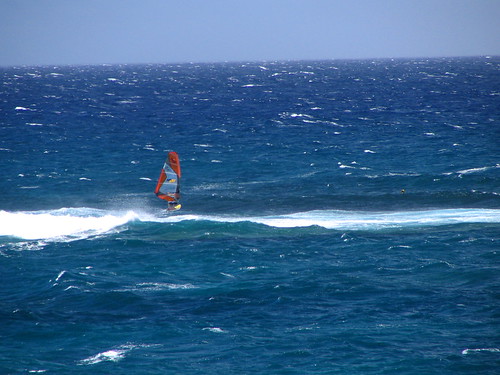
Trade winds…and lots of surf action Thursday
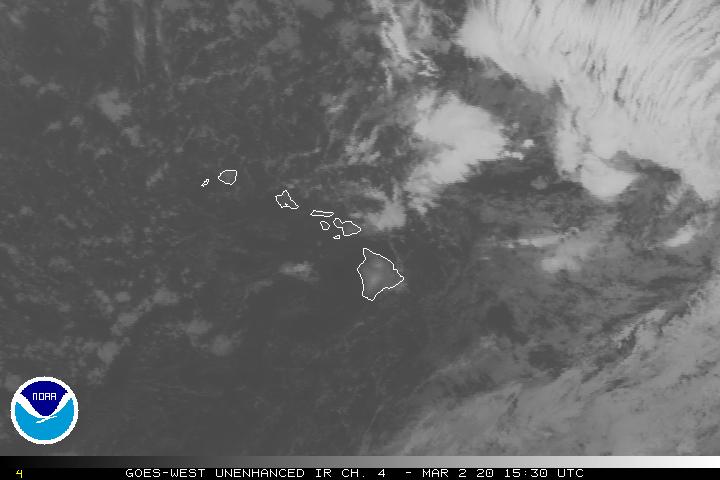
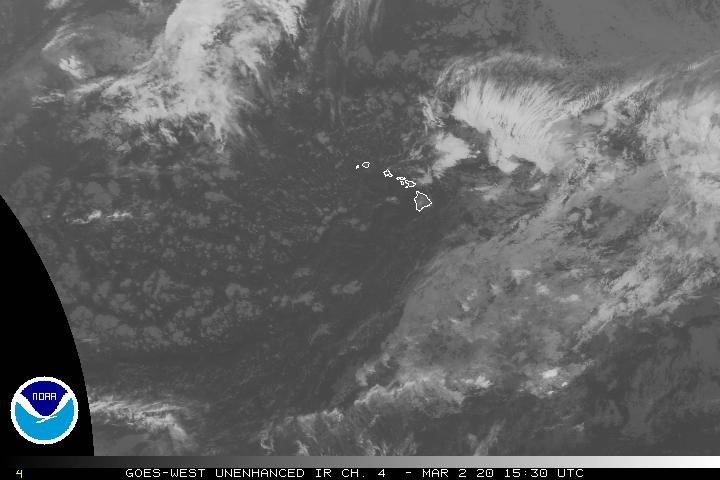
The trade winds will continue blowing through the rest of this week…into at least early next week. A dissipating cold front has passed over Kauai Wednesday afternoon, and will be crossing Oahu, on its way towards Molokai into Thursday. This frontal cloud band will stall somewhere in Maui County, missing the Big Island once again. This frontal cloud isn’t very productive in bringing showers, and most of those, will fall along the windward sides of the islands. We can see what this cold front looks like by glancing at this IR satellite image. We can see how spare the moisture is by using this looping radar image.
Following this weak front, we’ll find strengthening trade winds into Friday. Our local weather will remain on the good side though, with just those windward showers over all the islands. As we move into Friday and the upcoming weekend we’ll see the trade winds continuing, blowing generally in the moderately strong levels. The leeward sides will be in good shape for the most part, with little, if any showers. Air temperatures will be warm, although with the brisk trade winds coming out of the northeast direction, it may feel a little chilly at first. Nonetheless, near sea level, temperatures will be in the 70F’s and lower 80’s during the day Thursday.
The big news in
It’s Wednesday evening, as I begin writing the last section of today’s narrative. As noted above, the primary focus in our Hawaiian Island weather picture now, includes the high surf, the brisk trade winds, and the generally dry conditions. The windward sides will see some shower activity…perhaps becoming more generous Thursday into the upcoming weekend. The aforementioned cold front is moving very close to the island of Oahu early this evening, again as shown on this satellite image. Because we’ve pulled our view back some, we can also see all that bright white cloudiness to the southwest of the islands. This is called cirrus clouds, and consists of ice crystals. If we put this into motion, using this animated feature we can see the frontal cloud band moving down into the state, and also see that the cirrus isn’t exactly rushing in our direction. We may see a few streaks passing overhead from time to time, in the fast paced tropical jet stream, which is transporting it along. ~~~ Here in Kihei, before I leave for the drive back upcountry, it’s just about totally clear. The entire western flank of the Haleakala Crater is cloud free, which is a nice sight! The trade winds are brisk, and I know from driving by the beach at lunch, that there are waves breaking, and the ocean is filled with white caps. There will be lots of waves around on Thursday, with the best beaches in terms of swimming, likely the east facing shores. ~~~ I’ll be back early Thursday morning with your next new weather narrative, yes from paradise! I hope you have a great Wednesday night until then! Aloha for now…Glenn.
Extra: For you folks who shop at Whole Foods stores
Interesting: The Great Lakes, as well as other aquatic systems, have seen the accidental import of many invasive species. Some, as it turns out, are stronger than the native forms which dramatically changes local conditions and not always for the good. Amidst the public battle over handling of the Asian carp threat in the Great Lakes, there is good news on the invasive species front.
A New York State appellate court dismissed a challenge brought by shipping interests against the state’s tough new ballast water requirements, which are designed to limit the introduction of more invasive species into the Great Lakes. This is the second time that the state, with help from intervening Non-Government Organizations, has successfully defended the ballast water restrictions in court.
The Asian carp is the particular culprit in this case, including the bighead carp and the silver carp. Other species include the quagga mussel that now carpets the bottom of Lake Michigan. The population of prey fish, which sustain big fish like salmon, has dropped to less than 10% of what it was before invasive mussels arrived two decades ago. An invasive species is an animal or plant that moves into a new environment, often badly disrupting it.
Invasive species are becoming more common, in part because of international trade, which allows easy and accidental transport of wildlife from one corner of the world to another, and partly due to climate change, which prompts species to migrate to more hospitable environments, often at the expense of those that already live there. The Asian carp are particularly dangerous. Native to China and parts of Southeast Asia, the freshwater carp have been cultivated for aquaculture for more than 1,000 years, often raised in submerged rice paddies.
Catfish farmers in the U.S. imported the carp decades ago to eat up the algae in their ponds; the fish slowly escaped into the wild and have been making their way up the Mississippi river. Due to the environmental threat posed by invasive species, lawyers from NRDC intervened in the shipping industry lawsuit alongside the State of New York. The Appellate Division of the New York State Supreme Court, Third Judicial Department, rejected shipping industry arguments that the New York ballast water regulations were illegal because they were stricter than the U.S. EPA’s nationwide discharge permit.
“Today’s court decision is an important victory in the ongoing saga to protect our majestic Great Lakes from invasive species.” said Marc Smith, Policy Manager with National Wildlife Federation. “Requiring the shipping industry to install effective protections against these invaders is long over due. Now more than ever do we need aggressive federal action to help reinforce New York’s leadership to ensure a more comprehensive defense policy against invasive species."
The New York court’s ruling that states have authority to adopt ballast water rules that are more protective than federal standards is consistent with the decision last year in a lower state court as well as the federal appeals court in Cincinnati to uphold Michigan’s ballast water rules against a similar shipping industry challenge.
The Great Lakes are a unique ecosystem representing 1/5 of the Earth’s surface fresh water, but the vitality of the ecosystem has been threatened by alien species that have wreaked havoc on native fish and plants. Over 150+ invasive species have been identified in the Great Lakes since the St. Lawrence Seaway opened in 1959. 65% of these invasive species introductions have been attributed to ballast water.
The Canadian and U.S. operators of the St. Lawrence Seaway have begun requiring freighters to flush their ship steadying ballast tanks with ocean saltwater to kill or expel any unwanted organisms before they arrive in the Great Lakes. Marine advocates say the flushing largely has solved the ballast problem, and point to the fact that no new species have been detected in the lakes since late 2006. Others disagree.
Interesting2: A fresh coat of paint can change a room from dreary to divine. Stains, sealants, caulks, and adhesives help you build everything from a new bathroom to a bookcase. But all these useful products can also introduce unhealthy chemicals into your home and your body. In low-VOC paint, the biggest culprit is VOCs, or "volatile organic compounds," a large class of chemicals that readily evaporate at room temperature. If you walk into a room and notice that new-paint smell, you’re breathing VOCs.
Paints, stains, sealants, caulks, and adhesives release the highest levels of VOCs when wet. But even when they feel dry to the touch, they may keep releasing these gases for days, weeks, months, even years. Meanwhile your upholstery, carpets, and drapes act like sponges, absorbing VOCs and releasing them over time. While not everyone may be bothered by exposure to these gases, they can be a serious health risk for people with chemical sensitivities, asthma, or other respiratory conditions.
Interesting3: Biodiesel refers to a vegetable oil or animal fat based diesel fuel consisting of long chain alkyl is typically made by chemically these oils with an alcohol. Biodiesel is meant to be used in standard diesel engines and is thus distinct from the vegetable and waste oils used to fuel converted diesel engines. Biodiesel can be used alone, or blended with petro-diesel.
There was a recent White House’s announcement calling for expanded production of bio-fuels, 36 billion gallons by 2022 to be exact. But more bio-fuels is only part of the equation when it comes to reducing greenhouse gas emissions and our reliance on petroleum carbon based fuels.
Vehicles must be ready and sometimes converted to this usage. Enterprise Holdings just announced that it will convert its entire fleet of Alamo Rental Car, Enterprise Rent-A-Car and National Car Rental airport shuttle buses to biodiesel by spring of this year. That’s more than 600 buses throughout more than 50 North American markets.
A system known as the "B" factor is often used to state the amount of biodiesel in any fuel mix. For example fuel containing 20% biodiesel is labeled B20, while pure biodiesel is referred to as B100. Biodiesel can also potentially be used in some boilers or furnaces as a heating fuel in domestic and commercial boilers.
In some cases there may be additional maintenance issues. EPA studied biodiesel air emissions and concluded that that unburned hydrocarbons, particulate matter and carbon monoxide are all significantly reduced. On average a B100 fuel would have 67% less unburned hydrocarbons and 47% less particulates as air emissions.
Starting immediately, Enterprise will use at least B5 (5 percent biodiesel) in all of its shuttle buses, with a higher concentration of biodiesel, B20, being used in nine markets (Boston, Chicago, Denver, Detroit, Los Angeles, Miami, Raleigh/Durham, San Diego and San Antonio).
The company plans to extend the B20 blend to the remaining markets over the next five years, with 50 percent of the change over complete by the end of next year. The carbon reduction in the first year of using biodiesel in the shuttle buses will be the equivalent of retiring 40 buses from Enterprise’s fleet. It will also reduce use of petroleum diesel by about 420,000 gallons in the first year.
Interesting4: A new University of California, Davis, study by a top ecological forecaster says it is harder than experts thought to predict when sudden shifts in Earth’s natural systems will occur — a worrisome finding for scientists trying to identify the tipping points that could push climate change into an irreparable global disaster. "Many scientists are looking for the warning signs that herald sudden changes in natural systems, in hopes of forestalling those changes, or improving our preparations for them," said UC Davis theoretical ecologist Alan Hastings.
"Our new study found, unfortunately, that regime shifts with potentially large consequences can happen without warning — systems can ‘tip’ precipitously. "This means that some effects of global climate change on ecosystems can be seen only once the effects are dramatic. By that point returning the system to a desirable state will be difficult, if not impossible."
The current study focuses on models from ecology, but its findings may be applicable to other complex systems, especially ones involving human dynamics such as harvesting of fish stocks or financial markets. Hastings, a professor in the UC Davis Department of Environmental Science and Policy, is one of the world’s top experts in using mathematical models (sets of equations) to understand natural systems.
His current studies range from researching the dynamics of salmon and cod populations to modeling plant and animal species’ response to global climate change. In 2006, Hastings received the Robert H. MacArthur Award, the highest honor given by the Ecological Society of America. Hastings’ collaborator and co-author on the new study, Derin Wysham, was previously a postdoctoral scholar at UC Davis and is now a research scientist in the Department of Computational and Systems Biology at the John Innes Center in Norwich, England.
Scientists widely agree that global climate change is already causing major environmental effects, such as changes in the frequency and intensity of precipitation, droughts, heat waves and wildfires; rising sea level; water shortages in arid regions; new and larger pest outbreaks afflicting crops and forests; and expanding ranges for tropical pathogens that cause human illness.
And they fear that worse is in store. As U.S. presidential science adviser John Holdren (not an author of the new UC Davis study) recently told a congressional committee: "Climate scientists worry about ‘tipping points’ … thresholds beyond which a small additional increase in average temperature or some associated climate variable results in major changes to the affected system."
Among the tipping points Holdren listed were: the complete disappearance of Arctic sea ice in summer, leading to drastic changes in ocean circulation and climate patterns across the whole Northern Hemisphere; acceleration of ice loss from the Greenland and Antarctic ice sheets, driving rates of sea-level increase to 6 feet or more per century; and ocean acidification from carbon dioxide absorption, causing massive disruption in ocean food webs.
 Email Glenn James: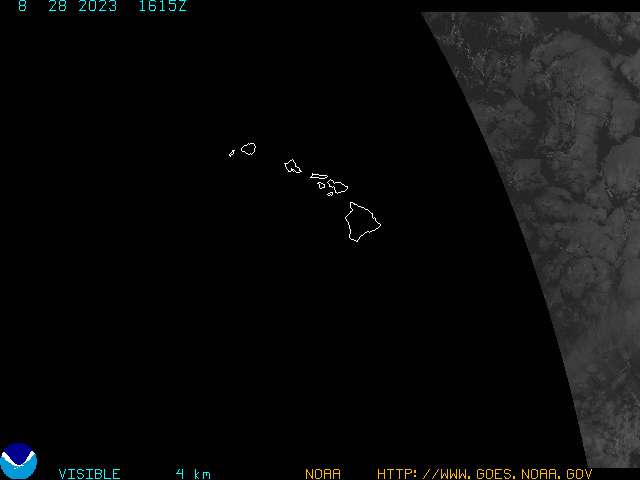

jack weber Says:
Hey Glenn and Eliza, I also appreciated seeing the Whole Foods video and passed it on to friends already. I also had the experience of dealing with the buyer for the new Maui store when i contacted her about carrying my greeting cards and books. She was totally uninterested in dealing with a local vendor! So much for their “local” is saner slogan. Seeing the Whole Foods video make the same point sealed the deal for me to stay away from this company.
On the bright side, we are getting some mild rains here, still not much to really drench the ground, but enough to keep this barely alive.
Goodnight…Jack~~~Hi Jack, it sounds as if you had a not very positive experience with WF, sorry to hear that. I still am looking forward to having them here on Maui, but will be careful about what I buy. Glad to hear that you are getting a little rain at least, we all need that! Thanks for your note from down there on the Big Island. Aloha, Glenn
Eliza Says:
Aloha Glenn –
Amazing YouTube story you posted at the end of your text, and before the Interesting stories. Thanks for the heads up… since they are about to open here. Have a nice night! Eliza~~~Hi Eliza, quite honestly, I’m disappointed, and would have probably bought some of those supposedly organic vegetables at Whole Foods, when it opens up here on Maui. I don’t buy frozen food, or vegetables in packages, but if I did, I sure be checking to see that they weren’t coming from China. Aloha, Glenn