











January 8-9, 2010
Air Temperatures – The following maximum temperatures were recorded across the state of Hawaii Friday afternoon:
Lihue, Kauai – 77
Honolulu, Oahu – 81
Kaneohe, Oahu – 78
Kaunakakai, Molokai – 81
Kahului, Maui – 82
Hilo, Hawaii – 83
Kailua-kona – 80
Air Temperatures ranged between these warmest and coolest spots near sea level around the state – and on the highest mountains…at 5pm Friday evening:
Port Allen, Kauai – 79F
Lihue, Kauai – 75
Haleakala Crater – 55 (near 10,000 feet on Maui)
Mauna Kea summit – 45 (near 14,000 feet on the Big Island)
Precipitation Totals – The following numbers represent the largest precipitation totals (inches) during the last 24 hours on each of the major islands, as of Friday afternoon:
0.05 Poipu, Kauai
0.05 Waimanalo, Oahu
0.01 Molokai
0.00 Lanai
0.02 Kahoolawe
4.54 West Wailuaiki, Maui !
0.00 Big Island
Marine Winds – Here’s the latest (automatically updated) weather map showing a weak high pressure system to the east-northeast of Hawaii. At the same time, we see a cold front approaching from the northwest. Our winds will be light southeasterly, then turning south and SW Saturday. Winds behind the cold front will be west, then northwest…finally turning north later Sunday.
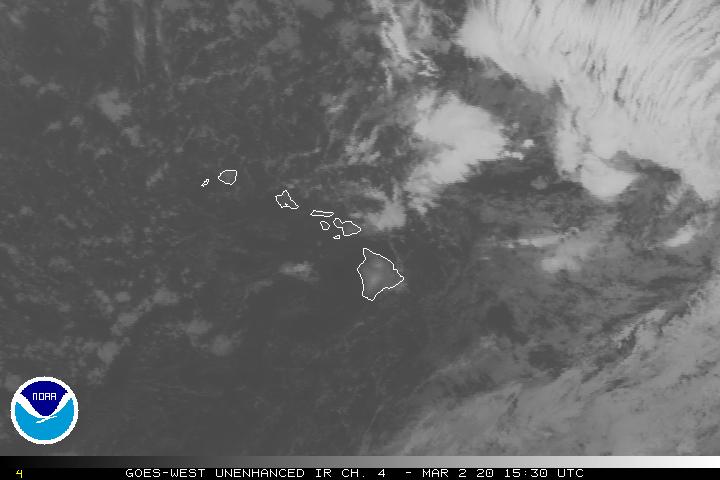
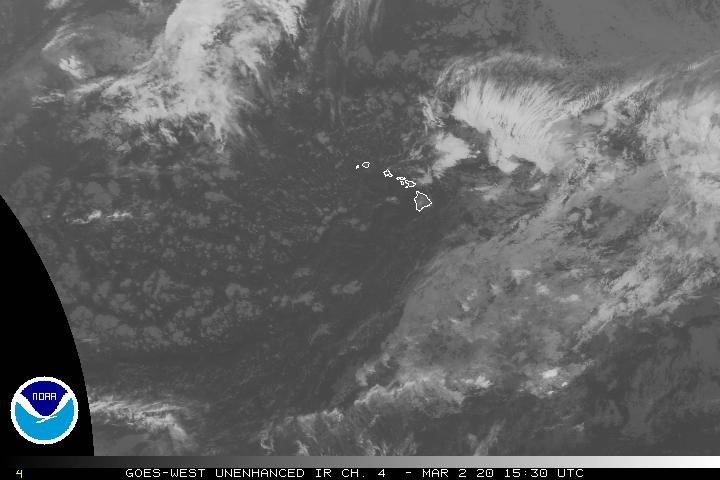
Satellite and Radar Images: To view the cloud conditions we have here in Hawaii, please use the following satellite links, starting off with this Infrared Satellite Image of the islands to see all the clouds around the state during the day and night. This next image is one that gives close images of the islands only during the daytime hours, and is referred to as a Close-up visible image. This next image shows a larger view of the Pacific…giving perspective to the wider ranging cloud patterns in the Pacific Ocean. Finally, here’s a Looping IR satellite image, making viewable the clouds around the islands 24 hours a day. To help you keep track of where any showers may be around the islands, here’s the latest animated radar image.
Hawaii’s Mountains – Here’s a link to the live webcam on the summit of near 14,000 foot Mauna Kea on the Big Island of Hawaii. The tallest peak on the island of Maui is the Haleakala Crater, which is near 10,000 feet in elevation. These two webcams are available during the daylight hours here in the islands…and when there’s a big moon rising just after sunset for an hour or two! Plus, during the nights and early mornings you will be able to see stars, and the sunrise too…depending upon weather conditions.
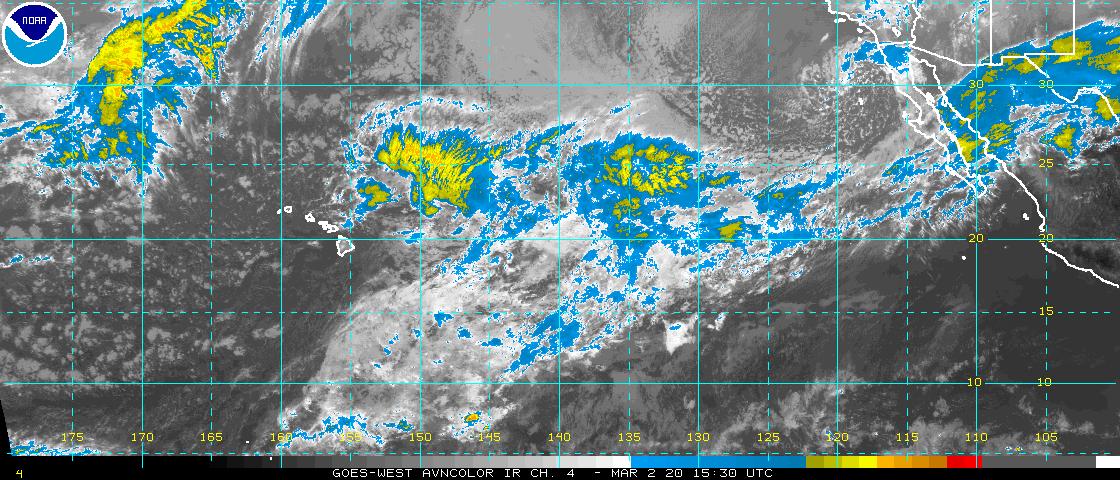
Tropical Cyclone activity in the eastern and central Pacific – Here’s the latest weather information coming out of the National Hurricane Center, covering the eastern north Pacific. You can find the latest tropical cyclone information for the central north Pacific (where Hawaii is located) by clicking on this link to the Central Pacific Hurricane Center. Here’s a tracking map covering both the eastern and central Pacific Ocean. A satellite image, which shows the entire ocean area between Hawaii and the Mexican coast…can be found here.
Aloha Paragraphs

High surf will continue to be head line news in Hawaii
We’re moving into an interesting weekend, in which Saturday should be mostly ok…with a cold front moving into the state late Saturday into Sunday. Glancing at this satellite image, we see that the most recent cold front has pretty much fallen apart. As the southeast to south winds begin blowing soon, these remnant clouds will move northward, away from the state. This in turn should make way for a pretty good Saturday. As the breezes swing around to the southeast, then south and southwest…some parts of the state may see some volcanic haze, and smoke from a wild fire in Kealakekua, on the Big Island, moving in Saturday. However, as the winds quicken Sunday, ahead of the aproaching cold front, whatever haze is around, may be swept away, at least hopefully.
The short spell of easterly trade winds are ending quickly, as they wrap around to the southeast, south and southwest…Kona winds. This shifting from the trade winds already, back into Kona winds, will occur due to the approach of yet another cold front. This next frontal cloud band will arrive over
We continue to see near back to back large to extra large swells pounding our north and west facing beaches. These shores have been on the receiving end of these waves, with even some south facing beaches, with a western exposure, getting into the act lately. This latest WNW swell will be diminishing Saturday. Although, already on Saturday, we’ll see another large north-northwest swell arriving, and then yet another NW swell arriving later Sunday into early Monday morning. The major word to the citizens of
It’s early Friday evening, as I begin writing the last section of today’s narrative. As noted above, there are more weather changes just up ahead, or right around the corner as is commonly said. Saturday should be an alright day, with a relatively dry and stable atmosphere overhead. This satellite image, showing a larger area than the one above, indicates that we may see some clouds arriving from the tropics ahead of the cold front. This satellite picture also shows the approaching cold front to the northwest of the islands…rushing in our direction. ~~~ It’s after work on Friday as I type out these last few words. I got invited to a party tonight, with some folks from work, here at the Pacific Disaster Center getting together. One of our co-workers is leaving, so its a sort of going away party. It’s in Wailea, so it will be a long drive home to Kula afterwards, I’ll just open the windows in my car, and listen to music to stay awake. Because I might be getting home later than usual, I may not have your next new weather narrative ready at the crack of dawn, as usual on Saturday’s. I will be back though, with more information about this approaching cold front, and the big surf, and the Kona winds, and also the cooler northwest to north winds that will fill in behind this next frontal cloud band. Here’s wishing you a great Friday night wherever you happen to be spending it! Aloha for now…Glenn.
Interesting: Antarctica is warming, but not melting anything like as much as expected. In fact, during the continent’s summer this time last year, there was less melting than at any time in the 30 years that we have had reliable satellite measurements of the region.
The apparent contradiction is explained by the seasonal pattern of warming, say two glaciologists writing in Eos, the weekly newspaper of the American Geophysical Union. The continent’s winters and springs have warmed most, but it is still too cold in these seasons for anything to melt.
Melting in Antarctica happens almost entirely in the summers, which have warmed very little, say Andrew Monaghan of the National Center for Atmospheric Research in Boulder, Colorado, and Marco Tedesco of the City College of New York. John King of the British Antarctic Survey, based in Cambridge, warned against misinterpreting the lack of summer warming.
"Climate change denialists will use this work as evidence that Antarctica is not warming, despite the authors saying their works show no such thing," he said. Every year is different, says Tedesco. "In 2005, we had summer melting occurring inland as well as over the coastal ice shelves, and over areas up to 2500 meters above sea level."
And even during the exceptionally low melt of last summer, ice on the Antarctic Peninsula, which stretches out towards South America, continued to melt. The Wilkins ice shelf, which is attached to the peninsula, has been collapsing rapidly since February 2008.
The continent’s huge ice sheets contain enough frozen water to raise sea levels globally by around 60 meters. Tedesco and Monaghan say the main factor in how much they warm each summer is the strength of the winds that circle the continent. Circumpolar winds act as a barrier to warm air.
They have become stronger over the past four decades, effectively sealing off most of the continent each summer from the effects of global warming. The circumpolar winds appear to have strengthened because the ozone layer in the stratosphere has thinned.
This has made the lower stratosphere cooler and generated stronger winds beneath. But Tedesco warns that as the ozone hole heals in the coming decades, the winds will weaken, the continent will become much warmer in summer – and melting will increase.
Interesting2: The cold spell blanketing the Deep South was good news for some fruit growers, though the latest round of extreme weather has created worries for other farmers after the drought and drenching rains of 2009. "Right now, we’re letting nature take care of itself," said Joe Mitcham Jr., whose 100 acres of peaches are the largest orchard in Louisiana.
His peaches need 850 to 1,000 hours of temperatures below 45 degrees, and he expected to be well into 700 hours by next week. The effects of the latest weather swing may be more ominous for growers of citrus, strawberries and other specialties — depending on how long the cold snap lasts and, particularly for fish farmers, how abruptly it warms back up.
Alabama catfish producers, for example, could see greater-than-normal winter kill. Crawfish become lethargic and don’t eat, so farmers can’t catch them because they won’t go after the bait in traps until the waters warm up. It’s been almost 14 years since the area has had such a long and biting cold snap, said National Weather Service meteorologist Robert Ricks.
He expected temperatures to trend back toward more normal, above-freezing temperatures next week. Because most non-citrus fruits require an extended season of chilling to produce a good crop, they’re not big in warmer parts of the Deep South: fewer than 400 acres of peaches in Louisiana, and 1,000 acres of peaches and 250 acres of apples in Mississippi.
Even for peaches, it may be too cold for the best results, said Gary D. Gray, a regional extension agent based in Chilton County, Ala., where about 2,500 acres — 80 percent of the state’s crop — are grown. He said the best chilling occurs between 32 degrees and 50 degrees.
In Georgia, temperatures dipping into the 20s and 30s were helping the state’s 10,000 acres of peaches rack up the chilling hours needed to mature, said Charles Hall, executive director of the Georgia Fruit and Vegetable Growers Association. Apples need about the same amount of cold or a bit more, said Mike Reeves, regional agent for northeast Alabama.
The state has about 250 acres of apples, a state extension service spokeswoman said. The unusual cold also could kill off insects that might otherwise wreak havoc on blueberries or already hard-hit row crops later this season.
"It has been a wacky year," Mississippi State University agricultural economist John Michael Riley said. There was a slow start for some crops in 2009, with rains delaying spring planting.
Then came a dramatic dry-out, and high hopes for decent yields for crops like soybeans, cotton and sweet potatoes virtually washed away for many producers by near-constant rains at the peak of the traditional harvest. "The probability of something like this happening was always there," Riley said.
"It just happened to go down this year." Economists have estimated revenue losses for major row crops in Louisiana and Mississippi at more than $800 million, and Riley believes a federal emergency aid package will be needed to help some producers stay in business in 2010.
In many cases, 2009’s losses compounded those felt in 2008. That year was hit by hurricanes Gustav and Ike, high fuel and production costs, and wildly fluctuating prices on the commodities market.
Congress has yet to act on a bailout. At least half of Louisiana’s citrus crop is already picked, but farmers will have problems if temperatures drop to 22 degrees or below, said Alan Vaughn of the Louisiana State University AgCenter.
Growers with at least 4,000 trees will be able to get the labor to pick the rest and the coolers to hold the fruit for months, he said — but smaller growers, with a few hundred trees, don’t have the labor or storage capacity. The fruit, un-cooled, is good for about 10 days, Vaughn said.
"The small guy, if it gets too cold, he’s just lost the rest of his crop," he said. The cold comes at a bit of a lull in the production year. While there are some major crops at risk — Florida farmers have been scrambling to protect their citrus — much of the concern across the Southeast now settles on niche crops.
Farmer Eddie Faust was nervous about what he’d find when he peeled the insulated blanket off his strawberries once it warmed up again in southeast Louisiana. He figured some of the green berries he’d hoped to have picked and ready for sale for Valentine’s Day would have freeze burn.
He just hoped there wouldn’t be many. "It’s going to be a wait-and-see thing," he said days into a deep freeze that had sent lows into the 20s, about 15-20 degrees below normal for parts of the region. "This is the first in many years it’s dropped like this."
Interesting3: Viruses love plane travel. They get to fly around the world inside a closed container while their infected carrier breathes and coughs, spreading pathogens to other passengers, either by direct contact or through the air. And once people deplane, the virus can spread to other geographical areas. Scientists already know that smallpox, measles, tuberculosis, seasonal influenza and severe acute respiratory syndrome (SARS) can be transmitted during commercial flights.
Now, in the first study to predict the number of H1N1 flu infections that could occur during a flight, UCLA researchers found that transmission during transatlantic travel could be fairly high. Reporting in the current online edition of the journal BMC Medicine, Sally Blower, director of the Center for Biomedical Modeling at the Semel Institute for Neuroscience and Human Behavior at UCLA, along with Bradley Wagner and Brian Coburn, postdoctoral fellows in Blower’s research group, used novel mathematical modeling techniques to predict in-flight transmission of the H1N1 virus.
They found that transmission could be rather significant, particularly during long flights, if the infected individual travels in economy class. Specifically, two to five infections could occur during a five-hour flight, five to 10 during an 11-hour flight, and seven to 17 during a 17-hour flight. "Clearly, it was air travel, by transporting infectious individuals from the epicenter in Mexico to other geographic locations, that significantly affected the spread of H1N1 during the outbreak last spring," Coburn said.
"However, until our study, it hadn’t been determined how important in-flight transmission could be. Therefore, we decided to make a mathematical model and predict what could be expected to occur during a flight." Using methods from the field of quantitative microbial risk assessment, the researchers determined the number of potential infections in one transatlantic flight, assuming there was just a single infected passenger on board.
Specifically, they used the long-established Wells-Riley equation, which was developed more than 30 years ago and is now standard for predicting the size of outbreaks within buildings and other enclosed environments for infectious pathogens transmitted through the air.
The equation is based on the number of exposed individuals, the respiratory rate of the infected person, the length of exposure to the infectious droplets and the concentration of infectious viral particles over time.
Amid concerns regarding terrorists targeting airliners using weapons less detectable by traditional means, the Transportation Security Administration (TSA) is ramping up deployment of whole body scanners at security checkpoints in U.S. airports. These systems produce anatomically accurate images of the body and can detect objects and substances concealed by clothing.
Interesting4: Contrary to conventional belief, as the climate warms and growing seasons lengthen subalpine forests are likely to soak up less carbon dioxide, according to a new University of Colorado at Boulder study. As a result, more of the greenhouse gas will be left to concentrate in the atmosphere. "Our findings contradict studies of other ecosystems that conclude longer growing seasons actually increase plant carbon uptake," said Jia Hu, who conducted the research as a graduate student in CU-Boulder’s ecology and evolutionary biology department in conjunction with the university’s Cooperative Institute for Research in Environmental Sciences, or CIRES.
The study will be published in the February edition of the journal Global Change Biology. Working with ecology and evolutionary biology professor and CIRES Fellow Russell Monson, Hu found that while smaller spring snowpack tended to advance the onset of spring and extend the growing season, it also reduced the amount of water available to forests later in the summer and fall.
The water-stressed trees were then less effective in converting CO2 into biomass. Summer rains were unable to make up the difference, Hu said. "Snow is much more effective than rain in delivering water to these forests," said Monson. "If a warmer climate brings more rain, this won’t offset the carbon uptake potential being lost due to declining snow packs." Drier trees also are more susceptible to beetle infestations and wildfires, Monson said.
 Email Glenn James: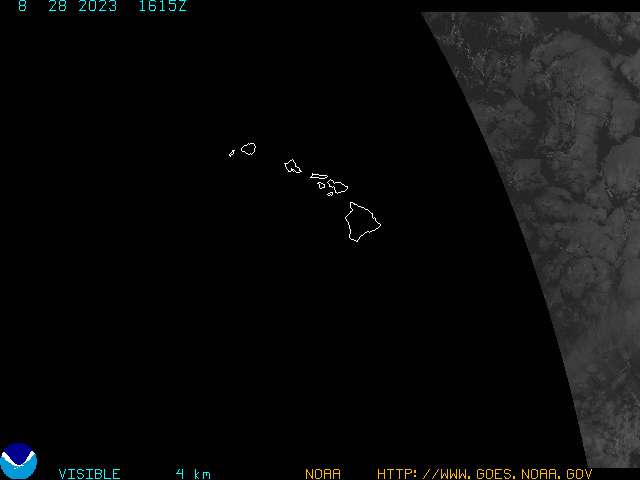

Dave Says:
Hi Glenn,
It seems like the tradewinds have been less frequent this year. Is there a graph that displays historical tradewind activity (daily windspeed & duration)? It would be interesting to compare 2009 to previous years.
Dave, Oahu~~~Hi David, I don’t know of any place that displays trade wind speeds everyday historically. This is basically because of our El Nino situation, which often causes lighter than normal winds, with few trade wind days. I agree, it would make for an interesting comparison. Aloha, Glenn
Tim Says:
Glenn, I stumbled upon your website when trying to figure out which day of the next four (Sunday – Wednesday) would be best to take in a Haleakala sunrise. Is it best if there are trade winds to create cloud cover on the eastern slopes of the mountain? Any advice for a mainland tourist who wants to maximize the chances of witnessing a spectacular sunrise?
Thanks for any help you can provide.~~~Hi Tim, good to hear from you, and I’m glad you stumbled upon my website. As to your question about good viewing during a sunrise up the mountain…I’d say not Sunday or Monday perhaps, and with Tuesday and Wednesday mornings being the preferable. Have a good time! Aloha, Glenn
Ron Phillips Says:
Glenn,
What has happened to the satellite image on your website ?
I enjoy yur weather forecasts. I live near Hilo on the
Big Island.~~~Hi Ron, I should have that one satellite image fixed on Monday, thanks for bearing with me. Good to hear from you down in Hilo, you folks have been dry there lately! Aloha, Glenn
Lily Says:
Hi Glenn,
Today’s photo of the rope-like cloud is impressive. Can you tell us more about that? Where was that, and what does it take to create a cloud like that? Thanks and have a great day! — Lily, Big Island~~~Hi Lily, I like it too. I honestly don’t know where it took place, or how it was established…sorry. I just happened to find the picture, and wanted to share it. Aloha, Glenn