











January 7-8, 2010
Air Temperatures – The following maximum temperatures were recorded across the state of Hawaii Thursday afternoon:
Lihue, Kauai – 77
Honolulu, Oahu – 81
Kaneohe, Oahu – 78
Kaunakakai, Molokai – 75
Kahului, Maui – 78
Hilo, Hawaii – 84
Kailua-kona – 80
Air Temperatures ranged between these warmest and coolest spots near sea level around the state – and on the highest mountains…at 5pm Thursday evening:
Kawaihae, Big Island – 79F
Molokai airport – 72
Haleakala Crater – 55 (near 10,000 feet on Maui)
Mauna Kea summit – 43 (near 14,000 feet on the Big Island)
Precipitation Totals – The following numbers represent the largest precipitation totals (inches) during the last 24 hours on each of the major islands, as of Thursday afternoon:
0.04 Kokee, Kauai
0.64 Kamehame, Oahu
0.40 Molokai
0.07 Lanai
0.00 Kahoolawe
0.69 Kahakuloa, Maui
0.01 Kawainui Stream, Big Island
Marine Winds – Here’s the latest (automatically updated) weather map showing high pressure systems to the northwest and northeast. A ridge of high pressure ridge is now located to the north of the state. Our winds will be trade winds, gradually becoming southeast to south Saturday.
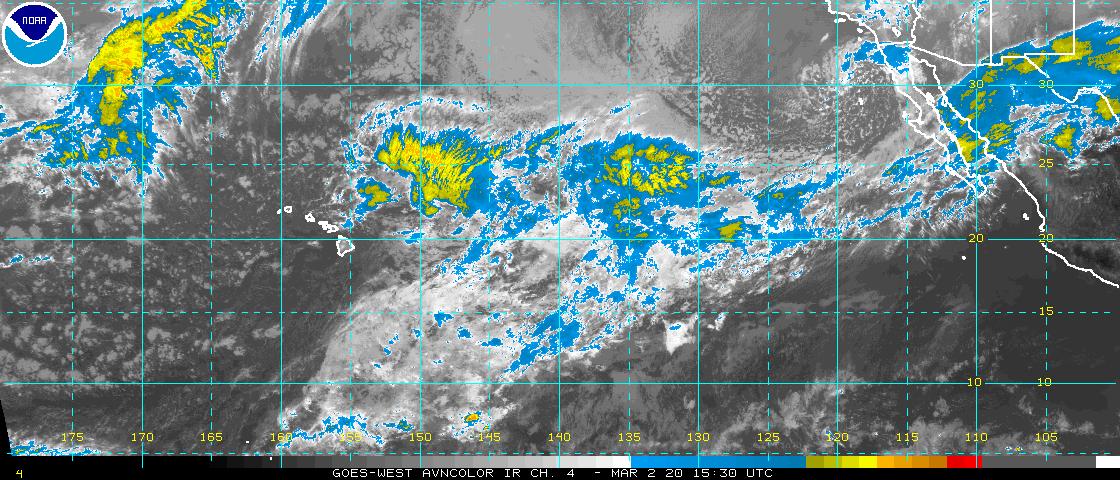
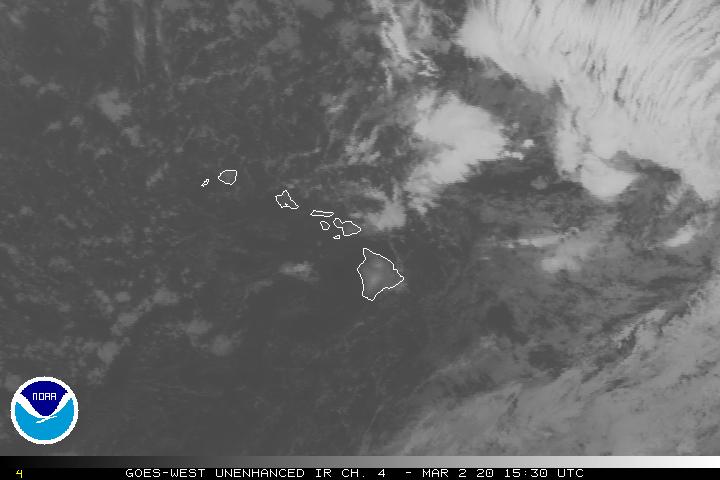
Satellite and Radar Images: To view the cloud conditions we have here in Hawaii, please use the following satellite links, starting off with this Infrared Satellite Image of the islands to see all the clouds around the state during the day and night. This next image is one that gives close images of the islands only during the daytime hours, and is referred to as a Close-up visible image. This next image shows a larger view of the Pacific…giving perspective to the wider ranging cloud patterns in the Pacific Ocean. Finally, here’s a Looping IR satellite image, making viewable the clouds around the islands 24 hours a day. To help you keep track of where any showers may be around the islands, here’s the latest animated radar image.
Hawaii’s Mountains – Here’s a link to the live webcam on the summit of near 14,000 foot Mauna Kea on the Big Island of Hawaii. The tallest peak on the island of Maui is the Haleakala Crater, which is near 10,000 feet in elevation. These two webcams are available during the daylight hours here in the islands…and when there’s a big moon rising just after sunset for an hour or two! Plus, during the nights and early mornings you will be able to see stars, and the sunrise too…depending upon weather conditions.
Tropical Cyclone activity in the eastern and central Pacific – Here’s the latest weather information coming out of the National Hurricane Center, covering the eastern north Pacific. You can find the latest tropical cyclone information for the central north Pacific (where Hawaii is located) by clicking on this link to the Central Pacific Hurricane Center. Here’s a tracking map covering both the eastern and central Pacific Ocean. A satellite image, which shows the entire ocean area between Hawaii and the Mexican coast…can be found here.
Aloha Paragraphs

Smaller surf Friday and Saturday…then up again Sunday
The cold fronts keep coming…the latest got hung up over Maui County Thursday, keeping cloudy and cooler weather in place…with the rest of the state finding generally clear skies
The showers that were more plentiful earlier this morning, over the central islands, had backed off gradually during the day…although not completely. There are still lots of clouds surrounding
This short spell of drier air from the NE and east, will then give way to warmer, light south to southeast breezes…as we move into the weekend. This shifting from the trade winds already, back into Kona winds, will occur due to the approach of yet another cold front. There’s a chance that these southeast winds will carry volcanic haze up into the state again, from the volcanic vents on the
We continue to see near back to back large to extra large surf pounding some parts of the 50th state. The north and west facing shores have been on the receiving end of these waves. Looking a bit further ahead, we wil see another very large northwest swell, perhaps qualifying as giant, arriving early this coming Monday morning. The major word to the citizens of
It’s early Thursday evening, as I begin writing the last section of today’s narrative. The two weak cold fronts merged together last night, and the resulting cloud band provided unexpected showers over Maui County. This was a good thing, as we’ve been so dry this winter. The Big Island especially is very dry, and has been with most of the recent cold fronts…that island missed all the rainfall once again this time. ~~~ This pattern will continue, with more cold fronts coming our way every 2-3 days or so. The next one in line, as noted above, will arrive later Sunday, and then move down to Oahu Monday morning. The big question now is, whether the front will be able to push down into Maui County? The various computer models are swinging back and forth with this, and since I live on Maui, and we (shall I saw desperately) need the rainfall…I’m pulling for it to reach Maui. I know that you folks down on the Big Island, and especially around the Kohala District, greatly need some precipitation too! So, let’s all cross our fingers, or do a combined rain dance, or whatever, and try and coax this cold front, and its associated showers over the Big Island later Monday as well. ~~~ I’m just heading up the mountain now, leaving cloudy Kihei, for the cloudy upcountry area of Kula. I love the clouds, have no problem with them whatsoever. I just wish we could have wrung some additional showers out of them today. We should be happy to see any rainfall now, as we could use every drop that falls! Now that I’m home in Kula, I wanted to let you know I found light showers or drizzle falling along the way, from half way between Kihei and Kahului, and then most of the way up the Haleakala Highway past Pukalani towards Kula. I’ll be back early Friday morning with your next new weather narrative, I hope you have a great Thursday night until then! Aloha for now…Glenn.
Interesting: Hybrid car advocates have taken aim at a government study that predicts it will take decades and hundreds of billions of dollars before the vehicles reach viability. The report, released last month by the National Research Council, concludes that plug-in hybrid cars, or PHEVs, probably won’t make a meaningful impact on carbon emissions or oil use before 2030.
The result stunned a pro-hybrid community for which 2009 was a banner year of government support. "This report is an incendiary tool that others are using to undermine support for PHEVs and EVs [electric vehicles]," said an online posting by CalCars, a nonprofit that has long promoted plug-in hybrids.
"Its science and economics need to be refuted — and its implications need to be responded to publicly and politically." According to the council report, PHEVs remain expensive mainly due to lithium-ion batteries — their costliest component. The NRC report says billions of the batteries are already being produced for cell phones, laptops and other devices — so scale is not the reason costs aren’t coming down.
But without a breakthrough in the basic science of the battery, it says, costs will remain high, severely limiting the number of hybrids that can be sold. But the cars’ advocates have taken issue with that assumption, saying the study deliberately uses battery costs out of line with what industry and government researchers have found.
Interesting2: An international research project involving the University of Adelaide has revealed that the magnetic field in the center of the Milky Way is at least 10 times stronger than the rest of the Galaxy. The evidence is significant because it gives astronomers a lower limit on the magnetic field, an important factor in calculating a whole range of astronomical data.
Researchers from the Max-Planck-Institute for Nuclear Physics, the University of Adelaide, Monash University and the United States have recently published their findings in Nature. Dr Roland Crocker, the lead author, and Dr David Jones both worked on the project while based at Monash University and the University of Adelaide’s School of Chemistry and Physics.
The two physicists are now based at the Max-Planck-Institute for Nuclear Physics in Heidelberg, Germany. "This research will challenge current thinking among astronomers," Dr Crocker says. "For the last 30 years there has been considerable uncertainty of the exact value of the magnetic field in the centre of the Milky Way.
The strength of this field enters into most calculations in astronomy, since almost all of space is magnetized," he says. Dr Jones says the findings will affect diverse fields, from star formation theory to cosmology. "If our Galactic Centre’s magnetic field is stronger than we thought, this raises additional questions of how it got so strong when fields in the early universe are, in contrast, quite weak.
We know now that more than 10% of the Galaxy’s magnetic energy is concentrated in less than 0.1% of its volume, right at its centre," he says. Dr Jones completed his PhD at Adelaide, studying the Galactic Centre magnetic field under the supervision of Dr Raymond Protheroe, Associate Professor of Physics at the University of Adelaide, and Dr Crocker, a former postdoctoral researcher at the University.
"The Milky Way just glows in radio waves and in gamma-rays produced by collisions of energetic particles, and is brightest near its centre. Knowing the magnetic field there helps us understand the source of the radio and gamma-rays better," says Dr Protheroe.
Interesting3: In two new videos from NASA’s Deep Impact spacecraft, bright flashes of light known as sun glints act as beacons signaling large bodies of water on Earth. These observations give scientists a way to pick out planets beyond our solar system (extra-solar planets) that are likely to have expanses of liquid, and so stand a better chance of having life.
These sun glints are like sunshine glancing off the hood of a car. We can see them reflecting off a smooth surface when we are positioned in just the right way with respect to the sun and the smooth surface. On a planetary scale, only liquids and ice can form a surface smooth enough to produce the effect — land masses are too rough — and the surface must be very large.
To stand out against a background of other radiation from a planet, the reflected light must be very bright. We won’t necessarily see glints from every distant planet that has liquids or ice. "But these sun glints are important because, if we saw an extra-solar planet which had glints that popped up periodically, we would know that we were seeing lakes, oceans or other large bodies of liquid, such as water," says Drake Deming, of NASA’s Goddard Space Flight Center in Greenbelt, Md.
Deming is the deputy principal investigator who leads the team that works on the Extra-solar Planet Observations and Characterization (EPOCh) part of Deep Impact’s extended mission, called EPOXI. "And if we found large bodies of water on a distant planet, we would become much more optimistic about finding life."
Interesting4: When scientists confirmed in October that they had detected the first rocky planet outside our solar system, it advanced the longtime quest to find an Earth-like planet hospitable to life. Rocky planets — Earth, Mercury, Venus and Mars — make up half the planets in our solar system. Rocky planets are considered better environments to support life than planets that are mainly gaseous, like the other half of the planets in our system: Jupiter, Saturn, Uranus and Neptune.
The rocky planet CoRoT-7 b was discovered circling a star some 480 light years from Earth. It is, however, a forbidding place and unlikely to harbor life. That’s because it is so close to its star that temperatures might be above 4,000 degrees F (2,200 C) on the surface lit by its star and as low as minus 350 F (minus 210 C) on its dark side.
Now scientists led by a University of Washington astronomer say that if CoRoT-7 b’s orbit is not almost perfectly circular, then the planet might also be undergoing fierce volcanic eruptions. It could be even more volcanically active than Jupiter’s moon Io, which has more than 400 volcanoes and is the most geologically active object in our solar system.
"If conditions are what we speculate, then CoRoT-7 b could have multiple volcanoes going off continuously and magma flowing all over the surface," says Rory Barnes, a UW postdoctoral researcher of astronomy and astrobiology. Any planet where the surface is being remade at such a rate is a place nearly impossible for life to get a foothold, he says.
Interesting5: The discovery of fossil footprints from early backboned land animals in Poland leads to the sensational conclusion that our ancestors left the water at least 18 million years earlier than previously thought. The results of the Polish-Swedish collaboration are published online this week in Nature. "These results force us to reconsider our whole picture of the transition from fish to land animals," says Per Ahlberg of Uppsala University, one of the two leaders of the study.
For nearly eighty years, palaeontologists have been scouring the planet for fossil bones and skeletons of the earliest land vertebrates or "tetra-pods" — the ultimate progenitors of all later amphibians, reptiles, birds and mammals including ourselves. Their discoveries have suggested that the first tetra-pods evolved relatively rapidly from lobe-finned fishes, through a short-lived intermediate stage represented by "elpistostegids" such as Tiktaalik, about 380 million years ago.
But there is another potential source of information about the earliest tetra-pods: the fossilized footprints they left behind. In the new study a Polish-Swedish team describe a rich and securely dated footprint locality from Zachelmie Quarry in Poland that pushes back the origin of tetra-pods a full 18 million years beyond the earliest skeletal evidence and forces a dramatic reassessment of the transition from water to land.
 Email Glenn James: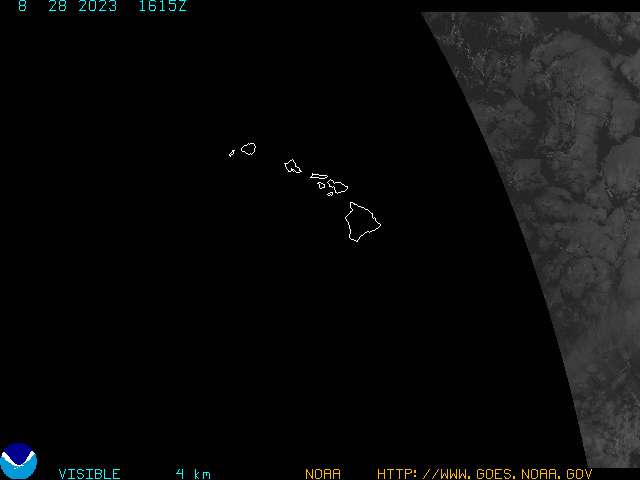

jack weber Says:
I’m dancing…and praying! Glad you got some water over there. J*~~~Jack, it’s just a matter of time, hang in there…you’ll get some water one of these days! Aloha, Glenn
Rex Dickey Says:
Glenn,
Your “a larger view of the Pacific” link is no longer working.~~~Rex, I fixed one missing satellite image, and in so doing, broke the one you are referring to. I should be able to fix that one on Friday. Thanks for pointing that out. Aloha, Glenn
Ron Phillips Says:
Glenn,
What is the matter with the satellite website
(large view)~~~Hi Ron, I see what you mean, I’ll fix that as soon as I have the chance…thanks for pointing it out. Aloha, Glenn
Tim Says:
Happy new year Glenn and hoping all is well! When you have a moment, I would greatly appreciate your professional opinion on which of the upcoming few days would be the driest on the east side…i.e Nahiku. I’m assuming it will be when the winds go back to Kona again. Thank you!! By the way and once again, this page is so helpful and greatly appreciated! Aloha~~~Hi Tim, I think you have the right idea, this weekend when the Kona winds come back, before the next cold front, that would reach you probably on Monday, would be the driest time. I’d say keep checking my narrative over the next several days, so you can fine tune the situation. Best of luck, and thanks too for your positive comment about my site! Aloha, Glenn