











January 6-7, 2010
Air Temperatures – The following maximum temperatures were recorded across the state of Hawaii Wednesday afternoon:
Lihue, Kauai – 83
Honolulu, Oahu – 81
Kaneohe, Oahu – 83
Kaunakakai, Molokai – 79
Kahului, Maui – 82
Hilo, Hawaii – 83
Kailua-kona – 82
Air Temperatures ranged between these warmest and coolest spots near sea level around the state – and on the highest mountains…at 5pm Wednesday evening:
Port Allen, Kauai – 81F
Kapalua, Maui – 75
Haleakala Crater – 57 (near 10,000 feet on Maui)
Mauna Kea summit – 43 (near 14,000 feet on the Big Island)
Precipitation Totals – The following numbers represent the largest precipitation totals (inches) during the last 24 hours on each of the major islands, as of Wednesday afternoon:
1.11 Puu Opae, Kauai
0.45 Manoa Valley Arboretum, Oahu
0.10 Molokai
0.01 Lanai
0.00 Kahoolawe
0.00 Maui
0.00 Big Island
Marine Winds – Here’s the latest (automatically updated) weather map showing a ridge of high pressure east of the Big Island, along with a cold front moving down into the state. Our winds will be locally breezy and slightly cooler from the north to northeast.
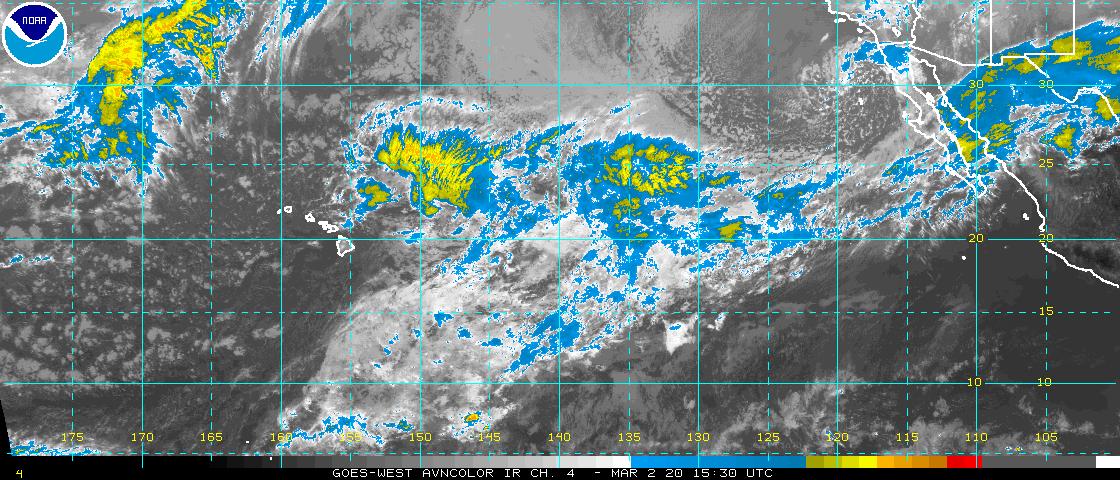
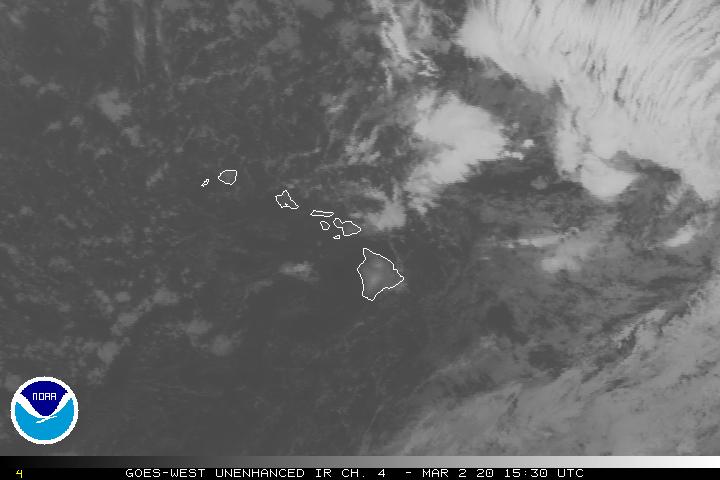
Satellite and Radar Images: To view the cloud conditions we have here in Hawaii, please use the following satellite links, starting off with this Infrared Satellite Image of the islands to see all the clouds around the state during the day and night. This next image is one that gives close images of the islands only during the daytime hours, and is referred to as a Close-up visible image. This next image shows a larger view of the Pacific…giving perspective to the wider ranging cloud patterns in the Pacific Ocean. Finally, here’s a Looping IR satellite image, making viewable the clouds around the islands 24 hours a day. To help you keep track of where any showers may be around the islands, here’s the latest animated radar image.
Hawaii’s Mountains – Here’s a link to the live webcam on the summit of near 14,000 foot Mauna Kea on the Big Island of Hawaii. The tallest peak on the island of Maui is the Haleakala Crater, which is near 10,000 feet in elevation. These two webcams are available during the daylight hours here in the islands…and when there’s a big moon rising just after sunset for an hour or two! Plus, during the nights and early mornings you will be able to see stars, and the sunrise too…depending upon weather conditions.
Tropical Cyclone activity in the eastern and central Pacific – Here’s the latest weather information coming out of the National Hurricane Center, covering the eastern north Pacific. You can find the latest tropical cyclone information for the central north Pacific (where Hawaii is located) by clicking on this link to the Central Pacific Hurricane Center. Here’s a tracking map covering both the eastern and central Pacific Ocean. A satellite image, which shows the entire ocean area between Hawaii and the Mexican coast…can be found here.
Aloha Paragraphs

More large to extra large waves
One weak cold front is dissipating over Maui County, while a new one is moving down through the island chain. The latest satellite images show that the first band of clouds has made it down as far as Maui County. Here’s the satellite image of this first cold front, actually both of the fronts…which may merge Wednesday night. Looking ahead, it appears that by the end of this coming weekend, we should see yet another cold front arriving, and some of the computer models continue to show it being more of a generous rainfall producer. We need all the rainfall we can get at the moment, as drought conditions prevail here in Hawaii this winter.
Winds have been generally light from the southwest the last several days, although are about to switch over to the opposite direction…coming in from the north to northeast later Thursday. Trade winds will prevail into Friday, although then give way to more light south to southeast breezes as we move into the weekend. This shifting from the trade winds already, back into Kona winds, will occur due to the approach of yet another cold front Sunday into next Monday. There’s always the chance, and its a pretty good one, that these winds will carry volcanic haze up into the state, from the volcanic vents on the Big Island.
It’s Wednesday evening, as I begin writing the last section of today’s narrative. Wednesday was another great day, especially over Maui and the Big Island, south and southeast of the frontal cloud bands over Kauai and Oahu, and even over Lanai and Molokai during the afternoon hours. Let’s take a look at this looping radar image, so we can see that neither of the two cold fronts in the state now…are bringing very much precipitation. As I was mentioning above, these two minor fronts, may join forces Wednesday night, but even then, still won’t be able to bring any significant showers to our dry islands. ~~~ The bigger news will be the large to extra large waves breaking on our north and west facing beaches. The NWS in Honolulu is keeping high surf warning flags stuck in the sand along those effected shorelines. Please be careful if you go to the beach to look at this surf on Thursday! ~~~ I’m about ready to take the drive back upcountry now, leaving Kihei towards Kula. Last evening when I left here, the Haleakala Crater was totally clear, although tonight in contrast, there’s some clouds up that way…although they look like dry ones from down here. I’ll be back early Thursday morning with your next new weather narrative, and before leaving, let you wish you well between now and then! Aloha for now…Glenn.
Interesting: "Some 3,000 years ago, farmers in eastern China domesticated the soybean. In 1765, the first soybeans were planted in North America. Today the soybean occupies more US cropland than wheat. And in Brazil, where it spread even more rapidly, the soybean is invading the Amazon rainforest," writes Lester R. Brown, president of the Earth Policy Institute, in a December commentary.
Since 1950 the world soybean harvest has climbed from 17 million tons to 250 million tons, a gain of more than 14-fold. This contrasts with growth in the world grain harvest of less than fourfold. Soybeans are the second-ranking US crop after corn, and they totally dominate agriculture in both Brazil and Argentina. Satisfying the global demand for soybeans, growing at nearly six million tons per year, poses a challenge.
The soybean is a legume, fixing atmospheric nitrogen in the soil, which means it is not as fertilizer-responsive as, say, corn, which has a ravenous appetite for nitrogen. But because the soy plant uses a substantial fraction of its metabolic energy to fix nitrogen, it has less energy to devote to producing seed.
This makes raising yields more difficult. Although the US area in corn has remained essentially unchanged since 1950, the area in soybeans has expanded fivefold. Farmers get more soybeans largely by planting more soybeans. Herein lies the dilemma: how to satisfy the continually expanding demand for soybeans without clearing so much of the Amazon rainforest that it dries out and becomes vulnerable to fire.
Interesting2: When Alaska’s Kasatochi Volcano erupted on Aug. 7, 2008, it virtually sterilized Kasatochi Island, covering the small Aleutian island with a layer of ash and other volcanic material several meters thick. The eruption also provided a rare research opportunity: the chance to see how an ecosystem develops from the very first species to colonize the island.
Next week, a team of researchers organized by the U.S. Geological Survey and the U.S. Fish and Wildlife Service will visit Kasatochi to look for signs of life on the island, almost exactly one year after the catastrophic eruption. The interdisciplinary research team will spend four days surveying the island, using the USFWS research vessel Tiglax as an operational base for the on-site research.
"Since volcanism plays such a big role in shaping the Aleutians, we hope to end up with a better understanding of how disturbances such as volcanic eruptions shape the ecology of these islands," says Tony DeGange, a USGS biologist and one of the research team coordinators. "There hasn’t been a study quite like this done in Alaska where scientists are taking such a comprehensive ecological view of the impact of an eruption and its resulting response and recovery."
Researchers expect that insects and birds will be the first animal species that recolonize the island. In preparation for the August survey, biologists set up monitoring and sampling equipment on Kasatochi earlier this summer, including insect traps for Derek Sikes, curator of insects at the University of Alaska Museum of the North. Sikes visited Kasatochi in June 2008 for a one-day survey of the insect fauna on the island before the eruption.
He will be part of the research team that visits the island next week. "Work in similar systems shows that flying- and wind-borne insects and spiders form a fairly constant rain during the summer months," says Sikes, adding that some of these species survive by preying or scavenging on other arthropods. "We’ll be looking for spiders, which are all predators, and ground beetles, which are mostly predators, as well as other species associated with bird droppings or vertebrate carrion."
An opportunity like this is extremely rare, according to Sikes. The most comparable example is the emergence of Surtsey Island off the coast of Iceland in 1963, when undersea volcanic eruptions reached the surface. That island was declared a United Nations World Heritage Site for its role as a pristine natural laboratory. Even today, access to Surtsey remains restricted to a small number of researchers each year who study the species that have colonized the island over the past 40 years.
According to the USFWS, the Kasatochi study is unique in that it takes place in an isolated marine ecosystem for which there are pre-eruption ecological data for the island and its nearby marine waters, including data from the Alaska Maritime National Wildlife Refuge dating from the mid-1990s and from Sikes’ 2008 field work on the island.
Interesting3: Americans scrapped more automobiles than they bought last year as the ragged economy reduced demand and some major cities expanded mass transit service, according to a new report. The United States scrapped 14 million autos while buying only 10 million last year, shrinking the country’s car and light duty truck fleet to 246 million from a record high of 250 million, according to the report to be released on Wednesday by nonprofit group the Earth Policy Institute (EPI).
The United States, the world’s biggest petroleum user, "is entering a new era, evolving from a car-dominated transport system to one that is much more diversified," said Lester Brown, the president of the EPI. While many cities like New York have had to cut mass transit services and raise fares during the recession, Phoenix, Seattle, Houston, Nashville and other cities have expanded or improved mass transit systems.
Cities are taking a variety of steps, like adding rapid bus lanes and light duty rail, to fight traffic congestion and air pollution. Some are raising parking meter prices and cutting down the required parking spaces per building, the report said. President Barack Obama’s "cash for clunkers" program, which last summer gave consumers a rebate of up to $4,500 for trading in older cars and light trucks, led to the scrapping of more than 700,000 vehicles.
But since the incentive was only available to consumers who bought new fuel-sipping vehicles, it did not affect the ratio of scrapped vehicles to new sales. Interesting4: In their quest to find solar systems analogous to ours, astronomers have determined how common our solar system is. They’ve concluded that about 15 percent of stars in the galaxy host systems of planets like our own, with several gas giant planets in the outer part of the solar system. "Now we know our place in the universe," said Ohio State University astronomer Scott Gaudi.
"Solar systems like our own are not rare, but we’re not in the majority, either." Gaudi reported the results of the new study at the American Astronomical Society Meeting in Washington, DC, when he accepted the Helen B. Warner Prize for Astronomy. The find comes from a worldwide collaboration headquartered at Ohio State called the Micro-lensing Follow-Up Network (MicroFUN), which searches the sky for extrasolar planets.
MicroFUN astronomers use a method called gravitational micro-lensing, which occurs when one star happens to cross in front of another as seen from Earth. The nearer star magnifies the light from the more distant star like a lens. If planets are orbiting the lens star, they boost the magnification briefly as they pass by. This method is especially good at detecting giant planets in the outer reaches of solar systems — planets analogous to our own Jupiter.
Interesting4: A team made up of mental health professionals, emergency response experts, and researchers from several universities, including Virginia Tech, has published the results of a study that shows serious emotional disturbances among children who were affected by Hurricane Katrina. The Category 3 storm ravaged the Gulf Coast in August 2005. The study, published in a recent issue of the Journal of the American Academy of Child and Adolescent Psychiatry, showed the estimated prevalence of serious emotional disturbances (SED) among residents of the affected areas was 14.9 percent.
Of those, 9.3 percent of youths were believed to have SED that was directly attributable to Hurricane Katrina. Characteristics of SED include inappropriate behavior, depression, hyperactivity, eating disorders, fears and phobias, and learning difficulties. "Stress exposure was associated strongly with serious emotional disturbances," said Russell Jones, professor of psychology in the College of Science at Virginia Tech and member of the research team.
"More than 20 percent of the youths with high stress exposure had hurricane-related SED." The study found that youth who experienced death of loved one during the storm had the strongest association with SED. Exposure to physical adversity was the next strongest. "The prevalence of SED among youths exposed to Hurricane Katrina remains high 18 to 27 months after the storm," Jones said.
"This suggests a substantial need for mental health treatment resources in the hurricane-affected areas." Katrina was the costliest hurricane in United States history as well as one of the five deadliest. Four years after the storm, nearly thousands of residents of Mississippi and Louisiana are still displaced from their homes.
 Email Glenn James: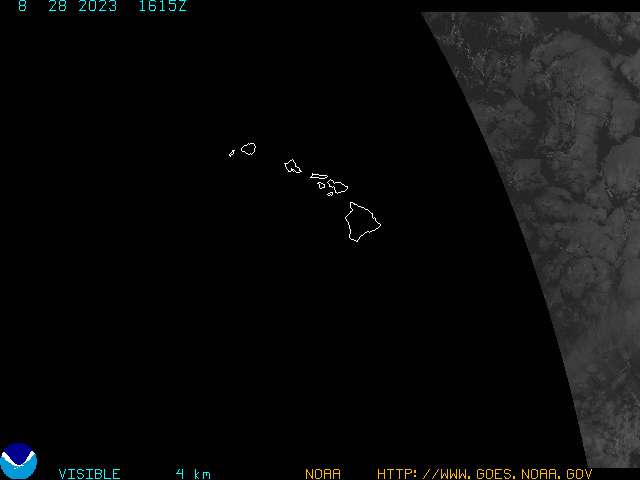

Myrtle Says:
Hi Glenn – I enjoy your description of the feeble cold fronts bringing little water to some of our islands. Perhaps if we express more appreciation for the precious water that we receive, the cold fronts will bless us with rain. Aloha, Myrtle~~~Let’s have large amounts of rainfall, of a gentle nature…falling everywhere, with no flooding problems whatsoever! Sound better? Aloha, Glenn
jack weber Says:
Thanks for the words, Glenn…when the trades return thursday/friday, that usually means rain for us here in E. Hawaii. You think we’ll get some? I am having to haul in water by hand and truck now, so therefore my concern! Cheers, J*~~~Hi Jack, that sounds like words definitely reflecting a drought. I’m not sure if you will get some showers, but lets certainly hope so! Let me know when you get something wet down there on the Big Island. Aloha, Glenn