January 30-31, 2010
Air Temperatures – The following maximum temperatures were recorded across the state of Hawaii Saturday afternoon:
Lihue, Kauai – 73
Honolulu, Oahu – 80
Kaneohe, Oahu – 77
Kaunakakai, Molokai – 80
Kahului, Maui – 79
Hilo, Hawaii – 80
Kailua-kona – 80
Air Temperatures ranged between these warmest and coolest spots near sea level around the state – and on the highest mountains…at 3pm Saturday afternoon:
Port Allen, Kauai – 81F
Lihue, Kauai – 72
Haleakala Crater – 46 (near 10,000 feet on Maui)
Mauna Kea summit – 39 (near 14,000 feet on the Big Island)
Precipitation Totals – The following numbers represent the largest precipitation totals (inches) during the last 24 hours on each of the major islands, as of Saturday afternoon:
2.35 Wainiha, Kauai
2.78 Olomana Fire Station, Oahu
3.74 Molokai
0.05 Lanai
0.53 Kahoolawe
1.26 Waikapu, Maui
0.42 Pohakuloa Keamuku, Big Island
Marine Winds – Here’s the latest (automatically updated) weather map showing a cold front dissipating over the central islands. A high pressure system to the northwest of the islands…is moving east-northeast. As this high pressure system gets into the area north of Hawaii, our winds will become northeast to easterly Sunday.
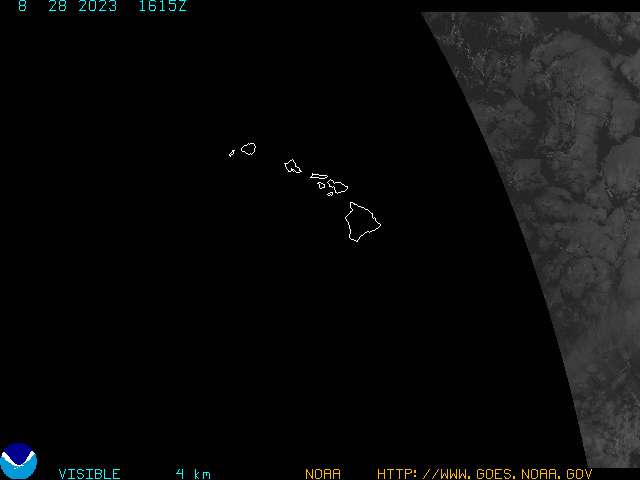
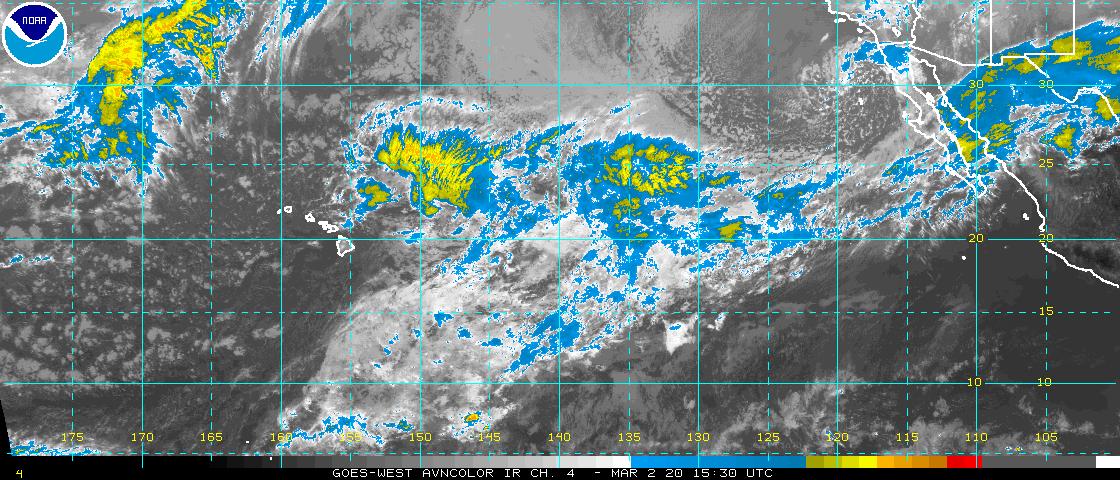
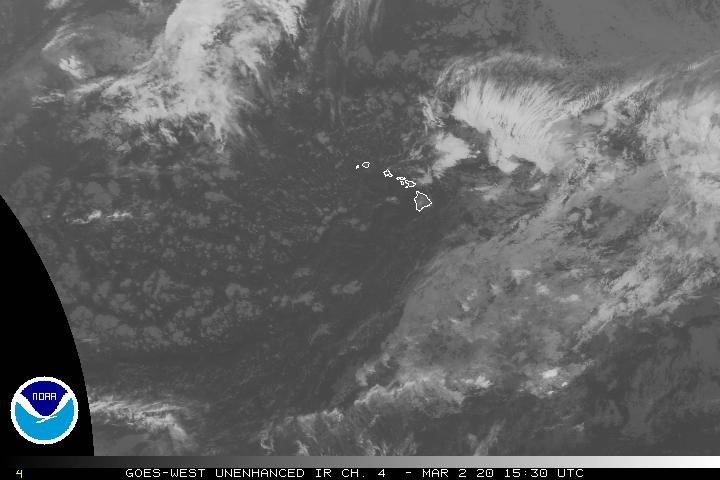
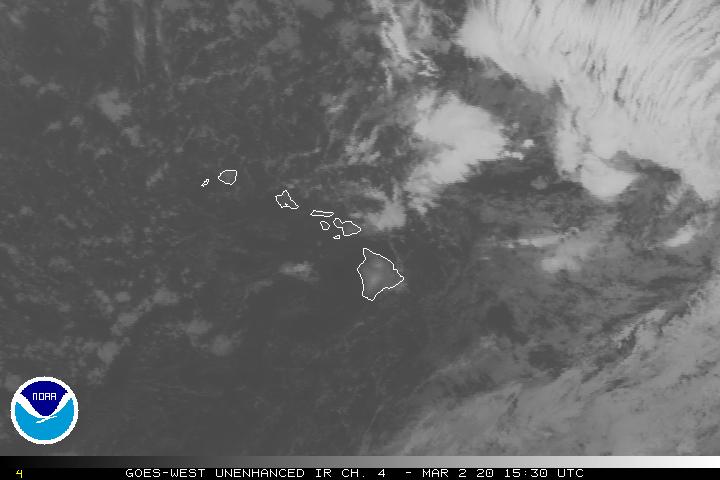
Satellite and Radar Images: To view the cloud conditions we have here in Hawaii, please use the following satellite links, starting off with this Infrared Satellite Image of the islands to see all the clouds around the state during the day and night. This next image is one that gives close images of the islands only during the daytime hours, and is referred to as a Close-up visible image. This next image shows a larger view of the Pacific…giving perspective to the wider ranging cloud patterns in the Pacific Ocean. Finally, here’s a Looping IR satellite image, making viewable the clouds around the islands 24 hours a day. To help you keep track of where any showers may be around the islands, here’s the latest animated radar image.
Hawaii’s Mountains – Here’s a link to the live webcam on the summit of near 14,000 foot Mauna Kea on the Big Island of Hawaii. The tallest peak on the island of Maui is the Haleakala Crater, which is near 10,000 feet in elevation. These two webcams are available during the daylight hours here in the islands…and when there’s a big moon rising just after sunset for an hour or two! Plus, during the nights and early mornings you will be able to see stars, and the sunrise too…depending upon weather conditions.
Tropical Cyclone activity in the eastern and central Pacific – Here’s the latest weather information coming out of the National Hurricane Center, covering the eastern north Pacific. You can find the latest tropical cyclone information for the central north Pacific (where Hawaii is located) by clicking on this link to the Central Pacific Hurricane Center. Here’s a tracking map covering both the eastern and central Pacific Ocean. A satellite image, which shows the entire ocean area between Hawaii and the Mexican coast…can be found here.
Aloha Paragraphs

Clouds, some showers…and a few rainbows
The latest cold front is dissipating over the central islands Saturday evening, after bringing plentiful rainfall from Kauai down through Maui. This left most of the Big Island out from under this front’s precipitation shield…which wasn’t good news for that dry island. This satellite image shows the clouds drapped over the 50th state. Here’s a closer view, showing more detail of the islands, using this satellite image. It clearly points out that the front’s clouds are still around, and will be slow to clear. There will continue to be the good chance that some showers will fall overnight…with the outside chance of a couple of locally heavy ones. Here’s a looping radar image so we can keep an eye on those showers as they form over the state.
Rainfall was generous in many areas, which have a good soaking to most of the state, which has been much appreciated. There was more than the ordinary amount of moisture in the atmosphere, at least in relation to the last several fronts. This fairly deep layer of moisture gave us more widespread showers, some of which were locally heavy. As described in the paragraph above, this front is in the dissipating phase now. There will be lots of clouds left around, which will keep most of the islands overcast Saturday night into Sunday morning. A high pressure system moving in behind the front will cause northeast, to easterly trade winds winds. This will push the front’s remnant moisture into the windward sides, keeping showers falling along those north and east facing coasts and slopes Sunday. This will finally give the Big Island a fighting chance to get some showers.
Looking a bit further ahead, after the localized showery trade winds this weekend, the computer models show another cold front approaching the state early in the new week. As this next cold front gets closer, our trade winds will ease up, giving way to more southeast breezes later Monday into Tuesday. The computer forecast models, at least at this time, are giving a good chance of more abundant showers being brought into the state later Tuesday into Wednesday. We’ll have to wait and see what actually pans out, for the precipitation that arrives then. The major change after that would be the return of the trade winds, a fairly prolonged period of trades actually…which we haven’t seen for quite a while. This would keep passing showers coming our way along the windward sides well into the week. The south and west facing leeward beaches will be in good shape though, with generally dry weather prevailing.
It’s Saturday evening, as I begin writing the last section of today’s narrative.
We really scored with this latest cold front, as many areas received the rainfall that they needed so much. As the satellite imagery above points out, there are lots of clouds still around as we push deeper into this weekend. The radar image up this page shows that indeed, there are showers, generally falling from Oahu down through Maui County…which happens to be under this faltering cold front. ~~~ Friday evening after work I went for a quick Thai dinner in Kahului, and then to see the new film called The Book of Eli (2009)…starring Denzel Washington, and Gary Oldman, which looked pretty good according to the trailers. I know that many of you will be thinking, "there he goes again with his action films." In this film, Denzel Washington fights his way across a post-apocalyptic wasteland to protect a book that holds the key to humanity’s future…which happened to be the Holy Bible. I’m not sure many of you will have the slightest desire to check out this trailer, but here it is, just in case. My friend and I both ended up enjoying this film, which wasn’t too surprising in my case, given my liking for these kinds of down and dirty flicks. ~~~ I went down to Costco and bought two new tires for my car this morning, and fortunately, they were’t too busy. I then drove down to Baldwin beach, and despite the cloudy skies, was actually quite nice. There weren’t that many people around, and hardly anyone in the ocean. I enjoyed the experience. Then, it was over to the health food store in Paia, where I ran into several folks who read this webpage…it was nice to meet these new friends! ~~~ I have a friend coming over soon for dinner, and a glass of wine, which will be pleasant. Looking out the window of my weather tower, it appears that the volcanic haze wasn’t washed completely out of the atmosphere, by the locally heavy rains. As a matter of fact, it’s still quite hazy, as the winds remained light with this cold front, keeping the vog in place. ~~~ I’ll be back Sunday morning at some point, but probably not at the crack of dawn as I often do Monday through Saturday. I hope you have a great Saturday night wherever you happen to be spending it! Aloha for now…Glenn
Interesting: Wind power is considered the most promising alternative source of energy. But British experts have now claimed that the noise caused by wind turbines can make some people ill. According to the study by a panel of independent experts the "swishing sound caused by turbines can annoy" some people, causing sleep deprivation and even mental health problems.
"The number of people who suffer these extreme effects are small and if the turbines are designed properly the effects are minimized even further," Dr Leventhall added. "The number of people who suffer these extreme effects are small and if the turbines are designed properly the effects are minimized even further," Dr Leventhall added.
Wind farms, which provide around 2.5 per cent of the country’s electricity, have traditionally been seen by protesters as a blot on the British countryside. Now they have come up with the allegation that their noise may make people ill. But the wind industry said if wind turbines were harmful, it would be impossible to live in a city given the sound levels normally present in urban environments.
"The findings of the study tally with UK research on the subject. In 2007 a Government-backed study carried out by the University of Sal ford found that only one wind farm in the UK was ever found to present a noise nuisance to residents and the issue has since been resolved," said a spokesman for the British Wind Energy Association. There are currently more than 2,500 turbines in Britain and it is planning to build up to 6,000 new wind turbines over the next ten years.
Interesting2: Osama bin Laden, the al-Qaeda leader, has condemned the US and other industrial economies, holding them responsible for the phenomenon of climate change. In an audio tape obtained by Al Jazeera, bin Laden criticized George Bush, the former US president, for rejecting the Kyoto pact and condemned global corporations. "This is a message to the whole world about those responsible for climate change and its repercussions – whether intentionally or unintentionally – and about the action we must take," bin Laden said.
"Speaking about climate change is not a matter of intellectual luxury – the phenomenon is an actual fact." The tape follows one released earlier this week in which the al-Qaeda leader praised a Nigerian man accused of a failed attempt to blow up an airliner heading for Detroit on Christmas Day. In the new recording, bin Laden says "all the industrial states" are to blame for climate change, "yet the majority of those states have signed the Kyoto Protocol and agreed to curb the emission of harmful gases".
He continued: "However, George Bush junior, preceded by [the US] congress, dismissed the agreement to placate giant corporations. And they are themselves standing behind speculation, monopoly and soaring living costs. "They are also behind ‘globalization and its tragic implications’. And whenever the perpetrators are found guilty, the heads of state rush to rescue them using public money." The Kyoto Protocol, a UN treaty aimed at combating global warming, was adopted in December 1997 and has since been ratified by 187 states, but not by the US congress.
Although a signatory to the agreement, the US under Bush refused to ratify the treaty, saying that it should contain binding goals for developing countries to reduce emissions as well as those for industrialized nations. In the new recording, bin Laden said: "Noam Chomsky [the US academic and political commentator] was correct when he compared the US policies to those of the Mafia. They are the true terrorists and therefore we should refrain from dealing in the US dollar and should try to get rid of this currency as early as possible.
"I am certain that such actions will have grave repercussions and huge impact." While continuing to attack America, bin Laden’s comments mark a shift from his earlier, more regionally focused commentary. In his previous tape, bin Laden warned that there would be further attacks on the US unless Barack Obama, the current US president, took steps to resolve the Palestinian conflict. The Obama administration dismissed bin Laden’s comments on the earlier tape and said intelligence analysts had not confirmed that the voice was that of bin Laden.
Interesting3: Half of British Columbia’s land base should be protected to maintain biodiversity in the face of climate change, a coalition of leading environmental groups has recommended to the provincial government. The coalition says in a 99-page report that existing parks and protected areas cover almost 15 per cent of the province’s land base, not nearly enough to protect landscapes and wildlife against the ravages of climate change.
The report, prepared by forest ecologist Jim Pojar, recommends that "at least an additional 35 per cent of the land base [be] managed for biodiversity and carbon," a recognition that natural forests store carbon dioxide better than do industrial forests. New land designations and/or tenures will likely be required to guide management of the expanded conservation network outside of existing parks and protected areas, the report states.
Only activities "compatible with the long-term objectives of biodiversity conservation and adaptation" should be allowed in these new areas, it says. Connectivity of landscapes will become increasingly important as B.C.’s climate continues to warm and species migrate to find new homes. "Species confronting rapid environmental change will either go extinct or survive in one of three ways: by acclimatizing, evolving, or migrating to suitable habitats elsewhere," the report states.
"Those that adapt in their original location will have additional competition from other species or genotypes better suited to the new local environment." B.C. is home to three-quarters of Canada’s mammal and bird species, 70 per cent of its freshwater fish, 60 per cent of its evergreen trees, and thousands of other animals and plants, the report says.
The province’s climate over the next 100 years will become even warmer, with mean annual temperatures warming by 3 to 5 degrees C if current trends continue unabated. There will be more extreme weather events with increasing intensity of storms, floods, wildfires and drought.
Interesting4: U.S. farmers grew record-large corn and soy crops in 2009 but production in 2010 could be even bigger, aided by an El Nino weather pattern that is typically a boon to the Midwest but less so for growers in Australia and southeast Asia, a forecaster said on Thursday. Allen Motew, meteorologist at QT Weather, forecast a dry U.S. spring, which should minimize problems at planting time, followed by a favorably wet summer growing season. "It’s exactly what we need to increase (crop) yields," Motew said at the Top Producer Seminar, a farmers’ conference held in Chicago.
Temperatures in the U.S. Corn Belt are expected to be mostly below normal this summer, while precipitation will be above normal. "We have a double-whammy here — colder and wetter," Motew said. "The odds say we are going to have quite a good year." Motew said corn yields typically increase when an El Nino weather pattern persists for two years in a row. The same is likely true for soybeans, he said. In two of the most recent such years, 1992 and 1998, corn yields increased by 21.1 and 6.1 percent, respectively, Motew said. He said that yields increased during the last 16 of 22 seasons of El Nino weather.
Interesting5: One-third of samples of milk and dairy products analyzed in various restaurants exceed the microbe contamination limits set by the European Union, according to a study carried out by researchers from the University of Valencia (UV). The experts advise against keeping milk in jugs and suggest that these foodstuffs need to be better handled. "Out of all the dairy products we analyzed, 35% of the samples exceeded the maximum contamination levels established by EU law for enterobacteriaceae, and 31% exceeded the limits set for mesophilic aerobic microorganisms (which grow at an optimum temperature of between 30 and 45ºC)," Isabel Sospedra, a researcher at the Department of Preventive Medicine and Public Health of the UV and one of the authors of the study, said.
The scientists examined 265 batches of milk and ready-to-use milk derivatives in a range of bars and restaurants in Valencia, and checked whether their microbial quality fell into line with European Union regulations. The results, which have been published recently in the journal Food borne Pathogens and Disease, show that one-third of the samples had some kind of microorganism contamination and were not fit for human consumption. "Luckily none of the batches we analyzed tested positive for Staphylococcus aureus, Listeria monocytogenes or Salmonella spp., which are pathogenic microorganisms that cause both food poisoning and toxoinfections," the study’s authors says.
The researchers found differences according to the source of the sample (hot milk, products at room temperature or homemade dairy products). According to the study, 2% of the samples of hot milk (kept in jugs or stainless steel thermos flasks) tested positive for the bacteria Escherichia coli. The team detected unsuitable practices, such as reheating milk over and over again, even in a microwave, and then pouring it back into the thermos, which increases the risk of microbial contamination.
The study shows that there is a greater contamination risk from milk kept in jugs, meaning this type of container is not suitable for storing milk. The experts advise that, when using milk in any way, it is important to clean jugs, thermos flasks and the steamers of coffee machines thoroughly and frequently, using the right kind of hygienic sponges or cloths, which is not always the case. "Kitchen cloths are not suitable for disinfecting because of their microstructure, which means they transfer even greater levels of contamination," the scientists explain.
In terms of milk that is cold or at room temperature, this is usually kept in its original container in restaurants and bars — a plastic bottle or tetrabrick. The study shows that containers with a lid are better, since tetrabricks opened with scissors are more exposed to microbial proliferation, and are especially vulnerable to enterobacteriaceae. In terms of dairy products prepared in the restaurants themselves (custards, mousses, puddings and crème caramels), custards (natillas) had the highest levels of contamination with microorganisms.
This may be due to the fact this was the only foodstuff analyzed that is further processed after being heated, say the scientists. Cross contamination could come from the hands of the person preparing the product, particularly when he or she places the biscuit on top of the dish. In line with previous studies, the researchers also showed that adding cinnamon to dairy products led to reduced microorganism contamination, since this substance helps to eliminate microorganisms such as Escherichia coli, Listeria monocytogenes and bacteria from the Salmonella family.
 Email Glenn James: