











January 27-28, 2010
Air Temperatures – The following maximum temperatures were recorded across the state of Hawaii Wednesday afternoon:
Lihue, Kauai – 78
Honolulu, Oahu – 78
Kaneohe, Oahu – 77
Kaunakakai, Molokai – 77
Kahului, Maui – 72
Hilo, Hawaii – 84
Kailua-kona – 79
Air Temperatures ranged between these warmest and coolest spots near sea level around the state – and on the highest mountains…at 5pm Wednesday evening:
Hilo, Hawaii – 78F
Molokai airport – 70
Haleakala Crater – 55 (near 10,000 feet on Maui)
Mauna Kea summit – 41 (near 14,000 feet on the Big Island)
Precipitation Totals – The following numbers represent the largest precipitation totals (inches) during the last 24 hours on each of the major islands, as of Wednesday afternoon:
0.96 Puu Opae, Kauai
1.23 Palehua, Oahu
0.50 Molokai
0.38 Lanai
0.07 Kahoolawe
0.71 Ulupalakua, Maui
0.01 Kamuela, Big Island
Marine Winds – Here’s the latest (automatically updated) weather map showing a cold front stalled over Maui County. A weak 1016 millibar high pressure system, to the northwest of the islands…is moving east. Our winds will be northerly, turning NE, then east and southeast into Friday.
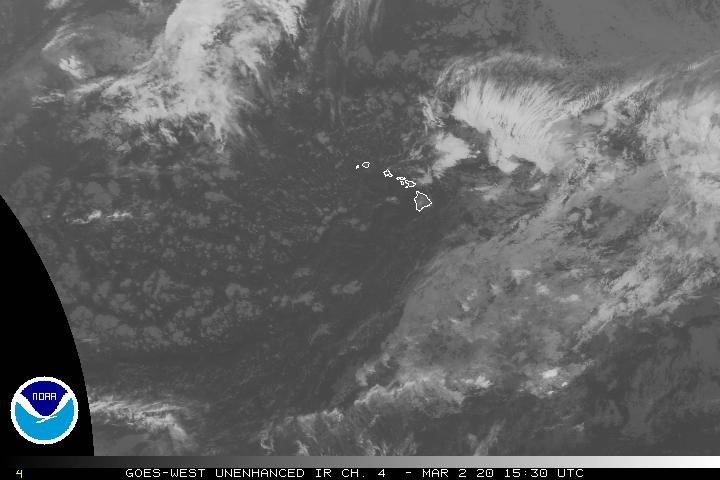
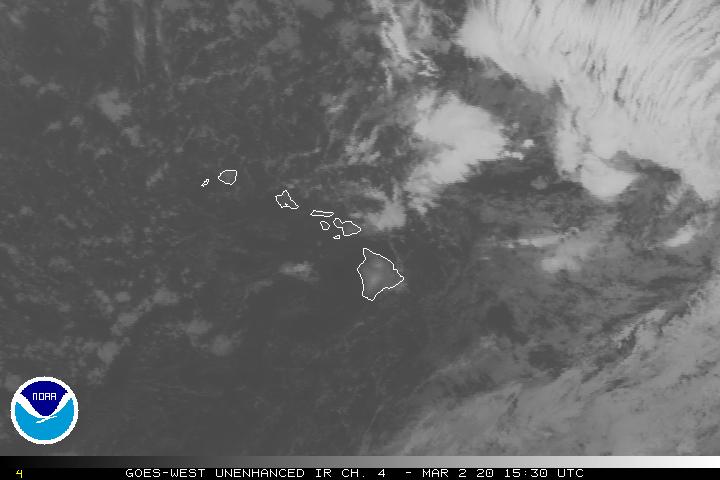
Satellite and Radar Images: To view the cloud conditions we have here in Hawaii, please use the following satellite links, starting off with this Infrared Satellite Image of the islands to see all the clouds around the state during the day and night. This next image is one that gives close images of the islands only during the daytime hours, and is referred to as a Close-up visible image. This next image shows a larger view of the Pacific…giving perspective to the wider ranging cloud patterns in the Pacific Ocean. Finally, here’s a Looping IR satellite image, making viewable the clouds around the islands 24 hours a day. To help you keep track of where any showers may be around the islands, here’s the latest animated radar image.
Hawaii’s Mountains – Here’s a link to the live webcam on the summit of near 14,000 foot Mauna Kea on the Big Island of Hawaii. The tallest peak on the island of Maui is the Haleakala Crater, which is near 10,000 feet in elevation. These two webcams are available during the daylight hours here in the islands…and when there’s a big moon rising just after sunset for an hour or two! Plus, during the nights and early mornings you will be able to see stars, and the sunrise too…depending upon weather conditions.
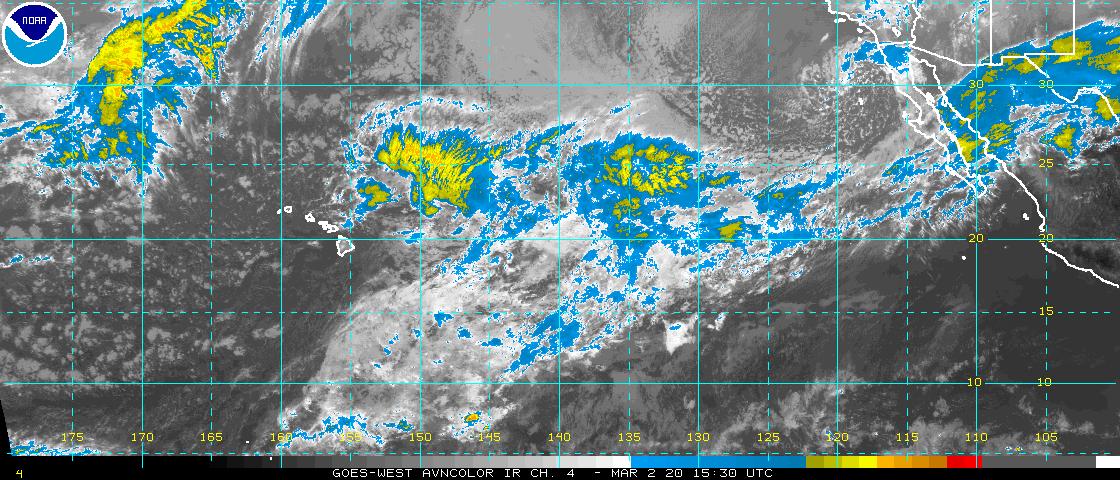
Tropical Cyclone activity in the eastern and central Pacific – Here’s the latest weather information coming out of the National Hurricane Center, covering the eastern north Pacific. You can find the latest tropical cyclone information for the central north Pacific (where Hawaii is located) by clicking on this link to the Central Pacific Hurricane Center. Here’s a tracking map covering both the eastern and central Pacific Ocean. A satellite image, which shows the entire ocean area between Hawaii and the Mexican coast…can be found here.
Aloha Paragraphs

Underwater is nice…a little chilly up above though
A cold front has brought some showers into the state, which stalled over Maui County Wednesday…with clouds and some showers falling there. Once again, as has become a bad habit, the Big Island has missed the moisture from this frontal cloud band. This satellite image shows the cold front’s ragged clouds over the state Wednesday night. Here’s a closer IR satellite image of what’s left of the cold front, which ran out of energy before reaching the Big Island. Although, looking at the looping radar image in the next paragraph, there appears to be a few showers that managed to sneak down towards the Kona side perhaps. The main thing now will be the brief bout of cooler air coming into the state in its wake…from the north and northeast. This will be followed by a quick spell of easterly trade winds, which may be able to carry some of the leftover showery clouds to the windward sides of the islands into Thursday.
Already we’re starting to look to the northwest, where our next cold front will be arriving from later Friday. The computer forecast models continue to show that we’ll see this next cold front arriving this Friday evening into Saturday…with yet another as we move into early next week. The Kona winds will precede the cold fronts, followed by cooler north to northeast breezes in their wake. This all sounds good, and during a more normal winter, would suggest generous rainfall perhaps from each frontal passage. However, during this El Nino winter, these cold fronts bring a dissapointingly small amount of rainfall our way. In order to get an idea about what I’m referring to, here’s a looping radar image, to see the small amount of showery weather that this cold front is providing around Maui County, and the west side of the Big Island Wednesday night.
The big deal now is the large surf that is breaking along our north and west shores. Giving some context to this situation, are the NWS issued high surf warnings along those beaches. This larger than normal swell will peak at some point tonight, and remain on the large side Thursday…gradually dropping into Friday. This larger than normal surf is such a classic example of what an El Nino winter brings to our
It’s Wednesday evening, as I begin writing the last section of today’s narrative. I think you have a pretty good idea about what’s going on with our weather here in the islands, if you had a chance to read down through the three paragraphs above. We continue to see these near back to back cold fronts, with their Kona winds blowing ahead of their arrivals, and the cooler north to northeast winds in their wake. None of these front’s have been able to put a dent in the drought conditions that we’re currently experiencing. Nonetheless, we are getting some rainfall, although most of it is falling over Kauai and Oahu, and nearly missing the Big Island completely…with Maui County definitely on the dry side of things too. ~~~ Looking out the windows here in Kihei, before I take the drive back upcountry to Kula, it’s mostly cloudy. These clouds are part of the stalled cold front parked over us at the moment. Hopefully, some of these clouds will continue to give us at least some light showers. We need every single drop of water we can coax out these gray overhead clouds. There’s a bit of chilly north breeze blowing too, which may prompt some folks to find that extra blanket for the bed tonight. Right now, I’m heading home, as it’s been a long day of work, and I’m ready to take the edge off with a walk, dinner, some reading, and then to bed. I’ll be up very early Thursday morning, ready to whip out yet another new weather narrative for you. I hope you have a great Wednesday night until then! Aloha for now…Glenn.
Interesting: Carbon dioxide is the gas we most associate with global warming, but methane gas also plays an important role. For reasons that are not well understood, methane gas stopped increasing in the atmosphere in the 1990s. But now it appears to be once again on the rise. Scientists are trying to understand why — and what to do about it. Methane gas comes from all sorts of sources including wetlands, rice paddies, cow tummies, coal mines, garbage dumps and even termites.
Drew Shindell, at NASA’s Goddard Institute in New York, says, "It’s gone up by 150 percent since the pre-industrial period. So that’s an enormous increase. CO2, by contrast, has gone up by something like 30 percent." Molecule for molecule, methane is much more effective than carbon dioxide at trapping heat in the atmosphere. And that’s just part of the trouble.
"Methane is much more complicated once it gets into the atmosphere than something like carbon dioxide is," Shindell says, "and that’s because it reacts with a lot of different important chemicals." For example, methane in the atmosphere also creates ground-level ozone. And ozone isn’t only bad for human health; it also contributes to global warming. Shindell recently totaled up all the effects of methane emissions and realized that the heating effect is more than 60 percent that of carbon dioxide’s.
Interesting2: Public concern about global warming has dropped sharply since the fall of 2008, according to the results of a national survey released January 27 by researchers at Yale and George Mason universities.
The survey found:
• Only 50 percent of Americans now say they are "somewhat" or "very worried" about global warming, a 13-point decrease.
• The percentage of Americans who think global warming is happening has declined 14 points, to 57 percent.
• The percentage of Americans who think global warming is caused mostly by human activities dropped 10 points, to 47 percent.
In line with these shifting beliefs, there has been an increase in the number of Americans who think global warming will never harm people in the United States or elsewhere or other species. "Despite growing scientific evidence that global warming will have serious impacts worldwide, public opinion is moving in the opposite direction," said Anthony Leiserowitz, director of the Yale Project on Climate Change.
"Over the past year the United States has experienced rising unemployment, public frustration with Washington and a divisive health care debate, largely pushing climate change out of the news. Meanwhile, a set of emails stolen from climate scientists and used by critics to allege scientific misconduct may have contributed to an erosion of public trust in climate science."
The survey also found lower public trust in a variety of institutions and leaders, including scientists. For example, Americans’ trust in the mainstream news media as a reliable source of information about global warming declined by 11 percentage points, television weather reporters by 10 points and scientists by 8 points. They also distrust leaders on both sides of the political fence.
Sixty-five percent distrust Republicans Arnold Schwarzenegger and Sarah Palin as sources of information, while 53 percent distrust former Democratic Vice President Al Gore and 49 percent distrust President Barack Obama. Finally, Americans who believe that most scientists think global warming is happening decreased 13 points, to 34 percent, while 40 percent of the public now believes there is a lot of disagreement among scientists over whether global warming is happening or not.
"The scientific evidence is clear that climate change is real, human-caused and a serious threat to communities across America," said Edward Maibach, director of the Center for Climate Change Communication at George Mason University. "The erosion in both public concern and public trust about global warming should be a clarion call for people and organizations trying to educate the public about this important issue."
The results come from a nationally representative survey of 1,001 American adults, age 18 and older. The sample was weighted to correspond with U.S. Census Bureau parameters. The margin of sampling error is plus or minus 3 percent, with 95 percent confidence. The survey was designed by researchers at Yale and George Mason Universities and conducted from December 23, 2009, to January 3, 2010 by Knowledge Networks using an online research panel of American adults.
Interesting3: A team funded by the National Science Foundation (NSF) is returning to Haiti this week to investigate the cause of the January 12, magnitude 7 earthquake there. The geologists will collect crucial data to assess whether the quake could trigger another major event to the east or west of Port-au-Prince, Haiti’s capital. Eric Calais, a Purdue University geophysicist leading the team, said that most aftershocks occur within weeks of the initial quake and that the team urgently needs to get to the site to make a detailed assessment before crucial geological information disappears.
"The big question is instead of small aftershocks, could there be a bigger earthquake coming," Calais said. "There are many historical examples of an initial earthquake triggering an even larger one along the same or nearby faults. We are concerned for the Dominican Republic, as our preliminary models show that the continuation of the fault in this area is loaded."
The January 12th quake killed an estimated 200,000 people in Haiti, left 250,000 injured and left 1.5 million homeless. Port-au-Prince experienced a magnitude 6 aftershock on January 20. "The GPS and geological data gathered by this team will provide important insights into the cause of the January 12, 2010, Haitian earthquake," said Tim Killeen, NSF assistant director for geosciences, "and are essential for evaluating the potential for future earthquakes in the Port-au-Prince area."
The Haitian Bureau of Mines and Energy and the Civil Protection Agency invited Calais and his team back to the country to examine the fault and advise officials as they prepare to rebuild. "The government needs scientifically informed advice to decide what to do now and in the future when they start thinking about rebuilding," Calais said.
"We know how to do the calculations that will tell us if the likelihood of other earthquakes along the fault has increased, but we need information that we can only get by going to the field, making direct observations, and taking measurements on the ground." Calais’ research team has been tracking the build-up of energy along the Enriquillo and Septentrional Faults on the island of Hispaniola, which includes Haiti and the Dominican Republic, using Global Positioning System technology.
The team has studied the area for five years using 100 GPS markers. In 2008, the researchers reported the potential for a magnitude 7.2 earthquake in Haiti and a magnitude 7.5 earthquake in the Dominican Republic. The research was funded by NSF. NSF has awarded the team a new grant to find and map the area of the fault that ruptured, resurvey the existing GPS markers, and install 10 new continuous GPS sites to monitor the changes that will occur in the years to come as Earth’s crust readjusts.
The research team includes other geoscientists at Purdue: Andrew Freed and graduate student Sarah Stamps; Paul Mann of the University of Texas at Austin; Glenn Mattioli of the University of Arkansas; Estelle Chaussard of the University of Miami; and Richard Koehler of the Alaska Division of Geological and Geophysical Surveys. Technical support for the operation is provided by UNAVCO, the NSF-supported facility for geodesy in Boulder, Colo. From GPS measurements at the surface, the team can determine what happened along the fault through its full depth 20 kilometers underground.
Precise measurements of this underground movement are critical for validating models of stress changes that can indicate the potential for, and possible magnitude of, future earthquakes, Calais said. "The shifting stresses in the Earth’s crust after a major earthquake can act to effectively clamp or unclamp other faults. If a fault is almost ready to go and the change in stress slightly unclamps it, then it may fail and cause an earthquake," he said.
"We think this is what’s causing the current sequence of aftershocks, which is mostly concentrated at the western end of the epicentral area, including the recent magnitude 6 aftershock." The team also will collaborate with Falk Amelung and Timothy Dixon of the University of Miami to collect satellite radar data to map crustal changes before and after the earthquake. This information, when combined with the GPS data, will provide the most precise estimate of the earthquake source, a critical starting point for future studies.
"This is an unprecedented opportunity to study a large earthquake at a fault where two tectonic plates meet," Freed said. "What we learn here can be translated to other similar faults throughout the world, such as the San Andreas fault system. Luckily major earthquakes do not occur very often, but that makes this a rare opportunity to learn about the Earth’s behavior."
Despite an invitation by the Haitian government and funding from the NSF, getting transportation into Haiti was difficult, Calais said. Members of Purdue’s Department of Aviation Technology made arrangements via Aeroservice in Miami for Calais and his equipment to be transported to Port-au-Prince on a cargo plane that will also bring aid and supplies to the country.
"The assistance of my Purdue colleagues is instrumental in getting me to Port-au-Prince," Calais said. "It is not easy to get into the country right now, and we don’t want to interfere with what is most important at this time–the ongoing aid and relief efforts." In addition to the donation of transportation, GPS manufacturer Trimble gave Haiti six GPS receivers, which have been fitted for field operation by UNAVCO and will be deployed by the research group.
 Email Glenn James: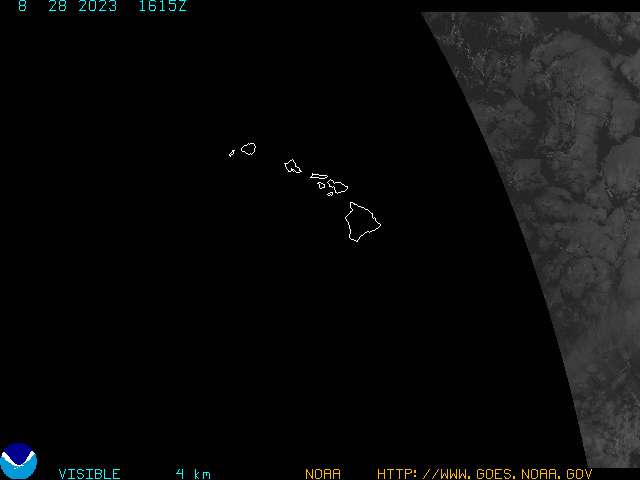

jan elliott Says:
Hi Glenn,
Read through your Wed evening update and just thought I’d mention that the rain didn’t make it as far as here in Muólea, on the Hana Coast. Between Hana Town and Kipahulu.
I know Ulaino and Honokalani, on the other side of Hana town, got rain, (they face North) but we are still super dry here (facing Southeast), just like the Big Island.
Tantalizing gray skies all day, but not a drop!
Noramlly, like you say, we get rain from both directions this time of year.
Thanks for all you do for us out here in the sticks
jan~~~Hi Jan, thanks for your nice note, from out Hana way. Sorry to hear that you didn’t get any rain from this last cold front, but perhaps as the trade winds swing around, you may get something. I know it’s been so dry out your way, and then there’s the Big Island, even further away from the front’s showers! Hang in there, no doubt…sooner or later you will get some water! Aloha, Glenn
Liz Says:
Aloha Glenn, So far this year we have only gotten 3/4″ of rain – and this is in Pahoa, on the ‘rainy’ side of the Big Island. I do enjoy the sunny days but this isn’t normal! Think we can order some rain soon? Keep up the great site – I check it every day 🙂 ~Liz~~~Liz, I believe that either you will pick up a little rainfall from the cold front heading in your direction now, or from the moisture picked up on the northeast winds that are following in the wake of the front. I know…it’s been so DRY! Thanks for using my website! Aloha, Glenn
Eliza Says:
After some fits and starts, Glenn,
The skies have opened up and we are receiving lovely straight down rains here in upper Ha`iku.
Have a great afternoon! ~ Eliza~~~Hi, this weak cold front is finally providing a bit of rain to the windward side of east Maui, very good! Here in Kihei, there’s a breezy, and slightly cool north wind blowing…with the hint of a little drizzle on the horizon. Aloha, Glenn