











January 25-26, 2010
Air Temperatures – The following maximum temperatures were recorded across the state of Hawaii Monday afternoon:
Lihue, Kauai – 80
Honolulu, Oahu – 81
Kaneohe, Oahu – 82
Kaunakakai, Molokai – 82
Kahului, Maui – 85
Hilo, Hawaii – 80
Kailua-kona – 81
Air Temperatures ranged between these warmest and coolest spots near sea level around the state – and on the highest mountains…at 5pm Monday evening:
Kaneohe, Oahu – 81F
Lihue, Kauai – 75
Haleakala Crater – 55 (near 10,000 feet on Maui)
Mauna Kea summit – 46 (near 14,000 feet on the Big Island)
Precipitation Totals – The following numbers represent the largest precipitation totals (inches) during the last 24 hours on each of the major islands, as of Monday afternoon:
0.34 Anahola, Kauai
0.02 Punaluu Stream, Oahu
0.00 Molokai
0.00 Lanai
0.00 Kahoolawe
0.00 Maui
0.01 Kamuela, Big Island
Marine Winds – Here’s the latest (automatically updated) weather map showing a weak 1020 millibar high pressure system far to the east-northeast. Our winds will be light-moderately strong, and locally gusty…from the south and southwest ahead of the next cold front late Tuesday into Wednesday.
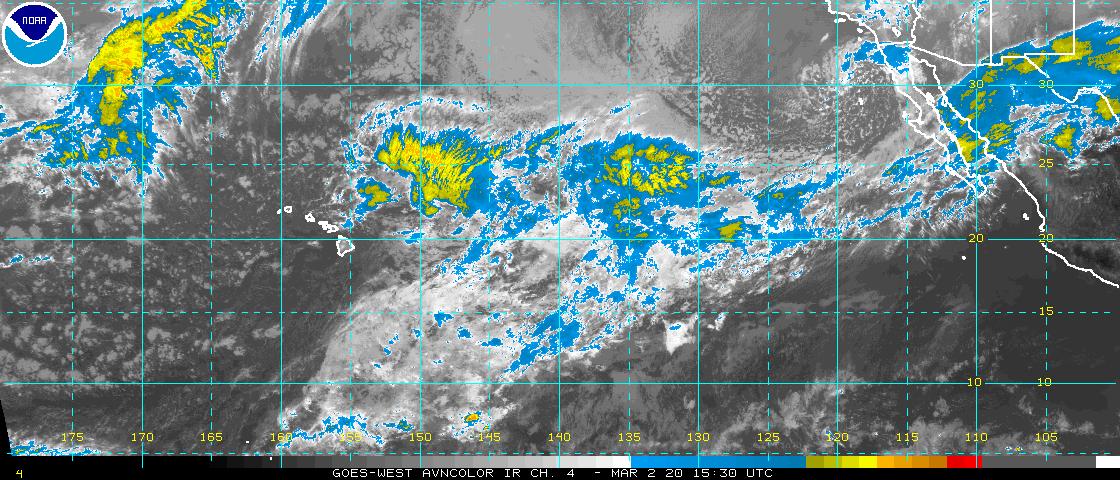
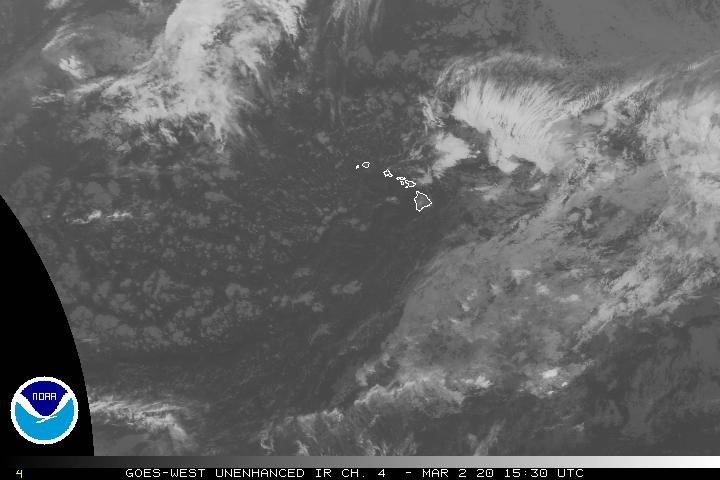
Satellite and Radar Images: To view the cloud conditions we have here in Hawaii, please use the following satellite links, starting off with this Infrared Satellite Image of the islands to see all the clouds around the state during the day and night. This next image is one that gives close images of the islands only during the daytime hours, and is referred to as a Close-up visible image. This next image shows a larger view of the Pacific…giving perspective to the wider ranging cloud patterns in the Pacific Ocean. Finally, here’s a Looping IR satellite image, making viewable the clouds around the islands 24 hours a day. To help you keep track of where any showers may be around the islands, here’s the latest animated radar image.
Hawaii’s Mountains – Here’s a link to the live webcam on the summit of near 14,000 foot Mauna Kea on the Big Island of Hawaii. The tallest peak on the island of Maui is the Haleakala Crater, which is near 10,000 feet in elevation. These two webcams are available during the daylight hours here in the islands…and when there’s a big moon rising just after sunset for an hour or two! Plus, during the nights and early mornings you will be able to see stars, and the sunrise too…depending upon weather conditions.
Tropical Cyclone activity in the eastern and central Pacific – Here’s the latest weather information coming out of the National Hurricane Center, covering the eastern north Pacific. You can find the latest tropical cyclone information for the central north Pacific (where Hawaii is located) by clicking on this link to the Central Pacific Hurricane Center. Here’s a tracking map covering both the eastern and central Pacific Ocean. A satellite image, which shows the entire ocean area between Hawaii and the Mexican coast…can be found here.
Aloha Paragraphs

The back side of the Haleakala Crater…Maui
The winds over our islands will remain generally light to moderately strong Monday evening, before they pick up more substantially from the Kona direction Tuesday into Wednesday…ahead of the next cold front. The last several days have seen volcanic haze over some of the smaller islands, and over some areas on the
We’re all counting on this next cold front to bring showers with it…as we sure need every drop of water we can get. It’s too soon to know for certain just how showery this next front will be, although the computer models continue to suggest that it will be a better rainfall producer (than the last one)…pushing all the way down through the island chain. The islands could certainly use the precipitation, especially those areas from Oahu down through
Getting back to the voggy weather, our best chance to see some atmospheric clearing would be after the cold front…when our winds veer around to the north and northeast briefly. This short spell of non-Kona winds will be replaced by a north and NE air flow. Besides the good chance of clearing the vog out, it will bring another cool snap to our islands…tropically speaking of course. Again, referring back to this IR satellite image, those clouds that are following right behind the cold front, or to the northwest and west, are called stratocumulus. They are formed typically when cool, or cold air flows over a warmer ocean surface. They are usually quite dry, and are good indicators of this cool snap. Cool in this case means a few degrees chillier during the days, perhaps keeping high temperatures in the 70F’s, rather than the lower 80’s at sea level…and a good reason to dig out that extra blanket again for Wednesday and Thursday nights coming up. Then, as we’ve been dancing this samba of Kona winds ~ cold front ~ chilly north breezes…we’ll find returning southeast to south winds, carrying more vog up into the state, ahead of the next cold front, scheduled for Friday night into the weekend.
It’s Monday, as I begin writing the last section of today’s narrative. As is so typical during an El Nino winter, we’re having dry to very dry weather. That’s why we are getting more and more excited about the upcoming cold front, which will hopefully bring showers to the entire state. Besides the dry cold front’s that we’ve seen through January, El Nino is also infamous for bringing Kona winds and voggy weather, which we’ve seen plenty of this winter too. Then, as common as the dry cold fronts, and dry weather, and the vog, we often find higher than normal surf conditions along our north and west facing shores. Just such a large to extra large swell is forecast to arrive later Wednesday into Thursday…which may very well cause the NWS forecast office in Honolulu to issue a high surf warning. ~~~ It wasn’t as voggy Monday, as it was this past weekend. Looking at high resolution visible satellite imagery, I could see that the vog has migrated just offshore to our south and southwest. As the south to southwest Kona winds start up tonight into Tuesday, this vog will be pushed over the islands again, bringing the thick haze back over us. ~~~ I’m just about ready to leave Kihei, as I’m done working now, taking the drive back upcountry to Kula. I’ll be home before its dark, and out on the road for a couple of quick paced loops around the neighborhood. I’ll be back well before sunrise Tuesday, with your next new weather narrative then. I hope you have a great Monday night until then! Aloha for now…Glenn.
Interesting: Bill Gates, the world’s richest man and a leading philanthropist, said on Sunday spending by rich countries aimed at combating climate change in developing nations could mean a dangerous cut in aid for health issues. Gates, the Microsoft Corp co-founder whose $34 billion foundation is fighting malaria, AIDS, tuberculosis and other diseases in developing countries, expressed concern about the amount of spending pledged at December’s Copenhagen global climate meeting.
Participants at the meeting agreed to a target of channeling $100 billion per year to developing countries to combat climate change by 2020. Gates said that amount represents more than three quarters of foreign aid currently given by the richest countries per year. "I am concerned that some of this money will come from reducing other categories of foreign aid, especially health," Gates wrote in a letter, released late on Sunday, describing the work of his foundation.
"If just 1 percent of the $100 billion goal came from vaccine funding, then 700,000 more children could die from preventable diseases," Gates added. Taking the focus away from health aid could be bad for the environment in the long run, said Gates, "because improvements in health, including voluntary family planning, lead people to have smaller families, which in turn reduces the strain on the environment."
Interesting2: The world is showing only lukewarm enthusiasm for a "Copenhagen Accord" to curb climate change, with no sign so far of deeper-than-planned 2020 curbs on greenhouse gas emissions before a January 31 deadline. In Brussels, a draft European Union letter on Friday showed plans for the 27-nation bloc to reiterate a minimum offer of a 20 percent cut in emissions by 2020 below 1990 levels, pleasing industry, and a 30 percent cut if other nations act comparably.
Other countries are likely to do the same after last month’s Copenhagen summit ended with a low-ambition accord. No nations have since announced radically tougher plans for action. "I think that countries are going to stick to their ranges," said Nick Mabey, head of the E3G think-tank in London.
He said it was too early for an overhaul of national goals." It’s almost like the beginning of a new negotiation," said Gordon Shepherd, director of international policy at the WWF environmental group. Many countries were still torn between showing "a burst of enthusiasm" to rebuild momentum after Copenhagen and "complete caution," taking time to review next moves, he said.
Few countries have so far sent letters to the U.N. Climate Change Secretariat before a January 31 deadline for outlining goals for 2020 set by the Copenhagen Accord, which was worked out by major emitters led by China and the United States.
Interesting3: Ice Age climate records from an Arizona stalagmite link the Southwest’s winter precipitation to temperatures in the North Atlantic, according to new research. The finding is the first to document that the abrupt changes in Ice Age climate known from Greenland also occurred in the southwestern U.S., said co-author Julia E. Cole of the University of Arizona in Tucson.
"It’s a new picture of the climate in the Southwest during the last Ice Age," said Cole, a UA professor of geosciences. "When it was cold in Greenland, it was wet here, and when it was warm in Greenland, it was dry here." The researchers tapped into the natural climate archives recorded in a stalagmite from a limestone cave in southern Arizona. Stalagmites grow up from cave floors.
The stalagmite yielded an almost continuous, century-by-century climate record spanning 55,000 to 11,000 years ago. During that time ice sheets covered much of North America, and the Southwest was cooler and wetter than it is now. Cole and her colleagues found the Southwest flip-flopped between wet and dry periods during the period studied. Each climate regime lasted from a few hundred years to more than one thousand years, she said.
In many cases, the transition from wet to dry or vice versa took less than 200 years. "These changes are part of a global pattern of abrupt changes that were first documented in Greenland ice cores," she said. "No one had documented those changes in the Southwest before."
Scientists suggest that changes in the northern Atlantic Ocean’s circulation drove the changes in Greenland’s Ice Age climate, Cole said. "Those changes resulted in atmospheric changes that pushed around the Southwest’s climate."
She added that observations from the 20th and 21st centuries link modern-day alterations in the North Atlantic’s temperature with changes in the storm track that controls the Southwest’s winter precipitation. "Also, changes in the storm track are the kinds of changes we expect to see in a warming world," she said. "When you warm the North Atlantic, you move the storm track north."
Interesting4: The simple formula we’ve learned in recent years — forests remove the greenhouse gas CO2 from the atmosphere; therefore forests prevent global warming — may not be quite as simple as we thought. Forests can directly absorb and retain heat, and, in at least one type of forest, these effects may be strong enough to cancel out a good part of the benefit in lowered CO2.
This is a conclusion of a paper that will be published on January 22, in Science by scientists in the Weizmann Institute’s Faculty of Chemistry. For the past 10 years, the Weizmann Institute has been operating a research station in the semi-arid Yatir Forest, a pine forest at the edge of the Negev Desert. This station is part of a world-wide project composed of over 400 stations, called FLUXNET, which investigates the relationship between forests, the atmosphere and climate around the globe.
The contribution of the Yatir station, says Prof. Dan Yakir of the Environmental Sciences and Energy Research Department, is unique as it ‘is one of very few in the semi-arid zone, which covers over 17% of the Earth’s land surface, and it has the longest record of the processes taking place in semi-arid forests.’ Forests counteract the ‘greenhouse effect’ by removing heat-trapping CO2 from the atmosphere and storing it in living trees.
Over the years of measurement, Yakir’s group has found that the semi-arid forest, even though it’s not as luxuriant as temperate forests farther north, is a surprisingly good carbon sink — better than most European pine forests and about on par with the global average.
This was unexpected news for a forest sitting at the edge of a desert, and it indicated that there is real hope for the more temperate forests if things heat up under future global change scenarios. But forests do more than just store CO2, and Yakir, together with Dr. Eyal Rotenberg, decided to look at the larger picture — the ‘total energy budget’ of a semi-arid forest.
The first hint they had that other processes might be counteracting the cooling effect of CO2 uptake came when they compared the forest’s albedo — how much sunlight is reflected from its surface back into space — with that of the nearby open shrub land.
They found that the dark-colored forest canopy had a much lower albedo, absorbing quite a bit more of the sun’s energy than the pale, reflective surface of surrounding areas. In a cloudless environment with high levels of solar radiation, albedo becomes an important factor in surface heating.
Interesting4: Tilapia has quickly risen through the ranks as an important aquaculture fish. It’s third in production behind carp and salmon, with over 1.5 million metric tons produced every year. Tilapia are the ideal fish farm species because they’re omnivorous, fairly big, quick-growing, tolerate high densities quite well and are mighty tasty.
They are also considered far more environmentally friendly than other species because they can be fed a vegetarian diet. A recent study of tilapia in Fiji drew some attention, however. Tilapia species have been in Fiji since at least 1949, and fish farms there produce tons of it.
But there’s a downside to being the perfect fish to farm: tilapia are also a highly damaging invasive species. Because they grow fast and eat whatever is available, they’re very adaptable to living in just about any freshwater environment that’s warm enough. They’ve invaded the waterways of many of the countries that farm them commercially.
The study revealed that these escapees are damaging the natural biodiversity of Fiji’s waterways. Researchers from Wetlands International, the Wildlife Conservation Society, and Conservation International found that two things correlated strongly to the diversity of native fish in an area. First, they found that the more an area had been cleared for housing or other reasons, the fewer species of native fish.
That was not shocking. It was the second variable that decimated native fish diversity that made headlines: the presence of tilapia. Of the 89 different sample locations surveyed, 85.4 percent had been invaded by tilapia. In Fiji, the loss of native fish is as much a cultural issue as it is an environmental one.
Many native species form an important part of the diet of inland communities, and, in particular, are important in small villages where fish are caught not farmed. As the human populations continue to expand, countries such as Fiji will rely more and more heavily on compact, efficient means of producing food, like fish farms. And while this study serves to warn of the downsides of aquaculture, it unfortunately doesn’t provide a solution to the underlying problem of too many mouths to feed on limited resources.
 Email Glenn James: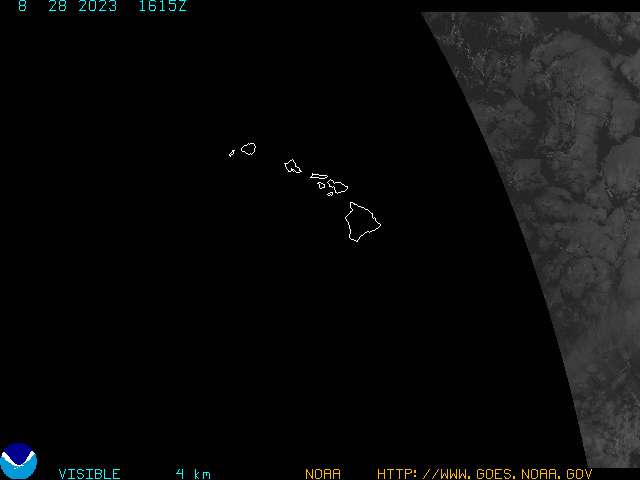

Erica Rainhart Says:
Aloha Glen,
Have you heard of and/or studied the, ‘ HAARP/ELF weather warfare complexes’ researched on History Channel Documentary last year?~~~Hi Erica, actually, I don’t watch TV, so I didn’t see that documentary…sounds interesting though. Aloha, Glenn
Danielle Says:
Hi,
I have an opportunity to go stay in Haiku for a week in mid-March. Since I live in the rainforest in Vancouver BC I don’t relish the idea of landing in Maui and sitting in rain! What do you think the chances are of sun during that time in Haiku?
THanks!~~~Hi Danielle, having lived in Haiku, on the windward side for many, many years, I’d say partly cloudy would be your best bet, with some sunshine and some showers. Although, this is an El Nino year, which means that we’ll see less than the normal amount of showers. Come ahead, Haiku is a great place to experience Hawaii! Aloha, Glenn