January 21-22, 2010
Air Temperatures – The following maximum temperatures were recorded across the state of Hawaii Thursday afternoon:
Lihue, Kauai – 76
Honolulu, Oahu – 80
Kaneohe, Oahu – 76
Kaunakakai, Molokai – 78
Kahului, Maui – 79
Hilo, Hawaii – 76
Kailua-kona – 82
Air Temperatures ranged between these warmest and coolest spots near sea level around the state – and on the highest mountains…at 5pm Thursday evening:
Kailua-kona – 79F
Hilo, Hawaii – 72
Haleakala Crater – 54 (near 10,000 feet on Maui)
Mauna Kea summit – 45 (near 14,000 feet on the Big Island)
Precipitation Totals – The following numbers represent the largest precipitation totals (inches) during the last 24 hours on each of the major islands, as of Thursday afternoon:
0.47 Mount Waialaele, Kauai
2.13 Oahu Forest NWR, Oahu
0.30 Molokai
0.00 Lanai
0.00 Kahoolawe
2.81 West Wailuaiki, Maui
1.55 Kawainui Stream, Big Island
Marine Winds – Here’s the latest (automatically updated) weather map showing a high pressure system to the north of the islands…moving southeastward. Our winds will be lighter from the southeast and and south, then southwest ahead of a cold front.
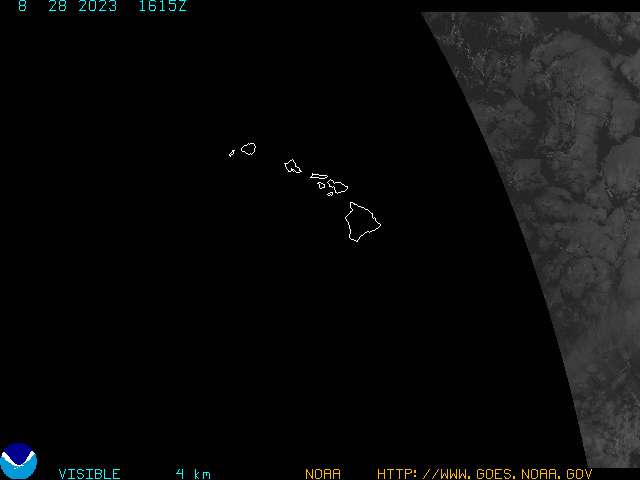
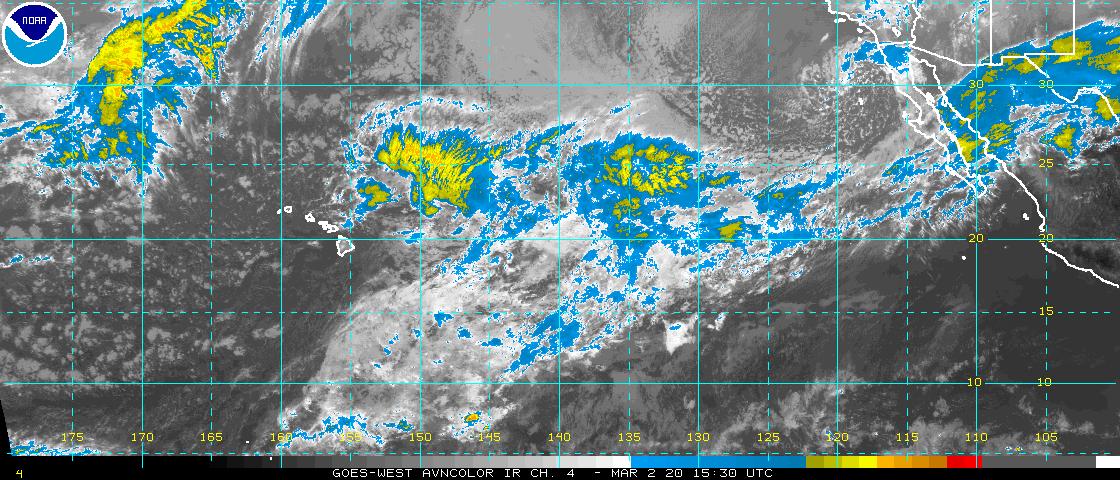
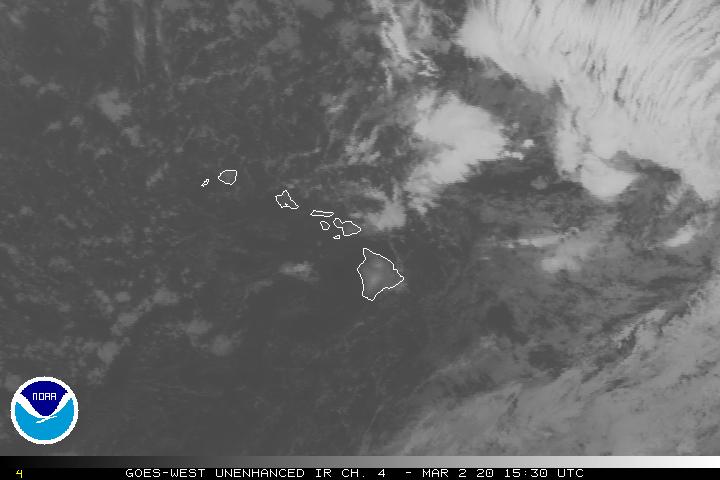
Satellite and Radar Images: To view the cloud conditions we have here in Hawaii, please use the following satellite links, starting off with this Infrared Satellite Image of the islands to see all the clouds around the state during the day and night. This next image is one that gives close images of the islands only during the daytime hours, and is referred to as a Close-up visible image. This next image shows a larger view of the Pacific…giving perspective to the wider ranging cloud patterns in the Pacific Ocean. Finally, here’s a Looping IR satellite image, making viewable the clouds around the islands 24 hours a day. To help you keep track of where any showers may be around the islands, here’s the latest animated radar image.
Hawaii’s Mountains – Here’s a link to the live webcam on the summit of near 14,000 foot Mauna Kea on the Big Island of Hawaii. The tallest peak on the island of Maui is the Haleakala Crater, which is near 10,000 feet in elevation. These two webcams are available during the daylight hours here in the islands…and when there’s a big moon rising just after sunset for an hour or two! Plus, during the nights and early mornings you will be able to see stars, and the sunrise too…depending upon weather conditions.
Tropical Cyclone activity in the eastern and central Pacific – Here’s the latest weather information coming out of the National Hurricane Center, covering the eastern north Pacific. You can find the latest tropical cyclone information for the central north Pacific (where Hawaii is located) by clicking on this link to the Central Pacific Hurricane Center. Here’s a tracking map covering both the eastern and central Pacific Ocean. A satellite image, which shows the entire ocean area between Hawaii and the Mexican coast…can be found here.
Aloha Paragraphs

Nice Weather Friday…although becoming hazy
The current blustery conditions will be winding down quickly…veering around to the southeast through south direction Friday. A high pressure system is located to the north of the islands Thursday evening…being pushed southeast by an approaching cold front. Our local winds will become much lighter, as the high pressure system moves away. Small craft wind advisory flags remain active across all of our coastal waters now, but will very likely be discontinued Friday. As we get into Friday, our more southerly winds will carry volcanic haze up from the Big Island vents, into some of the smaller islands. These lighter breezes will swing to the southwest, the Kona direction, ahead of a cold front that will arrive over the state this weekend. Then, we’ll find light winds hanging around in the wake of the cold front. It won’t be long before the winds pick up again, from the Kona direction, ahead of another cold front arriving around the middle of the new week ahead.
Showers will be few and far between, to say the least on Friday, with almost 100% of the state remaining completely dry. Looking at this IR satellite image, we see a very large area of clouds to the east through north of the state. These stratocumulus clouds are usually dry, and often evaporate during the daytime hours…leaving mostly sunny skies. Looking a bit further ahead, as mentioned above, our winds will veer around to the Kona direction later on Friday, due to the approach of the next cold front. This cold front should be able to bring more showers, although its still a little premature to try and guess how many will fall, or exactly where the front may stall along its travels through the island chain. The next chance for additional showers would be around the middle of next week, when another cold front arrives. We keep hoping that one of these showers will give us a good old fashioned soaking rain, although not yet.
It’s Thursday evening, as I begin writing the last section of today’s narrative. The weather today, on Thursday, was about as good as it gets. The only draw back to that statement was the nature of the locally gusty winds. They had much more of an easterly aspect though, compared to the chilly northeast winds of yesterday. I expect more fine weather on Friday, which will be mostly clear and dry, although the volcanic haze may very well be back in some areas…especially here in Maui County. ~~~ Looking out the window before I leave Kihei, it is essentially clear as a bell, with hardly a cloud in the sky. The western slope of the Haleakala Crater is absolutely cloud free! The winds are still whipping around along the windward sides though…with the strongest gust at 5pm, a potent 37 mph at South Point, on the Big Island. Maui County had gusts over 30 mph, with even an impressive 30 mph gust in the big city of Honolulu, on Oahu. I just took my evening walk, upon arriving home. I noticed, besides the good feeling it has given me, that it’s already turning hazy down in the Central Valley just as it’s getting dark out. ~~~ I’ll be back early Friday morning with your next new weather narrative, and will let you know if the vog has thickened up, as expected then. I hope you have a great Thursday night wherever you happen to be spending it! Aloha for now…Glenn.
Extra: Social Networking Evolution
Interesting: Wind energy could generate 20 percent of the electricity needed by households and businesses in the eastern half of the United States by 2024, but it would require up to $90 billion in investment, according to a government report released on Wednesday. For the 20 percent wind scenario to work, billions must be spent on installing wind towers on land and sea and about 22,000 miles of new high-tech power lines to carry the electricity to cities, according to the study from the Energy Department’s National Renewable Energy Laboratory.
"Twenty percent wind is an ambitious goal," said David Corbus, the project manager for the study. "We can bring more wind power online, but if we don’t have the proper infrastructure to move that power around, it’s like buying a hybrid car and leaving it in the garage," The private sector cannot fund all the needed spending, so a big chunk would have to come from the federal government through programs such as loan guarantees, Corbus said.
The Obama administration is already dedicating billions of dollars to double the amount of electricity produced by wind and other renewables energy sources by January 2012. The amount of U.S. electricity generated by wind was up 29 percent during January-October of last year compared to the same period is 2008, according to the Energy Department.
Interesting2: Scientists are reporting the first evidence from human research that blueberries — one of the richest sources of healthful antioxidants and other so-called phytochemicals — improve memory. They said the study establishes a basis for comprehensive human clinical trials to determine whether blueberries really deserve their growing reputation as a memory enhancer. A report on the study appears in ACS’ Journal of Agricultural and Food Chemistry.
Robert Krikorian and colleagues point out that previous studies in laboratory animals suggest that eating blueberries may help boost memory in the aged. Until now, however, there had been little scientific work aimed at testing the effect of blueberry supplementation on memory in people. In the study, one group of volunteers in their 70s with early memory decline drank the equivalent of 2-2 l/2 cups of a commercially available blueberry juice every day for two months.
A control group drank a beverage without blueberry juice. The blueberry juice group showed significant improvement on learning and memory tests, the scientists say. "These preliminary memory findings are encouraging and suggest that consistent supplementation with blueberries may offer an approach to forestall or mitigate neurodegeneration," said the report. The research involved scientists from the University of Cincinnati, the U.S. Department of Agriculture, and the Canadian department of agriculture.
Interesting3: Another 300,000 people are to be moved from their homes near China’s Three Gorges dam, according to state media. It is unclear if the relocations are directly because of the dam and its reservoir but almost 1.3 million people have already been moved from the area. The Three Gorges project is expected to produce 100bn kilowatt-hours of electricity a year at full capacity.
The dam is the biggest in the world, and opponents have long criticised its huge human and environmental costs. Initial reports quoted the China Daily as saying that people were being moved to prevent pollution in the reservoir, and to protect people against hazards like landslides.
A Three Gorges spokesman has since denied this. Hu Jiahai, a deputy of the local people’s congress, told the newspaper: "An eco-screen, or buffer belt, is waiting for approval to be built alongside the reservoir to improve the water quality of the Yangtze River streams and reduce the contamination from residents living nearby.
"Additionally, more people will have to move out of the area to avoid geographic hazards, like landslides," he added. He said the exact number who would need to move depended on an assessment of the geology of the area. But Peng Yehua from China Three Gorges Corporation told the BBC: "These people’s relocation is not a part of the Three Gorges Dam relocation project."
"This relocation of 300,000 is a decision of the Chongqing government, to move residents from high mountain areas with harsh living conditions into better lands." The Three Gorges dam has been controversial from its inception. It was championed by former Chinese leader Mao Zedong.
Officially, the infrastructure project has cost $27.2bn (£16.7m), but others believe the real price could be much higher. Critics claim it will cause massive environmental destruction, and others say the forced resettlement of nearby villagers has left many without compensation. Scientists also caused concern when they said the massive weight of the swelling reservoir was causing an increase in seismic activity and landslides in the area.
Interesting4: A tiny asteroid that buzzed Earth last week highlighted our planet’s vulnerability to objects whose peculiar orbits put them in a game of hide-and-seek with us. An Earth-based telescope spotted the 10-metre space rock hurtling our way just three days before a near miss on 13 January, when it flew by at just one-third of the distance to the moon.
The asteroid is never expected to hit Earth and would burn up before hitting the ground in any case. But its unusual orbit (see diagram) seems ingeniously designed to evade our surveys. It is likely that a handful of objects large enough to cause harm are hiding under similar circumstances.
Large asteroids are relatively easy to spot because they reflect the most sunlight. But smaller asteroids – which can still damage Earth if they span at least 30 to 50 meters – are usually too dim for telescopes to detect except during brief close approaches to Earth. For a typical near-Earth asteroid, these occurrences are a few years or decades apart.
However, last week’s unexpected visitor, called 2010 AL30, kept far enough from Earth to be invisible for more than a century. The prolonged avoidance occurred because the period of its solar orbit was 366 days – very close to Earth’s year (though the close pass shifted the space rock into a 390-day orbit).
Like a slightly slower race car that is periodically lapped by its competitor on a circular track, it stays far from Earth for long stretches. "2010 AL30 may become a sort of ‘poster child’ for hiding asteroids," says Alan Harris of the Space Science Institute in Boulder, Colorado. Similar "synchronized" asteroids may be hiding with periods of very close to two, three, four years and so on, Harris says.
Those with periods of about four years pose the greatest risk to Earth, because they would be in sync with both Earth and Jupiter, says Timothy Spahr of the Minor Planet Center in Cambridge, Massachusetts. Such asteroids would be particularly influenced by Jupiter’s gravity, which could nudge them onto a collision course with Earth.
Asteroids with non-synchronous orbits can also hide. Those with orbits mostly interior to Earth’s – called Aten asteroids – spend most of their time in the glare of the sun as seen from Earth, so telescopes have trouble spotting them.
Interesting5: The recent devastation caused by the earthquake in Haiti is not the only environmental disaster the islands of the world face. A more long term one is the pending sea level rise that could obliterate the world’s small island states, triggering fears of mass migration. However, a mass migration is not immediately likely and some of these small island nations are fighting back.
For Example the Indian Ocean island of Maldives says it has no plans to relocate its 300,000 inhabitants or purchase land in neighboring countries before the seas rise. "Maldives does not have a relocation plan and had at no time ever considered relocation to another country, either in the neighborhood or any other area," Ambassador Abdul Ghafoor Mohamed, the permanent representative of Maldives to the United Nations.
Still, the Pacific Small Island Developing States, which includes countries such as Fiji, Palau, Marshall Islands, Nauru and Tuvalu, have not ruled out the possibility of relocating before disaster strikes. Ambassador Stuart Beck of Palau says that displacement to a neighboring or third country "might be the only option if climate change continues at the current or increased rate without significant and urgent mitigation by the international community."
Mass migrations can and will occur after a natural disaster. The current Haiti problem is an example where over 200,000 people have been trying to find shelter in the neighboring Dominican Republic. During the American "Dust Bowl" of the 1930’s many fled when their farms dried up. The International Organization for Migration has predicted that in the worst case scenario, as many as 50 million to 350 million people may have to migrate from their island nations.
In most Pacific islands, the people, agricultural land, tourist resorts and infrastructure (including roads and airports) are concentrated in the coastal zones, and are thus especially vulnerable to any rise in sea level. Determining how severe this problem is, or might be, is complicated by natural shifts in sea level associated with the recurring ice ages and tectonic action.
The current sea level rise has occurred at a mean rate of 0.7 inches per year for the past century and more recently it has been estimated near 1.2 inches per year (1993-2003). What the future will bring as a sea rise is variable depending on the melting of the ice caps and average global temperatures. Some have predicted as much as 7 feet in the next century for example.
Fleeing is not the only option. Micronesia, a Pacific island nation, has just filed a plea to challenge plans by the Czech Republic to expand a coal fired power station some 10,000 miles away from Micronesia. At issue is Prunerov plant is one of the largest coal fired stations in the European Union and the largest single source of carbon dioxide emissions in the Czech Republic.
Carbon dioxide is a potential cause of global warming and hence sea level rise. "The Federated States of Micronesia is seriously endangered by the impacts of climate change, including the flooding of its entire territory and the eventual disappearance of a portion of its state," Andrew Yatilman, director of the country’s Office of Environment and Emergency Management, submitted in the plea filed with the Environment Ministry of the Czech Republic.
 Email Glenn James: