











January 20-21, 2010
Air Temperatures – The following maximum temperatures were recorded across the state of Hawaii Wednesday afternoon:
Lihue, Kauai – 77
Honolulu, Oahu – 83
Kaneohe, Oahu – 80
Kaunakakai, Molokai – 79
Kahului, Maui – 80
Hilo, Hawaii – 80
Kailua-kona – 82
Air Temperatures ranged between these warmest and coolest spots near sea level around the state – and on the highest mountains…at 5pm Wednesday evening:
Kailua-kona – 80F
Lihue, Kauai – 70
Haleakala Crater – 55 (near 10,000 feet on Maui)
Mauna Kea summit – 39 (near 14,000 feet on the Big Island)
Precipitation Totals – The following numbers represent the largest precipitation totals (inches) during the last 24 hours on each of the major islands, as of Wednesday afternoon:
0.08 Mount Waialaele, Kauai
0.19 Punaluu Stream, Oahu
0.00 Molokai
0.00 Lanai
0.00 Kahoolawe
0.06 West Wailuaiki, Maui
0.30 Kawainui Stream, Big Island
Marine Winds – Here’s the latest (automatically updated) weather map showing a high pressure system to the north-northwest of the islands…moving eastward into the area north and north-northeast of Hawaii. Our winds will be generally northeast, remaining strong into Thursday…then lighter from the east and southeast.
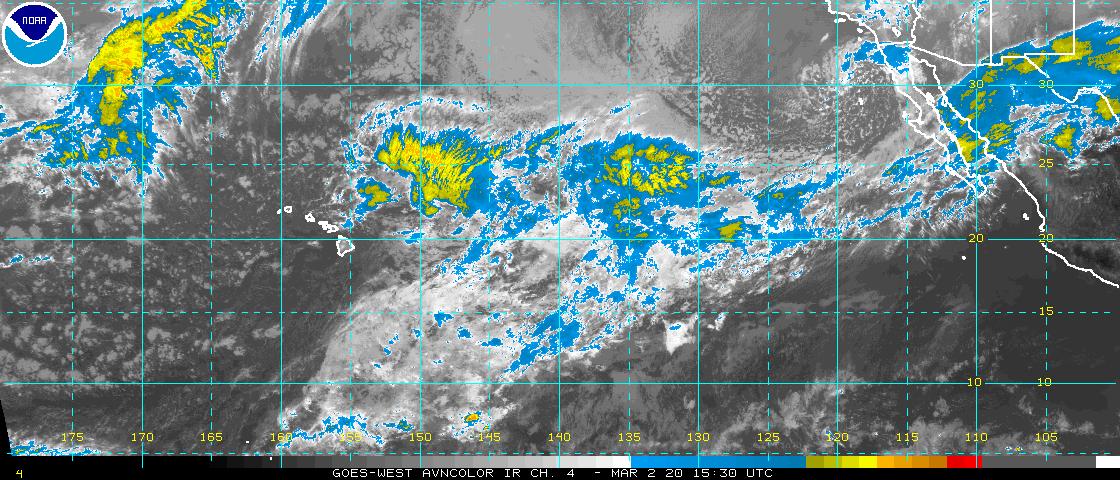
Satellite and Radar Images: To view the cloud conditions we have here in Hawaii, please use the following satellite links, starting off with this Infrared Satellite Image of the islands to see all the clouds around the state during the day and night. This next image is one that gives close images of the islands only during the daytime hours, and is referred to as a Close-up visible image. This next image shows a larger view of the Pacific…giving perspective to the wider ranging cloud patterns in the Pacific Ocean. Finally, here’s a Looping IR satellite image, making viewable the clouds around the islands 24 hours a day. To help you keep track of where any showers may be around the islands, here’s the latest animated radar image.
Hawaii’s Mountains – Here’s a link to the live webcam on the summit of near 14,000 foot Mauna Kea on the Big Island of Hawaii. The tallest peak on the island of Maui is the Haleakala Crater, which is near 10,000 feet in elevation. These two webcams are available during the daylight hours here in the islands…and when there’s a big moon rising just after sunset for an hour or two! Plus, during the nights and early mornings you will be able to see stars, and the sunrise too…depending upon weather conditions.
Tropical Cyclone activity in the eastern and central Pacific – Here’s the latest weather information coming out of the National Hurricane Center, covering the eastern north Pacific. You can find the latest tropical cyclone information for the central north Pacific (where Hawaii is located) by clicking on this link to the Central Pacific Hurricane Center. Here’s a tracking map covering both the eastern and central Pacific Ocean. A satellite image, which shows the entire ocean area between Hawaii and the Mexican coast…can be found here.
Aloha Paragraphs

Windy weather…easing off Thursday night into Friday
A brief surge in wind speeds is happening now…with winds dropping off quickly Thursday night into Friday. A high pressure system is located to the north-northwest of the islands, and will be shifting eastward…as this weather map shows. This high pressure cell will be moving rapidly eastward, on its way into the area further east. Our local winds have shown a definite increase in strength now, as this high pressure system moves by. Small craft wind advisory flags are now active across all of our coastal waters. As we get into Friday, our winds will veer around to the southeast and south, which might carry some volcanic haze up from the Big Island vents, into some of the smaller islands. Winds will swing all the way around to the southwest, the Kona direction, ahead of a cold front that will arrive over the state this weekend. Then, we’ll find another short spell of cooler north to NE breezes arriving in the wake of the cold front. It won’t be long before the winds shift again, to the Kona direction ahead of another cold front around the middle of next week…followed by light northerly to NE winds again for a couple of days.
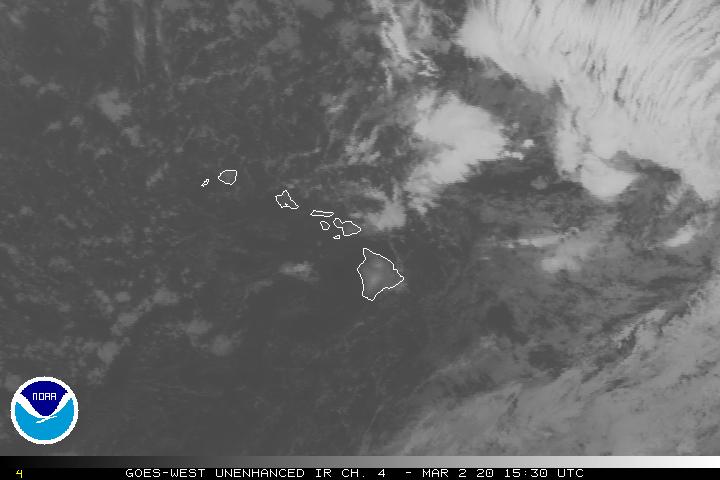
The locally strong and gusty NE to ENE winds will carry some showers into our area, from a cloud band off the ocean to our north. Looking at this IR satellite image, we see an area of clouds dropping down over the state now. It had overlapped the area from Kauai down to Maui County at the time of this writing…hopefully swooping down to the Big Island. The winds are actually strong enough to carry some of these rain drops over to the leeward sides. Checking out this looping radar image, we could actually get a little excited about those showers moving into our dry state! Looking a bit further ahead, as mentioned above, our winds will veer around to the Kona direction by Friday, due to the approach of the next cold front. This cold front should be able to bring more showers, especially to the areas from Kauai down to Oahu, or perhaps
It’s Wednesday evening, as I begin writing the last section of today’s narrative. The winds came on as expected today, strong and gusty, and chilly too! They’ve been able to drive a new cloud band, with its associated showers…down into the state. These winds are coming in generally from the northeast, after having passed the northern direction. These typically bring chilly air our way, and are about the only thing that reminds Hawaii’s residents that in fact…we do have winter weather here in the tropics! ~~~ It was even lightly raining here in Kihei, Maui, with rainbows in many directions. I’m about ready to hop in my car, and I know it’s going to be really cool when I get back upcountry, having gained nearly 3,000 feet in elevation in that 40 minute drive. It showered or drizzled most of the way home, although stopped when I got to Kula. Skies were totally clear over the western slopes of the mountain, with just the lowlands receiving that much need rainfall. The temperature when I left Kihei, a little before 6pm, was 74F degrees, and had dropped to 62 degrees by the time I got home. I immediately went out for my evening constitutional, which felt great. Wednesday evening the winds have really become blustery, with all islands finding gusts well over 30 mph, with the small island of Lanai reporting gusts over 50 mph! The NWS has issued a wind advisory over the Kohala area on the Big Island. I’ll be back early Thursday morning, with your next new weather narrative from our windy paradise, I hope you have a great Wednesday night! Aloha fro now…Glenn.
Interesting: Just over a week after the devastating earthquake struck, another earthquake rattled Haiti this morning. Fortunately, the weather will cooperate with recovery efforts. The earthquake this morning occurred at 6:03 a.m. EST. The epicenter of the 6.1-magnitude earthquake struck 35 miles west-southwest of Port-au-Prince. Estimates from the USGS indicate that the shaking felt in Port-au-Prince was light.
The city of Petit Goave likely endured severe shaking, potentially resulting in heavy damage to vulnerable structures. The weather will likely assist those providing aid to Haiti, as both the air and sea will be tranquil through the end of the week. The greater Caribbean Sea and nearby western Atlantic Ocean will be settled and mostly calm.
At sea, winds will tend to be light to moderate with seas no rougher than usual. In the corridor between Haiti and Florida, seas will vary mostly from 1-3 feet. Seas will be rougher north of the Bahamas and through the open Caribbean Sea. Dry weather will dominate the region; however, areas including Hispaniola could get some brief scattered showers and the possibility of a thunderstorm.
Rain was reported at the Port-au-Prince airport yesterday. Aid efforts continue in Haiti as supplies continue to be airlifted and shipped to the capital of Port-au-Prince. Medical teams struggle to treat the thousands of injured, and rescue operations continue to extract survivors from the rubble.
Interesting2: Long-term efforts to help Haiti recover from the earthquake will have to reverse environmental damage such as near-total deforestation that threatens food and water supplies for the Caribbean nation, experts say. The focus is now on emergency aid — Haitian officials estimate that between 100,000 and 200,000 people died in the January 12 quake.
But President Rene Preval urged donors on Monday also to remember the country’s long-term needs. Experts say deforestation in Haiti stretching back to the Duvalier dictatorships — leaving the nation with less than 2 percent forest cover — contributes to erosion that undermines food output by the poorest nation in the Western Hemisphere.
"We need to work…to create mechanisms that reinforce better use of natural resources," said Asif Zaidi, Operations Manager of the post-conflict and disaster management branch of the U.N. Environment Program (UNEP). Before the quake, UNEP had decided on a two-year project from 2010 to bolster Haiti’s environment, from forests to coral reefs, spokesman Nick Nuttall said.
Among quick measures for donors could be to provide propane to encourage a shift from charcoal-burning stoves. That could be backed in the llonger-term by reforestation and investments in renewable energies such as solar or wind power, Zaidi said.
Interesting3: Plasma jets capable of obliterating tooth decay-causing bacteria could be an effective and less painful alternative to the dentist’s drill, according to a new study published in the February issue of the Journal of Medical Microbiology. Firing low temperature plasma beams at dentin — the fibrous tooth structure underneath the enamel coating — was found to reduce the amount of dental bacteria by up to 10,000-fold.
The findings could mean plasma technology is used to remove infected tissue in tooth cavities — a practice that conventionally involves drilling into the tooth. Scientists at the Leibniz-Institute of Surface Modifications, Leipzig and dentists from the Saarland University, Homburg, Germany, tested the effectiveness of plasma against common oral pathogens including Streptococcus mutans and Lactobacillus casei.
These bacteria form films on the surface of teeth and are capable of eroding tooth enamel and the dentin below it to cause cavities. If left untreated it can lead to pain, tooth loss and sometimes severe gum infections. In this study, the researchers infected dentin from extracted human molars with four strains of bacteria and then exposed it to plasma jets for 6, 12 or 18 seconds.
The longer the dentin was exposed to the plasma the greater the amount of bacteria that were eliminated. Plasmas are known as the fourth state of matter after solids, liquids and gases and have an increasing number of technical and medical applications. Plasmas are common everywhere in the cosmos, and are produced when high-energy processes strip atoms of one or more of their electrons.
This forms high-temperature reactive oxygen species that are capable of destroying microbes. These hot plasmas are already used to disinfect surgical instruments. Dr Stefan Rupf from Saarland University who led the research said that the recent development of cold plasmas that have temperatures of around 40 degrees Celsius showed great promise for use in dentistry.
"The low temperature means they can kill the microbes while preserving the tooth. The dental pulp at the centre of the tooth, underneath the dentin, is linked to the blood supply and nerves and heat damage to it must be avoided at all costs." Dr Rupf said using plasma technology to disinfect tooth cavities would be welcomed by patients as well as dentists.
"Drilling is a very uncomfortable and sometimes painful experience. Cold plasma, in contrast, is a completely contact-free method that is highly effective. Presently, there is huge progress being made in the field of plasma medicine and a clinical treatment for dental cavities can be expected within 3 to 5 years."
Interesting4: The Metropolitan Manila Development Authority has started dismounting tarpaulins, mostly campaign posters and advertisements, along major thoroughfares as part of its program to make the metropolis “clean and green.” MMDA Chairman Oscar Inocentes has ordered the Roadway/Sidewalk Clearing Operations Group to remove the visual clutter strewn all over the major thoroughfares.
Some 200 MMDA workers have already been dispatched all over Metro Manila to enforce the directive. “Besides spoiling the visual landscape of Metro Manila, these posters put the public at risk, as most of them are placed on inappropriate areas,” Inocentes said in a statement.
Inocentes noted that the posting of advertising materials on trees also poses a hazard to the environment in general. He said according to Manuel Sayson, agency horticulturist, the nails used in tacking the posters damage the bark of the trees and serve as an additional entry point for insects, fungi and other pests, which cause diseases.
These factors, Inocentes said, lead to the reduction of carbon sequestration or a lesser capability of trees to filter air pollutants. “Our foremost priority is the health and safety of the public. The people who put those posters apparently don’t know that they are instigating grave damage to the environment,” Inocentes said.
A monitoring unit is continuously going around Metro Manila to check public installations such as electric posts, power cables, traffic signs, and sidewalk railings that have been covered with posters and advertisements.
Interesting5: One of the world’s largest tiger populations could be wiped out this century as rising seas threaten to engulf their dwindling habitat in the coastal mangrove forests of Bangladesh, researchers said Wednesday. A projected sea-level rise of 11 inches above 2000 levels along coastal Bangladesh by 2070 may cause the remaining tiger habitat in the Sundarbans to decline by 96 percent, pushing the total population to as few as five tigers, according to the new World Wildlife Fund-led study published this month in the peer-reviewed journal, Climatic Change.
Studies in the past have shown that tiger populations below 25 have difficulty surviving. Colby Loucks, WWF’s deputy director of conservation science, said in a statement that tigers were capable of thriving in a wide range of habitats from the snowy forests of Russia to the tropical forests of Indonesia, but the projected sea-level rise in Bangladesh would likely outpace the tiger’s ability to adapt.
"If we don’t take steps to address the impacts of climate change on the Sundarbans, the only way its tigers will survive this century is with scuba gear," said Loucks, the lead author of the study. Tigers are among the world’s most threatened species, with just 3,200 estimated left in the wild following widespread poaching and deforestation.
There are believed to be close to 250 tigers on the Indian side of the Sundarbans, and another 250 on the Bangladesh side. The study is the first to assess the impact of a sea-level rise on the tigers, and its conclusions were made possible by advances in the data collected on the Sundarbans, although it does not assess the impact on the Indian side of the forest. The Bangladesh government said it was working with several international groups to address the threats to the tigers highlighted in the study.
Interesting6: Ozone blowing over from Asia is raising background levels of a major ingredient of smog in the skies over California, Oregon, Washington and other Western states, according to a new study appearing in Thursday’s edition of the journal Nature. The amounts are small and, so far, only found in a region of the atmosphere known as the free troposphere, at an altitude of two to five miles, but the development could complicate U.S. efforts to control air pollution.
Though the levels are small, they have been steadily rising since 1995, and probably longer, said lead author Owen R. Cooper, a research scientist at the University of Colorado attached to the National Oceanic and Atmospheric Administration’s Earth System Research Laboratory in Boulder, Colo. "The important aspect of this study for North America is that we have a strong indication that baseline ozone is increasing," said Cooper.
"We still don’t know how much is coming down to the surface. If the surface ozone is increasing along with the free tropospheric ozone, that could make it more difficult for the U.S. to meet its ozone air quality standard." The study is the first link between atmospheric ozone over the U.S. and Asian pollution, said Dan Jaffe, a University of Washington-Bothell professor of atmospheric and environmental chemistry.
He contributed data from his observatory on top of Mount Bachelor in Oregon to the study. The U.S. Environmental Protection Agency is considering lowering the current limit on ozone in the atmosphere by as much as 20%, and has been working with China to lower its emissions of the chemicals that turn into ozone. Ozone is harmful to people’s respiratory systems and plants.
It is created when compounds produced by burning fossil fuels are hit by sunlight and break down. Ozone also contributes to the greenhouse effect, ranking behind carbon dioxide and methane in importance. Ozone is only one of many pollutants from Asia that reach the USA. Instruments regularly detect mercury, soot, and cancer-causing PCBs. Jaffe said it was logical to conclude that the increasing ozone was the result of burning more coal and oil as part of the Asia’s booming economic growth.
The next step is to track the amounts of Asian ozone reaching ground levels on the West Coast, said Cooper. Work will start in May and end in June, when air currents produce the greatest amounts of Asian ozone detected in the USA. Weather balloons and research aircraft will be launched daily to measure ozone closer to ground, where it affects the air people breathe, Cooper said.
The study to be published in Nature looked at thousands of air samples collected between 1995 and 2008 and found a 14% increase in the amount of background ozone at middle altitudes in springtime. When data from 1984 were factored in, the rate of increase was similar, and the overall increase was 29%. When ozone from local sources was removed from the data, the trend became stronger, Cooper said.
Using a computer model based on weather patterns, the ozone was traced back to southeastern Asia, including the countries of India, China, Vietnam, Laos and Cambodia. The ozone increases were strongest when winds prevailed from southeastern Asian, Cooper said.
In a commentary also published in Nature, atmospheric chemist Kathy Law of Universite de Paris in France said the study was "the most conclusive evidence so far" of increasing ozone over the western United States. Law noted that natural sources of ozone could contribute to the increases, and there were limitations to the computer model used to trace the sources of the increases, but the study remained a "vital benchmark" that could be used to test climate change models, which have been unable to reproduce increases in ozone.
 Email Glenn James: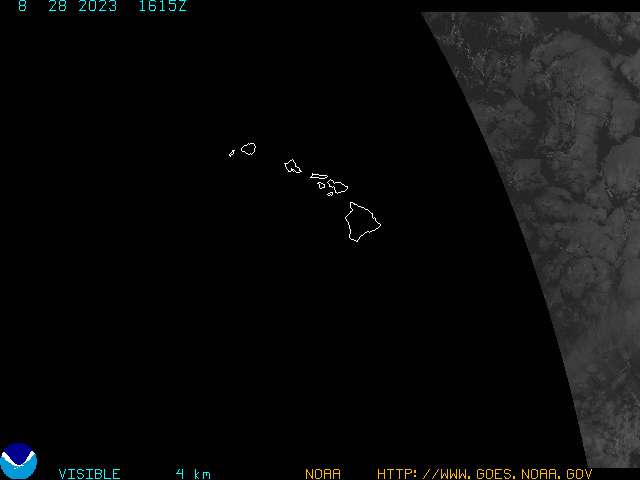


jack weber Says:
Alas, some meager raindrops on the blustery winds tonight…arriving just as I was hauling in water. Go figure! Cheers, Glenn~~~Hi Jack, meager as it was, I’m sure you were happy to see those drops falling! Aloha, Glenn
Candace Says:
Aloha Glenn,
As usual, everytime I visit your site – it is uplifting, informative and friendly – thanks again for your great contributions!
Regarding the article about increased ozone levels from Asia in the western US – are you aware of anyone tracking levels in the Hawaiian islands?
Mahalo and blessings,
Candace~~~Hi Candace, thanks for your positive comments about my writing, that is much appreciated. Yes, there are monitors atop Mauna Kea on the Big Island for sure, and probably here on Maui too. I would suggest you do a google or bing search for the subject you like to explore. I’m glad you are a visitor to this website! Aloha, Glenn