











January 19-20, 2010
Air Temperatures – The following maximum temperatures were recorded across the state of Hawaii Tuesday afternoon:
Lihue, Kauai – 78
Honolulu, Oahu – 83
Kaneohe, Oahu – 79
Kaunakakai, Molokai – 79
Kahului, Maui – 81
Hilo, Hawaii – 81
Kailua-kona – 80
Air Temperatures ranged between these warmest and coolest spots near sea level around the state – and on the highest mountains…at 4pm Tuesday afternoon:
Poipu, Kauai – 81F
Lihue, Kauai – 75
Haleakala Crater – 61 (near 10,000 feet on Maui)
Mauna Kea summit – 43 (near 14,000 feet on the Big Island)
Precipitation Totals – The following numbers represent the largest precipitation totals (inches) during the last 24 hours on each of the major islands, as of Tuesday afternoon:
0.00 Kauai
0.01 Waimanalo, Oahu
0.00 Molokai
0.00 Lanai
0.00 Kahoolawe
0.00 Kahakuloa, Maui
0.21 Kawainui Stream, Big Island
Marine Winds – Here’s the latest (automatically updated) weather map showing a high pressure system to the west of the islands, with a strengthening ridge of high pressure extending east into the area north of Kauai. Our winds will be trade winds, becoming considerably stronger Wednesday.
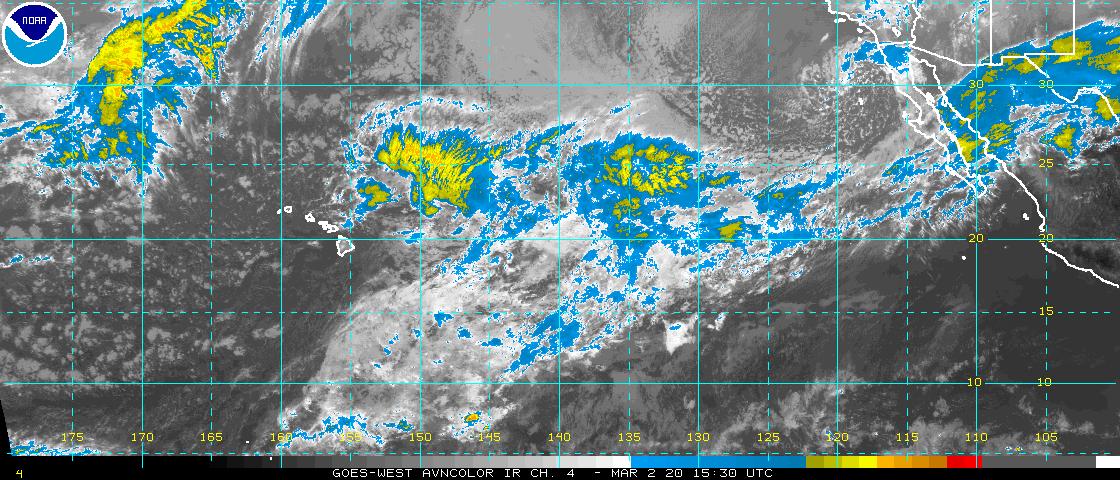
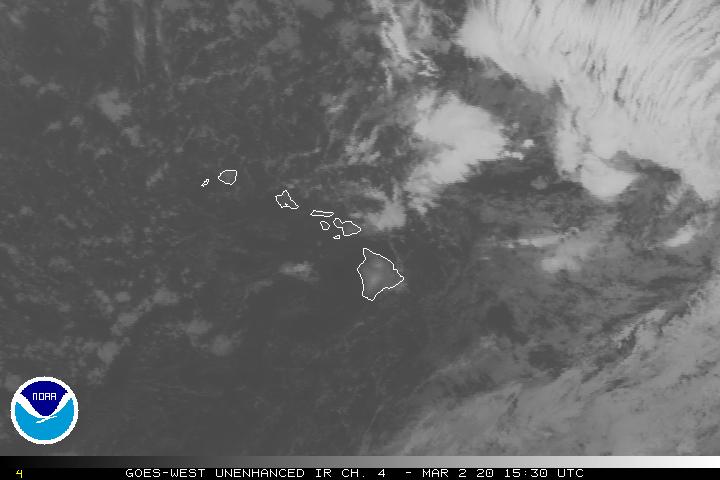
Satellite and Radar Images: To view the cloud conditions we have here in Hawaii, please use the following satellite links, starting off with this Infrared Satellite Image of the islands to see all the clouds around the state during the day and night. This next image is one that gives close images of the islands only during the daytime hours, and is referred to as a Close-up visible image. This next image shows a larger view of the Pacific…giving perspective to the wider ranging cloud patterns in the Pacific Ocean. Finally, here’s a Looping IR satellite image, making viewable the clouds around the islands 24 hours a day. To help you keep track of where any showers may be around the islands, here’s the latest animated radar image.
Hawaii’s Mountains – Here’s a link to the live webcam on the summit of near 14,000 foot Mauna Kea on the Big Island of Hawaii. The tallest peak on the island of Maui is the Haleakala Crater, which is near 10,000 feet in elevation. These two webcams are available during the daylight hours here in the islands…and when there’s a big moon rising just after sunset for an hour or two! Plus, during the nights and early mornings you will be able to see stars, and the sunrise too…depending upon weather conditions.
Tropical Cyclone activity in the eastern and central Pacific – Here’s the latest weather information coming out of the National Hurricane Center, covering the eastern north Pacific. You can find the latest tropical cyclone information for the central north Pacific (where Hawaii is located) by clicking on this link to the Central Pacific Hurricane Center. Here’s a tracking map covering both the eastern and central Pacific Ocean. A satellite image, which shows the entire ocean area between Hawaii and the Mexican coast…can be found here.
Aloha Paragraphs

Kula, Maui, Anthurium flower…from my backyard
The weather here in
The thing that makes the current situation particularly risky, is the forecast of strong and gusty winds starting up over the next couple of days. A high pressure ridge is a little distance to the north of
Back to the rainfall issues, the overlying atmosphere remains dry and stable, so that showers are few and far between Tuesday. The next best chance for some showers will come along, carried in our direction by the strengthening trade winds. Looking at this IR satellite image, we see considerable clouds to the east of the state. However, they aren’t the type that brings many showers, unfortunately. The blustery trade winds will help to push clouds upslope though, which will help to wring some showers out along the windward slopes. There was some hope earlier that the gusty trade winds would carry a few showers to the leeward sides, which would have limited the fire threat…but that seems less likely now. Looking a bit further ahead, our winds will veer around to the Kona direction later Thursday into Friday, due to the approach of a cold front. This cold front should be able to bring more showers, especially to the areas from Kauai down to Oahu, or perhaps
It’s Tuesday evening, as I begin writing the last section of today’s narrative. Everything seems to be conforming to schedule, in terms of the next weather change that just up ahead. The first sign will be the noticeably stronger winds, which hadn’t started as of this evening. Nonetheless, the NWS office has initiated small craft wind advisories across the entire state…in the marine zones that is. The prospect of any significant rainfall associated with this windy weather, doesn’t look good at this point. The better chance looks like with the upcoming cold front, slated for the weekend. Then, as mentioned above, we have another chance for increasing showers around next Tuesday. ~~~ Tuesday, today was pretty nice, although there were still quite a few lower level, but dry clouds hanging around. There has essentially been near totally dry conditions statewide, with just a few light showers, that have been few and very far between. I just took my early evening walk, and it’s so nice out, very mellow up here in Kula, Maui. It’s 65.7F degrees here at a little after 6pm. In contrast, downcountry in Kahului, at the same time, it was a warmer 74 degrees. Looking the other way, up this time, it was 57 up at the top of the Haleakala Crater, and a much cooler 37 degrees atop Mauna Kea, over on the Big Island. ~~~ I’m going out on the deck now, and just sit and be quiet as I watch the light fade on this nice 2nd day of the work week. I’ll be back early Wednesday morning with your next new weather narrative, I hope you have a great Tuesday night until then! Aloha for now…Glenn.
Interesting: Planet Earth has warmed much less than expected during the industrial era based on current best estimates of Earth’s "climate sensitivity" — the amount of global temperature increase expected in response to a given rise in atmospheric concentrations of carbon dioxide (CO2). In a study to be published in the Journal of Climate, a publication of the American Meteorological Society, Stephen Schwartz, of Brookhaven National Laboratory, and colleagues examine the reasons for this discrepancy.
According to current best estimates of climate sensitivity, the amount of CO2 and other heat-trapping gases added to Earth’s atmosphere since humanity began burning fossil fuels on a significant scale during the industrial period would be expected to result in a mean global temperature rise of 3.8°F — well more than the 1.4°F increase that has been observed for this time span.
Schwartz’s analysis attributes the reasons for this discrepancy to a possible mix of two major factors: 1) Earth’s climate may be less sensitive to rising greenhouse gases than currently assumed and/or 2) reflection of sunlight by haze particles in the atmosphere may be offsetting some of the expected warming. "Because of present uncertainties in climate sensitivity and the enhanced reflectivity of haze particles," said Schwartz, "it is impossible to accurately assign weights to the relative contributions of these two factors.
This has major implications for understanding of Earth’s climate and how the world will meet its future energy needs." A third possible reason for the lower-than-expected increase of Earth’s temperature over the industrial period is the slow response of temperature to the warming influence of heat-trapping gases. "This is much like the lag time you experience when heating a pot of water on a stove," said Schwartz.
Based on calculations using measurements of the increase in ocean heat content over the past fifty years, however, this present study found the role of so-called thermal lag to be minor. A key question facing policymakers is how much additional CO2 and other heat-trapping gases can be introduced into the atmosphere, beyond what is already present, without committing the planet to a dangerous level of human interference with the climate system.
Many scientists and policymakers consider the threshold for such dangerous interference to be an increase in global temperature of 3.6°F above the preindustrial level, although no single threshold would encompass all effects. The paper describes three scenarios: If Earth’s climate sensitivity is at the low end of current estimates as given by the Intergovernmental Panel on Climate Change, then the total maximum future emissions of heat-trapping gases so as not to exceed the 3.6° threshold would correspond to about 35 years of present annual emissions of CO2 from fossil-fuel combustion.
A climate sensitivity at the present best estimate would mean that no more heat-trapping gases can be added to the atmosphere without committing the planet to exceeding the threshold. And if the sensitivity is at the high end of current estimates, present atmospheric concentrations of heat-trapping gases are such that the planet is already committed to warming that substantially exceeds the 3.6° threshold.
The authors emphasize the need to quantify the influences of haze particles to narrow the uncertainty in Earth’s climate sensitivity. This is much more difficult than quantifying the influences of the heat-trapping gases. Coauthor Robert Charlson of the University of Washington likens the focus on the heat trapping gases to "looking for the lost key under the lamppost."
Schwartz observes that formulating energy policy with the present uncertainty in climate sensitivity is like navigating a large ship in perilous waters without charts. "We know we have to change the course of this ship, and we know the direction of the change, but we don’t know how much we need to change the course or how soon we have to do it."
Interesting2: Offshore wind power and wave energy foundations can increase local abundances of fish and crabs. The reef-like constructions also favor for example blue mussels and barnacles. What’s more, it is possible to increase or decrease the abundance of various species by altering the structural design of foundation.
This was shown by Dan Wilhelmsson of the Department of Zoology, Stockholm University, in a recently published dissertation. "Hard surfaces are often hard currency in the ocean, and these foundations can function as artificial reefs. Rock boulders are often placed around the structures to prevent erosion (scouring) around these, and this strengthens the reef function," says Dan Wilhelmsson.
A major expansion of offshore wind power is underway along European coasts, and the interest is growing in countries such as the US, China, Japan, and India. Moreover, wave power technologies are being developed very rapidly. Many thousand wind and wave power plants grouped in large arrays that each cover several square kilometers can be expected.
How marine life will react to this is not clear, but several research projects investigating the impacts of noise, shadows, electromagnetic fields, and changes in hydrology etc. are underway. Dan Wilhelmsson studied how offshore wind turbines constitute habitats for fish, crabs, lobsters, fouling animals, and plants. He shows that wind turbines, even without scour protection, function as artificial reefs for bottom dwelling fish.
The seabed in the vicinity of wind turbines had higher densities of fish compared to further away from the turbines and in reference areas. This was despite that the natural bottoms were rich in boulders and algae. Blue mussels dominated on the wind turbines that appeared to offer good growth conditions. Wave power foundations, too, constituting massive concrete blocks, proved to attract fish and large crabs.
Blue mussels fall down from the surface buoys and become food for animals on the foundations and on the adjacent seabed. Lobsters also settle under the foundations. In a large-scale experiment, holes were drilled in the foundations, and this dramatically increased numbers of crabs. The position of the holes also proved to be of importance for the crabs.
Interesting3: The earthquake which rocked Padang, western Sumatra in September last year killing more than 1000 people was not the ‘great earthquake’ which earth scientists are waiting for. In fact, it may have made the next massive earthquake more likely. That is the key conclusion of a paper published January 18 in the journal Nature Geoscience.
Following its publication, Professor John McCloskey of the University of Ulster, who is the lead author of the study and an internationally respected authority on Sumatran earthquakes, has issued the following appeal to the international community. He calls on governments and non-governmental organizations to take preparatory urgent action that will save lives in the next earthquake disaster rather than waiting until after it strikes.
He says: "We can’t continue to refuse to accept the inevitable; earthquakes happen, they kill people, they will kill more and more people if we don’t organize ourselves properly. We must start now." Professor McCloskey and his group rapidly analyzed the M9.2 earthquake that triggered the Indian Ocean 2004 Boxing Day tsunami and alerted the world to the threat of another large quake in the Sumatra region of the Indian Ocean 10 days before it struck. He is head of the Geophysics Research Group at Ulster’s Environmental Sciences Research Institute.
Professor McCloskey says: "At the end of a week which has been dominated by the awful scenes from Haiti, the thought that other big earthquakes are just round the corner is a truly bleak picture. "For some years now scientists have been warning of the build up of stress on one of the earth’s great plate boundaries to the west of Sumatra in Indonesia. For more than 200 years the collision between the Indian Ocean plate and the Asian plate has stored an enormous amount of energy.
"It’s just like slowly drawing a bow. For hundreds of years the energy is stored as the two tectonic plates bend and deform. Then, in just a few seconds all this energy is released generating a massive earthquake and sometimes flexing the seafloor to create a tsunami. "Off western Sumatra the bow is drawn tight. The last shock happened more than 200 years ago and the stresses are probably larger now than they were then; the earthquake must happen soon.
"The science of earthquakes is still on a steep learning curve and earthquake prediction is as far off as ever. "Science and scientists do not have all the answers. We don’t know where or when the next big earthquake will happen. We disagree on a lot of the details about how earthquakes work, how they start and how they stop but there are many things about which there is no disagreement.
"All the indicators are pointing in the same direction for western Sumatra. Another massive earthquake is due there and could happen literally any day." Scientists cannot forecast the exact size of the earthquake but in this case there is complete agreement that it will be very strong, probably bigger than magnitude 8.5, dwarfing the energy release in the Haitian quake.
We also cannot say for sure what size the tsunami will be but it has the potential to be very destructive — maybe even worse than 2004. "But the future need not look like Haiti. We know this earthquake is coming and we might have years or even decades to prepare. "Given the unfolding scenes of carnage following the Haiti earthquake and the completely inadequate speed of the international response, the responsibility on the Indonesian government, the international community and the international NGOs is enormous.
"We must work urgently to prepare for this earthquake if we are not to witness again the awful scenes of children dying for want of a few stitches or a cast for a broken leg. "The September Padang earthquake and the tragedy of Haiti underline the importance of preparation. There are many things that can be done to reduce the impact of earthquakes. Many of these are low-tech methods that have been tried and tested.
"In an earthquake a table can save your life, its legs are extremely strong under compression so when the roof falls down the table provides a small air space, if you’re in there you have a chance. "It’s also clear that we haven’t organized ourselves sufficiently internationally. "It was really disturbing to see children lying on the floor in hospitals with no pain relief, without any medical help at all.
How many lives could have been saved if the international community had prepared properly for this event? "Scientists can’t tell where and when but I can tell you now that other earthquakes like this are absolutely certain. We can’t continue to refuse to accept the inevitable; earthquakes happen, they kill people, they will kill more and more people if we don’t organize ourselves properly.
We must start now. "It is an international disgrace that we appear not to have made the smallest progress in preparation. The ‘international community’ is very good at preparing for war but has failed completely to prepare to help the poor who are always the ones to suffer in these events. "If we want to claim to be civilized we need to ensure that we never see these scenes again. Let’s make our motto: ‘We will do better next time’. "The next time will be sooner than we like to think."
Interesting4: The insight that nature provides services to mankind is not a new one. In 360BC Plato remarked on the helpful role that forests play in preserving fertile soil; in their absence, he noted, the land was turned into desert, like the bones of a wasted body. The idea that the value provided by such "ecosystem services" can be represented by ecologists in a way that economists can get to grips with, though, is rather newer.
A number of the thinkers who have made it a hot topic in the past decade gathered at a meeting on biodiversity and ecosystem services held by the Royal Society, in London, on January 13th and 14th. They looked at the progress and prospects of their attempts to argue for the preservation of nature by better capturing the value of the things – such as pollination, air quality and carbon storage – that it seemingly does for free.
Environmental valuations aim to solve a problem that troubles both economists and ecologists: the misallocation of resources. Take mangrove swamps. Over the past two decades around a third of the world’s mangrove swamps have been converted for human use, with many turned into valuable shrimp farms. In 2007 an economic study of such shrimp farms in Thailand showed that the commercial profits per hectare were $9,632. If that were the only factor, conversion would seem an excellent idea.
Interesting5: The decade of 2000-09 was the Earth’s warmest on record, according to data released last week by the National Climatic Data Center (NCDC) in Asheville, N.C. The climate center reported that the decade’s average global surface temperature was almost 1 degree above the 20th-century average. This shattered the 1990s reading, which was 0.65°F above average.
The global average is based on readings from more than 7,200 ground weather stations around the world and from ships and buoys at sea. Global weather data go back to 1880. The NCDC reports two sustained periods of warming have been recorded in the past 130 years, one that occurred from around 1910-1945, and the most recent worldwide warming trend, which began around 1976.
"Temperatures during the latter period of warming have increased at a rate comparable to the rates of warming projected to occur during the next century, with continued increases of anthropogenic (man-made) greenhouse gases," noted climatologist Ahira Sanchez-Lugo in an online report. 2009 continued a trend of anomalously warm years.
The years 2001 through 2008 each rank among the 10 warmest years of the 130-year (1880-2009) record, and 2009 was no exception. The climate center found that 2009 tied with 2006 as the fifth-warmest since records began in 1880. Almost all of the Earth’s land areas were warmer-than-average in 2009.
Parts of Australia and New Zealand endured record-breaking warmth in January, February and August. The only exceptions to the unusual warmth were in central Asia and interior sections of North America, including the U.S. Midwest, which experienced much cooler-than-normal temperatures. Global precipitation in 2009 was near the long-term average, reported the climate center.
 Email Glenn James: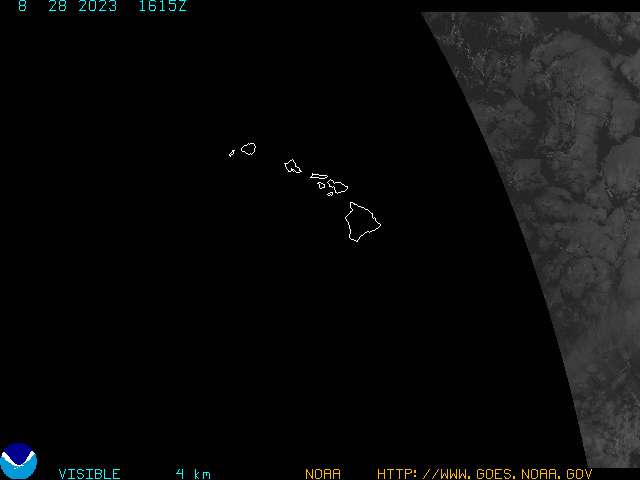



Max Says:
Aloha Glenn,
Good to hear we got some rain in the forecast. This weather has been a bit boring for a weather fan like myself!
I have one question. How come the temperatures you record at your house are often lower than the temperatures you list above for the summit of Haleakala? Seems like it would be significantly colder at 10,000ft – but maybe I’m unclear as to what time the readings at the summit are taken.
Take care,
Max~~~Hi Max, you are correct, it’s been unusual lately with the warmer temperatures atop the Haleakala Crater than down here in Kula. The answer is that there has been an unusually strong inversion around 5,000 feet, with warmer air higher up than it usually is. Good point, good eye…Aloha, Glenn