











January 14-15, 2010
Air Temperatures – The following maximum temperatures were recorded across the state of Hawaii Thursday afternoon:
Lihue, Kauai – 73
Honolulu, Oahu – 76
Kaneohe, Oahu – 75
Kaunakakai, Molokai – 74
Kahului, Maui – 77
Hilo, Hawaii – 78
Kailua-kona – 83
Air Temperatures ranged between these warmest and coolest spots near sea level around the state – and on the highest mountains…at 5pm Thursday evening:
Kailua-kona – 76F
Lihue, Kauai – 68
Haleakala Crater – 50 (near 10,000 feet on Maui)
Mauna Kea summit – 37 (near 14,000 feet on the Big Island)
Precipitation Totals – The following numbers represent the largest precipitation totals (inches) during the last 24 hours on each of the major islands, as of Thursday afternoon:
0.03 Kokee, Kauai
0.01 Waipio, Oahu
0.01 Molokai
0.00 Lanai
0.00 Kahoolawe
0.04 Kula, Maui
0.18 Honokaa, Big Island
Marine Winds – Here’s the latest (automatically updated) weather map showing a low pressure system to the northeast, moving away to the northeast. Meanwhile, a high pressure system to the northwest will be moving eastward, with our local winds becoming northeast, and ENE trade winds later Friday into Saturday.
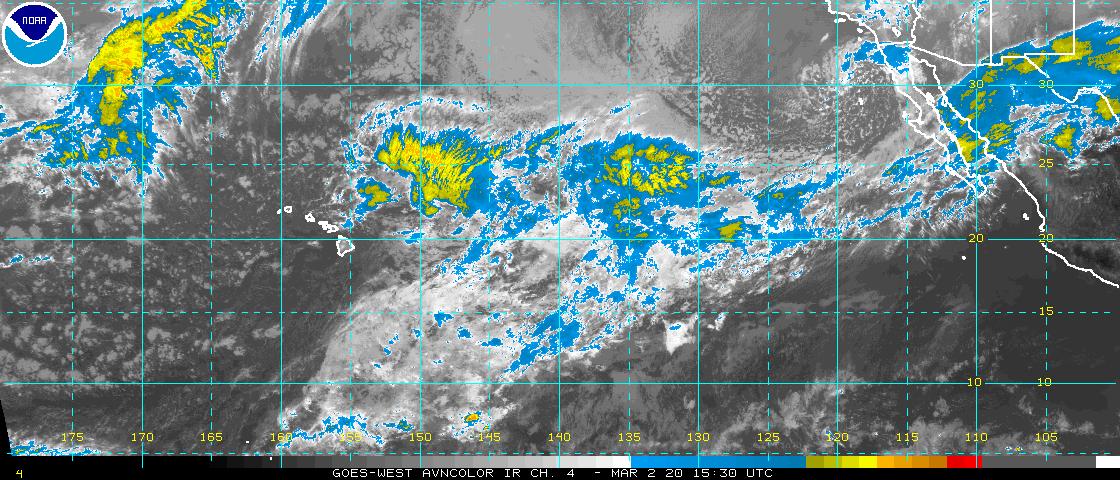
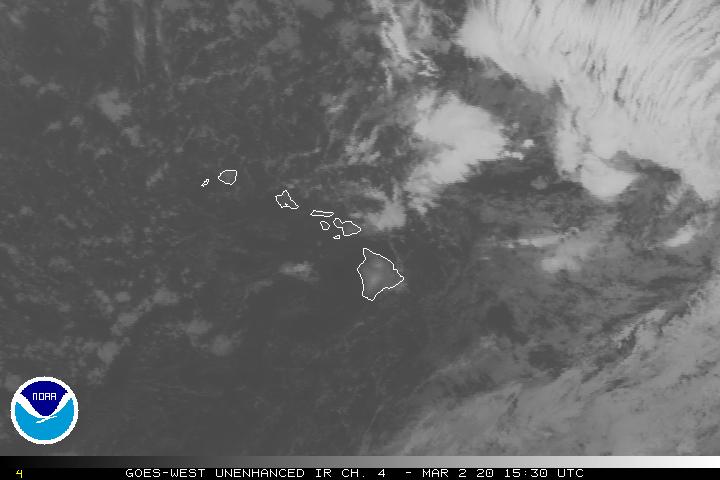
Satellite and Radar Images: To view the cloud conditions we have here in Hawaii, please use the following satellite links, starting off with this Infrared Satellite Image of the islands to see all the clouds around the state during the day and night. This next image is one that gives close images of the islands only during the daytime hours, and is referred to as a Close-up visible image. This next image shows a larger view of the Pacific…giving perspective to the wider ranging cloud patterns in the Pacific Ocean. Finally, here’s a Looping IR satellite image, making viewable the clouds around the islands 24 hours a day. To help you keep track of where any showers may be around the islands, here’s the latest animated radar image.
Hawaii’s Mountains – Here’s a link to the live webcam on the summit of near 14,000 foot Mauna Kea on the Big Island of Hawaii. The tallest peak on the island of Maui is the Haleakala Crater, which is near 10,000 feet in elevation. These two webcams are available during the daylight hours here in the islands…and when there’s a big moon rising just after sunset for an hour or two! Plus, during the nights and early mornings you will be able to see stars, and the sunrise too…depending upon weather conditions.
Tropical Cyclone activity in the eastern and central Pacific – Here’s the latest weather information coming out of the National Hurricane Center, covering the eastern north Pacific. You can find the latest tropical cyclone information for the central north Pacific (where Hawaii is located) by clicking on this link to the Central Pacific Hurricane Center. Here’s a tracking map covering both the eastern and central Pacific Ocean. A satellite image, which shows the entire ocean area between Hawaii and the Mexican coast…can be found here.
Aloha Paragraphs

Pleasant weather on tap!
A cold front, without the typical clear cut cloud band, with its leading edge…passed through the islands during the last 24 hours. This frontal boundary didn’t bring much rainfall, to say the least, but did draw in cooler air…riding in on a locally brisk northwest to north air flow. This is bringing low stable clouds into the north facing coasts and slopes, as shown on this IR satellite image. The brighter white clouds to the northeast, east and southeast of the
The surf has been larger than normal this winter, as is often the case during this El Nino phase of the ENSO cycle. These large high surf episodes have been tracking our way at least a couple of times per week, with one of the recent giant northwest swells reaching 55 or 60 feet, on the outer reefs of Oahu’s north shore! The famous surf spot on the north
It’s Thursday evening, as I begin writing the last section of today’s narrative. As noted in the two paragraphs above, it’s been a tropically cool day here in the islands. The air flow has been from the north, which has brought chilly air down from more northerly latitudes of the Pacific.
Speaking of chilly temperatures by the way, all the major airport weather stations, near sea level, remained in the 70F’s today. The one exception was the Kona area, which was blocked from the cooler north breezes.
At the same time, we now see flat, rather dry clouds being carried in our direction, on the northeast breezes…which will veer around to the more typical east-northeast trade wind direction soon. Rainfall has been scarce, and with a dry air mass flooding into the state now, we shouldn’t see much of anything in the precipitation department for a while. Looking way ahead, I don’t see any potentially significant rainfall on the horizon, that is until we get to next weekend, that’s not this coming weekend. ~~~ I’m about to head out for the drive back upcountry to Kula. It’s been a good day at work, as they typically are, although I’m looking forward to getting home anyway. I’ll be back early Friday morning with your next new weather narrative. And by the way, our weather will be really very nice through most of the next week, yeah! I hope you have a great Thursday night, and that you can meet me here again soon! Aloha for now…Glenn.
Extra: Picture of the day 14 January 2010
Interesting: The major earthquake that struck Haiti Tuesday may have shocked a region unaccustomed to such temblors, but the devastating quake was not unusual in that it was caused by the same forces that generate earthquakes the world over. In this case, the shaking was triggered by much the same mechanism that shakes cities along California’s San Andreas fault.
The 7.0-magnitude Haiti earthquake would be a strong, potentially destructive earthquake anywhere, but it is an unusually strong event for Haiti, with even more potential destructive impact because of the weak infrastructure of the impoverished nation.
Earthquakes typically occur along the jigsaw-puzzle pieces of Earth’s crust, called plates, which move relative to one another, most of the time at an imperceptibly slow pace. In the case of the Haiti quake, the Caribbean and North American plates slide past one another in an east-west direction.
This is known as a strike-slip boundary. Stress builds up in points along the boundary and along its faults where parts of the crust stick; eventually that stress is released in a sudden, strong movement that causes the two sides of the fault to move and generate an earthquake.
The fault system that ruptured to cause this quake is called the Enriquillo-Plantain Garden fault system. Another factor in the damage that a quake can cause is it intensity. While magnitude is a measurement of how much energy is released by an earthquake, intensity is "simply an estimate or a measure of how strongly that earthquake was felt," said Don Blakeman, an earthquake analyst with the United States Geological Survey.
Interesting2: The weather near the Haitian capital of Port-au-Prince the next several days will not hinder rescue and cleanup efforts in the wake of Tuesday’s devastating earthquake. Through the weekend, high temperatures between 88 and 90 degrees are expected. A stalled front, which recently ushered frigid air into the South, will trigger showers across northern Hispaniola through Friday.
A stray late-day shower cannot be ruled out near Port-au-Prince. There is a slightly better chance of a spotty shower dampening the devastated region this weekend. Any shower, however, should not severely impact rescue operations. This is the dry season in the region, where typically little rainfall occurs through April. The strongest earthquake in more than 200 years shook Haiti Tuesday afternoon.
The magnitude 7.0 quake was centered about 10 miles west of Port-au-Prince and lasted more than a minute. According to the U.S. Geological Survey, dozens of considerably strong aftershocks have rattled the region, with magnitudes varying from 4.5 to 5.9. Search and rescue operations are underway to help those injured and trapped in rubble.
Officials estimate that more than 100,000 people were killed. Officials say the city of Port-au-Prince, a city of several million people, is "destroyed." The Associated Press reports that along with countless homes, the quake has also destroyed major buildings in Port-au-Prince, including a hospital, the National Palace and the headquarters of the U.N. peacekeeping mission in Haiti.
Interesting3: Two-thirds of Antarctica is a high, cold desert. Known as East Antarctica, this section has an average altitude of about 1.2 miles, higher than the American Colorado Plateau. There is a continent about the size of Australia underneath all this ice; the ice sheet sitting on top averages a little over 1.2 miles thick. If all of this ice melted, it would raise global sea level by about 197 feet.
But little, if any, surface warming is occurring over East Antarctica. Radar- and laser-based satellite data show a little mass loss at the edges of East Antarctica, which is being partly offset by accumulation of snow in the interior, although a very recent result from the NASA/German Aerospace Center’s Gravity Recovery and Climate Experiment (Grace) suggests that since 2006 there has been more ice loss from East Antarctica than previously thought.
Overall, not much is going on in East Antarctica — yet. West Antarctica is a series of islands covered by ice. Think of it as a frozen Hawaii, with penguins. West Antarctica is very different. Instead of a single continent, it is a series of islands covered by ice — think of it as a frozen Hawaii, with penguins. Because it’s a group of islands, much of the West Antarctic Ice Sheet (WAIS, in jargon) is actually sitting on the floor of the Southern Ocean, not on dry land. Parts of it are more than 1 mile below sea level.
Pine Island is the largest of these islands and the largest ice stream in West Antarctica is called Pine Island Glacier. The WAIS, if it melted completely, would raise sea level by 16 to 23 feet. And the Pine Island Glacier would contribute about 10 percent of that. Since the early 1990’s, European and Canadian satellites have been collecting radar data from West Antarctica.
These radar data can reveal ice motion and, by the late 1990s, there was enough data for scientists to measure the annual motion of the Pine Island Glacier. Using radar information collected between 1992 and 1996, oceanographer Eric Rignot, based at NASA’s Jet Propulsion Laboratory, found that the Pine Island Glacier’s "grounding line" — the line between the glacier’s floating section and the part of the glacier that rests on the sea floor — had retreated rapidly towards the land.
That meant that the glacier was losing mass. He attributed the retreat to the warming waters around West Antarctica. But with only a few years of data, he couldn’t say whether the retreat was a temporary, natural anomaly or a longer-term trend from global warming. Rignot’s paper surprised many people. JPL scientist Ron Kwok saw it as demonstrating that "the old idea that glaciers move really slowly isn’t true any more."
One result was that a lot more people started to use the radar data to examine much more of Antarctica. A major review published in 2009 found that Rignot’s Pine Island Glacier finding hadn’t been a fluke: a large majority of the marine glaciers of the Antarctic Peninsula were retreating, and their retreat was speeding up. Last summer, a British group revisited the Pine Island Glacier finding and found that its rate of retreat had quadrupled between 1995 and 20068.
The retreat of West Antarctica’s glaciers is being accelerated by ice shelf collapse. Ice shelves are the part of a glacier that extends past the grounding line towards the ocean; they are the most vulnerable to warming seas. A longstanding theory in glaciology is that these ice shelves tend to support the end wall of glaciers, with their mass slowing the ice movement towards the sea.
This was confirmed by the spectacular collapse of the Rhode Island-sized Larsen B shelf along the eastern edge of the Antarctic Peninsula in 2002. The disintegration, which was caught on camera by NASA’s Moderate Resolution Imaging Spectro-radiometer (MODIS) imaging instruments on board its Terra and Aqua satellites, was dramatic: it took just three weeks to crumble a 12,000-year old ice shelf.
Over the next few years, satellite radar data showed that some of the ice streams flowing behind Larsen B had accelerated significantly, while others, still supported by smaller ice shelves, had not. This dynamic process of ice flowing downhill to the sea is what enables Antarctica to continue losing mass even as surface melting declines.
Interesting4: While governments around the world continue to explore strategies for reducing greenhouse gas emissions, a new study suggests policymakers should focus on what needs to be achieved in the next 40 years in order to keep long-term options viable for avoiding dangerous levels of warming. The study is the first of its kind to use a detailed energy system model to analyze the relationship between mid-century targets and the likelihood of achieving long-term outcomes.
"Setting mid-century targets can help preserve long-term policy options while managing the risks and costs that come with long-term goals," says co-lead author Brian O’Neill, a scientist at the National Center for Atmospheric Research (NCAR). The study, conducted with co-authors at the International Institute for Applied Systems Analysis (IIASA) in Austria and the Energy Research Centre of the Netherlands, is being published in the Proceedings of the National Academy of Sciences.
It was funded by IIASA, a European Young Investigator Award to O’Neill, and the National Science Foundation, NCAR’s sponsor. The researchers used a computer simulation known as an integrated assessment model to represent interactions between the energy sector and the climate system. They began with "business as usual" scenarios, developed for the Intergovernmental Panel on Climate Change’s 2000 report, that project future greenhouse gas emissions in the absence of climate policy.
They then analyzed the implications of restricting emissions in 2050, using a range of levels. The team focused on how emissions levels in 2050 would affect the feasibility of meeting end-of-century temperature targets of either about 3.5 degrees or 5.5 degrees Fahrenheit, respectively, above the pre-industrial average. The study identifies critical mid-century thresholds that, if surpassed, would make particular long-term goals unachievable with current energy technologies.
For example, the scientists examined what would need to be done by 2050 in order to preserve the possibility of better-than-even odds of meeting the end-of-century temperature target of 2 degrees Celsius of warming advocated by many governments. One "business as usual" scenario showed that global emissions would need to be reduced by about 20 percent below 2000 levels by mid-century to preserve the option of hitting the target.
In a second case, in which demand for energy and land grow more rapidly, the reductions by 2050 would need to be much steeper: 50 percent. The researchers concluded that achieving such reductions is barely feasible with known energy sources. "Our simulations show that in some cases, even if we do everything possible to reduce emissions between now and 2050, we’d only have even odds of hitting the 2 degree target-and then only if we also did everything possible over the second half of the century too," says co-author and IIASA scientist Keywan Riahi.
Interesting5: Scientists are reporting that "biochar" — a material that the Amazonian Indians used to enhance soil fertility centuries ago — has potential in the modern world to help slow global climate change. Mass production of biochar could capture and sock away carbon that otherwise would wind up in the atmosphere as carbon dioxide, the main greenhouse gas. Their report appears in ACS’ Environmental Science & Technology, a bi-weekly journal. Kelli Roberts and colleagues note that biochar is charcoal produced by heating wood, grass, cornstalks or other organic matter in the absence of oxygen.
The heat drives off gases that can be collected and burned to produce energy. It leaves behind charcoal rich in carbon. Amazonian Indians mixed a combination of charcoal and organic matter into the soil to improve soil fertility, a fact that got the scientists interested in studying biochar’s modern potential.
The study involved a "life-cycle analysis" of biochar production, a comprehensive cradle-to-grave look at its potential in fighting global climate change and all the possible consequences of using the material. It concludes that several biochar production systems have the potential for being an economically viable way of sequestering carbon — permanently storing it — while producing renewable energy and enhancing soil fertility.
Interesting6: During the southern hemisphere winter of 1983, temperatures at Russia’s Vostok research station in Antarctica plunged to a frighteningly cold minus 128.6 degrees Fahrenheit, which is 54 degrees colder than the winter average there and the coldest temperature ever recorded on Earth. Scientists have now figured out why it got so cold. For comparison, the coldest temperature ever recorded in the lower-48 United States was minus 70 degrees F (-57 degrees C) at Rogers Pass, Mont., on Jan. 20, 1954.
An explanation for why the mercury plunged precipitously during a 10-day period in July of 1983 (winter in Earth’s Southern Hemisphere) to that minus 128.6 F (minus 89.2 degrees Celsius) temperature has long eluded scientists. But scientists at the British Antarctic Survey (BAS) and the Arctic and Antarctic Research Institute (AARI) in Russia were able to solve the mystery with a computer model developed to simulate the future evolution of the Antarctic climate, along with weather charts and satellite imagery of the area
They found that relatively warm air that normally flows over the Southern Ocean onto the high Antarctic plateau almost came to a halt during this period. A flow of cold air circling Vostok was preventing the mixing of this warmer air from lower latitudes, isolating the station and causing near optimum cooling conditions.
Adding to this was the absence of a heat-trapping cloud cover and the presence of a layer of tiny particles of ice suspended in the air (known as diamond dust), allowing more heat from the continent’s icy surface to be lost to space.
The findings show just how extreme Mother Nature can be. "Distinguishing between natural variability and human induced changes to the Earth’s atmospheric climate is at the heart of our research, and we wanted to understand why this ‘normal’ weather system was thrown out of balance so severely," said team member John Turner at the BAS. "Our findings indicate that this was a natural event, but this is an important reminder of just how extreme Earth’s natural events can be and that we must always consider the potential for such anomalies to occur."
Turner and his colleagues think that the same combination of circumstances lasting over a longer period of time could make the thermometer at Vostok dip even further, down to minus 141 F (-96 C). The team hopes understanding this cold event will help them better predict how the Antarctic continent will respond to global warming.
"By appreciating that such possibilities can occur and in turn striving to understand the processes that cause them we are better equipped to make predictions for how the planet might react to future changes in polar atmospheric climate" Turner said.
Interesting7: A 7.0-magnitude earthquake has wreaked havoc on Haiti and its capital Port-au-Prince, with estimates of thousands of people killed. Citing a study by nonprofit research group GeoHazards International (GI), U.S. business magazine Forbes on Wednesday published a list of the 20 cities around the world that are most vulnerable to earthquakes. Kathmandu, Nepal, topped the list. GI researchers predicted in the 2001 study around 69,000 of the city’s one million inhabitants would die if a 6.0-magnitude quake struck the city."
Also on the list were Istanbul, Turkey; Delhi, India; Quito, Ecuador; Manila, Philippines; and Islambad/Rawalpindi, Pakistan, all of which could expect tens of thousands of deaths in a large earthquake. Japan has three cities on the list. According to the study, around 9,000 people would die in Tokyo if it were hit by a large earthquake, while Nagoya could expect 900 fatalities and Kobe 300.
The fatality estimates for Japan’s cities are much lower than those of less developed countries because their buildings are constructed to withstand earthquakes. GI ranked the cities based on variables including "building frailty, potential for landslides and fires, and the firefighting and lifesaving medical abilities of local authorities." Meanwhile, Time magazine in October last year named the five most quake-prone regions of the world: Los Angeles, Tokyo, Tehran, Indonesia and the Pacific Northwest coastal areas.
 Email Glenn James: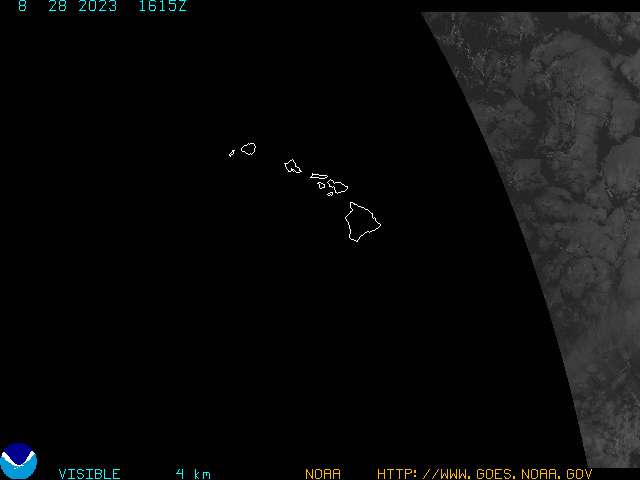


Ted Meeker Says:
Glenn,
What are the implications of such an incredibly dry winter, both in the short and long terms? I have lived here since ’53 and it seems to me that this lack of winter rain is a very different pattern than the one I grew up with.
Ted Meeker~~~Hi Ted, as to your questions, I’d say dry in the short term, and very dry in the long term. There will be those occasional wet storms, but on the whole, I’m looking at drought conditions conditions extending into the summer months. Aloha, Glenn
don kennedy Says:
Hi, I visit your site daily and have been for years. The last couple of days I can’t seem to bring up the large view of the pacific, says website not available. Is this my computer or can you fix it? Always enjoy your site and comments, Don~~~Hi Don, it’s something I can fix, and will get to that hopefully Friday…thanks for reminding me, and for your positive comment! Aloha, Glenn