











December 8-9, 2009
Air Temperatures – The following maximum temperatures were recorded across the state of Hawaii Tuesday afternoon:
Lihue, Kauai – 76
Honolulu, Oahu – 82
Kaneohe, Oahu – 78
Kaunakakai, Molokai – 78
Kahului, Maui – 80
Hilo, Hawaii – 79
Kailua-kona – 85
Air Temperatures ranged between these warmest and coolest spots near sea level around the state – and on the highest mountains…at 5pm Tuesday evening:
Kailua-kona – 82F
Lihue, Kauai – 71
Haleakala Crater – 50 (near 10,000 feet on Maui)
Mauna Kea summit – 41 (near 14,000 feet on the Big Island)
Precipitation Totals – The following numbers represent the largest precipitation totals (inches) during the last 24 hours on each of the major islands, as of Tuesday afternoon:
0.02 Poipu, Kauai
0.01 Kahuku Training Area, Oahu
0.01 Molokai
0.00 Lanai
0.00 Kahoolawe
0.72 West Wailuaiki, Maui
0.36 Honokaa, Big Island
Marine Winds – Here’s the latest (automatically updated) weather map showing weak 1017 millibar high pressure system to the north…moving eastward into the area northeast of the islands. Our local winds will be northeast, gradually becoming east-northeast trade winds.
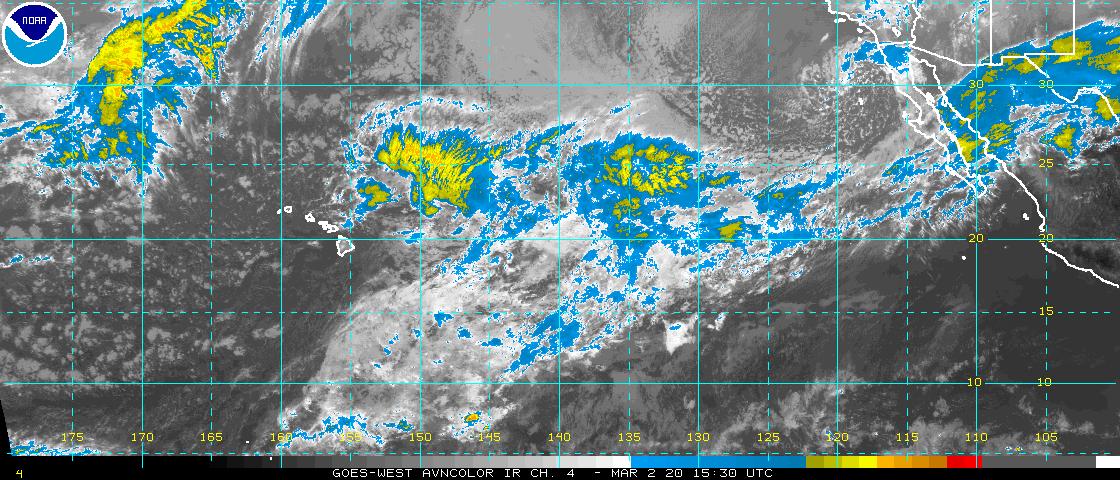
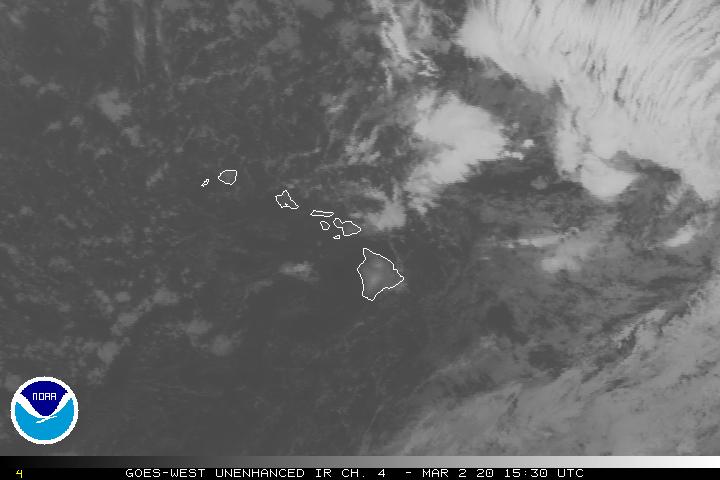
Satellite and Radar Images: To view the cloud conditions we have here in Hawaii, please use the following satellite links, starting off with this Infrared Satellite Image of the islands to see all the clouds around the state during the day and night. This next image is one that gives close images of the islands only during the daytime hours, and is referred to as a Close-up visible image. This next image shows a larger view of the Pacific…giving perspective to the wider ranging cloud patterns in the Pacific Ocean. Finally, here’s a Looping IR satellite image, making viewable the clouds around the islands 24 hours a day. To help you keep track of where any showers may be around the islands, here’s the latest animated radar image.
Hawaii’s Mountains – Here’s a link to the live webcam on the summit of near 14,000 foot Mauna Kea on the Big Island of Hawaii. The tallest peak on the island of Maui is the Haleakala Crater, which is near 10,000 feet in elevation. These two webcams are available during the daylight hours here in the islands…and when there’s a big moon rising just after sunset for an hour or two! Plus, during the nights and early mornings you will be able to see stars, and the sunrise too…depending upon weather conditions.
Tropical Cyclone activity in the eastern and central Pacific – Here’s the latest weather information coming out of the National Hurricane Center, covering the eastern north Pacific. You can find the latest tropical cyclone information for the central north Pacific (where Hawaii is located) by clicking on this link to the Central Pacific Hurricane Center. Here’s a tracking map covering both the eastern and central Pacific Ocean. A satellite image, which shows the entire ocean area between Hawaii and the Mexican coast…can be found here.
Aloha Paragraphs

Our beautiful Hawaiian Islands!
Slightly cool northeast breezes will gradually shift around to the trade wind direction Wednesday…into Thursday. Our overlying atmosphere has dried out considerably now, and become more stable too…which suggests that very pleasant weather conditions will prevail. It appears that our weather will be favorably inclined through much of the rest of this week. The next chance for organized showers will wait until late this coming weekend, when our next rain bearing cold front arrives into next Monday.
This next cold front won’t arrive until later in the day Sunday, but will cause southeast to southerly winds…with possible voggy weather beginning Saturday. This late weekend frontal cloud band will carry moderate showers into the state, but isn’t expected to be all that big a deal. This is the time of year though, when we find storms racing across the north Pacific Ocean, sending cold fronts down to us. Perhaps the main thing here, is that our weather will be really nice between now and the next cold front. It’s a little too soon to know exactly what will follow next week…after the frontal passage.
An unusually large NW swell, breaking on the north and west shores, remains dangerous at the time of this writing…although will be gradually losing some size later Wednesday onwards. The east sides will likely see some wrap from these extra large waves, so those beaches will be locally much larger than normal as well. The south shores too, will generally be small, but some areas may see somewhat larger waves breaking too. These waves will be dangerous, so that staying well away from the ocean where these waves are breaking, seems like it would be a wise thing to do. The next large northwest swell will arrive right after the upcoming weekend…which may be dynamic enough to trigger another high surf warning then.
It’s early Tuesday evening here on Maui, as I begin writing this last section of today’s narrative. As noted above, the weather will be near perfect through the rest of the work week, and likely into the beginning of the weekend. The next cold front, as it approaches the state, will turn our winds to the southeast. This is the infamous wind direction that brings volcanic haze (vog) to the islands…carried up from the volcanic vents on the Big Island. ~~~ Meanwhile, the extra large surf will finally begin to diminish in size later Wednesday, through Friday. This will be a relief to the emergency management community, including the life guards around Hawaii’s beaches. This level of high surf has attracted so many people to the coast for viewing, that traffic jams have been terrible the last couple of days along those north and west facing beaches. I haven’t heard of any deaths in relation to this pounding surf, which is great news! ~~~ I’m getting ready to leave Kihei for the drive back upcountry to Kula. Looking out the window here before I go, I don’t see hardly a cloud in the sky in any direction! Skies have turned amazingly clear today, as this satellite image confirms. There were just a few leftover clouds near the Big Island, but even those should be fading away overnight. It looks like we’re moving into a very dry spell of weather. This is good news for anyone who has been waiting for these conditions…so they can get out there and paint that fence, or take that hike out in nature. Wednesday morning, even at sea level, ought to be another cool one, so perhaps think about where that extra blanket might be for the bed. ~~~ I’ll be back early Wednesday morning with your next new weather narrative, I hope you have a restful night until then! Aloha for now…Glenn.
Extra: here’s an amazing slide show of pictures, of the famous surf spot called Jaws here on Maui…from Monday.
Interesting: In theory, New York City Mayor Michael Bloomberg’s landmark plan to reduce greenhouse gas emissions by retrofitting leaky old buildings was a good idea. In the face of a global recession, and with a mandate for building owners to foot much of the bill, the owners didn’t agree. After fierce criticism, the city is dropping a plan that would have required older buildings — those measuring 50,000 square feet or more —to perform energy audits and subsequent efficiency upgrades.
If passed, the mandate would have applied to roughly 22,000 buildings, or nearly half the city’s square footage, requiring owners to upgrade light bulbs, old boilers and leaky windows. The legislation also would have represented a big push in the green building movement, since most cities impose efficiency standards on new construction only.
In the city, buildings contribute 80 percent of the city’s total carbon emissions, and Mayor Bloomberg is trying to lower emissions by 30 percent by 2030. A major sticking point was cost, with owners required to pay for most of the upgrades. Officials estimated private investors would need to kick in $2.5 billion for building improvements since the city only had $16 million in federal stimulus funds to pay for such changes.
Interesting2: South Dakota State University researchers and their colleagues elsewhere in America and in France have found compelling evidence of a previously undocumented large volcanic eruption that occurred exactly 200 years ago, in 1809. The discovery helps explain the record cold decade from 1810-1819. Researchers made the finding by analyzing chemicals in ice samples from snow-capped Antarctica and Greenland in the Arctic.
The year-by-year accumulation of snow in the polar ice sheets records what is going on in the atmosphere. "We found large amounts of volcanic sulfuric acid in the snow layers of 1809 and 1810 in both Greenland and Antarctica," said Professor Jihong Cole-Dai of SDSU’s Department of Chemistry and Biochemistry, the lead author in an article published Oct. 25, in the scientific journal Geophysical Research Letters.
Cole-Dai said climate records show that not only were 1816 — the so-called "year without a summer" — and the following years very cold, the entire decade of 1810-1819 is probably the coldest for at least the past 500 years. Scientists have long been aware that the massive and violent eruption in 1815 of an Indonesian volcano called Tambora, which killed more than 88,000 people in Indonesia, had caused the worldwide cold weather in 1816 and after.
Volcanic eruptions have a cooling effect on the planet because they release sulfur gases into the atmosphere that form sulfuric acid aerosols that block sunlight. But the cold temperatures in the early part of the decade, before that eruption, suggest Tambora alone could not have caused the climatic changes of the decade.
"Our new evidence is that the volcanic sulfuric acid came down at the opposite poles at precisely the same time, and this means that the sulfate is from a single, large eruption of a volcano in 1809," Cole-Dai said.
"The Tambora eruption and the undocumented 1809 eruption are together responsible for the unusually cold decade." Cole-Dai said the Tambora eruption was immense, sending about 100 million tons of sulfur gas into the atmosphere, but the ice core samples suggest the 1809 eruption was also very large — perhaps half the size of Tambora — and would also have cooled the earth for a few years.
The researchers reason that, because the sulfuric acid is found in the ice from both polar regions, the eruption probably occurred in the tropics, as Tambora did, where wind patterns could carry volcanic material to the entire world, including both poles.
Interesting3: Those who are quick to dismiss paper as old-fashioned should hold off on the trash talk. Scientists have made batteries and super-capacitors with little more than ordinary office paper and some carbon and silver nanomaterials. The research, published online December 7 in Proceedings of the National Academy of Sciences, brings scientists closer to lightweight printable batteries that may one day be molded into computers, cell phones or solar panels.
"Power storage is one of the very important aspects of solving the energy issue," comments Robert Linhardt of Rensselaer Polytechnic Institute in Troy, N.Y. The paper-based devices show excellent performance. That performance is largely due to paper’s porous nature: at the nano scale, paper is a tangled matrix of fibers.
This vast surface area helps inks stick, says Yi Cui of Stanford University, coauthor of the new work. This holds true for carbon nanotube ink as well. When carbon-nanotube ink touches paper, the nanotubes "get caught very tightly to the cellulose," says Cui, probably just via good old electrostatic forces.
The paper acts as a scaffold, and the carbon nanotubes act as electrodes that electrolytes in solution react with. This nanotube-paper combination offers a lightweight alternative to traditional energy storage devices that rely on metals.
Interesting4: Iran will reduce heavily subsidized gasoline quota for private motorists in winter, the official IRNA news agency reported. Such a move could help the country lower its consumption as well as vulnerability to any possible Western sanctions targeting its fuel imports.
"The gasoline quota for the private motorists will be reduced to 80 liters from the beginning of winter (starting December 22)," IRNA quoted Mohammad Rouyanian, head of Iran’s Transportation and Fuel Management Office, as saying. The current quota is 100 liters per month. Iran, the world’s fifth-largest oil exporter, lacks sufficient refining capacity and imports 40 percent of its gasoline, a burden for its annual budget.
Interesting5: A new scientific study warns that sea level could rise much faster than previously expected. By the year 2100, global sea level could rise between 75 and 190 centimeters (29-75 inches), according to a paper published in the Proceedings of the National Academy of Sciences.
The authors, Martin Vermeer of Helsinki University of Technology in Finland and Stefan Rahmstorf of the Potsdam Institute for Climate Impact Research in Germany, based their analysis on measurements of sea level and temperature taken over the past 130 years.
In those data they identified a strong link between the rate of sea level rise and global temperature. "Since 1990 sea level has been rising at 3.4 millimeters per year, twice as fast as on average over the 20th Century," says Stefan Rahmstorf. Even if that rate just remained steady, this would already lead to 34 centimeters (13 inch) rise in the 21st century. "But the data show us clearly: the warmer it gets, the faster sea level rises. If we want to prevent a galloping sea level rise, we should stop global warming as soon as possible," adds Rahmstorf.
 Email Glenn James: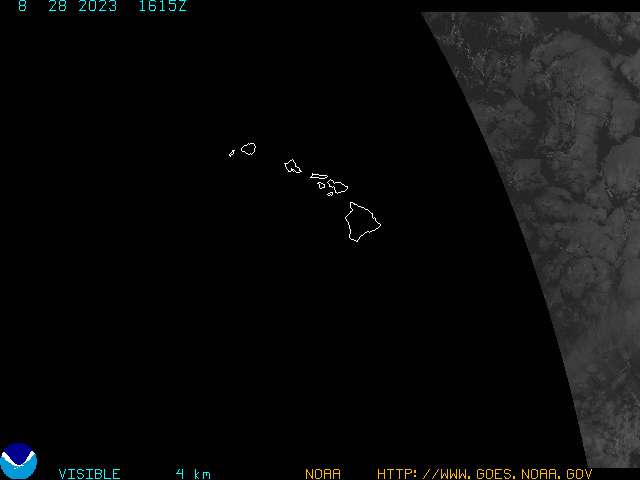

Larry Jones Says:
We departed Maui in June and have been sailing the south Pacific. We successfully weathered a Tsunami in Pago Pago on Sept 29. I’ve been reading about the SOI and I understand that anything less than -10 denotes an El Nino
condition. The information that I have is that we might be experiencing a mild El Nino season in the south pacific.
Could you give me your opinion on this? And could you recommend a hurricane tracking website for the south Pacific? As we have sailed around the Hawaiian islands in the last five years we have benefited greatly from your weather website–sorry to see your TV broadcast end.
Thanks
Larry Jones~~~Hi Larry, from down in the south Pacific…nice! Yes, El Nino affects the entire globe, in various ways, including the south Pacific. I would recommend that you track tropical cyclones by using this site: http://www.usno.navy.mil/JTWC ~~~Best of luck in your travels, sounds exciting! Aloha, Glenn