











December 30-31, 2009
Air Temperatures – The following maximum temperatures were recorded across the state of Hawaii Wednesday afternoon:
Lihue, Kauai – 79
Honolulu, Oahu – 81
Kaneohe, Oahu – 79
Kaunakakai, Molokai – 80
Kahului, Maui – 83
Hilo, Hawaii – 84
Kailua-kona – 84
Air Temperatures ranged between these warmest and coolest spots near sea level around the state – and on the highest mountains…at 5pm Wednesday evening:
Kapalua, Maui – 81F
Lihue, Kauai – 74
Haleakala Crater – 52 (near 10,000 feet on Maui)
Mauna Kea summit – 43 (near 14,000 feet on the Big Island)
Precipitation Totals – The following numbers represent the largest precipitation totals (inches) during the last 24 hours on each of the major islands, as of Wednesday afternoon:
1.08 Puu Lua, Kauai
1.04 Palehua, Oahu
0.00 Molokai
0.00 Lanai
0.00 Kahoolawe
0.00 Maui
0.00 Big Island
Marine Winds – Here’s the latest (automatically updated) weather map showing a 1027 millibar high pressure system to the northeast of the islands…with its associated ridge running southwest over the southern part of the island chain. Our winds will remain light from the south to southwest…gradually becoming light trade winds into Friday.
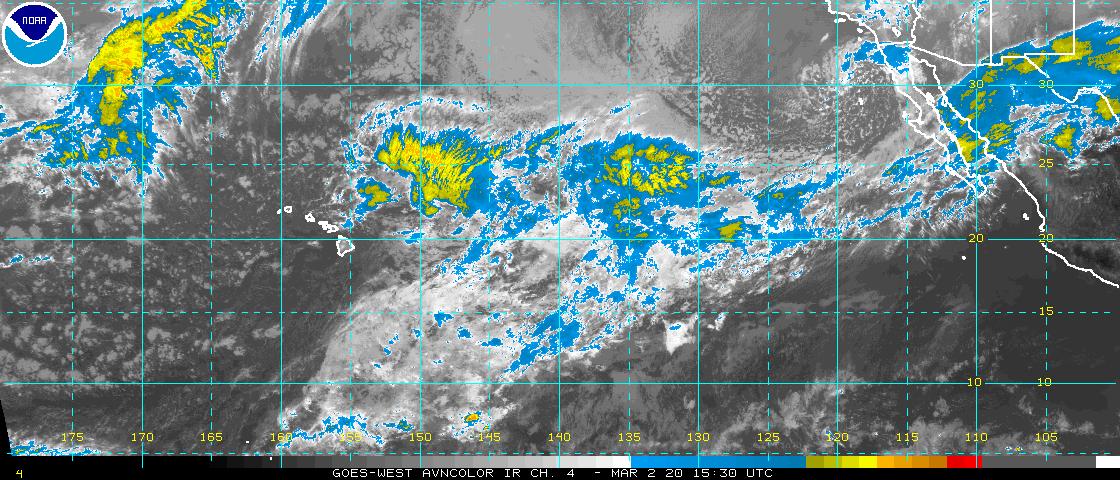
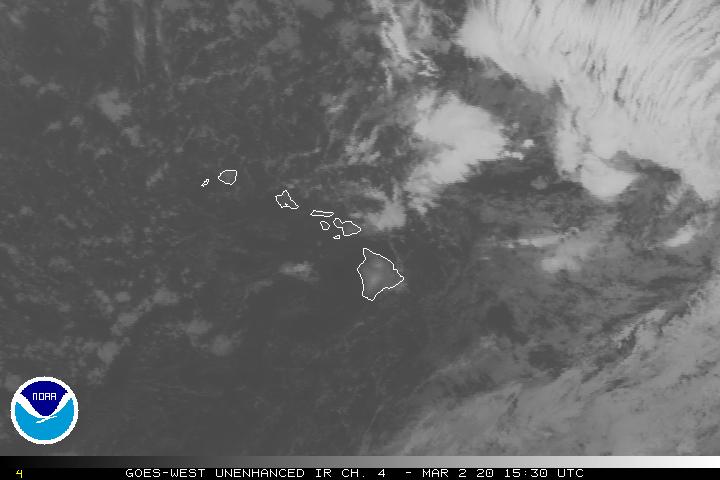
Satellite and Radar Images: To view the cloud conditions we have here in Hawaii, please use the following satellite links, starting off with this Infrared Satellite Image of the islands to see all the clouds around the state during the day and night. This next image is one that gives close images of the islands only during the daytime hours, and is referred to as a Close-up visible image. This next image shows a larger view of the Pacific…giving perspective to the wider ranging cloud patterns in the Pacific Ocean. Finally, here’s a Looping IR satellite image, making viewable the clouds around the islands 24 hours a day. To help you keep track of where any showers may be around the islands, here’s the latest animated radar image.
Hawaii’s Mountains – Here’s a link to the live webcam on the summit of near 14,000 foot Mauna Kea on the Big Island of Hawaii. The tallest peak on the island of Maui is the Haleakala Crater, which is near 10,000 feet in elevation. These two webcams are available during the daylight hours here in the islands…and when there’s a big moon rising just after sunset for an hour or two! Plus, during the nights and early mornings you will be able to see stars, and the sunrise too…depending upon weather conditions.
Tropical Cyclone activity in the eastern and central Pacific – Here’s the latest weather information coming out of the National Hurricane Center, covering the eastern north Pacific. You can find the latest tropical cyclone information for the central north Pacific (where Hawaii is located) by clicking on this link to the Central Pacific Hurricane Center. Here’s a tracking map covering both the eastern and central Pacific Ocean. A satellite image, which shows the entire ocean area between Hawaii and the Mexican coast…can be found here.
Aloha Paragraphs

Hawaiian beauty…takes the cake!
The cold front stopped its forward motion, creeping to a halt just to the northwest of
As far as precipitation from this cold front is concerned, the lions share has fallen over
In the wind department, there hasn’t been anything strong, certainly not anywhere near small craft advisory levels. As a matter of fact, the islands have remained in a field of light winds over the last several days. The trade winds have been taking a break for quite a while. During El Nino episodes, we often see lighter than normal winds, as high pressure ridges are pushed southward over the islands. At the same time, these light and variable winds typically help to bring hazy conditions to the islands…many times that haze has the volcanic vents on the Big Island as their origin. Since we’re talking about El Nino again, it would be prudent to mention that we often see examples where cold fronts lose steam before they arrive, or stall as they try and push through the island chain. This in turn limits their rainfall potential, putting the state in a drought condition…as is happening now. One more common thread through this El Nino display is larger than normal surf, destined for our north and west facing shores.
Looking into the future, there appears to be more of the same in store, with light winds and volcanic haze, more weak cold fronts, and large to extra large surf for next week. Rewinding for just a second, it looks very likely that our New Year’s Eve celebrations will be couched in haze and smoke, at least in some of those urban areas, where fireworks will be let off. We should see a very brief spell of easterly, or ENE trade winds on Friday, perhaps helping to clear the current bout of hazy weather away. This won’t last long though, as more soft winds will return this weekend, with probably just enough of a southerly and southeasterly flow to bring the vog back. This will be happening as a ridge drops down over or near us, prompted by the approach of the next weak cold front, which will likely not produce much rainfall…and stall someplace between Kauai and
It’s early Wednesday evening here on Maui, as I begin writing the last section of today’s narrative. The islands of Kauai and Oahu had clouds today, while the rest of the state luxuriated in mostly clear and warm weather conditions! Here on Maui is was simply delicious, the weather couldn’t have been any better, as even the vog backed off some later in the day. Friday looks like another great day, the last full day of the year, of the decade for that matter! ~~~ If you had a chance to look outside last night, perhaps you saw that big, round, bright, near full moon out your window…if you missed it then, check it out tonight for sure. Right now, as I look out the window of my Kula weather tower, that thing is so bright, so large, it’s just out of this world! You may know that we have our second full moon of the month about to happen on New Year’s Eve night…what timing! As I’ve been mentioning lately, it’s referred to as a blue moon, due to its rarity.
~~~ It’s just before sunset now, and as was the case yesterday, I really want to see the sunset. So, I’m going to finish these last few lines very soon. I’ll be back very early Friday morning with your next new weather narrative. I hope you have a great Wednesday night until then! Aloha for now…Glenn.
Interesting: California scientists hope studying 180 black mussels pried from algae-covered rocks in San Francisco Bay will provide clues into how many drugs and chemicals are polluting waters across the nation. Mussels filter water and store contaminants in their tissue, providing a record of pollution in the environment.
The creatures are being culled from 80 sites in California as part of a pilot study by the National Oceanic and Atmospheric Administration to see how pervasive the substances have become. "We haven’t measured mussels for these compounds, so there’s not a lot of data," Dominic Gregorio, a senior environmental scientist with the State Water Resources Control Board, said.
"So this is really a first step to be proactive and get ahead of the curve on this." Regulators are concerned about an array of chemicals and pharmaceuticals — synthetic estrogen used in birth control pills, anti-bacterial agents in hand sanitizers and a flame retardant used on computers, furniture and cars — that can accumulate in the tissue of animals and people.
Recent studies found levels of PBDEs, or polybrominated diphenyl ethers, a flame retardant used in the manufacture of a wide range of consumer products, in waters off of every U.S. coast. The chemicals are being detected more often in surface water, state water quality officials said, but little data exists about how these substances negatively effect the health of humans and animals.
After conducting tests on the mussels, the data will help guide the study of emerging contaminants in other states, said Gunnar Lauenstein, program manager for NOAA’s Mussel Watch, which has tested mussels since 1986. Traces of PBDEs have also been found in human breast milk, aquatic birds and fish in North America, Europe and Asia, according to the U.S. Environmental Protection Agency. Until now NOAA’s Mussel Watch has tested the bivalves for pollutants like the pesticide DDT.
This pilot study could help guide regulators in determining what new pollutants in mussels should be regularly monitored. "What we’re trying to do now is focus on a newer generation of consumer products," Lauenstein said. The California mussels will also be tested for bisphenol A, or BPA, a chemical used to harden plastics and line the cans of baby formula and other foods.
Scientists are concerned that BPA exposure may harm reproductive systems and promote prostate and breast cancers, though the Centers of Disease Control and Prevention says human health effects of BPA exposure are still unknown. Gregorio said the data collected from around the state will include mussels from a wide range of areas including cities, agricultural regions and open spaces.
Interesting2: Coral reef fish can undergo a personality change in warmer water, according to an intriguing new study suggesting that climate change may make some species more aggressive. Experiments with two species of young damselfish on Australia’s Great Barrier Reef have shown for the first time that some reef fish are either consistently timid, or consistently bold, and that these individual differences are even more marked as water temperatures rise.
A slight lift of just one or two degrees may have only a small effect on some fish but the behavior of others can be transformed — leading them to become up to 30 times more active and aggressive.
"The idea that fish have personalities may seem surprising at first, but we now know that personality is common in animal populations, and that this phenomenon may have far-reaching implications for understanding how animals respond to ecological and environmental challenges," says Dr Peter Biro, of the UNSW School of Biological, Earth and Environmental Sciences, who led the study with colleagues Christa Beckmann and Judy A. Stamps. It is published in the journal Proceedings of the Royal Society B.
Interesting3: Here’s an opportunity to wisely spend some of the $100 billion that Secretary of State Hillary Clinton promised at Copenhagen to cut the greenhouse gases of developing nations by aiding in the development of renewable energy infrastructure to by-pass fossil fuel dependence. Apparently one in four Chinese cities and seven out of 10 counties are without sewage-treatment plants, according to the People’s Daily.
While there are many ways to treat sewage or municipal waste; one of the newest is the use of municipal solid waste to make renewable energy. Converting waste to energy is done in several ways. One is making bio-gas from sewage (human or animal) to run gas-turbine driven electric power plants.
Another is to create a biofuel, such as that used by nearly every vehicle in Sweden’s fifth largest city Linkoping. Greenhouse gas emissions there were reduced as much as 90% with the technology. It helped Sweden achieve a 9% below-Kyoto emissions cut with simultaneous 44% economic growth.
This presents an opportunity to kill two birds with one stone; by building the infrastructure in the developing world that uses municipal solid waste to make renewable energy. This would cut the greatest source of the rise expected in greenhouse gas emissions from fossil fuel use in the next decades: from fast-developing nations like India and China.
The developed world evolved water treatment technologies well before our knowledge of climate change drove us to invent uses for municipal solid waste as a source of renewable energy with no greenhouse gas emissions.
Interesting4: The US Geological Survey will use Recovery Act funding to improve its ability to monitor volcanoes and to predict their eruptions. Some of the funds will be used to modernize instrumentation and information systems to state-of-the-art, providing the necessary tools to communicate hazard information quickly to those who need it.
The United States and its territories contain 169 volcanoes considered capable of erupting. One, Kilauea in Hawaii, has been erupting continuously for the past 26 years, at times inundating residential areas with lava and at other times requiring national park closures due to explosions and toxic gas.
Another, Redoubt Volcano in Alaska, shot ash clouds to heights of more than 50,000 feet several times this year. The three-month long eruption appears to have paused and may have ended, but not before severely disrupting aviation operations, repeatedly dusting Alaskan communities with ash, and forcing an oil storage facility to suspend operations. Photo shows Mt Redoubt eruption.
Residents and critical infrastructure in the nation’s six highest-risk volcanic areas—including the Yellowstone region– will benefit from increased monitoring and analysis as a result of Recovery Act funds being channeled into volcano monitoring, Secretary Salazar announced today.
The U.S. Geological Survey is planning to use $15.2 million of its American Recovery and Reinvestment Act funds to upgrade volcano monitoring and the analysis and distribution of eruption information at the five volcano observatories that cover Wyoming, Alaska, Hawaii, the Northwest, California, as well as the network that covers the Commonwealth of the Northern Mariana Islands.
"These stimulus funds will not only create or preserve jobs, but also could very well preserve lives," said Secretary Salazar. "The funds help protect both people on the ground as well as airline passengers flying over the eruption-prone regions. At the same time that the funds are helping public safety, they are also spurring scientific innovation with economic benefits."
The Yellowstone Volcano Observatory in Wyoming, jointly operated by the USGS, Yellowstone National Park, and the University of Utah, will coordinate the expenditure of $950,000 in USGS recovery funds for two primary purposes: (1) upgrade seismic and other monitoring systems within Yellowstone National Park, and (2) create a variety of software tools, alarming capabilities and display systems for use by partners and collaborating state agencies.
Although the last volcanic eruption in Yellowstone was prehistoric, the Yellowstone volcano is the largest and perhaps most persistently restless volcano in the United States. Rock-hurling steam explosions are relatively frequent and the intense seismic activity around New Year’s 2009 highlighted flaws within the existing monitoring network as well as the extent of public concern about the Yellowstone Volcano.
Yellowstone National Park experienced an intense swarm of earthquakes around New Year’s Day that attracted concern nationwide. Work to be conducted with ARRA funds is divided into six projects, coinciding with the six high-risk volcanic areas in the United States.
In addition to $950,000 for Yellowstone, these allocations are $7.56 million for the Alaska Volcano Observatory, $2.4 million for the Cascades Volcano Observatory in Washington state, $3.3 million for the Hawaiian Volcano Observatory, $200,000 for the Long Valley Observatory in California and $800,000 for upgrading networks in the Commonwealth of the Northern Marianas.
 Email Glenn James: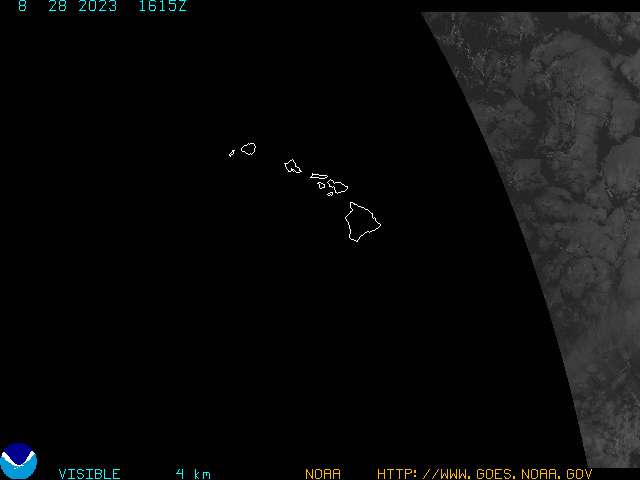

Myrtle Says:
Hi Glenn — Tomorrow night’s full moon will be the last of the decade! The 00’s are almost pau…Aloha, Myrtle~~~Hi Myrtle, ringing in the new year…moving into a new decade! Thanks for your note. Aloha, Glenn