











December 3-4, 2009
Air Temperatures – The following maximum temperatures were recorded across the state of Hawaii Thursday afternoon:
Lihue, Kauai – 79
Honolulu, Oahu – 81
Kaneohe, Oahu – 82
Kaunakakai, Molokai – 80
Kahului, Maui – 81
Hilo, Hawaii – 81
Kailua-kona – 83
Air Temperatures ranged between these warmest and coolest spots near sea level around the state – and on the highest mountains…at 5pm Thursday evening:
Port Allen, Kauai – 82F
Princeville, Kauai – 77
Haleakala Crater – 43 (near 10,000 feet on Maui)
Mauna Kea summit – 39 (near 14,000 feet on the Big Island)
Precipitation Totals – The following numbers represent the largest precipitation totals (inches) during the last 24 hours on each of the major islands, as of Thursday afternoon:
0.02 Hanalei River, Kauai
0.02 Waimanalo, Oahu
0.00 Molokai
0.00 Lanai
0.00 Kahoolawe
0.00 Maui
0.41 Mountain View, Big Island
Marine Winds – Here’s the latest (automatically updated) weather map showing a cold front moving down through the islands. Winds will be gusty south to southwest ahead of the front, with lighter north to northeast winds later Friday into Saturday…in its wake.
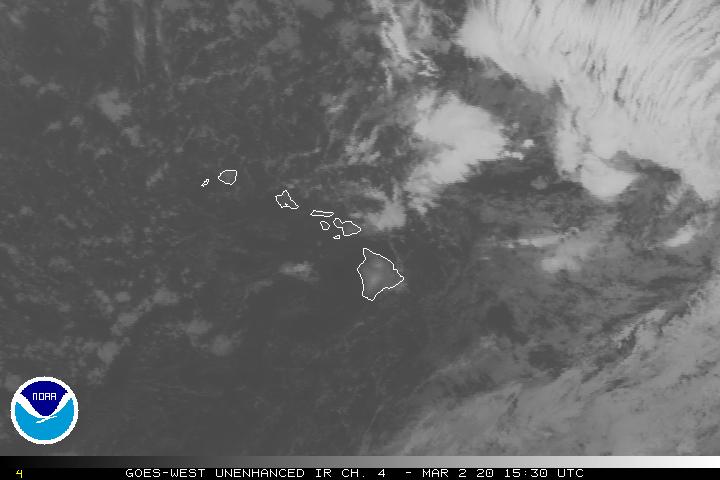
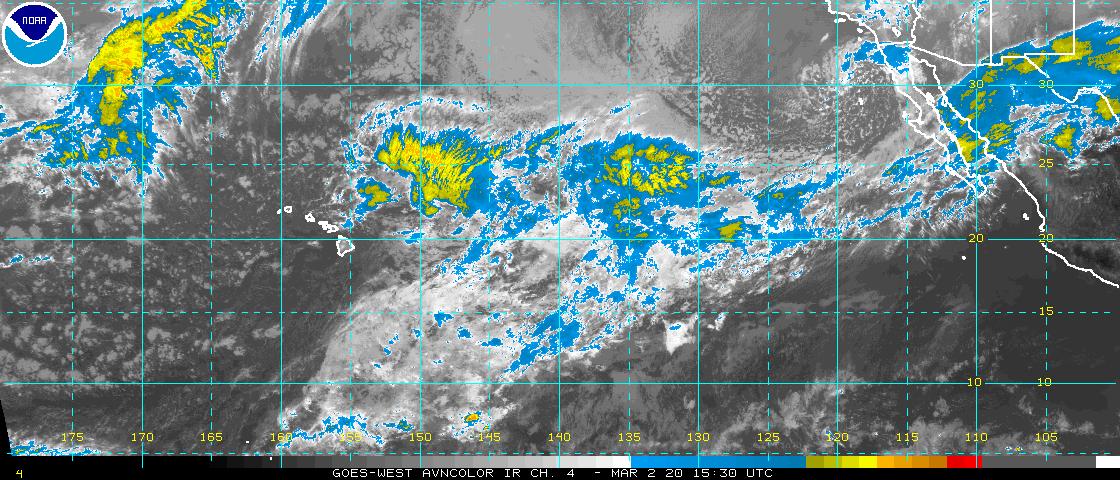
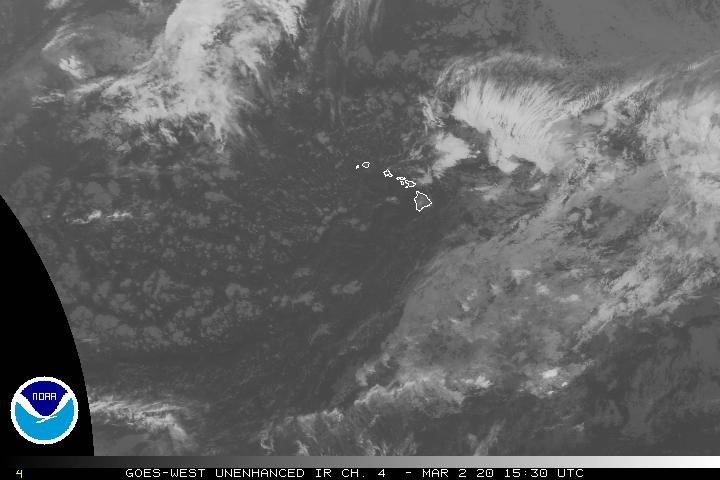
Satellite and Radar Images: To view the cloud conditions we have here in Hawaii, please use the following satellite links, starting off with this Infrared Satellite Image of the islands to see all the clouds around the state during the day and night. This next image is one that gives close images of the islands only during the daytime hours, and is referred to as a Close-up visible image. This next image shows a larger view of the Pacific…giving perspective to the wider ranging cloud patterns in the Pacific Ocean. Finally, here’s a Looping IR satellite image, making viewable the clouds around the islands 24 hours a day. To help you keep track of where any showers may be around the islands, here’s the latest animated radar image.
Hawaii’s Mountains – Here’s a link to the live webcam on the summit of near 14,000 foot Mauna Kea on the Big Island of Hawaii. The tallest peak on the island of Maui is the Haleakala Crater, which is near 10,000 feet in elevation. These two webcams are available during the daylight hours here in the islands…and when there’s a big moon rising just after sunset for an hour or two! Plus, during the nights and early mornings you will be able to see stars, and the sunrise too…depending upon weather conditions.
Tropical Cyclone activity in the eastern and central Pacific – Here’s the latest weather information coming out of the National Hurricane Center, covering the eastern north Pacific. You can find the latest tropical cyclone information for the central north Pacific (where Hawaii is located) by clicking on this link to the Central Pacific Hurricane Center. Here’s a tracking map covering both the eastern and central Pacific Ocean. A satellite image, which shows the entire ocean area between Hawaii and the Mexican coast…can be found here.
Aloha Paragraphs

Approaching cold front will bring showers…some locally heavy
Showers, some locally heavy are moving into the islands Thursday evening…continuing into the night and Friday. A cold front is bearing down on our Aloha state, arriving tonight into Friday. The pre-frontal showers will arrive earlier, and may turn out to be quite generous from Kauai down through Maui County. This IR satellite image shows the approaching cloud band to our northwest…racing along at near 20-30 mph. If we glance at this looping radar image we can already see heavier showers reaching into the state from the southwest
Winds are picking up from the south and southwest directions as the cold front gets closer. These south and SW Kona winds will become locally gusty this evening into the night, ahead of the frontal boundary. Winds will relax in the wake of the frontal passage later Friday, becoming quite light into the weekend. This will put us back into a convective weather pattern, with cool mornings, giving way to cloudy periods during the afternoons…especially around the mountains. The atmosphere will be quite dry and stable by then, so shower activity will be rather limited.
Looking further ahead, another cold front comes towards us early next week…although will fall apart before reaching
The parent low pressure systems for these cold front’s, will be deep storms in the north Pacific…which will send us large northwest swells. We’ll see these winter-like swells arriving every couple of days, with high surf advisories, and warnings going up each time. The current northwest swell qualifies as large, although we’ll have to wait until Saturday, and then again next Monday…for extra large swell trains of waves to arrive. The storm that will generate this giant swell, will have hurricane force winds revolving around its center. These swells will be something to photograph, but all of us will need to stay out of the ocean on the north and west facing beaches while they’re breaking. These high surf episodes are common as we move towards our upcoming winter season.
Everything seems to be falling into place now, so that most of the details in the paragraphs above should work out…according to plan. Taking a look at this big picture of the Pacific, we can get an idea of all the activity that’s happening now…including our cold front. Earlier this morning, the cold front was racing along at 30-35 mph, but has more recently slowed down its forward progress down a little. At this rate it will arrive on Kauai this evening or tonight, Oahu early Friday morning, then Maui near sunrise…and the
It’s early Thursday evening here on Maui, as I begin writing this last section of today’s narrative. Ok, here we go, under the waterfall…so to speak. As you see in the looping radar image up the page, heavy rains are upon us now, first on Oahu. I guess we could say "batten down the hatches", as the gusty Kona winds, rain, and possible thunder and lightning qualify easily as inclement weather conditions. The good thing about all this, is that it will be over rather quickly, with the weekend looking good already. I’ll keep a close eye on all of this, and if things get wild tonight, I might have to crawl out from under that warm down comforter, to get back online then? ~~~ I’ll be back one way or the other early Friday morning, with your next new weather narrative from paradise. I hope you have a great Thursday night until then! Aloha for now…Glenn.
Interesting: The largest known mass extinction in Earth’s history, about 252 million years ago at the end of the Permian Period, may have been caused by global warming. A new fossil species suggests that some land animals may have survived the end-Permian extinction by living in cooler climates in Antarctica.
Jörg Fröbisch and Kenneth D. Angielczyk of The Field Museum together with Christian A. Sidor from the University of Washington have identified a distant relative of mammals, Kombuisia antarctica, that apparently survived the mass extinction by living in Antarctica.
The new species belongs to a larger group of extinct mammal relatives, called anomodonts, which were widespread and represented the dominant plant eaters of their time. "Members of the group burrowed in the ground, walked the surface and lived in trees," said Fröbisch, the lead author of the study.
"However, Kombuisia antarctica, about the size of a small house cat, was considerably different from today’s mammals — it likely laid eggs, didn’t nurse its young and didn’t have fur, and it is uncertain whether it was warm blooded," said Angielczyk, Assistant Curator of Paleomammology at The Field Museum.
Kombuisia antarctica was not a direct ancestor of living mammals, but it was among the few lineages of animals that survived at a time when a majority of life forms perished. Scientists are still debating what caused the end-Permian extinction, but it was likely associated with massive volcanic activity in Siberia that could have triggered global warming.
When it served as refuge, Antarctica was located some distance north of its present location, was warmer and wasn’t covered with permanent glaciers, said the researchers. The refuge of Kombuisia in Antarctica probably wasn’t the result of a seasonal migration but rather a longer-term change that saw the animal’s habitat shift southward.
Fossil evidence suggests that small and medium sized animals were more successful at surviving the mass extinction than larger animals. They may have engaged in "sleep-or-hide" behaviors like hibernation, torpor and burrowing to survive in a difficult environment.
Interesting2: Leading mental health researchers are warning that some of the most important health consequences of climate change will be on mental health, yet this issue is unlikely to be given much attention at the UN climate change conference in Copenhagen. Dr Lisa Page and Dr Louise Howard from the Institute of Psychiatry (IoP) at King’s College London reviewed a range of recent research by scientists into the potential mental health impacts of climate change.
In an article published in Psychological Medicine online, the two mental health experts conclude that climate change has the potential to have significant negative effects on global mental health. These effects will be felt most by those with pre-existing serious mental illness, but that there is also likely to be an increase in the overall burden of mental disorder worldwide.
The scientists urge for the lack of research into the mechanisms that cause the effects of climate change on mental disorder to be addressed, so that mental health policy makers can plan for the significant impacts of climate change on mental health that are to be expected.
Dr Page, lead author of the article and Clinical Lecturer in Liaison Psychiatry at the IoP, comments: ‘Climate change is assuming centre stage with the upcoming UN conference in Copenhagen. While delegates will discuss the effects of climate change and possible responses by the international governments, we fear that the effects of climate change on mental health will be largely ignored, posing a tremendous risk to the mental health of millions of people in the not-too-distant future.’
Dr Page and Dr Howard identified the following ways in which climate change is likely to impact mental health:
• Natural disasters, such as floods, cyclones and droughts, are predicted to increase as a consequence of climate change. Adverse psychiatric outcomes are well documented in the aftermaths of natural disasters and include post-traumatic stress disorder, major depression and somatoform disorders.
• The needs of people will chronic mental illness have often been overlooked following disaster in favour of trauma-focused psychological interventions and yet the mentally ill occupy multiply vulnerabilities for increased mortality and morbidity at such times.
• As global temperatures increase, people with mental illness are particularly vulnerable to heat-related death. Contributing risk factors such as psychotropic medication, pre-existing respiratory and cardiovascular disease and substance misuse, are all highly prevalent in people with serious mental illness. In addition, maladaptive coping mechanisms and poor quality housing are likely to further increase vulnerability, and death by suicide may also increase above a certain temperature threshold.
• Adverse impacts such as psychological distress, anxiety and traumatic stress resulting from emerging infectious disease outbreaks are also likely to increase if the predicted outbreaks of serious infectious diseases become reality.
• Coastal change and increased flooding is expected to lead to forced mass migration and displacement, which will undoubtedly lead to more mental illness in affected population.
• Urbanization, a phenomenon which will be partially beneficial, for example by increasing opportunities for work and better access to health services, is associated with an increased incidence of schizophrenia in developed countries. In many low- and middle-income countries, mental health provision is already hugely inadequate and is unlikely to be prioritized should further economic collapse occur secondary to climate change.
• The knowledge of man-made climate change could in itself have adverse effects on individual psychological well-being.
Interesting3: The 30-year record low in Antarctic snowmelt that occurred during the 2008-09 austral summer was likely due to concurrent strong positive phases for two main climate drivers, ENSO (El Niño — Southern Oscillation) and SAM (Southern Hemisphere Annular Mode), according to Dr. Marco Tedesco, Assistant Professor of Earth & Atmospheric Sciences at The City College of New York. Professor Tedesco, who is also on the doctoral faculty at the CUNY Graduate Center, added that Antarctic snowmelt levels should revert to higher norms as one of the drivers, the SAM, subsides as the damage to the ozone layer is repaired.
His conclusions, which are based on space-borne microwave observations between 1979 and 2009, were reported in Geophysical Research Letters earlier this fall. "The study’s goal was not only to report on melting but also on the relationship between melting and the climate drivers, El Niño and the SAM," he explained. Low melt years during the 1979-2009 satellite record are related to the strength of the westerly winds that encircle Antarctica, known as the Southern Hemisphere Annular Mode (SAM).
"When the SAM is in a positive phase — meaning that the belt of winds is stronger than average — it has a cooling effect on Antarctic surface temperatures," he explained. "The SAM was especially strong in austral spring and summer 2008-2009, and subsequently the 2008-2009 snowmelt was lower than normal." During the past 30-40 years, the SAM has gradually strengthened during austral summer, due mainly to human-caused stratospheric ozone depletion, he continued.
However, as the hole is repaired as a result of compliance with the Montreal protocol, the winds will weaken and Antarctica will be subject to more warming air. The increasing summer SAM trends are projected to subside, he added. "It is likely that summer temperature increases over Antarctica will become stronger and more widespread because the warming effect from greenhouse gas increases will no longer be kept by the weakened circumpolar winds. The bottom line is as the ozone layer recovers we’ll likely have more melting on Antarctica."
Interesting4: State and Federal agencies have begun poisoning a nearly 6-mile stretch of the Chicago Sanitary Ship Canal to kill off invasive Asian carp while maintenance is performed on an electrical barrier intended to keep the fish out of Lake Michigan. The Lake’s ecosystem is already irreparably damaged by invasive species making the introduction of these new invasive fish a dire threat to the entire Great Lakes system.
The fish can grow to 100 pounds in size and out-compete native species in an ecosystem due to their prolific breeding and ability to filter feed 40% of their body weight on a daily basis. Underscoring the threat, Governor Jennifer Granholm of Michigan today called for the re-opening of a nearly century-old case sitting before the U.S. Supreme Court regarding the Chicago Diversion to force immediate action around the carp issue.
According to Henry Henderson, Director of the Natural Resources Defense Council’s Midwest Program (and a former Commissioner of the Environment for the City of Chicago), "Nobody wants to see 200,000 pounds of dead fish hauled out of the water, but the alternative is far worse. This is a desperate, last ditch attempt to protect Lake Michigan, but more proactive efforts should have been made to stave off this threat."
"The problem does not go away after the poison has floated down the canal. It will require proactive and thoughtful action — two things that have been scarce during this slow motion disaster. In the short-term we need to close the locks and put protections in place on the waterways with no barriers.
But the carp will continue to come up the Illinois River until we re-establish the natural barriers that once protected the Lakes. Until that happens, the Great Lakes will continue to be threatened. No poisoning can fix this issue and the problem will not be solved until we’ve closed the door on these fish."
 Email Glenn James: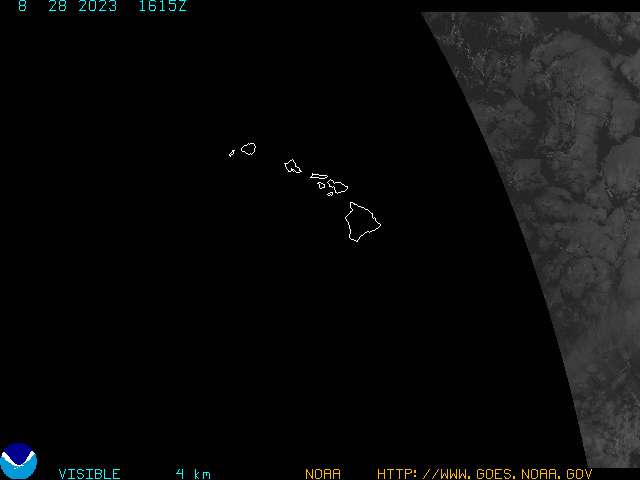

Frank Parrino Says:
Glorious rain last night. 4am check of my West End Molokai rain guage….2.4 inches!~~~Nice Frank, that’s a good hefty amount, we had an overnight spell of rain here on Maui too. Thanks for the precipitation report. Aloha, Glenn
manis Says:
can you tell us anything about the high altitude Aersol spraying (chem-trails) happening in hawaii and how it effects our weather and our lungs?
i have been seeing this unusual practice for the past year on maui and wonder if the weather people are noticing this practice?
thanks
manis~~~Hi Manis, I haven’t come across this yet, but if I do, I’ll post it in my interesting news stories. Thanks for sharing your concern about this condensation. Aloha, Glenn