











December 28-29, 2009
Air Temperatures – The following maximum temperatures were recorded across the state of Hawaii Monday afternoon:
Lihue, Kauai – 79
Honolulu, Oahu – 82
Kaneohe, Oahu – 81
Kaunakakai, Molokai – 81
Kahului, Maui – 85
Hilo, Hawaii – 82
Kailua-kona – 82
Air Temperatures ranged between these warmest and coolest spots near sea level around the state – and on the highest mountains…at 5pm Monday evening:
Barking Sands, Kauai – 81F
Molokai airport – 76
Haleakala Crater – 52 (near 10,000 feet on Maui)
Mauna Kea summit – 43 (near 14,000 feet on the Big Island)
Precipitation Totals – The following numbers represent the largest precipitation totals (inches) during the last 24 hours on each of the major islands, as of Monday afternoon:
0.01 Wainiha, Kauai
0.02 Waimanalo, Oahu
0.00 Molokai
0.00 Lanai
0.00 Kahoolawe
0.05 West Wailuaiki, Maui
0.01 Pahoa, Big Island
Marine Winds – Here’s the latest (automatically updated) weather map showing a 1023 millibar high pressure system to the northeast of the islands. Our winds will remain light from the southeast…gradually becoming south to southwest ahead of a stalling cold front.
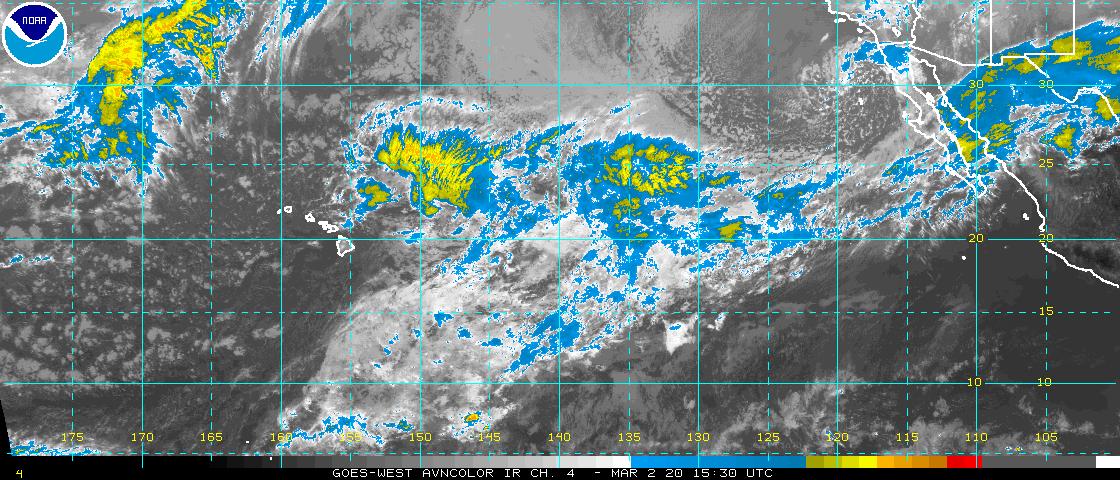
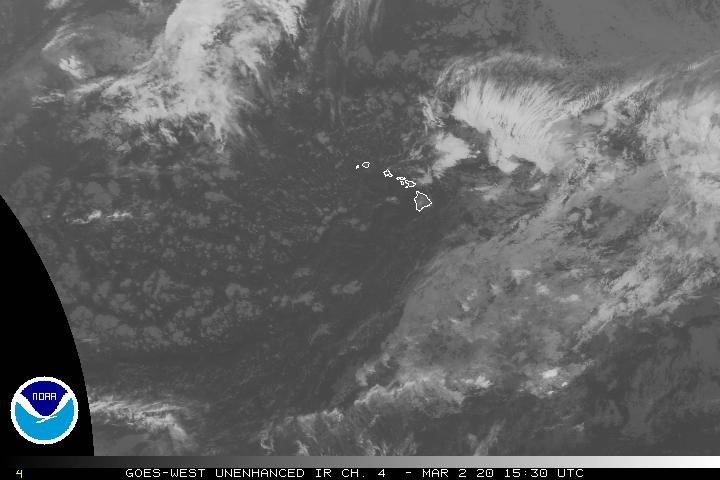
Satellite and Radar Images: To view the cloud conditions we have here in Hawaii, please use the following satellite links, starting off with this Infrared Satellite Image of the islands to see all the clouds around the state during the day and night. This next image is one that gives close images of the islands only during the daytime hours, and is referred to as a Close-up visible image. This next image shows a larger view of the Pacific…giving perspective to the wider ranging cloud patterns in the Pacific Ocean. Finally, here’s a Looping IR satellite image, making viewable the clouds around the islands 24 hours a day. To help you keep track of where any showers may be around the islands, here’s the latest animated radar image.
Hawaii’s Mountains – Here’s a link to the live webcam on the summit of near 14,000 foot Mauna Kea on the Big Island of Hawaii. The tallest peak on the island of Maui is the Haleakala Crater, which is near 10,000 feet in elevation. These two webcams are available during the daylight hours here in the islands…and when there’s a big moon rising just after sunset for an hour or two! Plus, during the nights and early mornings you will be able to see stars, and the sunrise too…depending upon weather conditions.
Tropical Cyclone activity in the eastern and central Pacific – Here’s the latest weather information coming out of the National Hurricane Center, covering the eastern north Pacific. You can find the latest tropical cyclone information for the central north Pacific (where Hawaii is located) by clicking on this link to the Central Pacific Hurricane Center. Here’s a tracking map covering both the eastern and central Pacific Ocean. A satellite image, which shows the entire ocean area between Hawaii and the Mexican coast…can be found here.
Aloha Paragraphs

Kailua Beach…Oahu
Dry to very dry weather has been the case lately, with little change expected for the moment. An atmospheric stabilizing ridge of high pressure is nearby Monday evening, meaning that whatever few clouds that are around, will be shallow. Thin low level clouds are usually very light precipitation producers…at best. Thus, rainfall totals lately have been extremely low, with most areas remaining totally dry. Getting back to that ridge of high pressure, here’s a weather map showing where it sits early Monday evening…over
The latest computer forecast models don’t show this front getting into the state, although it will get close enough…that the ridge will be pushed down towards the Big Island Tuesday. Here’s an IR satellite image, showing the cloud band to our north, with a few thunderstorms firing-off along it’s generally east to west oriented length. This even larger view, shows this cold front, along with another low, and it’s associated cold front, which is expected to bring some showers to the state later Tuesday into Wednesday. There’s some chance that southerly or even southwesterly Kona breezes may carry some showers to our leeward sides later Tuesday…in other words prefrontal showers.
As far as winds go, they will remain light, generally from the southeast …gradually turning around to the south and southwest. The location of the high pressure ridge will determine which direction these light breezes blow. As the ridge was over Kauai at the time of this writing, our winds were coming up from the southeast generally, lightest near
This in turn will allow breezes to strengthen a bit over Kauai and
It’s Monday evening here on Maui, as I begin writing the last section of today’s narrative. The volcanic haze (vog) is the main story Monday evening, as it has become quite thick over some parts of the island chain. Here on Maui, a little before sunset, it’s very obvious to the most casual observer. I can still see the West Maui Mountains, from here in Kula…but not well. The clouds that surrounded the islands during the afternoon hours, at least in some places, are collapsing and disappearing quickly, as we approach sunset. There has been the most minimum amount of showers falling, that our dry period contines. We should begin to see some increasing showers, although likely not all that many, over the next few days. ~~~ It’s just before 6pm Monday evening, as I write these last few sentences. I finished a book called The Crossing, written by Cormac McCarthy, which exhibited the classical dark side of life, as Mr. McCarthy is famous for. You may remember that he was the author of No Country for Old Men, which became the #1 film of 2008, when it was put to film. If any of you had the opportunity to see that great film, you know that it was dark and intense…but oh so well done! ~~~ I’m about to get out there for my early evening walk now, although will return early Tuesday morning with your next new weather narrative from paradise. By the way, the picture up this page, of Kailua, Oahu, happens to be where President Obama and his family are staying now. The weather has been fine for their vacation so far, but may slip half a notch later Tuesday into Wednesday…as the next cold front pushes down into the state then. Aloha for now…Glenn.
Interesting: Earth’s various ecosystems, with all their plants and animals, will need to shift about a quarter-mile per year on average to keep pace with global climate change. How well particular species can survive rising worldwide temperatures attributed to excess levels of heat-trapping "greenhouse" gases emitted by human activity hinges on those species’ ability to migrate or adapt in place.
The farther individual species — from shrubs and trees to insects, birds and mammals — need to move to stay within their preferred climate, the greater their chance of extinction. The study suggests that scientists and governments should update habitat conservation strategies that have long emphasized drawing boundaries around environmentally sensitive areas and restricting development within those borders.
A more "dynamic" focus should be placed on establishing wildlife corridors and pathways linking fragmented habitats, said research co-author Healy Hamilton of the California Academy of Sciences. "Things are on the move, faster than we anticipated," she told Reuters.
"This rate of projected climate change is just about the same as a slow-motion meteorite in terms of the speed at which it’s asking a species to respond." The new research suggests that denizens of mountainous habitats will experience the slowest rates of climate change because they can track relatively large swings in temperature by moving just a short distance up or down slope.
Interesting2: Despite near instantaneous condemnation of his role in the culmination of the COP15 climate negotiations last week, president Obama voiced his frustration over the course those negotiations took and accord that resulted from them. Speaking with Jim Lehrer, president Obama said that "people are justified in being disappointed about the outcome in Copenhagen."
Lehrer asked about comments Obama made that Copenhagen "was a success anyhow," despite the tepid nature of the accord. President Obama responded: What—what did occur was that at a point where there was about to be complete breakdown, and the prime minister of India was heading to the airport and the Chinese representatives were essentially skipping negotiations, and everybody’s screaming, what did happen was cooler heads prevailed.
So that—that was an important principle, that everybody’s got to do something in order to solve this problem. But I make no claims, and didn’t make any claims going in, that somehow that was going to be everything that we needed to do to solve climate change. And—and my main responsibility here is to convince the American people that it is smart economics and it is going to be the engine of our economic growth for us to be a leader in clean energy.
And if we pass a bill in the Senate, reconcile it with the House, that says we are going to invest in wind energy and solar energy and we’re going to be the guys who are producing wind turbines, and we’re going to be the folks who are producing solar panels on rooftops, and we’re going to be the country that is retrofitting all its homes and businesses so that we are 30 percent more energy efficient than we are right now, that produces jobs that can’t be exported; it reduces our dependence on foreign oil; it is good economics; it will increase our exports—oh, and by the way, it also solves the climate problem.
And that is, I think, an argument that I’m going to be making not just next year, but for several years to come. What I said was essentially that rather than see a complete collapse in Copenhagen, in which nothing at all got done and would have been a huge backward step, at least we kind of held ground and there wasn’t too much backsliding from where we were.
Interesting3: Are hybrid cars still considered niche, or even — dare we say — "luxury" purchases? The failure of the lower-cost Honda Insight hybrid to dent the market for the Prius has some in the auto industry answering yes. Business Week reports that the Insight, which was introduced this year with a base MSRP of $19,800, over $2,000 less than the Prius, is still being outsold by Toyota’s car 6 to 1.
The Insight’s sluggish sales is proving a useful cautionary tale to other automakers looking to catch up to Toyota in the hybrid market, and some have already made major strategic shifts as a result. General Motors, which will introduce the Volt late next year through its Chevy brand, has scrapped plans for a "Prius-killer" hybrid sedan that would get 53 miles to the gallon.
Part of the reason, no doubt, is that the beleaguered car company needs to focus its energies on making the Volt successful. But the other big reason is Prius’ merciless crushing of the Insight. Rich Liberal Elitists Driving Fancy Hybrid Cars. The Insight, which is based on the Honda Fit subcompact body, was meant to be a low-budget hybrid, a car for a market segment that may not exist.
Honda hoped to sell 40,000 Insights this year, but now admits it will fall far short of that goal. From the Business Week article. It’s not clear that the Insight will ever seriously challenge the Prius because Honda has overlooked a lesson Toyota learned years ago: Hybrids aren’t a budget purchase.
According to Business Week, many Prius owners make more than $100,000 a year. The 3rd generation Prius, which went on sale this year, features a bigger, more powerful engine, more passenger space, and "Lexus" touches. Not to mention egregiously expensive — yet environmentally snazzy — options like a solar powered roof ($3,600).
Interesting4: The University of Alabama at Birmingham (UAB) has published an important research paper that shows a clear link between calorie intake and the lifespan of human cells. Researchers from the have discovered that restricting consumption of glucose, the most common dietary sugar, can extend the life of healthy human-lung cells and speed the death of precancerous human-lung cells, reducing cancer’s spread and growth rate.
The research has wide-ranging potential in age-related science, including ways in which calorie-intake restriction can benefit longevity and help prevent diseases like cancer that have been linked to aging, said principal investigator Trygve Tollefsbol, Ph.D., D.O., a professor in the Department of Biology. "These results further verify the potential health benefits of controlling calorie intake," Tollefsbol said.
"Our research indicates that calorie reduction extends the lifespan of healthy human cells and aids the body’s natural ability to kill off cancer-forming cells." The UAB team conducted its tests by growing both healthy human-lung cells and precancerous human-lung cells in laboratory flasks. The flasks were provided either normal levels of glucose or significantly reduced amounts of the sugar compound, and the cells then were allowed to grow for a period of weeks.
"In that time, we were able to track the cells’ ability to divide while also monitoring the number of surviving cells. The pattern that was revealed to us showed that restricted glucose levels led the healthy cells to grow longer than is typical and caused the precancerous cells to die off in large numbers," Tollefsbol said. In particular, the researchers found that two key genes were affected in the cellular response to decreased glucose consumption.
The first gene, telomerase, encodes an important enzyme that allows cells to divide indefinitely. The second gene, p16, encodes a well known anti-cancer protein. "Opposite effects were found for these genes in healthy cells versus precancerous cells. The healthy cells saw their telomerase rise and p16 decrease, which would explain the boost in healthy cell growth," Tollefsbol said.
"The gene reactions flipped in the precancerous cells with telomerase decreasing and the anti-cancer protein p16 increasing, which would explain why these cancer-forming cells died off in large numbers." The UAB research into the links between calorie intake, aging and the onset of diseases related to aging is thought to be a first of its kind given that it used the unique approach of testing human cells versus laboratory animals.
Interesting5: Middle Eastern and North African countries, often referred to under the umbrella term MENA countries, have the potential to create more than 3 times the world’s power needs, according to a new study reported in the Dubai-based Khaleej Times. Countries that move fast, the study suggests, could have the competitive advantage. Who could take the lead: MENA countries, especially ones located on the Arabian Peninsula, as well as others like Jordan, Lebanon, and Israel could be.
These countries are no strangers to the notion of solar energy, and Green Prophet has covered countless articles touting solar energy in the Middle East. One of the region’s leading solar energy development countries, Israel, has even been asked by the UN to increase its development of solar energy.
Despite being an instrumental innovator through companies such as BrightSource or Solel, Israel’s own use of solar power at home more closely resembles that of a developing nation. The Khaleej Times article pointed out that countries in the MENA region have the "greatest potential for solar regeneration" supplying 45% of the world’s energy sources possible through renewable energy.
Renewable energy sources of interest in this region include Abu Dhabi’s Masdar City as well as its hosting of the World Renewable Energy Agency headquarters . Known as IRENA, this center could fuel development in the whole region. A big problem, however, is under-funding of renewable energy projects, due to a big abundance of oil and other fossil fuels, says Beirut based Ibrahim El Hussenei, a partner in the London based energy project development company, Booz & Company whose representatives were present at the COP 15 Climate Change Conference in Copenhagen.
Interesting6: Alaska’s Mount Redoubt volcano is rumbling again. The Alaska Volcano Observatory says a series of small earthquakes began occurring around the summit of the volcano Sunday and continued Monday.
As a result, scientists have upgraded the volcano’s alert status. Redoubt, about 105 miles southwest of Anchorage, went through an eruptive period that led to major explosions earlier this year, including one that dusted Anchorage with ash fall.
The erupting volcano forced the Cook Inlet Pipeline Co. to remove millions of gallons of oil stored at the Drift River Terminal 22 miles away. Hundreds of airline flights also had to be canceled because of ash clouds this spring. The last time Mount Redoubt had a similar period of activity was in late 1989 to spring 1990.
 Email Glenn James: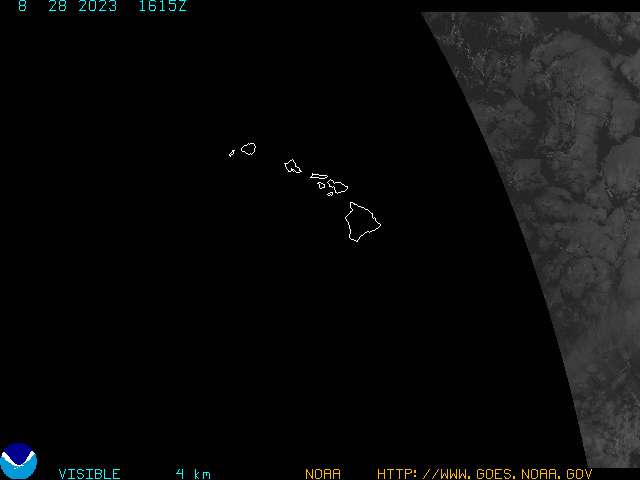


marty Says:
Aloha Glenn,
Thanks so much for this past years weather reports, I look at them every day for all of our sports we do including Paragliding, Surfing, Windsurfing, Toe-in Surfing etc…
Happy Holidays and I hope you have a great new year.
Mahalo,
Marty~~~Hi Marty, thanks for your positive feedback! It sounds like you have a life filled with great sports…nice! Happy New Year to you and yours as well. Aloha, Glenn