











December 19-20, 2009
Air Temperatures – The following maximum temperatures were recorded across the state of Hawaii Saturday afternoon:
Lihue, Kauai – 76
Honolulu, Oahu – 80
Kaneohe, Oahu – 74
Kaunakakai, Molokai – 76
Kahului, Maui – 79
Hilo, Hawaii – 73
Kailua-kona – 81
Air Temperatures ranged between these warmest and coolest spots near sea level around the state – and on the highest mountains…at 4pm Saturday afternoon:
Port Allen, Kauai – 81F
Princeville, Kauai – 72
Haleakala Crater – 41 (near 10,000 feet on Maui)
Mauna Kea summit – 32 (near 14,000 feet on the Big Island)
Precipitation Totals – The following numbers represent the largest precipitation totals (inches) during the last 24 hours on each of the major islands, as of Saturday afternoon:
0.05 Wainiha, Kauai
0.07 Punaluu Pump, Oahu
0.00 Molokai
0.00 Lanai
0.00 Kahoolawe
1.68 West Wailuaiki, Maui
8.95 Laupahoehoe, Big Island!
Marine Winds – Here’s the latest (automatically updated) weather map showing a 1022 millibar high pressure system moving by to the area north of the islands. Our winds will come in from the northeast this weekend, losing some steam into the new week.
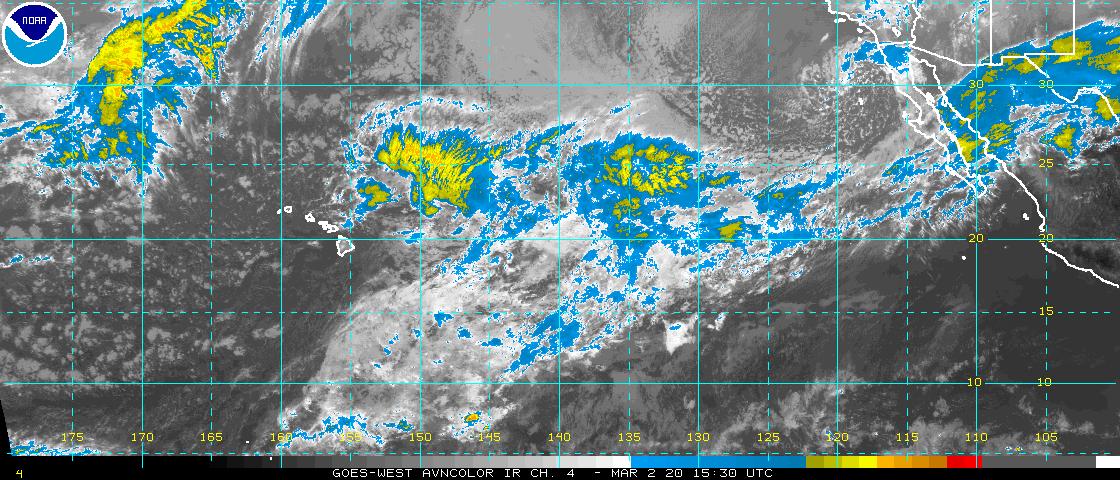
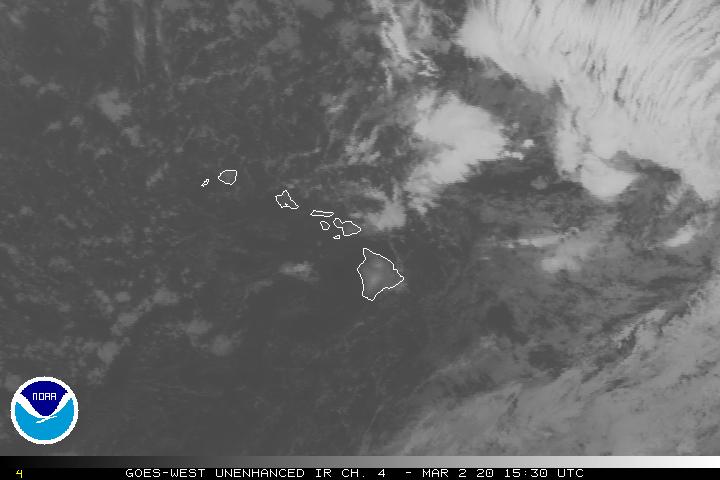
Satellite and Radar Images: To view the cloud conditions we have here in Hawaii, please use the following satellite links, starting off with this Infrared Satellite Image of the islands to see all the clouds around the state during the day and night. This next image is one that gives close images of the islands only during the daytime hours, and is referred to as a Close-up visible image. This next image shows a larger view of the Pacific…giving perspective to the wider ranging cloud patterns in the Pacific Ocean. Finally, here’s a Looping IR satellite image, making viewable the clouds around the islands 24 hours a day. To help you keep track of where any showers may be around the islands, here’s the latest animated radar image.
Hawaii’s Mountains – Here’s a link to the live webcam on the summit of near 14,000 foot Mauna Kea on the Big Island of Hawaii. The tallest peak on the island of Maui is the Haleakala Crater, which is near 10,000 feet in elevation. These two webcams are available during the daylight hours here in the islands…and when there’s a big moon rising just after sunset for an hour or two! Plus, during the nights and early mornings you will be able to see stars, and the sunrise too…depending upon weather conditions.
Tropical Cyclone activity in the eastern and central Pacific – Here’s the latest weather information coming out of the National Hurricane Center, covering the eastern north Pacific. You can find the latest tropical cyclone information for the central north Pacific (where Hawaii is located) by clicking on this link to the Central Pacific Hurricane Center. Here’s a tracking map covering both the eastern and central Pacific Ocean. A satellite image, which shows the entire ocean area between Hawaii and the Mexican coast…can be found here.
Aloha Paragraphs

Celebrating being here in Hawaii!
A relatively dry and stable air mass remains in place…although not statewide. The Big Island and to some extent Maui, continue to see residual moisture from yesterday’s frontal cloud band. The Big Island has had localized heavy rains, and even a few thunderstorms. Maui, along the windward side at least, has seen some of that pooled moisture from the Big Island, spreading back there too. A trough of low pressure, with its unusually cold air aloft, has been the triggering mechanism, which set off the locally heavy rainfall. The generous rainfall backed off some during the day Saturday, but may resume again Saturday evening into Sunday morning. Meanwhile, the rest of the state has been much drier, and will stay that way through the weekend…other than some passing showers along the windward sides here and there.
The winds remain out of the northeast direction, although not very strong…keeping a slightly cool atmosphere over the islands this weekend. Looking ahead, the next cold front will approach Tuesday, although is expected to be rather weak, and unable to push very far into the state then. The islands of Kauai and Oahu may see a few showers, but they shouldn’t amount to much. The winds will falter again as this first cold front of the week, pushes a high pressure ridge down over the state. This in turn may signal the arrival of the next round of volcanically hazy weather for some parts of the state. The computer models go on to show another cold front arriving with precipitation, later in the new work week…which may turn out to be rather significant. This second cold front may turn our winds south to southwest, from the Kona direction, preceding its arrival around Christmas, with another possible bout of cool north to northeast winds in its wake, into next weekend.
It’s early Saturday evening here on Maui, as I begin writing this last section of this morning’s narrative. There’s been a large disparity between one end of the island chain, to the other, which is a little unusual. The Kauai side of the state is quite dry and stable, with few showers anywhere. In contrast, the air mass over the Big Island has been unstable and rather wet. Here’s a satellite image, with which you can see the bright white clouds around the Big Island, where the heavy precipitation is falling. In addition, an area of high clouds are streaming overhead, coming in from the north. This heavy stuff tapered off during the day, but may start back up again Saturday night into Sunday morning…as the next area of cold air flows over the state, triggering more locally heavy precipitation. Some of this rainfall may spread back over the windward sides of Maui during this time as well.
~~~ I mostly read, and hung out with my neighbors this morning, before heading down to Paia town, on the north shore early this afternoon. I went to the beach for a short while, and found a few people there, but the chilly weather kept most away. There were large and rough waves breaking, and it was quite cloudy too. Since I was there though, I figured why not jump in that cool ocean for a little swim. I was glad I did, as it wasn’t all that nippy, except just when taking that first dive. I then went shopping, and came pretty much right back home to Kula. My friend Marco has invited me to a dance party tonight, where there will be a live band playing. I often prefer a disc jockey, but he has led me to believe it will be very fun. I’m going down to lower Kula to meet him in a little while, and will let you know how it went Sunday morning, when I’ll be back with your next new weather narrative then. I hope you have a great Saturday night until then! Aloha for now…Glenn.
Interesting: Many animals test their legs and totter forth only hours after they are born, but humans need a year before they take their first, hesitant steps. Is something fundamentally different going on in human babies? Maybe not. A new study shows that the time it takes for humans and all other mammals to start walking fits closely with the size of their brains.
In past studies to develop a new animal model for the brain events that support motor development, neurophysiologist Martin Garwicz of Lund University in Sweden and his colleagues discovered that the schedules by which ferrets and rats acquire various motor skills, such as crawling and walking, are strikingly similar to each other; the progress simply happens faster for rats.
That made them wonder how similar the timing of motor development might be among mammals in general. They compared the time between conception and walking in 24 species and looked at how well this duration correlated with a range of variables, including gestation time, adult body mass, and adult brain mass.
As they report in this week’s issue of PNAS, brain mass accounts for the vast majority (94%) of the variance in walking time between species. Species with larger brains, such as humans, tend to take longer to learn to walk.
Strikingly, a model based on adult brain mass and walking time in the other 23 species almost perfectly predicts when humans begin to walk. "We’ve always considered humans the exception," Garwicz says, "But in fact, we start walking at exactly the time that would be expected from all other walking mammals."
Interesting2: With 1,174 residents per square mile, it is the most densely populated state in the country. The Meadowlands are not known for wildlife diversity, but rather football diversity (the only stadium that’s home to two NFL teams). The longest hike many visitors may take is along Atlantic City’s neon-lit boardwalk.
In short, New Jersey is probably better known for providing habitat to The Sopranos than to species. Yet even this most urban of states provides the latest reminder of how important conservation is to Americans, evident with the approval of the state-wide Green Acres conservation bond on Nov. 3.
In an election in which the incumbent governor who supported the Green Acres bond lost, and the "economy" and "taxes" were the runaway top issues cited by voters in exit polls, this $400 million conservation bond received 53 percent of New Jersey voters’ support.
In doing so, the Green Acres conservation bond actually won more counties than either of the two major gubernatorial candidates. How do you explain this? Well, the first answer may be that people in New Jersey would rather get their clean water from filtering forests and wetlands than expensive water treatment facilities.
Voters may have remembered nearby New York City’s deliberations about future water use in the mid-1990s. At that time, the Big Apple realized it could spend less than $2 billion on preserving existing watershed lands upstate, or spend an estimated $6-8 billion to build new water treatment facilities. That’s an easy decision.
The second reason may be there is actually more to the Garden State than just turnpikes. The state’s Pinelands National Reserve is home to the largest body of open space on the Mid-Atlantic seaboard between Richmond and Boston. The state also has more than 200 miles of ocean and bay shoreline, and its 800,000-acre Highlands Region provides clean drinking water to more than one-half the state’s population.
The urge to protect the value of those assets is completely understandable, as the payoff is "better than gold." The third may be that people in New Jersey are really not that different than the rest of the country — because conservation goes beyond politics in the United States.
Interesting3: If the planet is headed for another mass extinction like the previous five, each of which wiped out more than 75 percent of all species on the planet, then North American mammals are one-fifth to one-half the way there, according to a University of California, Berkeley, and Pennsylvania State University analysis. Many scientists warn that the perfect storm of global warming and environmental degradation — both the result of human activity is leading to a sixth mass extinction equal to the "Big Five" that have occurred over the past 450 million years, the last of which killed off the dinosaurs 68 million years ago.
Yet estimates of how dire the current loss of species is have been hampered by the inability to compare species diversity today with the past. By combining data from three catalogs of mammal diversity in the United States between 30 million years ago and 500 years ago, UC Berkeley and Penn State researchers show that the bulk of mammal extinctions occurred within a few thousand years after the arrival of humans, with losses dropping after that.
Although modern humans emerged from Africa into Europe and Asia by about 40,000 years ago, they didn’t reach North American until about 13,000 years ago, and most mammal extinctions occurred in the subsequent 1-2,000 years. "The optimistic part of the study is that we haven’t come all that far on extinction in the past 10,000 years," said co-author Anthony Barnosky, UC Berkeley professor of integrative biology.
"We have this pulse when humans had their first effect about 13,000 years ago, but diversity has remained pretty steady for about 10,000 years." He expects to see a similar pattern in Europe after the invasion of Homo sapiens some 40,000 years ago. In the last 100 or so years, however, "we are seeing a lot of geographic range reductions that are of a greater magnitude than we would expect, and we are seeing loss of subspecies and even a few species.
So it looks like we are going into another one of these extinction events." "I’m optimistic that, because we haven’t lost those species yet, if we redouble our conservation efforts we can stem the tide of extinctions and have those species around in the future," he added. The study’s 30 million-year timeline allowed the researchers to compare species diversity over a period of dramatic change in the landscape.
The Rocky Mountains and Sierra Nevada ranges formed in the West, while there were dramatic swings in climate that may have been larger than and as fast as the Earth is seeing today, said co-author and UC Berkeley research associate Marc A. Carrasco.
Yet these changes did not have a great effect on mammal diversity, compared to what happened when the last glacial period ended, the ice retreated in North America, and humans crossed from Asia into America. "The only difference is that 13,000 years ago humans appear on the scene," Carrasco said. "The bottom line is, mammals in general were able to deal with these changes in the past. Only when humans arrive do the numbers fall off a cliff."
Interesting4: The consumption of wild cereals among prehistoric hunters and gatherers appears to be far more ancient than previously thought, according to a University of Calgary archaeologist who has found the oldest example of extensive reliance on cereal and root staples in the diet of early Homo sapiens more than 100,000 years ago. Julio Mercader, holder of the Canada Research Chair in Tropical Archaeology in the U of C’s Department of Archaeology, recovered dozens of stone tools from a deep cave in Mozambique showing that wild sorghum, the ancestor of the chief cereal consumed today in sub-Saharan Africa for flours, breads, porridges and alcoholic beverages, was in Homo sapiens’ pantry along with the African wine palm, the false banana, pigeon peas, wild oranges and the African "potato."
This is the earliest direct evidence of humans using pre-domesticated cereals anywhere in the world. Mercader’s findings are published in the December 18 issue of the research journal Science. "This broadens the timeline for the use of grass seeds by our species, and is proof of an expanded and sophisticated diet much earlier than we believed," Mercader said. "This happened during the Middle Stone Age, a time when the collecting of wild grains has conventionally been perceived as an irrelevant activity and not as important as that of roots, fruits and nuts."
In 2007, Mercader and colleagues from Mozambique’s University of Eduardo Mondlane excavated a limestone cave near Lake Niassa that was used intermittently by ancient foragers over the course of more than 60,000 years. Deep in this cave, they uncovered dozens of stone tools, animal bones and plant remains indicative of prehistoric dietary practices. The discovery of several thousand starch grains on the excavated plant grinders and scrapers showed that wild sorghum was being brought to the cave and processed systematically.
"It has been hypothesized that starch use represents a critical step in human evolution by improving the quality of the diet in the African savannas and woodlands where the modern human line first evolved. This could be considered one of the earliest examples of this dietary transformation," Mercader said.
"The inclusion of cereals in our diet is considered an important step in human evolution because of the technical complexity and the culinary manipulation that are required to turn grains into staples." Mercader said the evidence is on par with grass seed use by hunter-gatherers in many parts of the world during the closing stages of the last Ice Age, approximately 12,000 years ago. In this case, the trend dates back to the beginnings of the Ice Age, some 90,000 years earlier.
Interesting5: Which came first, the warmer temperatures or the clearer skies? Answers to that and similar "chicken or egg" type questions could have a significant impact on our understanding of both the climate system and manmade global warming. In an invited talk the week of December 14 at the American Geophysical Union’s fall meeting, Dr. Roy Spencer from The University of Alabama in Huntsville discussed the challenge of answering questions about cause and effect (also known as forcing and feedback) in the climate.
"Feedbacks will determine whether the manmade portion of global warming ends up being catastrophic or barely measurable," Spencer said recently. Spencer’s interest is in using satellite data and a simple climate model to test the simulated feedback processes contained in climate models that are used to forecast global warming. "I am arguing that we can’t measure feedbacks the way people have been trying to do it," he said.
"The climate modelers see from satellite data that warm years have fewer clouds, then assume that the warmth caused the clouds to dissipate. If this is true, it would be positive feedback and could lead to strong global warming. This is the way their models are programmed to behave. "My question to them was, ‘How do you know it wasn’t fewer clouds that caused the warm years, rather than the other way around?’
It turns out they didn’t know. They couldn’t answer that question." One problem is the simplicity of the climate models. Because cloud systems are so complex and so poorly understood, all of the climate models used by the United Nations’ Intergovernmental Panel on Climate Change use greatly simplified cloud parameters to represent clouds. But the calculations that set those parameters are based on assumed cause-and-effect relationships.
Those assumptions might be working in the wrong direction, Spencer said. "What we have found is that cloud cover variations causing temperature changes dominate the satellite record, and give the illusion of positive feedback." Using satellite observations interpreted with a simple model, Spencer’s data support negative feedback (or cooling) better than they support positive feedback.
"This critical component in global warming theory -¬ cloud feedback -¬ is impossible to measure directly in the real climate system," Spencer said. "We haven’t figured out a good way to separate cause and effect, so we can’t measure cloud feedback directly. And if we don’t know what the feedbacks are, we are just guessing at how much impact humans will have on climate change. "I’m trying to spread the word: Let’s go back to basics and look at what we can and cannot do with measurements of the real climate system to validate both climate models and their predictions."
 Email Glenn James: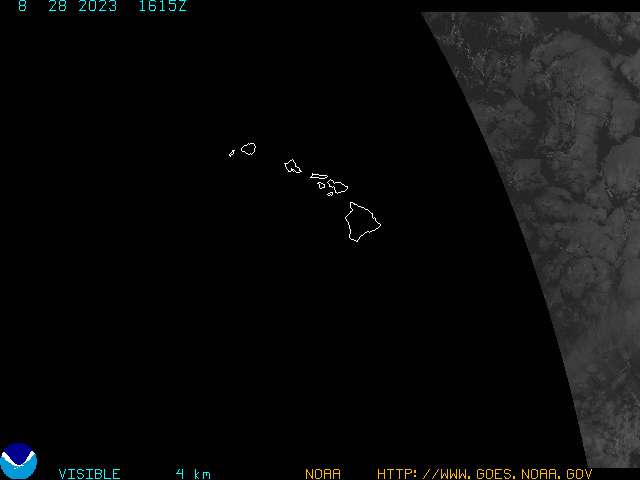

Salma Ansari Says:
There is hail falling in Kahului this monring at 6:45am~~~Salma, this is very unusual! There are certainly no lack of thunderstorms firing off early Sunday, the source of all the lightning and thunder…and the hail too! Thanks for your report. Aloha, Glenn
jack weber Says:
Glenn, we are drowning out here! But, the orchard is happy after no rain for a week! Keep us posted…thanks! jack~~~Hi Jack, nice, water those plants, they need a drink…after all that dry weather. You have more showers, or rain, perhaps even a bit more lightning and thunder tonight into Sunday morning, enjoy! Aloha, Glenn