











December 15-16, 2009
Air Temperatures – The following maximum temperatures were recorded across the state of Hawaii Tuesday afternoon:
Lihue, Kauai – 79
Honolulu, Oahu – 80
Kaneohe, Oahu – 81
Kaunakakai, Molokai – 80
Kahului, Maui – 83
Hilo, Hawaii – 81
Kailua-kona – 82
Air Temperatures ranged between these warmest and coolest spots near sea level around the state – and on the highest mountains…at 5pm Tuesday evening:
Port Allen, Kauai – 81F
Molokai airport – 75
Haleakala Crater – 50 (near 10,000 feet on Maui)
Mauna Kea summit – 39 (near 14,000 feet on the Big Island)
Precipitation Totals – The following numbers represent the largest precipitation totals (inches) during the last 24 hours on each of the major islands, as of Tuesday afternoon:
0.13 Opaekaa Stream, Kauai
0.18 Waihee Pump, Oahu
0.00 Molokai
0.00 Lanai
0.00 Kahoolawe
0.01 Puu Kukui, Maui
0.02 Honaunau, Big Island
Marine Winds – Here’s the latest (automatically updated) weather map showing an approaching cold front to the northwest, moving southeast towards Hawaii. The light breezes will gradually become south to southwest Wednesday…ahead of the front. Winds will veer around to the northwest and north in the wake of the frontal passage.
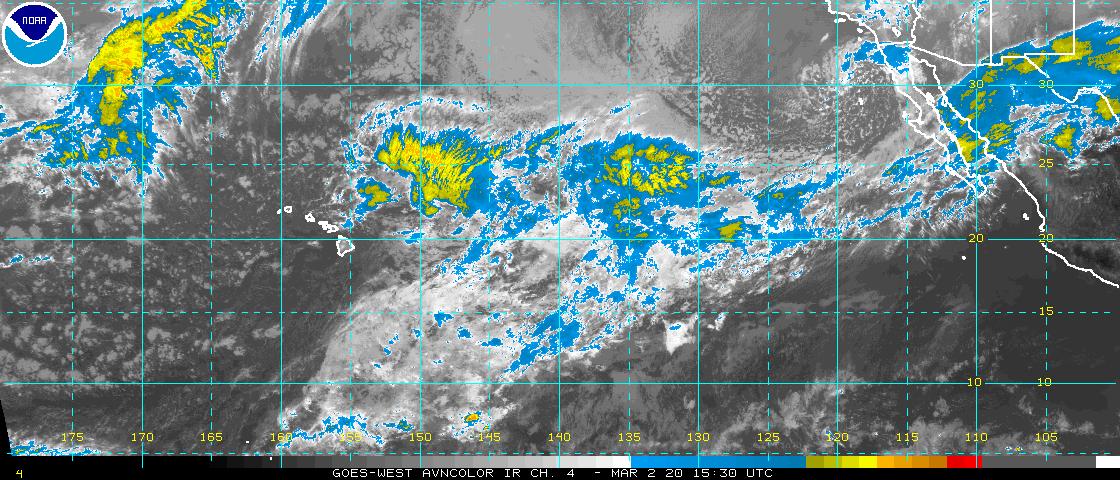
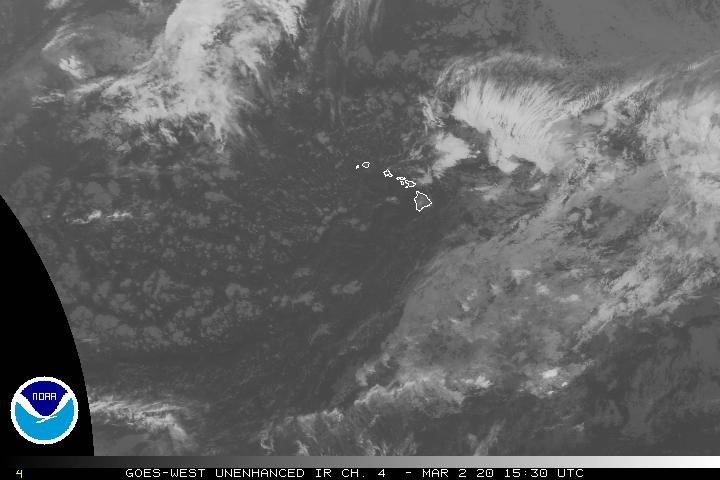
Satellite and Radar Images: To view the cloud conditions we have here in Hawaii, please use the following satellite links, starting off with this Infrared Satellite Image of the islands to see all the clouds around the state during the day and night. This next image is one that gives close images of the islands only during the daytime hours, and is referred to as a Close-up visible image. This next image shows a larger view of the Pacific…giving perspective to the wider ranging cloud patterns in the Pacific Ocean. Finally, here’s a Looping IR satellite image, making viewable the clouds around the islands 24 hours a day. To help you keep track of where any showers may be around the islands, here’s the latest animated radar image.
Hawaii’s Mountains – Here’s a link to the live webcam on the summit of near 14,000 foot Mauna Kea on the Big Island of Hawaii. The tallest peak on the island of Maui is the Haleakala Crater, which is near 10,000 feet in elevation. These two webcams are available during the daylight hours here in the islands…and when there’s a big moon rising just after sunset for an hour or two! Plus, during the nights and early mornings you will be able to see stars, and the sunrise too…depending upon weather conditions.
Tropical Cyclone activity in the eastern and central Pacific – Here’s the latest weather information coming out of the National Hurricane Center, covering the eastern north Pacific. You can find the latest tropical cyclone information for the central north Pacific (where Hawaii is located) by clicking on this link to the Central Pacific Hurricane Center. Here’s a tracking map covering both the eastern and central Pacific Ocean. A satellite image, which shows the entire ocean area between Hawaii and the Mexican coast…can be found here.
Aloha Paragraphs

The Hilo coast…on the Big Island
The winds will remain generally light through Tuesday, with some modest increase from the south and southwest Wednesday…ahead of an active Pacific cold front. This frontal boundary, along with an associated upper trough of low pressure, will bring a short period of rainfall, as it moves down through the state later Wednesday through Thursday night…into Friday morning. The upper trough, associated with the cold front, may bring the slim chance of a few thunderstorms to the islands as well. In the wake of this rain bearing frontal cloud band, drier air will push into the state, which will be a bit on the cool side for a short period…before NE trade winds take over into the weekend. Winds will falter again early next week as yet another cold front approaches, pushing a ridge of high pressure down over us again then.
The light breezes today will keep a convective weather pattern intact over the islands…with Tuesday starting off quite clear, although locally voggy…with afternoon clouds gathering over and around the mountains. There may be a few showers falling, although they will be generally light, with most areas remaining dry through Wednesday. Wednesday will remain locked into a light wind condition, especially over and around the
The north to northeast breezes coming into the state in the wake of the cold front…will have a tropical chill to them. Our daytime air temperatures will be a couple of degrees cooler than the air ahead of the front…with a cool night Friday and Saturday. As we move into the weekend, we’ll see improving weather conditions, with nice weather again then, as generally dry conditions take over again. The winds are expected to swing around to the trade wind direction Saturday, which could always bring a few showers to the windward sides. The leeward sides, as is often the case, should stay dry and sunny during the days. Looking ahead further, the next cold front may arrive by the middle of next week, bringing another batch of rain to the islands. Then, looking way into the future, another cold front might reach us by next weekend…along with strong and gusty kona winds. This last prediction by the models is way too far out into the future to be taken with absolute certainty…by any means.
It’s early Tuesday evening here on Maui, as I begin writing this last section of today’s narrative. As noted above, the next cold front will be more robust than the one that flirted with Kauai and Oahu last night. This next front will have what we call upper level support…or an upper trough of low pressure accompanying it. This will prompt enhanced showers, although it will be slowing down once it passes Kauai towards Oahu and Maui County. Nonetheless, it will likely bring some decent showers, with a slim chance of a random thunderstorm or two. Once it passes through, our weather will turn a little cooler briefly, as north breezes blow in its wake. This weekend looks like it will be quite nice, with pleasant trade winds blowing. ~~~ Looking out the window here in Kihei, before I take the drive back upcountry to Kula, I see generally clear skies, with what looks like quickly collapsing clouds, that blanketed the island during the afternoon hours. Tuesday night will be slightly cool, although we’ll have to wait until after this next cold front, for a brief tropical cool snap to occur. ~~~ I’ll catch up with you again early Wednesday, when I’ll be up well before sunrise, preparing your next new weather narrative from paradise. I hope you have a great Tuesday night until then! Aloha for now…Glenn.
Interesting: When it comes to nature, timing is everything. Spring flowers depend on birds and insects for pollination. But if spring-like weather arrives earlier than usual, and flowers bloom and wither before the pollinators appear, the consequences could be devastating for both the plants and the animals that feed on them.
Global warming has made the early arrival of spring commonplace across the planet, say climate scientists. Plants are blooming earlier, birds are nesting sooner and mammals are breaking hibernation earlier than they were a few decades ago.
Understanding how global warming altered the timing of natural cycles in the past can provide important insights about the impact of climate change in the future, said Noah Diffenbaugh, an assistant professor of environmental Earth system science at Stanford University.
"In recent years, there has been quite a bit of work in phenology, which is the study of the timing of lifecycles — when do birds migrate, trees drop their leaves, crops mature, etc.," said Diffenbaugh, a center fellow at Stanford’s Woods Institute for the Environment. "Many of these natural events are tied to the climate."
Using a very high-resolution computer model, Diffenbaugh’s research group has conducted a new experiment that uses phenological observations from the past to project future impacts of global warming at local and regional scales. "Our experiment is unprecedented," he said. "It’s the first time that a climate model has been applied at such spatial and temporal detail over such a long period of time."
Interesting2: New discoveries about the deep ocean’s temperature variability and circulation system could help improve projections of future climate conditions. The deep ocean is affected more by surface warming than previously thought, and this understanding allows for more accurate predictions of factors such as sea level rise and ice volume changes.
High ocean surface temperatures have also been found to result in a more vigorous deep ocean circulation system. This increase results in a faster transport of large quantities of warm water, with possible impacts including reduction of sea ice extent and overall warming of the Arctic. "The deep ocean is relatively unexplored, and we need a true understanding of its many complex processes," said U.S. Geological Survey Director Marcia McNutt.
"An understanding of climate change and its impacts based on sound, objective data is a keystone to the type of long-term strategies and solutions that are being discussed now at the United Nations conference in Copenhagen." USGS scientists created the first ever 3-D reconstruction of an ocean during a past warm period, focusing on the mid-Pliocene warm period 3.3 to 3 million years ago.
"Our findings are significant because they improve our previous understanding that the deep ocean stayed at relatively constant, cold temperatures and that the deep ocean circulation system would slow down as surface temperatures increased," said USGS scientist Harry Dowsett. "By looking at conditions in the past, we acquire real data that allow us to see the global climate system as it actually functioned."
"The average temperature of the entire ocean during the mid-Pliocene was approximately one degree warmer than current conditions, showing that warming wasn’t just at the surface but occurred at all depths" said USGS scientist Marci Robinson. "Temperatures were determined by analyzing marine plankton fossils, which are organisms that inhabited the water’s surface, as well as fossils of bottom-dwelling organisms, known as ostracodes."
Global average surface temperatures during the mid-Pliocene were about 5.5°F greater than today and within the range projected for the 21st century by the Intergovernmental Panel on Climate Change. Therefore it may be one of the closest analogs in helping to understand Earth’s current and future conditions. USGS research on the mid-Pliocene is also the most comprehensive global reconstruction for any warm period.
Interesting3: A visit to your local graveyard can provide not only a history lesson, but a science lesson as well. Historians have long scoured old burial sites to piece together the stories of those who rest there, but scientists are now learning much more from those letters carved in stone. Gravestones are telling the story of changes in Earth’s atmospheric chemistry and rainfall.
Moreover, scientists are asking for your help to read the stones. The iconic white marble headstones found in most graveyards around the world are wonderful diaries of changes in the atmosphere. Chemical interactions occur between the marble and the atmosphere over time. Little by little, atmospheric gases dissolved in rain drops cause the marble to erode.
Changes in atmospheric chemistry also change the rate at which the marble weathers. By accumulating volunteers’ measurements of marble gravestones of different ages around the world, scientists hope to produce a world map of the weathering rates of those gravestones and thereby deduce how the atmosphere has been changing.
Participants are asked to take measurements using simple calipers and GPS, following a set of scientific protocols that are explained online. Data is then logged by participants directly into the scientific database via the project Web site. The project is part of the new global citizen science program called EarthTrek, which is administered by The Geological Society of America in partnership with organizations across America and around the globe.
People interested in participating can register online and follow links to the Gravestone Project or any of several other scientific research projects currently underway through the EarthTrek program. "Being involved in EarthTrek provides people with the opportunity to be involved in real scientific research," says Gary Lewis, EarthTrek Director.
Interesting4: The massive iceberg that has been headed toward Australia’s southwest coast is shedding hundreds of smaller chunks of ice to the ocean. The iceberg is now located in 45 degree F water. While this is considered bitter cold to humans, it is warm for icebergs. This warmer water is causing the iceberg to deteriorate. The massive ice chunk, named B17B, is reportedly drifting in a more easterly direction to coincide with ocean currents, according to the Australian Antarctic Division.
The iceberg is one of several that broke off of Antarctic ice shelves nearly a decade ago and is estimated to be twice the size of Manhattan. As the iceberg continues to break apart, the resulting icebergs likely spread over a large area, which could be extremely hazardous for ships. The Australian Bureau of Meteorology issued a shipping alert last Friday.
Interesting5: Black soot deposited on Tibetan glaciers has contributed significantly to the retreat of the world’s largest non-polar ice masses, according to new research by scientists from NASA and the Chinese Academy of Sciences. Soot absorbs incoming solar radiation and can speed glacial melting when deposited on snow in sufficient quantities. Temperatures on the Tibetan Plateau — sometimes called Earth’s "third pole" — have warmed by 0.3°C (0.5°F) per decade over the past 30 years, about twice the rate of observed global temperature increases.
New field research and ongoing quantitative modeling suggests that soot’s warming influence on Tibetan glaciers could rival that of greenhouse gases. "Tibet’s glaciers are retreating at an alarming rate," said James Hansen, coauthor of the study and director of NASA’s Goddard Institute for Space Studies (GISS) in New York City. "Black soot is probably responsible for as much as half of the glacial melt, and greenhouse gases are responsible for the rest."
"During the last 20 years, the black soot concentration has increased two- to three-fold relative to its concentration in 1975," said Junji Cao, a researcher from the Chinese Academy of Sciences in Beijing and a coauthor of the paper. The study was published December 7th in the Proceedings of the National Academy of Sciences. "Fifty percent of the glaciers were retreating from 1950 to 1980 in the Tibetan region; that rose to 95 percent in the early 21st century," said Tandong Yao, director of the Chinese Academy’s Institute of Tibetan Plateau Research.
Some glaciers are retreating so quickly that they could disappear by mid-century if current trends continue, the researchers suggest. Since melt water from Tibetan glaciers replenishes many of Asia’s major rivers — including the Indus, Ganges, Yellow, and Brahmaputra — such losses could have a profound impact on the billion people who rely on the rivers for fresh water. While rain and snow would still help replenish Asian rivers in the absence of glaciers, the change could hamper efforts to manage seasonal water resources by altering when fresh water supplies are available in areas already prone to water shortages.
Interesting6: The northern coastline of Alaska midway between Point Barrow and Prudhoe Bay is eroding by up to one-third the length of a football field annually because of a "triple whammy" of declining sea ice, warming seawater and increased wave activity, according to new study led by the University of Colorado at Boulder. The conditions have led to the steady retreat of 30 to 45 feet a year of the 12-foot-high bluffs — frozen blocks of silt and peat containing 50 to 80 percent ice — which are toppled into the Beaufort Sea during the summer months by a combination of large waves pounding the shoreline and warm seawater melting the base of the bluffs, said CU-Boulder Associate Professor Robert Anderson, a co-author on the study.
Once the blocks have fallen, the coastal seawater melts them in a matter of days, sweeping the silty material out to sea. The problem is caused by several factors, including increased erosion along the Alaskan coastline due to longer ice-free summer conditions and warmer seawater bathing the coast, Anderson said.
The third potential factor is that the longer the sea ice is detached from the coastline, the further out to sea the sea-ice edge will be. This open-ocean distance between the sea ice and the shore, known as the "fetch," increases both the energy of waves crashing into the coast and the height to which warm seawater can come into contact with the frozen bluffs, said Anderson.
Interesting7: In a perverse way, climate change has inspired people around the world to make competing claims that they are its first victims. From low-lying Pacific islands like Kiribati and Tuvalu, where people face being literally swallowed by rising seas, to Tibetan farmers in Kashmir’s remote Ladakh region, where receding Himalayan glaciers threaten agriculture, people in every corner of the world are coming forward as being on the frontline of global climate change.
Crop failure and drought in Africa, loss of biodiversity in the Amazon and extreme flooding and heat waves in Europe all prove that, if nothing else, climate change is successfully uniting the world in a collective state of imperilment. Now add to the list Hawaii. As the only US state located in the tropics, and the only one surrounded entirely by water, scientists expect climate change to affect the Hawaiian Islands in ways unlike anywhere else in the country.
Speaking at a global climate change conference last month on the island of Kauai, scientists from the University of Hawaii (UH) and the US Geological Survey sketched a potential profile of a near-future Hawaii that is expected to be warmer, drier and more susceptible to dramatic rain events and severe coastal erosion.
Dr. Thomas Giambelluca, a climatologist and eco-hydrologist with the UH Geography Department, said that while the overall global surface temperatures have been warming since at least 1860, Hawaii is in an area of slower warming, about half the global rate.
He noted that records since the mid-1970s show that, although Hawaii’s daytime temperatures are remaining constant or climbing slowly, nighttime temperatures are rising at a high rate, especially at higher elevations where the warming rate has been about 0.44 degrees Celsius since the mid-70s. Warmer nights have implications for not only greater energy use, but also biological impacts such as slower growth of crops and natural vegetation.
As overall global rainfall has increased during the last century, Hawaii’s recorded precipitation has experienced a 5 percent to 20 percent decrease between 1901-2005. According to Giambelluca, this downward trend isn’t limited to Hawaii, but can be seen across the same band of latitude (19 degrees N – 28 degrees N) around the world. Giambelluca pointed to a decrease in precipitation during Hawaii’s winter months (November to April) over the last century, with a more dramatic decline (27 percent) since 1970.
Research also shows that Hawaii’s summer rainfall is increasing slightly, with trends pointing to a drier archipelago with a potentially shrinking cloud zone around Hawaii’s high volcanic peaks in the zone where rising moist tropical air creates the rain that makes the islands lush and green. Giambelluca said Hawaii could start to experience more frequent droughts punctuated by periodic extreme heavy downpours. "It is possible we will have less rainfall, but still have more big rain events," Giambelluca said.
Between February 2006 and April 2006, parts of Hawaii had six weeks of nearly continuous heavy rainfall during which time the Kaloko Dam on Kauai was breached, sending hundreds of millions of gallons of water racing toward the sea, killing seven residents who were swept out of their own homes. Last month, an extreme rain event on Kauai flooded the Hanalei Valley, home to the bulk of Hawaii’s taro crop and a wildlife refuge for rare and endangered Hawaiian birds.
Biologists on Kauai have since reported an increase in bird deaths as they move from flooded areas into the flow of automobile traffic. Today, Hawaii relies on about 50 stream gauges to measure stream flow, down from a high of around 200 in the 1960s, said Dr. Gordon Tribble, director of the Pacific Islands Water Science Center for the US Geological Survey. The reduced capacity to measure stream flow, Tribble said, is reflective of reduced state and federal funding.
Hawaii, which has traditionally been made up of communities arranged around watershed systems, still relies on aquifers and groundwater replenished by trade wind-introduced rainfall for the bulk of its fresh water. Reduced rainfall and the decline of dry-weather flow in Hawaii’s streams, Tribble said, has major implications for not only Hawaii’s 1.3 million people, but also its flora and fauna, including about one-quarter of all federally listed threatened and endangered species in the US.
The impact climate change may have on Hawaii’s unique flora and fauna are of particular interest to botanists and biologists. Chipper Wichman, director of the National Tropical Botanical Garden, speaking from the organization’s headquarters on Kauai, said that because 90 percent of Hawaii’s native plants (even higher for invertebrates and birds) are found only in Hawaii, often confined to a single mountain or valley, they are especially vulnerable as climate change alters their ecosystems.
Wichman pointed to shifting rainfall patterns and higher temperatures as having direct and indirect consequences for plants and animals. As wet forests become mesic and mesic forests become dry, it is unlikely all native species will be able to evolve or migrate fast enough to keep up with climate change, Wichman said.
Hawaii’s native bird population, already decimated by avian malaria and avian pox, could suffer final death blows if even a slight rise in ambient temperature increases the territory of mosquitoes, allowing them to move beyond their current range of up to 3,500 feet.
Because native Hawaiian birds serve as pollinators and are essential for seed dispersal, their loss severely affects plants too. "Biodiversity is the fabric of life," Wichman said. "As we lose what some perceive to be insignificant species, we are actually breaking the threads of this fabric. When enough threads are broken, the very integrity of our ecosystem will unravel." Speaking at the climate change conference, Dr. Charles Fletcher, chair of the UH Geology and Geophysics Department said, "scientists are not doing a good job of communicating the facts of global warming to policy makers and the public."
He was referring to what he called "climate change deniers," particularly in the United States. "You don’t see that in other countries," Fletcher said. Citing the example of the Federated States of Micronesia, Fletcher spoke of how low-lying islands in the Pacific are being threatened right now by increasingly high tides and the accompanying salt water, which destroys the soil and aquifers, making food production and obtaining drinking water difficult, if not impossible. Global sea level rise averages about 3.3 millimeters per year.
In Micronesia, the rise is 8 mm to 10 mm per year, the result, in part, of ocean heating and wind patterns. In Hawaii, Fletcher said, sea levels are rising more slowly, around 1.5 mm a year. If and when Hawaii sees accelerated rates of sea level rise as in Micronesia, Hawaii’s current problems will seem small by comparison, Fletcher said. Fletcher noted that the ocean absorbs about 80 percent of the heat in the earth’s climate system and, as such, buffers us from the major impacts of global warming.
Taking 1/100th of one degree from the ocean and releasing it into the atmosphere would raise the atmospheric temperature by 18 degrees Fahrenheit. Fletcher called the ocean the "800-pound gorilla in the climate system that absorbs excess heat." Whether a one meter sea level rise occurs by 2100 or whether it happens later (Fletcher said that carbon released into the atmosphere already ensures this will happen), forecasts indicate a number of dramatic changes for Kauai, and consequently all the Hawaiian Islands in relatively similar ways.
The majority of Hawaii’s population lives in coastal plains where large ocean waves are going to increasingly "punch further into the islands." At just over half a meter sea level rise, Fletcher said flooding will become an annual event. Worsening drainage and high tides means the water will have no place to go. With higher sea levels, it will take less rainfall intensity to cause the same amount of flooding. "Eventually, you will be wondering if it’s fresh water or salt water that is coming into your living room," he said.
Sea level rise, flooding and the greater impact of waves may also effectively transform many coastal communities in Hawaii into a series of barrier islands. "We’re going to be saying ‘aloha’ (farewell) to a lot of our beaches," Fletcher said. On Kauai, Fletcher said, nearly three-quarters (72 percent) of the sandy coastline is eroding at rate of about one foot (0.3 meters) per year.
Fletcher suggested planning for a possible sea level rise of one meter (3.2 feet) over the next 90 years. It’s high time to carefully reconsider what crops will be grown, where and how buildings and infrastructure are built and how people in Hawaii conduct their daily affairs, according to the UH professor. "Climate-proofing our infrastructure and towns now could buy us a few generations of use for many of our communities," Fletcher said.
"We should be building up (from ground level) and back (from the shoreline)." One of the earliest ecosystems to show evidence of climate change are coral reefs. Like other reef systems around the world, Hawaii’s corals are bearing the brunt of rising temperatures, accelerated erosion and greater terrestrial runoff, although to a lesser degree than other regions.
UH research scientist with the Hawaii Institute of Marine Biology Dr. Paul Jokiel has studied coral ecosystems since the early 1970s. He said that climate change would adversely affect Hawaiian corals and all life that depends on them for survival. "Dry areas will get drier, wet areas wetter and greater storm activity will bring more sediment onto the reefs," Jokiel said, adding that increased severe storms, rising sea levels and greater ocean acidification can all lead to mass coral bleaching (the result of stress conditions) and mortality.
Two significant coral bleachings in Hawaii occurred in 1996 and 2002. "If we work real hard, we can probably hold temperature increases to 2 degrees Celsius. If we go much beyond that, the projections get pretty grim," Jokiel said. "At an increase of 5 degrees Celsius, we’re talking about projections of a 90 percent decrease in crop production in Africa." Still, Jokiel said that even a 2 degrees Celsius increase will result in massive loss of coral reefs.
Quoting a colleague, he noted that coral reef biologists may lose their own subject of study, but could at least provide a warning for the rest of the world as to the seriousness of climate change. "Eventually, if we keep doing what we’re doing with the atmosphere and the oceans, we’ll reach a place where nothing will calcify and we may see an entire ecosystem go belly-up," Jokiel said.
Pointing to a PowerPoint projection of a mass of sharply downward sloping lines from 50 research models tracking coral reef viability, Jokiel’s message is stark: "Everything is crashing." A warmer, more acidic ocean not only affects coral reefs, but also fish populations, mammals, zooplankton and algae. In Hawaiian waters, for example, scientists are reporting drops in the production of spiny lobster and monk seal pups that seem to be linked to documented increases in ocean temperature and a decrease in oceanic productivity.
Jokiel said the goal right now should be to limit temperature rise to 2 degrees Celsius through 2100. Rising 6 degrees Celsius would bring changes which, according to Jokiel, "you don’t want to see." Continuing, he said, "the CO2 we put in the atmosphere stays there unless part of it goes in the ocean. It doesn’t go away. The stuff we put in the air remains with us for thousands of years. On a geologic scale it doesn’t mean much, but for humans it means a great deal."
As these and other Hawaii-based scientists continue their research and amass more data, the forecasts are growing increasingly consistent, all pointing to an immediate future in which Kauai and the other Hawaiian Islands are warmer, drier and more vulnerable to extreme weather events like torrential rains and drought.
Coastal inundation, severe disruptions of ecosystems, the loss of biodiversity from the coral reefs to cloud forests, now the last refuge of countless plants and animals found nowhere else on earth, are all indicative of a paradise literally lost. Ask anyone in Hawaii today and they’ll tell you the place remains drop-dead gorgeous.
Travel magazines still gush about Kauai and rank it among the world’s best tropical islands. But as climate change accelerates, it ushers in new conditions that force even the most die-hard skeptics to re-examine the evidence, consider the consequences and starting today, plan for a different tomorrow.
 Email Glenn James: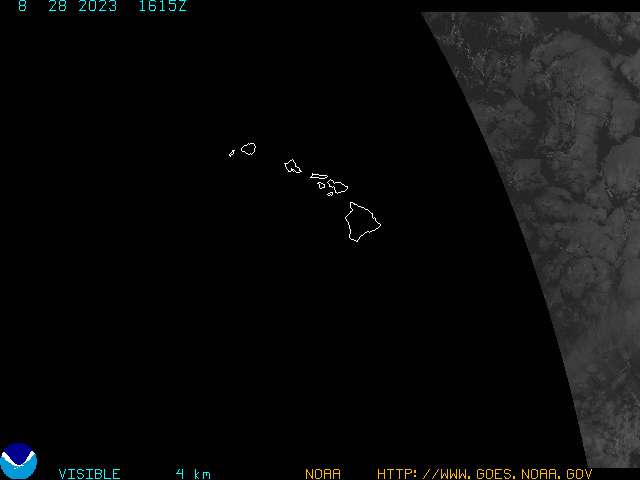

Erica Rainhart Says:
Glen, in South sky above the horizon over Hawaii- (I write from East Kauai) – are those two planets migrating West through the night?
Mahalo – I know is not exactly weather question yet inhabits the arc of sky…
Thank you for your fascinating and valuable works!
Erica~~~Hi Erica, yes they are, just as the moon rises in the east, and sets in the west…so do the stars and planets. Thanks for your positive comment, from there on the east side of Kauai! Aloha, Glenn