











December 14-15, 2009
Air Temperatures – The following maximum temperatures were recorded across the state of Hawaii Monday afternoon:
Lihue, Kauai – 78
Honolulu, Oahu – 80
Kaneohe, Oahu – 80
Kaunakakai, Molokai – 80
Kahului, Maui – 81
Hilo, Hawaii – 82
Kailua-kona – 84
Air Temperatures ranged between these warmest and coolest spots near sea level around the state – and on the highest mountains…at 5pm Monday evening:
Barking Sands, Kauai – 81F
Kapalua, Kauai – 75
Haleakala Crater – 52 (near 10,000 feet on Maui)
Mauna Kea summit – 41 (near 14,000 feet on the Big Island)
Precipitation Totals – The following numbers represent the largest precipitation totals (inches) during the last 24 hours on each of the major islands, as of Monday afternoon:
0.01 Opaekaa Stream, Kauai
0.05 Luluku, Oahu
0.00 Molokai
0.00 Lanai
0.00 Kahoolawe
0.06 Kepuni, Maui
0.07 Saddle Quarry, Big Island
Marine Winds – Here’s the latest (automatically updated) weather map showing a weak cold front approaching the islands from the northwest. Meanwhile, there’s high pressure systems to the northwest and northeast. The lighter southeast breezes will gradually become south to southwest later Tuesday into Wednesday.
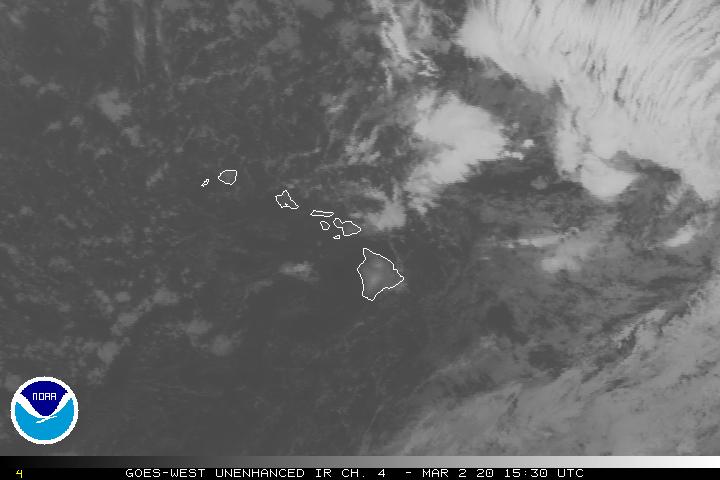
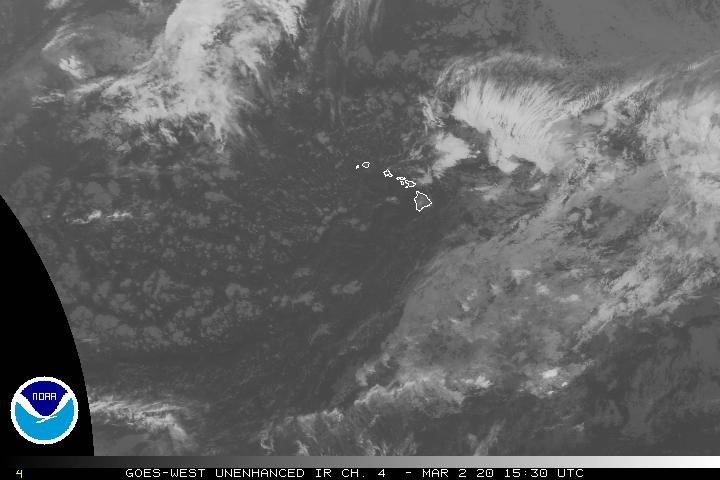
Satellite and Radar Images: To view the cloud conditions we have here in Hawaii, please use the following satellite links, starting off with this Infrared Satellite Image of the islands to see all the clouds around the state during the day and night. This next image is one that gives close images of the islands only during the daytime hours, and is referred to as a Close-up visible image. This next image shows a larger view of the Pacific…giving perspective to the wider ranging cloud patterns in the Pacific Ocean. Finally, here’s a Looping IR satellite image, making viewable the clouds around the islands 24 hours a day. To help you keep track of where any showers may be around the islands, here’s the latest animated radar image.
Hawaii’s Mountains – Here’s a link to the live webcam on the summit of near 14,000 foot Mauna Kea on the Big Island of Hawaii. The tallest peak on the island of Maui is the Haleakala Crater, which is near 10,000 feet in elevation. These two webcams are available during the daylight hours here in the islands…and when there’s a big moon rising just after sunset for an hour or two! Plus, during the nights and early mornings you will be able to see stars, and the sunrise too…depending upon weather conditions.
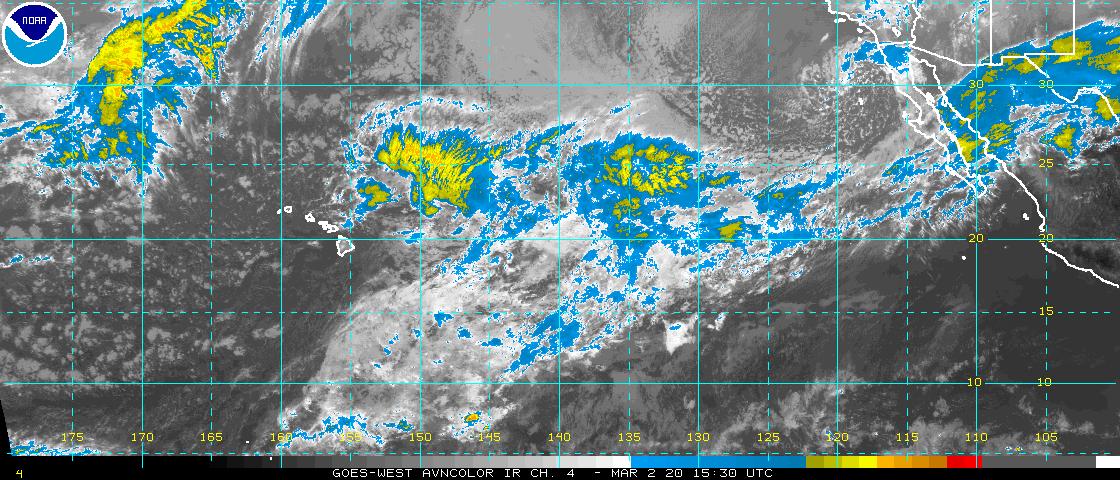
Tropical Cyclone activity in the eastern and central Pacific – Here’s the latest weather information coming out of the National Hurricane Center, covering the eastern north Pacific. You can find the latest tropical cyclone information for the central north Pacific (where Hawaii is located) by clicking on this link to the Central Pacific Hurricane Center. Here’s a tracking map covering both the eastern and central Pacific Ocean. A satellite image, which shows the entire ocean area between Hawaii and the Mexican coast…can be found here.
Aloha Paragraphs

View from Wailea…south Maui
Our overlying atmosphere remains quite dry and stable Monday night, which suggests that pleasant weather conditions will prevail through Tuesday. The winds will remain generally light through Tuesday, with some modest increase from the south and southwest later Tuesday into Wednesday. This will occur ahead of a cold front, which will be bearing down on us then. There will be a little haze here and there, especially over the southern Islands. It may become thicker, as the vog collects more fully in places with the southeast wind flow.
Satellite imagery shows a weak cold front moving towards the island of Kauai late in the day Monday. This weakening cold front may bring a few showers to Kauai, although make no further progress into the state than that…probably. A second stronger cold front is forecast to arrive around the middle of the week. This one, along with an associated upper trough of low pressure then, could bring more substantial rainfall, as it moves down through the state later Wednesday through Thursday night…into early Friday morning. In the wake of this rain bearing frontal boundary, drier air will push into the state, bringing back nice weather, although a bit on the cool side into the weekend. The upper trough, in association with the cold front, may bring a few thunderstorms to the lowlands, and a short spell of snow atop the summits on the Big Island.
The light breezes have prompted a convective weather pattern over the islands…with days starting off quite clear, and then afternoon clouds gathering over and around the mountains. There may be a few showers falling, although they will be light, and most areas will remain completely dry through Tuesday into Wednesday. Conditions will turn cloudier and wetter as a cold front arrives late Wednesday into Thursday night. The island of Kauai will receive the showers first, and perhaps most generously when it arrives…with Oahu getting wet Thursday…then Maui getting the last of the weakening cold front’s showers Thursday night. The Big Island’s chance of moisture is slim, but not completely out of the question.
As we get into later Tuesday our winds will swing around to the south and southwest Kona directions…ahead of the approaching cold front. The breezes coming into the state in the wake of the cold front, will have a tropical chill to them. Our daytime air temperatures will be a couple of degrees cooler than the air ahead of the front…with a chilly night Friday and Saturday coming up. Friday into the weekend will bring improving weather conditions, with nice weather on tap again then, with generally dry conditions taking over again.
It’s early Monday evening here on Maui, as I begin writing this last section of today’s narrative. With all the talk about a couple of cold fronts approaching, it’s about time to put a satellite picture of this stuff onboard. Here’s an image, showing the first of two fronts, along with some high cirrus cloudiness just to the south of the Big Island. As long as we’re adding pictures, we’d best put this looping radar image, so we can see whatever few showers that arrive with the cold front near Kauai…if any arrive that is! As we can see by checking out this larger view of the central Pacific, the second cold front isn’t in view just yet. ~~~ Looking out the window here in Kihei, before I head back upcountry to Kula, there’s some very light haze, but it certainly hasn’t gotten out of hand by any means…which is a good thing. ~~~ I’m quite sure that there will be still a few "shooting stars" flying around tonight, in association with the Geminid Meteor Shower…like there were last night! I’m going to be out there again, if I can pry myself out of bed, to check things out. ~~~ I’ll meet you here again early Tuesday morning, at which point I’ll have your next new weather narrative from paradise waiting. I hope you have a great Monday night until then! Aloha for now…Glenn.
Interesting: This is something that would make Lawrence of Arabia turn in his grave: Recent studies are now showing that sand, once Saudi Arabia’s most common commodity (outside of oil) is now becoming almost as scarce as water. For those who are still fascinated with the 1962 Hollywood extravaganza starring Peter O’Toole and Omar Sharif, there seemed to be an endless amount of the yellowish grainy stuff, especially when a frequent sand storm would obliterate virtually all landscapes until it blew over.
It now appears that due to the high quality of Saudi sand for building projects in Bahrain and other Persian Gulf locations sand is now becoming scarce. Scarce enough so that authorities have halted the export of tons of this material — one of the main ingredients in concrete and other building materials used in the construction of all those futuristic-looking cities that are now often seen in TV advertisements promoting tourism and business venues in these locations.
Saudi sand, being usually found in hard to get to desert areas, like Ar Rub al Khali, is expensive to transport to concrete companies, which mix it with gravel and other materials to make the high grade concrete desired for these building projects, like at Masdar City in Abu Dhabi said to be the world’s first "carbon neutral" city, and only projected to be fully completed by the year 2020.
Interesting2: The most detailed seismic images yet published of the plumbing that feeds the Yellowstone supervolcano shows a plume of hot and molten rock rising at an angle from the northwest at a depth of at least 410 miles, contradicting claims that there is no deep plume, only shallow hot rock moving like slowly boiling soup. A related University of Utah study used gravity measurements to indicate the banana-shaped magma chamber of hot and molten rock a few miles beneath Yellowstone is 20 percent larger than previously believed, so a future cataclysmic eruption could be even larger than thought.
The study’s of Yellowstone’s plume also suggests the same "hotspot" that feeds Yellowstone volcanism also triggered the Columbia River "flood basalts" that buried parts of Oregon, Washington state and Idaho with lava starting 17 million years ago. Those are key findings in four National Science Foundation-funded studies in the latest issue of the Journal of Volcanology and Geothermal Research.
The studies were led by Robert B. Smith, research professor and professor emeritus of geophysics at the University of Utah and coordinating scientist for the Yellowstone Volcano Observatory. "We have a clear image, using seismic waves from earthquakes, showing a mantle plume that extends from beneath Yellowstone,” Smith says.
The plume angles downward 150 miles to the west-northwest of Yellowstone and reaches a depth of at least 410 miles, Smith says. The study estimates the plume is mostly hot rock, with 1 percent to 2 percent molten rock in sponge-like voids within the hot rock.
Some researchers have doubted the existence of a mantle plume feeding Yellowstone, arguing instead that the area’s volcanic and hydrothermal features are fed by convection — the boiling-like rising of hot rock and sinking of cooler rock — from relatively shallow depths of only 185 miles to 250 miles.
Interesting3: An international team of scientists led by researchers at the University of Hawaii at Manoa has found no evidence supporting an extraterrestrial impact event at the onset of the Younger Dryas approximately 13,000 years ago. The Younger Dryas is an abrupt cooling event in Earth’s history. It coincided with the extinction of many large mammals including the woolly mammoth, the saber toothed jaguar and many sloths.
This cooling period is generally considered to be the result of the complex global climate system, possibly spurred on by a reduction or slowdown of the thermohaline circulation in North America. This paradigm was challenged two years ago by a group of researchers that reported finding high iridium concentrations in terrestrial sediments dated during this time period, which led them to theorize that an impact event was instead the instigator of this climate shift.
A team led by François Paquay, a Doctoral graduate student in the Department of Geology and Geophysics at the University of Hawaii at Manoa (UHM) decided to also investigate this theory, to add more evidence to what they considered a conceptually appealing theory. However, not only were they unable to replicate the results found by the other researchers, but additional lines of evidence failed to support an impact theory for the onset of the Younger Dryas. Their results will be published in the December 7th early online edition of the Proceedings of the National Academy of Sciences.
Interesting4: Vanderbilt LifeFlight is now using technology once reserved for military operations or secret spy missions. With the ability to enhance light 10,000 times, the air ambulance service’s new night vision goggles essentially turn night into day. "You can see a lit cigarette 10 miles away," said Wilson Matthews, R.N., E.M.T., chief flight nurse for LifeFlight’s base in Lebanon, Tenn., who is part of the night vision transition.
"You go from seeing nothing to seeing the texture of tree leaves." Matthews said night vision will be most useful when making scene landings because pilots and nurses will be able to see the trees, power lines, rising terrain and other hazards on the ground. "Night vision is absolutely amazing. I have been at LifeFlight since 1997, and this is the single best thing we have done to enhance safety," he said.
Because military demand had dropped, this is the first time that the goggles are available to civilian aviation operations. Three of LifeFlight’s four bases are already using night vision, and the final base should be trained by early 2010. A five-hour training program is required for pilots and nurses, and pilots have additional required hours of use in the sky, including take-off, landing, emergency procedures and transitioning between night vision and regular vision.
Night vision works by gathering ambient light from the moon, stars or distant light sources into a special tube. The tube enhances the energy level of the light and hurls the particles at a phosphorus screen that creates the amplified image seen through the eyepiece. Night vision is known for its eerie green hue. That color was chosen because the eye can differentiate more shades of green than any other color.
Interesting5: Ethanol — often promoted as a clean-burning, renewable fuel that could help wean the nation from oil — would likely worsen health problems caused by ozone, compared with gasoline, especially in winter, according to a new study led by Stanford researchers. Ozone production from both gasoline and E85, a blend of gasoline and ethanol that is 85 percent ethanol, is greater in warm sunny weather than during the cold weather and short days of winter, because heat and sunlight contribute to ozone formation.
But E85 produces different byproducts of combustion than gasoline and generates substantially more aldehydes, which are precursors to ozone. "What we found is that at the warmer temperatures, with E85, there is a slight increase in ozone compared to what gasoline would produce," said Diana Ginnebaugh, a doctoral candidate in civil and environmental engineering, who worked on the study. She will present the results of the study on Tuesday, Dec. 15, at the American Geophysical Union meeting in San Francisco.
"But even a slight increase is a concern, especially in a place like Los Angeles, because you already have episodes of high ozone that you have to be concerned about, so you don’t want any increase." But it was at colder temperatures, below freezing, that it appeared the health impacts of E85 would be felt most strongly. "We found a pretty substantial increase in ozone production from E85 at cold temperatures, relative to gasoline when emissions and atmospheric chemistry alone were considered," Ginnebaugh said.
Although ozone is generally lower under cold-temperature winter conditions, "If you switched to E85, suddenly you could have a place like Denver exceeding ozone health-effects limits and then they would have a health concern that they don’t have now." The problem with cold weather emissions arises because the catalytic converters used on vehicles have to warm up before they reach full efficiency.
So until they get warm, a larger proportion of pollutants escapes from the tailpipe into the air. There are other pollutants that would increase in the atmosphere from burning E85 instead of gasoline, some of which are irritants to eyes, throats and lungs, and can also damage crops, but the aldehydes are the biggest contributors to ozone production, as well as being carcinogenic.
 Email Glenn James: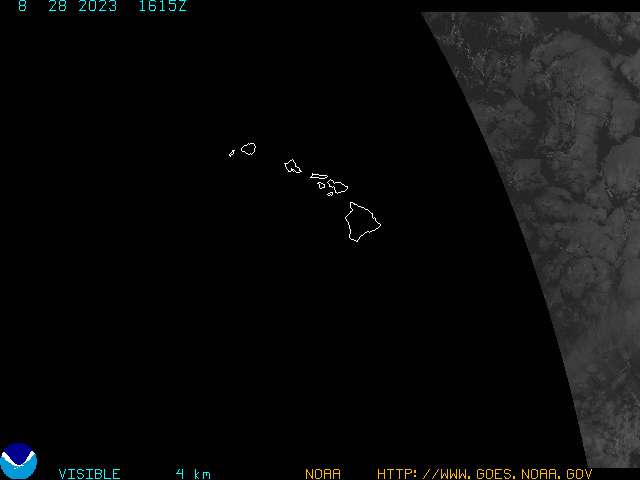

John Says:
Aloha Glenn
If there is anything that makes us look forward to our three weeks in paradise it is our weather here in Edmonton. In case you didn’t hear, on Sunday at the International Airport it was -46.1 C, (-58C with the wind chill – that’s -72 F). We were the coldest city anywhere – except maybe Siberia but I don’t know if there are cities in Siberia. Thank God for heated seats in cars! We come to Maui in Late January but obviously are wishing it was NOW.
Have a great Christmas and and wonderful New Year.~~~Hi John, brrrr is an understatement! That would be a novelty to experience such cold temperatures, but I’m that would get old very fast. Glad to know that you will be taking a break in January, coming to the warmth provided by our tropical paradise…have fun! Thanks for your holiday wishes, same to you and yours. Aloha, Glenn