











December 13-14, 2009
Air Temperatures – The following maximum temperatures were recorded across the state of Hawaii Sunday afternoon:
Lihue, Kauai – 79
Honolulu, Oahu – 81
Kaneohe, Oahu – 79
Kaunakakai, Molokai – 82
Kahului, Maui – 83
Hilo, Hawaii – 80
Kailua-kona – 84
Air Temperatures ranged between these warmest and coolest spots near sea level around the state – and on the highest mountains…at 5pm Sunday evening:
Port Allen, Kauai – 82F
Princeville, Kauai – 75
Haleakala Crater – 55 (near 10,000 feet on Maui)
Mauna Kea summit – 43 (near 14,000 feet on the Big Island)
Precipitation Totals – The following numbers represent the largest precipitation totals (inches) during the last 24 hours on each of the major islands, as of Sunday afternoon:
0.01 Anahola, Kauai
0.01 Kahuku, Oahu
0.00 Molokai
0.00 Lanai
0.00 Kahoolawe
0.05 Kepuni, Maui
0.30 Hilo airport, Big Island
Marine Winds – Here’s the latest (automatically updated) weather map showing a weak cold front approaching the island from the northwest. Meanwhile, there’s high pressure systems to the northwest and northeast. The lighter southeast breezes will prevail Monday, gradually becoming south to southwest Tuesday.
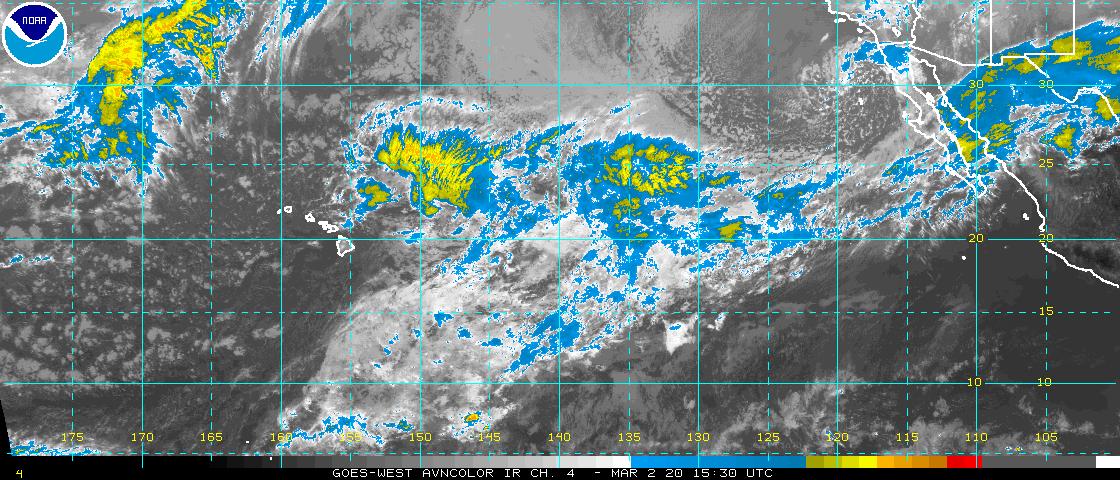
Satellite and Radar Images: To view the cloud conditions we have here in Hawaii, please use the following satellite links, starting off with this Infrared Satellite Image of the islands to see all the clouds around the state during the day and night. This next image is one that gives close images of the islands only during the daytime hours, and is referred to as a Close-up visible image. This next image shows a larger view of the Pacific…giving perspective to the wider ranging cloud patterns in the Pacific Ocean. Finally, here’s a Looping IR satellite image, making viewable the clouds around the islands 24 hours a day. To help you keep track of where any showers may be around the islands, here’s the latest animated radar image.
Hawaii’s Mountains – Here’s a link to the live webcam on the summit of near 14,000 foot Mauna Kea on the Big Island of Hawaii. The tallest peak on the island of Maui is the Haleakala Crater, which is near 10,000 feet in elevation. These two webcams are available during the daylight hours here in the islands…and when there’s a big moon rising just after sunset for an hour or two! Plus, during the nights and early mornings you will be able to see stars, and the sunrise too…depending upon weather conditions.
Tropical Cyclone activity in the eastern and central Pacific – Here’s the latest weather information coming out of the National Hurricane Center, covering the eastern north Pacific. You can find the latest tropical cyclone information for the central north Pacific (where Hawaii is located) by clicking on this link to the Central Pacific Hurricane Center. Here’s a tracking map covering both the eastern and central Pacific Ocean. A satellite image, which shows the entire ocean area between Hawaii and the Mexican coast…can be found here.
Aloha Paragraphs

The cliffs on the Napali coast…Kauai
More great weather is expected through the first couple of days of the new work week ahead. Our overlying atmosphere remains dry and stable Sunday night…which suggests that very pleasant weather conditions will prevail. The winds will remain generally light through Monday, with some increase from the south and southwest later Tuesday into Wednesday. The atmosphere will gradually become more hazy, as is already beginning to show up in some locations now. It may become thicker over the next couple of days, as the vog collects locally.
Weather maps show a weak cold front edging towards Kauai Monday, although it will stall before arriving…leaving the state in dry weather. A second stronger cold front is forecast to arrive around the middle of the new week ahead. This one, along with an associated upper trough of low pressure then, could bring more substantial rainfall…as it moves down through the state through later later Wednesday through Thursday night. In the wake of this rain bearing frontal boundary, drier air will flood into the state, bringing back nice weather, although a bit on the cool side. The upper trough in assocation with the cold front may bring a short spell of snow atop the summits on the Big Island. The latest model output suggest stronger southwest to west winds arriving behind the cold front…we’ll have to wait until Monday or Tuesday for clarification on the conflicting model forecasts.
Our days will start off quite clear, with afternoon clouds gathering over and around the mountains. There may be a few showers falling, although they will be light, and most areas will remain completely dry through Tuesday. Things will turn cloudier, windier, and wetter as a cold front ushers in inclement weather beginning Wednesday-Thursday. The island of Kauai will receive the showers first, and perhaps most generously on Wednesday, with Oahu during the night, Maui Thursday morning…then the Big Island will get the last of the weakening cold front’s showers Thursday evening or night.
As I mentioned above, our weather will remain favorably inclined for a couple more days. The winds are light enough now, that a convective weather pattern has developed, characterized by cool and clear mornings, leading to cloudy periods over the mountains during the afternoons. Those clouds will have little luck in dropping any showers though, with generally dry weather continuing into Tuesday. As we get into the later Tuesday time period, our winds will swing around to the south and southwest Kona directions…ahead of the approaching cold front. They will be most breezy perhaps atop the mountains, especially on the Big Island and maybe the Haleakala Crater on Maui. Wednesday will begin the wet weather, which will end later Thursday. Friday should begin an improvement, with nice weather on tap again then, heading into next weekend.
It’s Sunday evening here on Maui, as I begin writing this last section of today’s narrative. Sunday turned out just about like expected, with a lovely clear morning giving way to cloudiness during the afternoon hours…along with increased volcanic haze (vog) during the day. It’s still cloudy at sunset, with light to almost moderately thick haze. I’m quite sure that the clouds will collapse soon, giving way to generally clear skies, at least I’m hoping so…so we can witness the Geminid Meteor Shower tonight! It appears that we’ll have a repeat performance of today’s weather, again on Monday. So, if you can, get to the beaches during the morning hours, before the light winds, and daytime heating prompt afternoon clouds. I’ll be back with you again early Monday morning, I hope you have a great Sunday night until then! Aloha for now…Glenn.
Extra: Tonight will be the peak of the famous Geminid Meteor Shower…here’s a link for information. It’s expected to be a special one this time around!
Interesting: Observers were able to accurately judge some aspects of a stranger’s personality from looking at photographs, according to a study in the current issue of Personality and Social Psychology Bulletin (PSBP), the official monthly journal of the Society for Personality and Social Psychology. Self-esteem, ratings of extraversion and religiosity were correctly judged from physical appearance.
Researchers asked participants to assess the personalities of strangers based first on a photograph posed to the researchers’ specifications and then on a photograph posed the way the subject chose. Those judgments were then compared with how the person and acquaintances rated that individual’s personality.
They found that while both poses provided participants with accurate cues about personality, the spontaneous pose showed more insight, including about the subject’s agreeableness, emotional stability, openness, likability, and loneliness. The study suggested that physical appearance alone can send signals about their true personality.
Interesting2: The gases which formed the Earth’s atmosphere — and probably its oceans — did not come from inside the Earth but from outer space, according to a study by University of Manchester and University of Houston scientists. The report published in the journal Science means that textbook images of ancient Earth with huge volcanoes spewing gas into the atmosphere will have to be rethought.
According to the team, the age-old view that volcanoes were the source of the Earth’s earliest atmosphere must be put to rest. Using world-leading analytical techniques, the team of Dr Greg Holland, Dr Martin Cassidy and Professor Chris Ballentine tested volcanic gases to uncover the new evidence. The research was funded by Natural Environment Research Council (NERC).
"We found a clear meteorite signature in volcanic gases," said Dr Greg Holland the project’s lead scientist. "From that we now know that the volcanic gases could not have contributed in any significant way to the Earth’s atmosphere. "Therefore the atmosphere and oceans must have come from somewhere else, possibly from a late bombardment of gas and water rich materials similar to comets.
"Until now, no one has had instruments capable of looking for these subtle signatures in samples from inside the Earth — but now we can do exactly that." The techniques enabled the team to measure tiny quantities of the un-reactive volcanic trace gases Krypton and Xenon, which revealed an isotopic ‘fingerprint’ matching that of meteorites which is different from that of ‘solar’ gases.
The study is also the first to establish the precise composition of the Krypton present in the Earth’s mantle. Project director Prof Chris Ballentine of The University of Manchester, said: "Many people have seen artist’s impressions of the primordial Earth with huge volcanoes in the background spewing gas to form the atmosphere. "We will now have to redraw this picture."
Interesting3: The massive iceberg that has been headed toward Australia’s southwest coast has prompted authorities to issue a shipping alert. The massive ice chunk, named B17B, is about 1,000 miles from Australia’s southwest coast and is reportedly drifting northward with the wind and current. The iceberg is one of several that broke off of Antarctic ice shelves nearly a decade ago and is estimated to be twice the size of Manhattan.
As the iceberg moves northward, relatively warmer water (50F degrees) will likely cause the iceberg to break up into hundreds of smaller pieces, which could be hazardous to ships. The Australian Bureau of Meteorology issued a shipping alert Friday.
Interesesting4: The picture on many milk cartons shows cows grazing on a pasture next to a country barn and a silo — but the reality is very different. More and more milk comes from confined animal feeding operations (CAFOs), where large herds live in feedlots, awaiting their thrice-daily trip to the milking barn.
A factory farm with 2,000 cows produces as much sewage as a small city, yet there’s no treatment plant. Across the country, big dairies are coming under increased criticism for polluting the air and the water. In New Mexico, they’re in the midst of a manure war. Everyday, an average cow produces six to seven gallons of milk and 18 gallons of manure. New Mexico has 300,000 milk cows.
That totals 5.4 million gallons of manure in the state every day. It’s enough to fill up nine Olympic-size pools. The New Mexico Environment Department reports that two-thirds of the state’s 150 dairies are contaminating groundwater with excess nitrogen from cattle excrement. Either the waste lagoons are leaking, or manure is being applied too heavily on farmland.
Interesting5: People paid by the hour exhibit a stronger relationship between income and happiness, according to a study published in the current issue of Personality and Social Psychology Bulletin (PSPB), the official journal of the Society for Personality and Social Psychology. Researchers explored the relationship between income and happiness by focusing on the organizational arrangements that make the connection between time and money. They found that the way in which an employee is paid is tied to their feeling of happiness.
The researchers theorize that hourly wage-earners focus more attention on their pay than those who earn a salary. That concrete, consistent focus on the worth of the employee’s time in each paycheck influences the level of happiness the employee feels.
"Much of our day-to-day lives are subject to various organizational practices of payment that can prime different ways of thinking, such as the monetary value of one’s time," write authors Sanford E. DeVoe of the University of Toronto and Jeffrey Pfeffer of Stanford University. "It is important to consider the broader context in which people live and work in order to gain a better understanding of the determinants of happiness."
Interesting6: The movement towards zero emission electric cars is gaining a tremendous amount of momentum. As we move into 2010, practical electric vehicles for the vast majority of the public will be available late in the year with the release of the Nissan Leaf. If you plan to purchase an electric car in 2010, you can expect a healthy federal income tax credit to reward you.
For plug-in electric vehicles with a gross vehicle weight of less than 14,000 pounds acquired after December 31, 2009, the maximum tax credit available will be $7,500. The base amount of the credit is $2,500. If the car has a battery capacity of at least 5kWh, then an additional $417 in tax credits will be available.
For every kWh of battery capacity in excess of 5kWh, $417 will be added to the total amount. The additional amount, based on battery capacity, over the base amount is limited to a total of $5,000. If you buy an electric car, charging it will be an obvious concern.
Thanks to the Recovery Act, money has been allocated to build the necessary infrastructure in limited markets to support the growth of the electric vehicle. If you spend money putting in a charger, there is a 30% tax credit on the amount spent. The total credit amount is limited to $30,000 for commercial/retail installations and $1,000 for homeowners, and is set to sunset at the end of 2010.
Interesting7: Long, long ago, some of the first dinosaurs walked the Earth. But scientists have not known with any confidence where those initial dino prints were made. Much more recently, hikers stumbled across a few bits of bone at Ghost Ranch in New Mexico, leading to the discovery of a game-changing dinosaur that reveals where it all began.
The dinosaur, now called Tawa hallae, had a body that was only the size of a medium to large dog, but its remains have helped scientists shore up where dinosaurs came from. The research team used the extremely well-preserved and complete skeletal remains as a means to fitting the newbie and other early dinosaurs onto the evolutionary tree.
"[The results] showed a lot of the South American dinosaurs in the Triassic were the most primitive dinosaurs we have found to date," said lead researcher Sterling Nesbitt of the University of Texas at Austin. "They are closest to the common ancestor of all dinosaurs." (Nesbitt was at the American Museum of Natural History in New York when he made the discovery.)
The upshot: the earliest dinosaurs originated and diverged in what is now South America before trekking across the globe more than 220 million years ago when the continents were assembled into one gargantuan landmass called Pangea. Nesbitt and his colleagues describe the dinosaur in the Dec. 11 issue of the journal Science. Their analyses suggest T. hallae lived some 213 million years ago and was a primitive theropod (mostly carnivorous dinosaur that walked on two legs).
Like Velociraptor, the dinosaur was likely covered with feather-like structures and sported claws and serrated teeth for snagging prey. After the hikers stumbled upon the dinosaur quarry in 2004, scientists excavated the area in northern New Mexico. They uncovered five to seven partial skeletons belonging to T. hallae species buried together in a relatively small pocket among a jumble of tens of thousands of other fossils.
The excavated skeletons suggest this species had a snout-to-tail tip length of about 6 to 13 feet, with a hip height of 3 to 5 feet. The bones suggested that when alive, T. hallae was equipped with air sacs surrounding its neck and braincase — features found in birds today. To find out how T. hallae was related to other early theropods and how the animal came to its North American resting place, the researchers compared T. hallae with other dinosaurs.
"If you have continents splitting apart, you get isolation," Nesbitt said. "So when barriers develop, you would expect that multiple carnivorous dinosaurs in a region should represent a closely related endemic radiation. But that is what we don’t see in early dinosaur evolution." Rather, in the Ghost Ranch sediments they found three carnivorous dinosaur species, including T. hallae, that were only distantly related.
"This implies that each carnivorous dinosaur species descended from a separate lineage before arriving in [the part of Pangea that is now] North America, instead of all evolving from a local ancestor," said study researcher Randall Irmis of the Utah Museum of Natural History and the University of Utah. That wouldn’t be surprising, since the giants were free to roam at the time.
"[Dinosaurs] could essentially walk from pretty far south in the Southern Hemisphere to pretty far north in the Northern Hemisphere," Nesbitt told LiveScience. The team then looked at a variety of reptile groups to see if other animals were wandering across the still-connected continents during the Late Triassic period (about 225 million years ago).
And just like the early theropods, such reptiles were indeed making multiple trips between what are now North and South America, the researchers speculate. This free movement of animals at the time means there were no physical barriers, such as large mountain ranges, hemming dinosaurs and others in to certain parts of Pangea.
But this presents a seeming paradox. "We wondered," Irmis said, "if reptiles, including dinosaurs, were able to freely move around Pangea during the Late Triassic, then why aren’t there any sauropodomorph and ornithischian dinosaurs in North America during the Triassic?" They think the answer is climate. For some reason, only the carnivorous dinosaurs found temperatures in North America to be hospitable, the researchers suggest.
 Email Glenn James: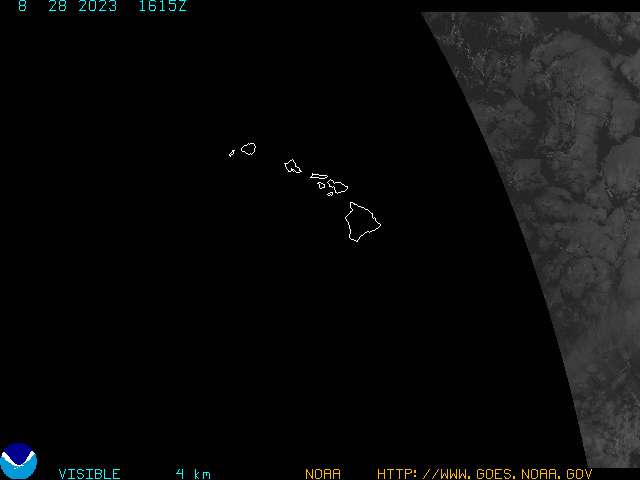

Nancy Says:
Ahh, Glenn, I haven’t been to Maui since ’06. I miss Mana’o radio, Mana Foods, Hana and the Upcountry, but reading your narrative brings back memories and makes me feel better!
Nancy~~~Thanks for writing Nancy, I can see you have such fond memories of your time here on Maui, three years ago. It’s such a great place to visit and live. Happy Holiday’s to you and yours this Christmas…and for 2010 too! Aloha, Glenn
myrtle Says:
Hi Glenn — Thanks for the heads-up on the Geminid meteor shower tonight. Myrtle~~~Hi Myrtle, you’re welcome, hope you can find a dark viewing place in your backyard…to see a few “shooting stars” Aloha, Glenn