











December 10-11, 2009
Air Temperatures – The following maximum temperatures were recorded across the state of Hawaii Thursday afternoon:
Lihue, Kauai – 77
Honolulu, Oahu – 82
Kaneohe, Oahu – 80
Kaunakakai, Molokai – 80
Kahului, Maui – 82
Hilo, Hawaii – 81
Kailua-kona – 83
Air Temperatures ranged between these warmest and coolest spots near sea level around the state – and on the highest mountains…at 5pm Thursday evening:
Kailua-kona – 79F
Lihue, Kauai – 74
Haleakala Crater – 50 (near 10,000 feet on Maui)
Mauna Kea summit – 43 (near 14,000 feet on the Big Island)
Precipitation Totals – The following numbers represent the largest precipitation totals (inches) during the last 24 hours on each of the major islands, as of Thursday afternoon:
0.02 Poipu, Kauai
0.01 Kahuku, Oahu
0.00 Molokai
0.00 Lanai
0.00 Kahoolawe
0.00 Maui
0.01 Mountain View, Big Island
Marine Winds – Here’s the latest (automatically updated) weather map showing a weak 1018 millibar high pressure system to our east, with another weak 1017 millibar cell to the northwest…moving into the area north of us. The combination, with their associated ridges, will keep the light to moderately strong trade winds around for the time being. Their appearance will be brief at best…as the cold front shifts the ridge down over us, or close by again this weekend.
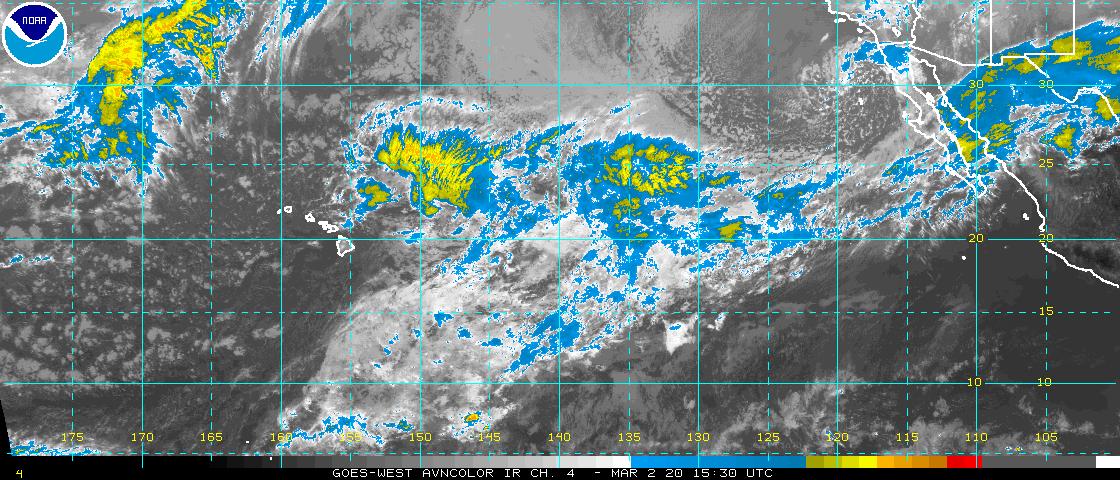
Satellite and Radar Images: To view the cloud conditions we have here in Hawaii, please use the following satellite links, starting off with this Infrared Satellite Image of the islands to see all the clouds around the state during the day and night. This next image is one that gives close images of the islands only during the daytime hours, and is referred to as a Close-up visible image. This next image shows a larger view of the Pacific…giving perspective to the wider ranging cloud patterns in the Pacific Ocean. Finally, here’s a Looping IR satellite image, making viewable the clouds around the islands 24 hours a day. To help you keep track of where any showers may be around the islands, here’s the latest animated radar image.
Hawaii’s Mountains – Here’s a link to the live webcam on the summit of near 14,000 foot Mauna Kea on the Big Island of Hawaii. The tallest peak on the island of Maui is the Haleakala Crater, which is near 10,000 feet in elevation. These two webcams are available during the daylight hours here in the islands…and when there’s a big moon rising just after sunset for an hour or two! Plus, during the nights and early mornings you will be able to see stars, and the sunrise too…depending upon weather conditions.
Tropical Cyclone activity in the eastern and central Pacific – Here’s the latest weather information coming out of the National Hurricane Center, covering the eastern north Pacific. You can find the latest tropical cyclone information for the central north Pacific (where Hawaii is located) by clicking on this link to the Central Pacific Hurricane Center. Here’s a tracking map covering both the eastern and central Pacific Ocean. A satellite image, which shows the entire ocean area between Hawaii and the Mexican coast…can be found here.
Aloha Paragraphs

Great weather continues in the islands!
Generally dry weather is expected through the rest of this week…with warm sunny to partly cloudy days. Our overlying atmosphere remains dry and stable now…which suggests that very pleasant weather conditions will prevail well into the future. As the trade winds return briefly now through Friday into Saturday morning, we may see a few minor windward biased showers…while the leeward beaches remain totally dry. Daytime temperatures at sea level will be in the upper 70F’s, reaching into the lower 80’s, with overnight lows mostly in the 60’s to lower 70’s.
There are no cold fronts scheduled to arrive here in the islands through Tuesday of next week. The north Pacific Ocean will continue to have gale and storm low pressure systems racing by, although their associated cold fronts will stay north of Hawaii through this period. The computer models are hinting at finally having a cold front bringing some showers around the middle of next week. A couple of cold fronts before that will move by close to the islands, but not reach us. They will however keep our local winds light, and could eventually bring volcanic haze (vog) to the islands.
The large northwest swell, breaking on the north and west shores, is lowering in size now…so that the high surf advisory has been dropped Thursday afternoon. The next northwest swell will arrive early this weekend, with another NW swell coming our way later next Monday into Tuesday. The east sides will see some wrap from these waves, so those beaches will be somewhat larger than normal. The south shores will be very small to near flat in contrast…making them good places for a casual swim or snorkeling. Sea water temperatures are running about 77F degrees now, amply warm for a great ocean experience.
The last several days have been exceptionally nice, with nearly cloud free skies the rule for the most part. As the islands are surrounded by a warm ocean, it’s almost impossible to not have a couple of clouds in sight somewhere though. The mornings will be clear, while the afternoon hours will have some clouds forming over the mountains at times. As the trade winds get a brief lift in strength this evening into early Saturday morning, there will be a few clouds riding in along the north and east facing slopes at times. The main thing though, is that showers will be at a minimum. This pleasant weather pattern will persist, staying with us right on through the upcoming weekend. Next week will have cold fronts trying to stretch into our area, perhaps getting close to Kauai at times. As noted above, one of these shower bearing fronts will finally be able to push into the state…around the middle of next week.
It’s early Friday evening here on Maui, as I begin writing this last section of today’s narrative. Near perfect weather continues here in the Hawaiian Islands, and the extra large surf that we saw recently…is fading away. The trade winds are back, having started off quite light today, they should pick up some on Friday. All things considered, we’re having about as good weather as we could hope for this time of year! Looking out the window here in Kihei before I leave for the drive back upcountry to Kula, I see more clear skies than I do clouds. Most of those dry clouds are hovering over and around the West Maui Mountains, and along the slopes of the Haleakala Crater. As the trade winds have returned, our early morning temperatures, at least at sea level locations, will be warming up a few degrees, as will our daytime temperatures too. I’ll be back with your next new weather narrative early Friday morning. I hope you have a great Thursday night until then! Aloha for now…Glenn.
Extra:
There’s a new website, openhazards.com, by a group of earthquake experts that claims to be able to forecast the chance of earthquakes anywhere in the world.
Interesting: It may not sound like "tree-hugging," but cutting down a real tree for Christmas is actually greener than going with the artificial kind. "It is a little counterintuitive to people," said Clint Springer, a biologist at Saint Joseph’s University in Philadelphia. Because of concerns over deforestation around the world, many people naturally worry that buying a real tree might contribute to that problem, Springer says.
But most Christmas trees for sale these days are grown not in the forest but on tree farms, for the express purpose of being cut. Moreover, from a greenhouse gas perspective, real trees are "the obvious choice". Live trees actively photosynthesize as they grow from saplings…which removes carbon dioxide from the atmosphere. The tree farms that grew the trees also replant after the trees are cut.
Artificial trees, on the other hand, don’t come out even in the carbon balance. Petroleum is used to make the plastics in the trees and lots of carbon dioxide-creating energy is required to make and transport them.
Interesting2: As the world grows warmer, some fish may stop acting like themselves. With a small rise in temperature, a new study found, some fish become more daring and more aggressive than they would otherwise be. The finding suggests that climate change could put fish in peril in unexpected ways. "The fact that big effects on behavior were happening over the course of just a couple degrees surprised me," said Peter Biro, a fish ecologist and evolutionary biologist at the University of New South Wales in Sydney, Australia.
"I would have never expected that from the things I had read in the literature." Biro stumbled on the discovery by accident. He was working with damselfish in an indoor lab that naturally got warmer over the course of a day. His original goal was to study personality traits in the fish.
But as the lab heated up every day, he noticed some fish becoming more active, aggressive and bold. To figure out what was behind their personality transformations, Biro and colleagues put 30 young damselfish in individual aquaria. All fish were the same size and the same age, and the researchers gave them as much food as they wanted so that hunger wouldn’t affect their behavior.
Then came the personality tests. To measure boldness, Biro used what he calls "the scary test." First, he shoved a wooden stick into each fish’s tank, sending it into hiding. When he removed the stick, he timed how long it took for the fish to emerge from their shelters.
In a test of aggressiveness, each fish was placed near a jar that contained another fish. Scientists then watched to see how frequently the fish tried to attack or scare their intruders. To gauge activity levels, the researchers simply counted how many times each fish crossed the center of its aquarium over two minutes.
Interesting3: Hillside Farmers Co-op. in Northfield, Minnesota, initiated by Latino immigrants, raises free-range chickens on scattered small, one-quarter acre sites. This makes it a great model for urban farmers as well as rural. By staying small, co-op leader, Regi Haslett-Marroquin told me, Latino farmers will be able to start a farm even though they have very little capital to work with.
In just a few weeks, each farm can sell about a thousand chickens. That quick turnaround will be key to building savings. Over time, it will allow farmers to make more expansive choices in the future, he says – perhaps to buy their own land, or to start supportive businesses in the region.
By keeping each production unit small and family-sized, Marroquin believes, farmers can have a great deal of independence, and the network of small producers can more easily respond to changing market conditions. Start-up costs are relatively small. The Co-op has designed simple chicken barns, framed from wood and covered with plastic sheets that provide shelter for the birds from spring through fall.
Each barn has large doors through which young chicks can stroll at will – and do so, because their feed is outside. Hillside Co-op’s chickens "work out" every day (they are not raised in winter).
Running through fields, pulling sprouted barley grass out of the ground, and searching out organic grains to eat from scattered feeding stations, the chicks build muscle tone. This is a marked contrast to industrial farms in which so-called "free-range" chickens are raised. In those confined operations, there may be a small door for chickens to use to walk outside, but few of the birds even realize they have that choice.
Interesting4: Mild weather that has been dominating Europe during so far this month will yield to a blast of harsh wintry cold early next week. Temperatures during next week as a whole will slide well below normal, 10 degrees and more in some instances, over a wide swathe of Scandinavia to Poland, Germany, France and even the United Kingdom. Cities such as London, Prague and Moscow will likely see their coldest weather all year.
Along with the cold will erupt outbreaks of snow which could be heavy enough to disrupt ground and air transportation. Strong high pressure centered near Iceland will trigger the cold wave as it will drive frigid air southwestward out of arctic Europe and into the heart of the continent.
Interesting5: The National Science Foundation has picked Maui’s Haleakala mountaintop as the site for the world’s largest solar optical telescope. The federal agency picked the dormant volcano last week and announced the choice Tuesday in the Federal Register.
The $300 million project is due to be built on a half-acre among a cluster of observatories near Haleakala’s summit. It will enable scientists to observe sunspots, flares and other phenomena too small to be seen with current equipment.
Backers say the telescope would advance understanding of the sun. Opponents say it would defile a place sacred to Native Hawaiians. The state Board of Land and Natural Resources must approve the project.
 Email Glenn James: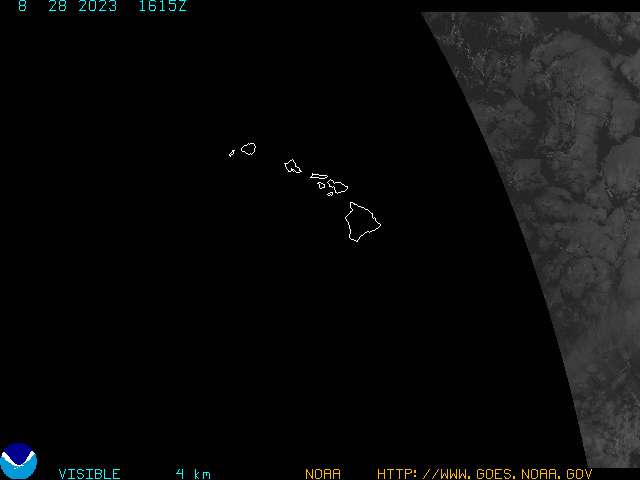

SUSAN K. Says:
Hey Glenn, Does Friday come sooner on Maui than the mainland? But you woke up by the end of the narrative, and realized it was Thursday—but you had me all excited there for a moment. We believe every word you give us!!!Mahalo, Susan~~~Hi Susan, I’m a little confused about what you wrote, it sounds like maybe I thought it was Friday in some writing I did…but it’s only Thursday? Anyway, always nice to hear from you. Aloha, Glenn
butch Says:
Aloha Glen, Thanks for the great reporting, we love your site!!!! I saw a link the other day to a slide show of waves @ Jaws. Do you still have that link and will you be kind enough to send it to me PLEASE !!!!!
Many mahalos’ Keep up your great service, many of us boat people appreciate your work.
peace & love Butch~~~Hi Butch, thanks for your positive feedback on my website! As for that slide show, here’s the URL you are referring to: http://www.flickr.com/photos/schultzdave/sets/72157622956461982/show/ – Aloha, Glenn
Mark Says:
Hi Glenn,
Any early Christmas forecast yet?~~~Too early Mark…Aloha, Glenn