











December 1-2, 2009
Air Temperatures – The following maximum temperatures were recorded across the state of Hawaii Tuesday afternoon:
Lihue, Kauai – 78
Honolulu, Oahu – 82
Kaneohe, Oahu – 79
Kaunakakai, Molokai – 82
Kahului, Maui – 83
Hilo, Hawaii – 80
Kailua-kona – 82
Air Temperatures ranged between these warmest and coolest spots near sea level around the state – and on the highest mountains…at 5pm Tuesday evening:
Honolulu, Oahu – 81F
Lihue, Kauai – 75
Haleakala Crater – 46 (near 10,000 feet on Maui)
Mauna Kea summit – 41 (near 14,000 feet on the Big Island)
Precipitation Totals – The following numbers represent the largest precipitation totals (inches) during the last 24 hours on each of the major islands, as of Tuesday afternoon:
0.05 Mount Waialaele, Kauai
1.24 Oahu Forest NWR, Oahu
0.30 Molokai
0.10 Lanai
0.00 Kahoolawe
0.48 Puu Kukui, Maui
1.08 Mountain View, Big Island
Marine Winds – Here’s the latest (automatically updated) weather map showing a 1020 millibar high pressure system far to the northeast of the islands. Winds will become light and variable…gradually becoming south to southwest Thursday.
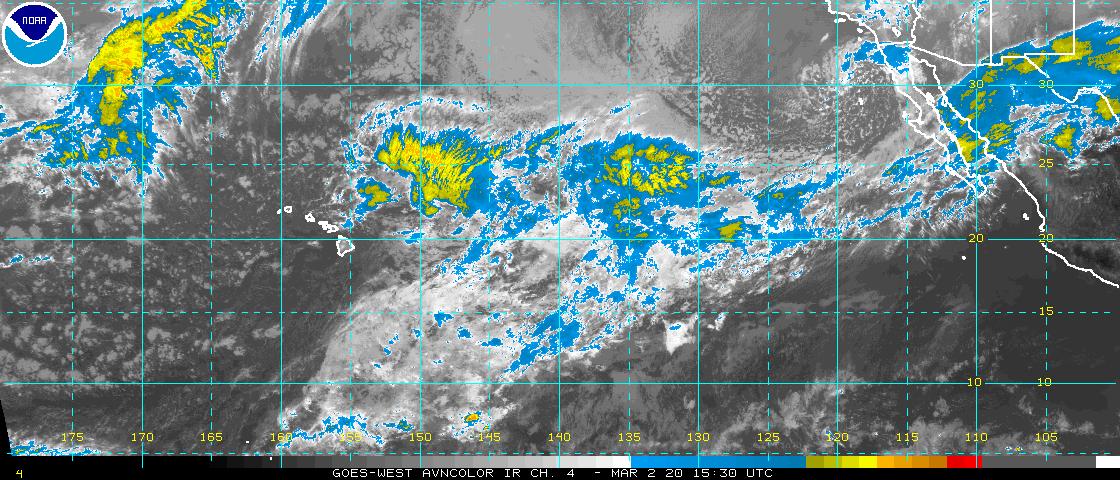
Satellite and Radar Images: To view the cloud conditions we have here in Hawaii, please use the following satellite links, starting off with this Infrared Satellite Image of the islands to see all the clouds around the state during the day and night. This next image is one that gives close images of the islands only during the daytime hours, and is referred to as a Close-up visible image. This next image shows a larger view of the Pacific…giving perspective to the wider ranging cloud patterns in the Pacific Ocean. Finally, here’s a Looping IR satellite image, making viewable the clouds around the islands 24 hours a day. To help you keep track of where any showers may be around the islands, here’s the latest animated radar image.
Hawaii’s Mountains – Here’s a link to the live webcam on the summit of near 14,000 foot Mauna Kea on the Big Island of Hawaii. The tallest peak on the island of Maui is the Haleakala Crater, which is near 10,000 feet in elevation. These two webcams are available during the daylight hours here in the islands…and when there’s a big moon rising just after sunset for an hour or two! Plus, during the nights and early mornings you will be able to see stars, and the sunrise too…depending upon weather conditions.
Tropical Cyclone activity in the eastern and central Pacific – Here’s the latest weather information coming out of the National Hurricane Center, covering the eastern north Pacific. You can find the latest tropical cyclone information for the central north Pacific (where Hawaii is located) by clicking on this link to the Central Pacific Hurricane Center. Here’s a tracking map covering both the eastern and central Pacific Ocean. A satellite image, which shows the entire ocean area between Hawaii and the Mexican coast…can be found here.
Aloha Paragraphs

The beauty of our Big Island
We’re now moving into a light and variable wind condition…followed by strengthening south to southwest Kona winds Thursday. This new wind pattern is being caused by a cold front, which will stall before arriving at mid-week. As this cold front gets going again, and pushes our high pressure ridge down southeast of the islands, our winds will turn south and southwest…from the Kona direction Thursday. Winds may come in briefly from the north or northeast behind the cold front, which pushes into the state Friday. A second cold front will turn our winds again to the south and southwest by Sunday…ahead of this cloud bands arrival on Monday of next week.
A light winded convective weather pattern will turn our mornings cooler, with afternoon interior clouds…but only a few showers for a day or two. Then, as we move into Thursday, our winds will become Kona in direction (south and southwest), as an active Pacific cold front moves in our direction from the northwest…as noted above. This cold front will bring some rain to our islands Friday. The computer models suggest that rather than passing all the way through the island chain, it will stall and settle into the area around Maui or the Big Island on Saturday, perhaps into Sunday. The Kona winds ahead of the next cold front, may bring some pre-frontal showers to the islands Sunday.
The parent low pressure systems for these cold fronts, will be deep storms this time of year…which will also send us large northwest swells. We’ll see these winter-like swells arriving every 2-3 days, with high surf advisory flags going up each time. The next couple of these swells will qualify as large, although we will have to wait until late this coming weekend…for an extra large swell train of waves to arrive. The storm that will generate this giant swell, will have hurricane force winds revolving around its center, pointed in our direction by Friday. These swells will be something to photograph, but most of us will need to stay out of the ocean on the north and west facing beaches while they’re breaking. My advice would be to head to the south, or even east facing beaches, where swimming conditions will be much more user friendly!
It’s early Tuesday evening here on Maui, as I begin writing this last section of today’s narrative. It’s been a relatively quiet day here in the islands Tuesday, with much lighter winds in most places…compared to the last several days. What clouds that formed over our islands, were generally restricted to the upcountry interior sections during the afternoon hours. Wednesday will be another similiar day, starting off with chilly morning temperatures, before the warm sunshine brings back our tropical reality soon thereafter. ~~~ As I was saying this morning, let’s not forget to check out that December full moon tonight, which occurs here in the islands at 931pm. We have a second full moon this month, a blue moon that will be with us on December 31st! ~~~ I’m just about ready to take the drive back upcountry, home to Kula from Kihei. I may be leaving with enough time to get back up there before dark. I always enjoy taking a walk upon arriving home, especially when its still light enough to see. It will certainly be a moon light filled night, as you will see the moon beams flooding through your windows while in bed! I hope you have a great Tuesday night, and that you will join me here again on Wednesday! Aloha for now…Glenn.
Extra: Cute kitten play
Interesting: In a memo sent on November 20, US Forest Service Chief Tom Tidwell told his regional offices and station directors that "responding to the challenges of climate change in providing water and water-related ecosystem services is one of the most urgent tasks facing us as an agency. History will judge us by how well we respond to these challenges." Referring to how the challenge will alter future forestry management, Tidwell said that “Climate change is dramatically reshaping how we will deliver on our mission of sustaining the health, diversity, and productivity of the Nation’s forests and grasslands for present and future generations."
Tidwell’s memo follows up on the strategic framework for responding to climate change released last month, and seeks to integrate that framework into the agency’s day-to-day operations. Tidwell has proposed dividing the country into five planning regions, asking his managers and area directors to work together to create "aggressive and well-coordinated" area-specific action plans for landscape conservation. Much of the planning work is already underway, but Tidwell is urging his agency to expand their work into "full blown regions, stations and area action plans" addressing water as "fundamental outcome set."
Interesting2: The Naval Research Laboratory’s Ion Tiger, a hydrogen-powered fuel cell unmanned air vehicle (UAV), has flown 26 hours and 1 minute carrying a 5-pound payload, setting another unofficial flight endurance record for a fuel-cell powered flight. The test flight took place on November 16th through 17th. The electric fuel cell propulsion system onboard the Ion Tiger has the low noise and signature of a battery-powered UAV, while taking advantage of hydrogen, a high-energy fuel. Fuel cells create an electrical current when they convert hydrogen and oxygen into water and heat.
The 550 Watt (0.75 horsepower) fuel cell onboard the Ion Tiger has about four times the efficiency of a comparable internal combustion engine and the system provides seven times the energy in the equivalent weight of batteries. The Ion Tiger weighs approximately 37 pounds and carries a 4- to 5-pound payload.
The Ion Tiger fuel cell system development team is led by NRL and includes Protonex Technology Corporation, HyperComp Engineering, and Arcturus UAV. The program is sponsored by the Office of Naval Research.
Interesting3: Hit-and-run attacks by sharks can be solved with a new technique that identifies the culprits by the unique chomp they put on their victims, according to a University of Florida researcher and shark expert. In a method analogous to analyzing human fingerprints, scientists can make identifications by precisely comparing shark bites to the jaws and teeth of the powerful predators, said George Burgess, director of the International Shark Attack File, which is housed at UF’s Florida Museum of Natural History.
"Every time we investigate a shark attack one of the pieces of information that we want to have is what species was involved and what size it was," he said. "Because I’ve been looking at shark attack victims for 30 years I can estimate what did the damage, but I have never been able to actually prove it."
Now scientists can say with a degree of certainty whether the beast was a 14-foot tiger shark or a 9-foot bull shark, a distinction that has unforeseen emotional, ecological and even monetary benefits, said Burgess, who collaborated with researchers from the University of South Florida.
Their findings are published in the November issue of Marine Biology. "There’s a psychological need for many shark attack victims to know what bit them," Burgess said. "One of the few things shark attack victims have going for them after a bite is bragging rights and the bragging rights include knowing what did the damage."
Because of the hype surrounding shark attacks, off-the-cuff estimates of shark size are often exaggerated, he said. "This will give an actual basis for determining what species was involved and the size, not that that’s going to affect the size claimed by the victim in a bar," he said.
Using dried shark jaws from museums and private collections, the researchers were able to identify bite patterns of particular sizes and species of sharks by measuring jaw circumference and the distance between the six frontal teeth on the top and lower jaws, Burgess said. They experimented on 10 to 24 sets of shark jaws for each of the 14 species they analyzed.
The technique works not only on human and animal tissue, but also on inanimate objects like surfboards and underground cable lines, he said. The ability to make predictions from bite patterns is important to understanding the behavioral underpinnings of shark attacks and their prey habits, said lead researcher Dayv Lowry, a biologist with the Washington Department of Fish and Wildlife, who did the work as a graduate student at the University of South Florida.
"Often someone will send us a picture of a dolphin carcass or a sea turtle and want to know what kind of shark bit it," Lowry said. "Knowing that it’s a large tiger shark, for example, would help us figure out what large tiger sharks like to eat and how they attack their prey. If an animal or person has been bitten on the rear end, then we know these sharks are likely to sneak up to get their prey instead of facing the victims."
Being able to determine what size shark attacked people in certain geographic areas such as South Africa where offshore nets are used to protect swimmers is valuable because it may influence the size mesh that is used, Lowry said. With larger sharks, beaches can get by with bigger mesh sizes, which are cheaper and less environmentally intrusive, he said.
The technique also has the potential to save thousands of dollars in damages caused by the sharks’ penchant for attacking underwater electronic equipment, which includes intercontinental telephone wires, top-secret communication lines between government officials and sensors companies use to uncover oil fields, Burgess said.
Sharks are equipped with organs on the underside of their snouts — gel filled pits called ampullae of Lorenzini — that allow them to detect electromagnetic fields from their intended food, Burgess said. Unfortunately, sharks often do not distinguish between the signals sent by prey and equipment, which can be ruined by water seeping in through the bite marks, he said. "That’s one thing that makes them special — they can sense electro-magnetic fields around their prey items," he said.
Interesting4: Marine aquaculture could play a large role in feeding humanity in the coming decades, although substantial changes will be needed to reduce its reliance on terrestrial agriculture and other external feed subsidies. The oceans could become the source of more of humanity’s food if steps are taken to expand and improve marine aquaculture, according to a study published in the December 2009 issue of BioScience.
As the world’s population continues to grow, lack of fresh water and space mean that terrestrial agriculture is unlikely to be able to meet food demand, according to Carlos M. Duarte of the University of the Balearic Islands, Spain, and his seven coauthors. Freshwater aquaculture, which is largely confined to the tropics, is expanding, but its reliance on fresh water may limit long-term growth.
Fisheries catches have been declining globally for two decades, and although conservation measures and a shift in consumption patterns could allow some recovery, marine aquaculture holds more potential for sustained growth. Marine aquaculture is already on the rise: production has increased ten-fold over the past 30 years and is expected to exceed fisheries catches within 20 years.
Yet Duarte and his colleagues argue that its continued growth will depend on adapting current techniques so that the food needed to feed marine animals is itself derived from marine aquaculture, rather than harvested from the wild or derived from agriculture. This goal is achievable, they maintain, if more animals low on the food chain are cultivated, including more plankton and algae.
These could be used as food for both humans and for fish. New technology will also help, by allowing marine aquaculture operations to be expanded into more exposed, offshore locations. Although some environmental impacts can be expected from the expansion of marine aquaculture, these are modest compared to those resulting from food production on land.
 Email Glenn James: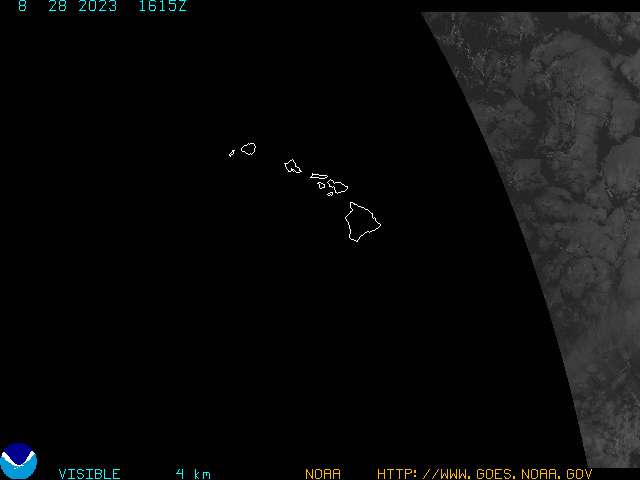

teri Says:
HI GLENN- LAST NIGHT MY SON AND I SAW A LARGE FALLING METEOR
TOWARDS THE NORTH. IT WAS AROUND 8:00PM.
DID ANYONE ELSE REPORT IT?~~~Hi Teri, I didn’t see it, as it was so cloudy here in Kula, but I’m glad you and your son had such a great sighting! Thanks for letting us know. Aloha, Glenn
cloud Says:
Hi Glenn–ooh, you pick the cutest kitty vids…so how was the art film in haiku? missed your reportage. I enjoyed “Up in the Air,” too, and thought the character very familiar. I think we all know someone like that, so it was a warm surprise to run into a friend of mine after in the lobby, she’s a literature professor at Stanford, and hear her take on the film (he didn’t change enough at the end). p.s. really liked the Guernsey book,thanks; best one yet!~~~Hi Cloud, always good to hear from you, thanks for your note. To see my take on the art film, please go to the left hand margin of this page, click on archived narratives, and click on the narrative of that date, which was two days ago. We both liked Up in the Air then, it was very easy to settle into for me. Take care, and write whenever you feel like it. Aloha, Glenn
SUSAN K. Says:
Hi Glenn, thank youu for all the very informative info you give us besides the weather. Tonight i liked the heads up about the full moon. I didn’t see the moon but everything was sure lit up and there was a sky full of stars. I sure am getting “homesick”, time to come back to the islands! Aloha, Susan~~~Hi Susan, glad you liked this first full moon of the month, another at the end on the 31st. Yes, better get back to the islands, it’s great here! Thanks for your note, Aloha, Glenn
Myrtle Says:
Hi Glenn — Thank you for your ever-interesting local weather coverage. We are wondering why the Central Pacific Hurricane Center stops providing the tropical weather outlook from December to June because we look at it every day via your website. Is it because the Central Pacific lapses into a highly predictable weather pattern from December to June? Mahalo for your insights!
Myrtle~~~Hello Myrtle, thanks for your note. The CPHC ends its coverage of tropical cyclone activity, because rarely do we see any storms, much less hurricanes here in the central Pacific from December through May. Actually, the Central Pacific moves into a much less predictable weather circumstances…when the fun of weather changes are much more evident. Aloha, Glenn