November 23-24, 2009
Air Temperatures – The following maximum temperatures were recorded across the state of Hawaii Monday afternoon:
Lihue, Kauai – 80
Honolulu, Oahu – 85
Kaneohe, Oahu – 81
Kaunakakai, Molokai – 82
Kahului, Maui – 83
Hilo, Hawaii – 80
Kailua-kona – 83
Air Temperatures ranged between these warmest and coolest spots near sea level around the state – and on the highest mountains…at 4pm Monday afternoon:
Honolulu, Oahu – 83F
Lihue, Kauai– 77
Haleakala Crater – 50 (near 10,000 feet on Maui)
Mauna Kea summit – 41 (near 14,000 feet on the Big Island)
Precipitation Totals – The following numbers represent the largest precipitation totals (inches) during the last 24 hours on each of the major islands, as of Monday afternoon:
0.46 Mount Waialaele, Kauai
0.25 South Fork Kaukonahua, Oahu
0.00 Molokai
0.00 Lanai
0.00 Kahoolawe
0.68 West Wailuaiki, Maui
0.78 Waiakea Uka, Big Island
Marine Winds – Here’s the latest (automatically updated) weather map showing a 1028 millibar high pressure system far to the northeast of the islands. Winds will be moderately strong, although locally gusty from the trade wind direction, becoming a little less strong through Tuesday…then picking up again mid-week.
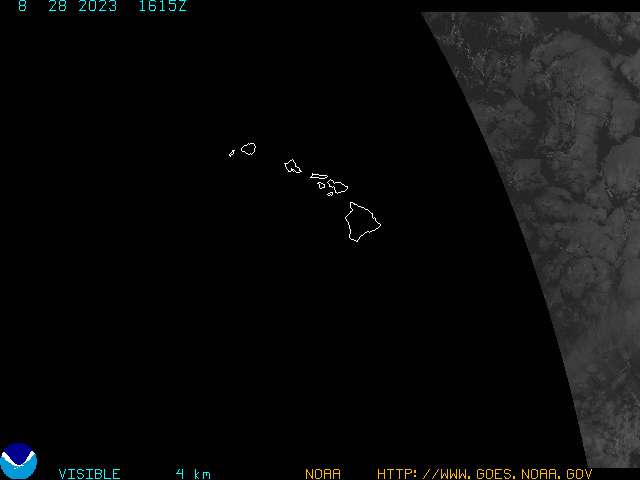
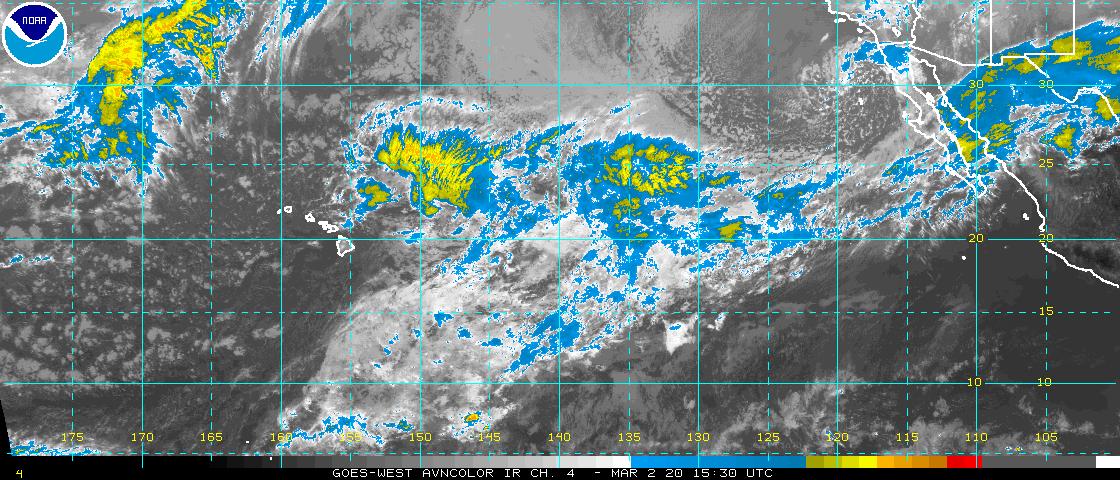
Satellite and Radar Images: To view the cloud conditions we have here in Hawaii, please use the following satellite links, starting off with this Infrared Satellite Image of the islands to see all the clouds around the state during the day and night. This next image is one that gives close images of the islands only during the daytime hours, and is referred to as a Close-up visible image. This next image shows a larger view of the Pacific…giving perspective to the wider ranging cloud patterns in the Pacific Ocean. Finally, here’s a Looping IR satellite image, making viewable the clouds around the islands 24 hours a day. To help you keep track of where any showers may be around the islands, here’s the latest animated radar image.
Hawaii’s Mountains – Here’s a link to the live webcam on the summit of near 14,000 foot Mauna Kea on the Big Island of Hawaii. The tallest peak on the island of Maui is the Haleakala Crater, which is near 10,000 feet in elevation. These two webcams are available during the daylight hours here in the islands…and when there’s a big moon rising just after sunset for an hour or two! Plus, during the nights and early mornings you will be able to see stars, and the sunrise too…depending upon weather conditions.
Tropical Cyclone activity in the eastern and central Pacific – Here’s the latest weather information coming out of the National Hurricane Center, covering the eastern north Pacific. You can find the latest tropical cyclone information for the central north Pacific (where Hawaii is located) by clicking on this link to the Central Pacific Hurricane Center. Here’s a tracking map covering both the eastern and central Pacific Ocean. A satellite image, which shows the entire ocean area between Hawaii and the Mexican coast…can be found here.
Aloha Paragraphs

Koolau Range…windward Oahu
The fine trade wind weather conditions, which we experienced this past weekend, will continue on through the first several days of this new holiday work week. The computer models continue to show a reduction in wind speeds. This being noted, Maui and the
This ridge is being eroded to some extent by two deep storm low pressure systems, and their trailing cold fronts. This in turn is the reason our trade winds have lost some strength now. The computer models show another high pressure system, now in the western Pacific, moving quickly eastward. This new high pressure cell will increase the pressure gradient across the
Besides a few locally heavy rainfall amounts in some mountain areas, conditions have been somewhat dry recently. The windward sides are where the most generous precipitation has occurred at lower elevations. The computer models have been suggesting, since last week actually, that we could see some modest increase in showers along those north and east facing windward coasts and slopes at mid-week. As is often the case under such a typical trade wind weather pattern, the most generous showers would likely fall during the night and early morning hours.
This satellite image shows the large perspective, with the deep low and cold front to our north…which are tamping down our local trade wind speeds now. The models show this first cold front stalling before arriving, with a better chance of a second one pushing down into the state later this coming weekend. The models show a third cold front, which looks like it could be more of a gully washer, arriving in about 240 hours from today…or around next Wednesday and Thursday. This is way out there into the future, and may or may not manifest?
It’s late Monday afternoon here in Kihei, Maui, as I begin writing this last section of today’s narrative. Monday was one of those especially nice days here in the islands, considering what it can sometimes be like this late in November. Skies were mostly clear, even along most of our windward sides. Rainfall was pretty scarce, although may increase a tad during the night. I expect Tuesday will be another lovely day, a very good chance of that happening as a matter of fact. ~~~ I want to remind you that we have quite a large swell train of waves running along our north shores now, with an associated high surf advisory from Kauai down through Maui. There’s a very good chance that an even larger northwest swell will arrive along these beaches by mid-week. I suggest being careful in those areas where large waves are breaking! ~~~ I’m about ready to take the drive home to Kula. I’ll have a quick dinner, before heading over to Haiku, on the windward side of east Maui. I’ll join some other folks to take part in three periods of zazen, or zen meditation. It will be a later getting to bed night, but I feel it’s worth staying up later than normal under these circumstances. ~~~ I’ll meet up with you again early Tuesday morning, when I’ll have your next new weather narrative from paradise waiting here. I hope you have a great Monday night until then! Aloha for now…Glenn.
Interesting: On the skin’s surface, bacteria are abundant, diverse and constant, but inflammation is undesirable. Research at the University of California, San Diego School of Medicine now shows that the normal bacteria living on the skin surface trigger a pathway that prevents excessive inflammation after injury.
"These germs are actually good for us," said Richard L. Gallo, MD, PhD, professor of medicine and pediatrics, chief of UCSD’s Division of Dermatology and the Dermatology section of the Veterans Affairs San Diego Healthcare System. The study, to be published in the advance on-line edition of Nature Medicine on November 22, was done in mice and in human cell cultures, primarily performed by post-doctoral fellow Yu Ping Lai .
"The exciting implications of Dr. Lai’s work is that it provides a molecular basis to understand the ‘hygiene hypothesis’ and has uncovered elements of the wound repair response that were previously unknown. This may help us devise new therapeutic approaches for inflammatory skin diseases," said Gallo.
The so-called "hygiene hypothesis," first introduced in the late 1980s, suggests that a lack of early childhood exposure to infectious agents and microorganisms increases an individuals susceptibility to disease by changing how the immune system reacts to such "bacterial invaders."
The hypothesis was first developed to explain why allergies like hay fever and eczema were less common in children from large families, who were presumably exposed to more infectious agents than others. It is also used to explain the higher incidence of allergic diseases in industrialized countries.
The skin’s normal microflora — the microscopic and usually harmless bacteria that live on the skin — includes certain staphylococcal bacterial species that will induce an inflammatory response when they are introduced below the skin’s surface, but do not initiate inflammation when present on the epidermis, or outer layer of skin.
Interesting2: Talk about bearing a grudge! Even though wolves were extirpated from Colorado in the 1930s, yellow-bellied marmots there still fear them, a recent study shows. Foxes, coyotes, and mountain lions all think marmots make a nice meal. But each predator represents a different threat: foxes, for example, usually attack pups, whereas coyotes are adept at catching marmots of all ages.
Belying their name, adult yellow-bellies sometimes actually chase foxes, but they turn tail and scamper to their burrows when a coyote shows up. The rodents react appropriately to the danger level. Daniel T. Blumstein, a behavioral ecologist at the University of California, Los Angeles, and two colleagues were curious to see if the Colorado marmots would still respond defensively to wolves — a major menace way back when.
They sprinkled horse feed in a field to attract marmots, and erected life-size photographs of a fox, coyote, mountain lion, wolf, or African antelope (as a control) nearby. When the researchers suddenly unveiled one of the pictures, foraging marmots were most likely to flee in response to the wolf.
Blumstein says the marmots’ reaction supports the “multipredator hypothesis,” the notion that prey maintain their fear of extinct predators so long as similar enemies—probably coyotes, in the marmots’ case — remain in play to keep them on their toes.
Interesting3: New research adds to the growing body of evidence suggesting the Red Planet once had an ocean. In a new study, scientists from Northern Illinois University and the Lunar and Planetary Institute in Houston used an innovative computer program to produce a new and more detailed global map of the valley networks on Mars.
The findings indicate the networks are more than twice as extensive (2.3 times longer in total length) as had been previously depicted in the only other planet-wide map of the valleys. Further, regions that are most densely dissected by the valley networks roughly form a belt around the planet between the equator and mid-southern latitudes, consistent with a past climate scenario that included precipitation and the presence of an ocean covering a large portion of Mars’ northern hemisphere.
Scientists have previously hypothesized that a single ocean existed on ancient Mars, but the issue has been hotly debated. "All the evidence gathered by analyzing the valley network on the new map points to a particular climate scenario on early Mars," NIU Geography Professor Wei Luo said.
"It would have included rainfall and the existence of an ocean covering most of the northern hemisphere, or about one-third of the planet’s surface." Luo and Tomasz Stepinski, a staff scientist at the Lunar and Planetary Institute, publish their findings in the current issue of the Journal of Geophysical Research — Planets.
Interesting4: There are signs Asian carp may have breached barriers designed to keep the prolific fish out of the Great Lakes, which could spell ecological disaster for the vital source of fresh water. Concentrations of DNA discovered by Notre Dame University researchers may indicate the presence of bighead and silver carp upstream from two electrical barriers designed to bottle up the invasive fish.
Environmentalists say that if the fish reach the Great Lakes, about 20 miles from the barriers, they would quickly destroy the lakes’ $4.5 billion fishery by consuming other fish and their food sources. Only Lake Superior among the five lakes may be too cold for the carp, which can reproduce rapidly and reach 100 pounds. The Great Lakes are the world’s largest body of surface fresh water and are relied on by 30 million people in the United States and Canada for drinking water and recreation.
"This is devastating news," Andy Buchsbaum of the National Wildlife Federation said of the discovery of carp DNA in the Cal-Sag channel 8 miles from Lake Michigan. "We have to hope that there aren’t enough population of fish to reproduce and create an epidemic of Asian carp in the lakes," he said.
Interesting5: At a recent solar energy conference in Anaheim, economic development officials from Ohio talked up a state that seemed far removed from the solar panels and high-tech devices that dominated the convention floor. Ohio, long known for its smokestack auto plants and metal-bending factories, would be an ideal place for green technology companies to set up shop, they said.
"People don’t traditionally think of Ohio when they think of solar," said Lisa Patt-McDaniel, director of Ohio’s economic development agency. But in fact, the Rust Belt goes well with the Green Belt, she said. For all of green tech’s futuristic sheen, solar power plants and wind farms are made of much of the same stuff as automobiles: machine-stamped steel, glass and gearboxes.
Interesting6: Understanding mixing in the ocean is of fundamental importance to modeling climate change or predicting the effects of an El Niño on our weather. Modern ocean models primarily incorporate the effects of winds and tides. However, they do not generally take into account the mixing generated by swimming animals. More than 60 years ago, oceanographers predicted that the effect of swimming animals could be profound. Accounting for this effort has proven difficult, though, so it has not entered into today’s models.
Now Kakani Katija and John Dabiri at the California Institute of Technology have developed a way to estimate the extent of "biogenic" mixing. After conducting field measurements on swimming jellyfish, they built models of how animals mix the waters ocean-wide and concluded that the effect may be extensive. "Swimming animals may contribute to ocean mixing on the same level as winds and tides," says Katija. "This necessitates the inclusion of biogenic mixing sources in ocean circulation and global climate models."
Interesting7: Sixty-five world leaders have confirmed they will attend a U.N. conference in Copenhagen in December that will try to clinch a new global climate deal, and many more are considering, Danish officials said on Sunday. Facing splits in the climate talks, Denmark 10 days ago formally invited the heads of state and government of 191 U.N. member states to come for the final two days of the December 7-18 conference to push for a deal at the meeting, originally meant for environment ministers.
Danish officials declined to provide a full list of those who had agreed to come to the Copenhagen conference, but noted some leaders, such as those from Britain, Germany, France, Spain, Australia, Japan, Indonesia and Brazil, had announced their intention to attend. The United Nations said this month about 40 leaders had indicated plans to attend, mostly from developing nations as well as from Germany and Britain, even before the official invitation.
European Commission President Jose Manuel Barroso has said he would come. And U.S. President Barack Obama has said he would attend if it could give impetus to a deal. Marathon talks since 2007 have failed to overcome differences between developed and developing nations on issues such as the depth of greenhouse gas cuts by industrialized countries by 2020 or extra funds to help poor nations.
Interesting8: East Antarctica’s ice started to melt faster from 2006, which could cause sea levels to rise sooner than anticipated, according to a study by scientists at the University of Texas. In the study published in Nature’s Geoscience journal, scientists estimated that East Antarctica has been losing ice mass at an average rate of 5 to 109 gigatons per year from April 2002 to January 2009, but the rate speeded up from 2006. The melt rate after 2006 could be even higher, the scientists said.
"The key result is that we appear to be seeing a large amount of ice loss in East Antarctica, mostly in the long coastal regions (in Wilkes Land and Victoria Land), since 2006," Jianli Chen at the university’s center for space research and one of the study’s authors, told Reuters. "This, if confirmed, could indicate a state change of East Antarctica, which could pose a large impact on global sea levels in the future," Chen said.
 Email Glenn James: