











November 22-23, 2009
Air Temperatures – The following maximum temperatures were recorded across the state of Hawaii Sunday afternoon:
Lihue, Kauai – 79
Honolulu, Oahu – 86
Kaneohe, Oahu – 80
Kaunakakai, Molokai – 82
Kahului, Maui – 84
Hilo, Hawaii – 79
Kailua-kona – 82
Air Temperatures ranged between these warmest and coolest spots near sea level around the state – and on the highest mountains…at 6pm Sunday evening:
Kailua-kona – 79F
Hilo, Hawaii – 70
Haleakala Crater – 45 (near 10,000 feet on Maui)
Mauna Kea summit – 32 (near 14,000 feet on the Big Island)
Precipitation Totals – The following numbers represent the largest precipitation totals (inches) during the last 24 hours on each of the major islands, as of Sunday evening:
3.28 Mount Waialaele, Kauai
0.81 Oahu Forest NWR, Oahu
0.02 Molokai
0.00 Lanai
0.01 Kahoolawe
1.00 Oheo Gulch, Maui
0.41 Mountain View, Big Island
Marine Winds – Here’s the latest (automatically updated) weather map showing a 1026 millibar high pressure system far to the northeast of the islands. Winds will be locally strong and gusty from the trade wind direction, becoming a little less strong through Tuesday…even lighter in those less exposed areas.
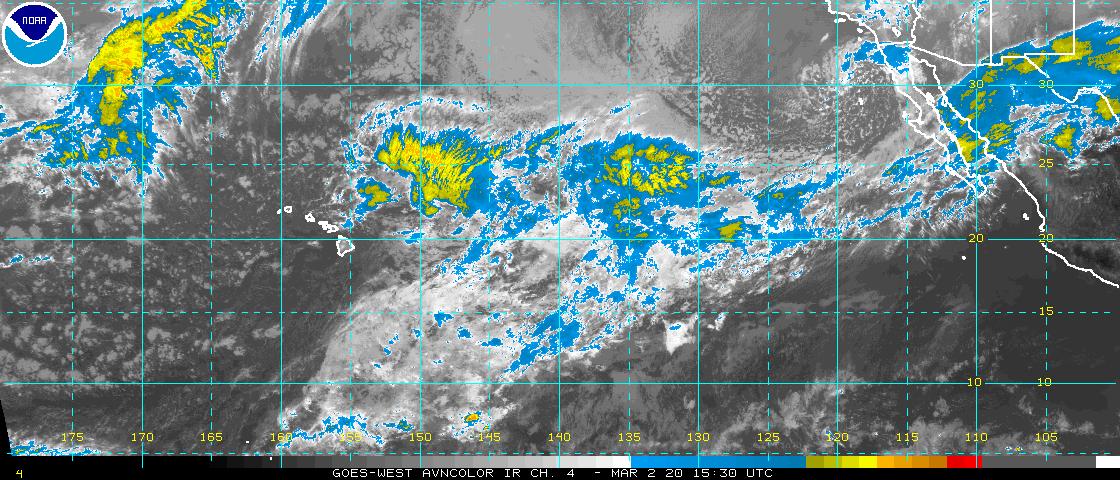
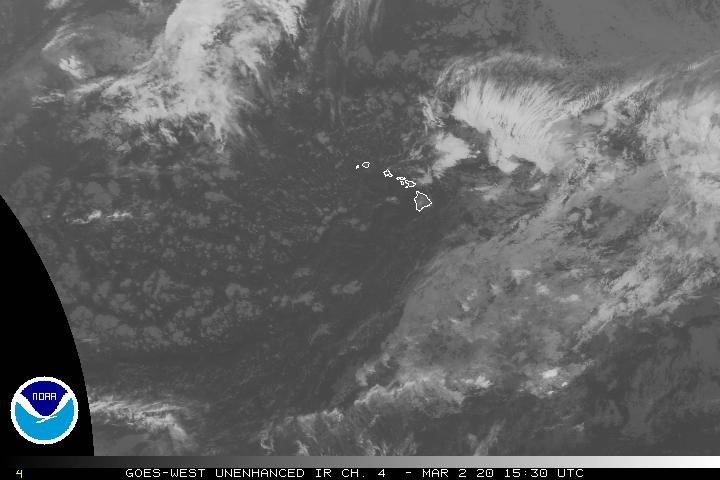
Satellite and Radar Images: To view the cloud conditions we have here in Hawaii, please use the following satellite links, starting off with this Infrared Satellite Image of the islands to see all the clouds around the state during the day and night. This next image is one that gives close images of the islands only during the daytime hours, and is referred to as a Close-up visible image. This next image shows a larger view of the Pacific…giving perspective to the wider ranging cloud patterns in the Pacific Ocean. Finally, here’s a Looping IR satellite image, making viewable the clouds around the islands 24 hours a day. To help you keep track of where any showers may be around the islands, here’s the latest animated radar image.
Hawaii’s Mountains – Here’s a link to the live webcam on the summit of near 14,000 foot Mauna Kea on the Big Island of Hawaii. The tallest peak on the island of Maui is the Haleakala Crater, which is near 10,000 feet in elevation. These two webcams are available during the daylight hours here in the islands…and when there’s a big moon rising just after sunset for an hour or two! Plus, during the nights and early mornings you will be able to see stars, and the sunrise too…depending upon weather conditions.
Tropical Cyclone activity in the eastern and central Pacific – Here’s the latest weather information coming out of the National Hurricane Center, covering the eastern north Pacific. You can find the latest tropical cyclone information for the central north Pacific (where Hawaii is located) by clicking on this link to the Central Pacific Hurricane Center. Here’s a tracking map covering both the eastern and central Pacific Ocean. A satellite image, which shows the entire ocean area between Hawaii and the Mexican coast…can be found here.
Aloha Paragraphs

Large waves on the north shores now
The long lasting trade winds will continue to blow in our Hawaiian Island weather picture Sunday night…relaxing some Monday and Tuesday. The small craft wind advisories have been taken down now, and likely won’t be needed again until the second of the upcoming work week. Computer models suggest that the trade wind speeds will accelerate again by mid-week onwards. Wind speeds in general will be in the moderately strong category, although those windier areas will find stronger and gusty conditions.
Generally fair weather conditions will prevail, with just the usual few windward showers falling…mostly during the nights and early mornings. This IR satellite image shows that a fairly minor area of high cirrus clouds is located to the southeast of the Big Island. This larger satellite picture shows the extent of these high cirrus clouds, which are more extensive far to the southeast. Looking ahead, we find that there will be just those occasional passing showers along our windward sides…with favorably inclined weather for our leeward beaches. The Big Island may see some increase in showers later Tuesday into Wednesday…spreading up along the windward sides of the smaller islands Thursday.
It’s Sunday evening here in Kula, Maui, as I begin writing this last section of today’s narrative. I had a simply wonderful day, right from my first waking moment, through now, before I crawl into bed for some reading, before falling asleep. I ended up hanging out with my next door neighbors pretty much all day. I took my breakfast over there and sat out with them on their sunny deck. None of us had gotten up all that early, due to our little private party last night. Our other neighbor had some things to do, so took a rain check on what the other three of us did around noon. This is when the fun factor really kicked in, as we packed for a walk into the Haleakala Crater. We drove up to the top, and then hiked down into the Crater for a distance. It was something like perhaps 30-45 minutes down what’s called Sliding Sands trail. We had our lunch and water, and lounged around just off the trail for an hour or so. It is so quiet in the Crater, as close to totally quiet as anywhere I’ve ever been, at least as far as I can remember. We took our time walking out, and then drove back down the mountain to our home. I had this stuff to do to get ready for the work week, so I’ve been scrambling alittle for the last hour. ~~~ I’m go to retire soon, so I’ll say good night for now. I’ll be back early Monday morning though, right here with your next new narrative then. I hope you have a great Sunday night! Aloha for now…Glenn.
Interesting: The diversity of life on Earth is undergoing an "immense and hidden" tragedy that requires the scale of global response now being deployed to tackle climate change, according to one of the world’s most eminent biologists. Prof Edward Wilson, an ecologist who has been described as "Darwin’s natural heir" and hailed by novelist Ian McEwan as an "intellectual hero" and "inspirational" writer, told the Guardian that the threat was so grave he is pushing for the creation of an international body of experts modeled on the UN’s Intergovernmental Panel on Climate Change (IPCC).
The IPCC, which is credited with convincing world leaders that the threat from climate change is real, includes about 2,500 scientific expert reviewers from more than 130 countries and was awarded the Nobel peace prize in 2007 along with Al Gore. Wilson’s proposed organization – which he names the Barometer of Life – would report to governments on the threats posed to species around the world.
Wilson said the problem of biodiversity loss had been "eased off centre stage" because of the focus on climate change. "We don’t hear as much public concern, protestation and plans by political leaders to save the living environment. It doesn’t get anything like the attention the physical environment has," he said.
Since the beginning of the last century, 183 species are known to have become extinct, including the Tasmanian tiger, the Caribbean monk seal and the toolache wallaby. But this number is a gross underestimate of the true number of extinctions, according to the International Union for Conservation of Nature species program.
Wilson was speaking ahead of the 150th anniversary of the publication of the Origin of Species on Tuesday. The 80-year-old scientist will deliver a lecture via video link to an audience at London’s Royal Institution on Darwin’s legacy and "the future of biology".
Interesting2: Roughly 15,000 years ago, at the end of the last ice age, North America’s vast assemblage of large animals — including such iconic creatures as mammoths, mastodons, camels, horses, ground sloths and giant beavers — began their precipitous slide to extinction. And when their populations crashed, emptying a land whose diversity of large animals equaled or surpassed Africa’s wildlife-rich Serengeti plains then or now, an entirely novel ecosystem emerged as broadleaved trees once kept in check by huge numbers of big herbivores claimed the landscape.
Soon after, the accumulation of woody debris sparked a dramatic increase in the prevalence of wildfire, another key shaper of landscapes. This new picture of the ecological upheaval of the North American landscape just after the retreat of the ice sheets is detailed in a study published November 19 in the journal Science.
The study, led by researchers from the University of Wisconsin-Madison, uses fossil pollen, charcoal and dung fungus spores to paint a picture of a post-ice age terrain different from anything in the world today.
The work is important because it is "the clearest evidence to date that the extinction of a broad guild of animals had effects on other parts of these ancient ecosystems," says John W. Williams, a UW-Madison professor of geography and an expert on ancient climates and ecosystems who is the study’s senior author.
What’s more, he says, the detailing of changes on the ice age landscape following the crash of keystone animal populations can provide critical insight into the broader effects of animals disappearing from modern landscapes.
Interesting3: A nutritionist in Nigeria says that malnutrition and iron deficiency in schoolchildren could be reduced in her country by baking up snail pie. In a research paper to be published in the International Journal of Food Safety, Nutrition and Public Health, she explains snail is not only cheaper and more readily available than beef but contains more protein.
Ukpong Udofia of the Department of Home Economics, at the University of Uyo, has looked at the moisture levels, protein content, and iron composition of the flesh of the giant West African land snail and compared it to beef steak.
Snail pie is much more nutritious than a beef pie, she says. Udofia and her research team baked pies of both varieties and asked young mothers and their children to try the tasty meal.
Most of them preferred the taste and texture of the pies baked with the snail Archachatina marginata to those made with beef. The kids and their mothers judged the snail pies to have a better appearance, texture, and flavor.
"Snail pie is recommended as a cheap source of protein and iron for school-age children and young mothers and could contribute in the fight against iron deficiency anemia," Udofia says.
"The land snail is a readily available and affordable source of animal protein, inhabits a lot of the green forest and swamps of most developing countries including Nigeria," Udofia adds, "It is also increasingly cultivated, although in the West it is more familiar as an unusual pet than a pie.
Iron deficiency and a lack of protein in the diet affect young mothers and their children in many developing countries including Nigeria, according to the World Health Organization leading to serious health problems.
There is no quick fix for the problem of malnutrition in such countries, but alternative to high-cost meat products could help. Snail meat contains protein, fat (mainly polyunsaturated fatty acid), iron, calcium, magnesium, phosphorus, copper, zinc, vitamins A, B6, B12, K and folate.
It also contains the amino acids arginine and lysine at higher levels than in whole egg. It also contains healthy essential fatty acids such as linoleic and linolenic acids. The high-protein, low-fat content of snail meat makes it a healthy alternative food.
Interesting4: Sustainable farming, initially adopted to preserve soil quality for future generations, may also play a role in maintaining a healthy climate, according to researchers at the Department of Energy’s Oak Ridge and Los Alamos national laboratories. ORNL and LANL scientists are exploring the large potential of the earth’s soils to sequester carbon, with estimates claiming that new land-use practices could greatly reduce U.S. carbon emissions by as much as 25 percent.
But exactly which practices are the most effective is still unclear, and a research paper published in the Soil Science Society of America Journal shines some light on this topic by introducing an easy-to-use field-portable approach to measure the carbon content of soils.
"This is a tool one could use to measure changes in soil carbon over time and try to establish whether soil carbon stocks are increasing or decreasing as a result of land-use practices," said lead author Madhavi Martin of ORNL’s Environmental Sciences Division.
"Although it is possible to measure these properties in the laboratory, the simplicity and portability of the device allow researchers exponentially greater flexibility to conduct their investigations." The paper describes the adaptation of Laser Induced Breakdown Spectroscopy, or LIBS, a technique that once made Martin something of a celebrity when she used it confirm the common origin of two separate pieces of firewood — evidence that eventually led to a confession in a 2006 Texas murder case.
LIBS works by measuring the light emitted when a small portion of the sample is annihilated with a laser pulse, a flash that provides an elemental fingerprint of virtually any substance under examination. The challenge for the authors was configuring the experimental design to ensure accurate measurements of carbon regardless of soil characteristics.
To accomplish this, the authors acquired a varied set of soil samples with different sand, silt and clay compositions from the Natural Resources Conservation Service and tested them against numerous laser wavelength and energies.
 Email Glenn James: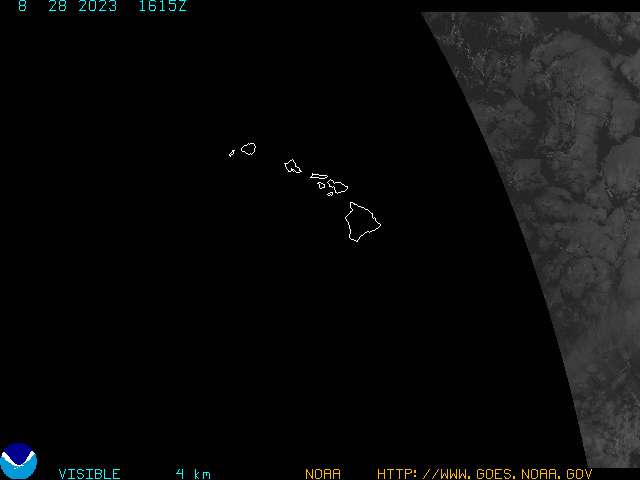



Linda Baker Says:
Hi Glenn,
We love your weather page – read it faithfully. We arrive Friday and I’m wondering what the weather will be? Do you see any significant storms approaching at the end of the week? I’m a nervous flyer and always worry about the wind!
Linda~~~Hi Linda, I honestly don’t know of any windy storms heading towards the islands at the end of the coming week. I trust you folks will have a great flight, and a wonderful vacation! Aloha, Glenn