November 19-20, 2009
Air Temperatures – The following maximum temperatures were recorded across the state of Hawaii Thursday afternoon:
Lihue, Kauai – 80
Honolulu, Oahu – 84
Kaneohe, Oahu – 76
Kaunakakai, Molokai – 82
Kahului, Maui – 82
Hilo, Hawaii – 81
Kailua-kona – 84
Air Temperatures ranged between these warmest and coolest spots near sea level around the state – and on the highest mountains…at 5pm Thursday evening:
Honolulu, Oahu – 83F
Hilo, Hawaii – 76
Haleakala Crater – 46 (near 10,000 feet on Maui)
Mauna Kea summit – 32 (near 14,000 feet on the Big Island)
Precipitation Totals – The following numbers represent the largest precipitation totals (inches) during the last 24 hours on each of the major islands, as of Thursday afternoon:
0.29 Mount Waialaele, Kauai
2.11 Maunawili, Oahu
0.11 Molokai
0.00 Lanai
0.00 Kahoolawe
1.49 Puu Kukui, Maui
1.05 Mountain View, Big Island
Marine Winds – Here’s the latest (automatically updated) weather map showing a 1027 millibar high pressure system to the north-northwest of the islands…with a weaker 1023 millibar cell far to the east-northeast. Winds will be locally strong and gusty from the trade wind direction through Saturday…lighter in those less exposed areas.
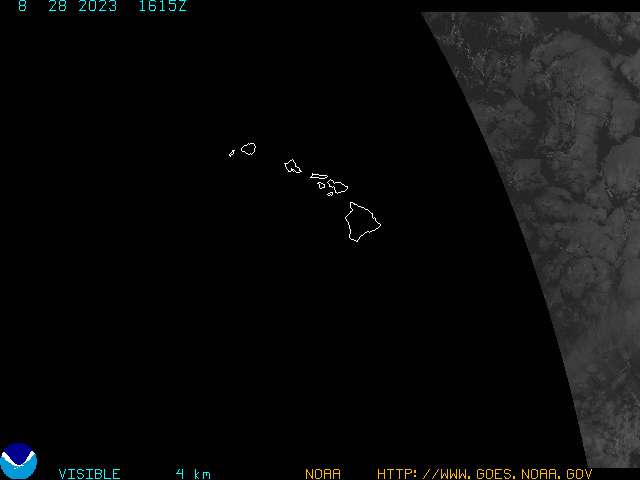
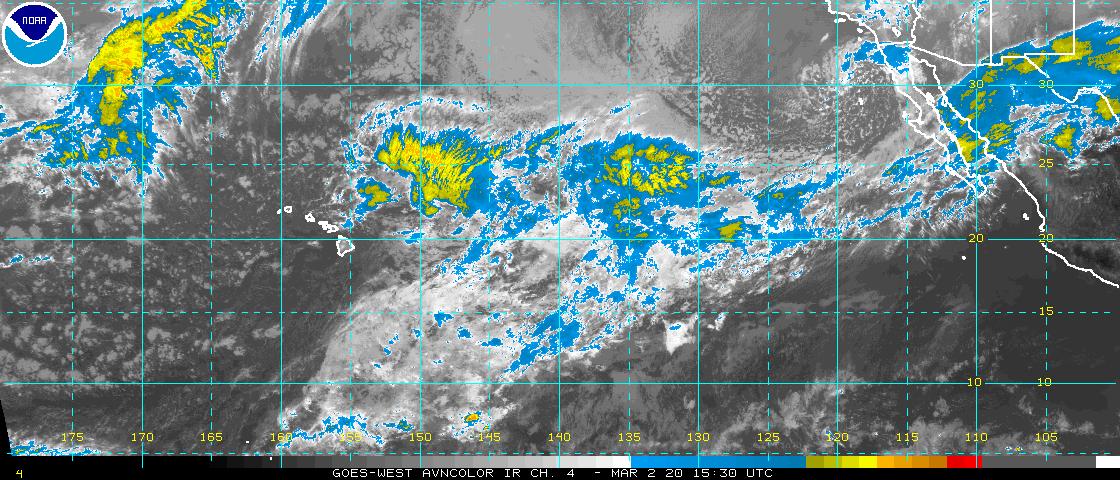
Satellite and Radar Images: To view the cloud conditions we have here in Hawaii, please use the following satellite links, starting off with this Infrared Satellite Image of the islands to see all the clouds around the state during the day and night. This next image is one that gives close images of the islands only during the daytime hours, and is referred to as a Close-up visible image. This next image shows a larger view of the Pacific…giving perspective to the wider ranging cloud patterns in the Pacific Ocean. Finally, here’s a Looping IR satellite image, making viewable the clouds around the islands 24 hours a day. To help you keep track of where any showers may be around the islands, here’s the latest animated radar image.
Hawaii’s Mountains – Here’s a link to the live webcam on the summit of near 14,000 foot Mauna Kea on the Big Island of Hawaii. The tallest peak on the island of Maui is the Haleakala Crater, which is near 10,000 feet in elevation. These two webcams are available during the daylight hours here in the islands…and when there’s a big moon rising just after sunset for an hour or two! Plus, during the nights and early mornings you will be able to see stars, and the sunrise too…depending upon weather conditions.
Tropical Cyclone activity in the eastern and central Pacific – Here’s the latest weather information coming out of the National Hurricane Center, covering the eastern north Pacific. You can find the latest tropical cyclone information for the central north Pacific (where Hawaii is located) by clicking on this link to the Central Pacific Hurricane Center. Here’s a tracking map covering both the eastern and central Pacific Ocean. A satellite image, which shows the entire ocean area between Hawaii and the Mexican coast…can be found here.
Aloha Paragraphs

Eroded Koolau Mountains…Oahu
The trade winds will remain locally on the strong and gusty side for the time being, although falling back into the more moderate realms as we move into the weekend…through the first half of the new week ahead. The wind speeds have dropped enough Thursday evening, that small craft wind advisories have been pared back to just the major channels, and a few other places on Maui and the Big Island. Our winds will begin to mellow-out a little as we move into the weekend and beyond, although not very much as is now the case. These gusty winds have dropped enough upstream as well, so that the NWS forecast office in Honolulu has dropped the high surf advisory along our east facing shores.
Showers will continue to fall mainly along our windward coasts and slopes…although less now in general. This IR satellite image shows fewer than the usual cumulus and stratocumulus clouds being carried our way on the trade wind flow. This larger satellite view shows patches of incoming trade wind moisture stretching well east and ENE of the islands. There looks like there might be an area of high cirrus clouds approaching us from the west too. The overlying atmosphere is quite stable now, and drier too. There will continue to be a few off and on showers however, but considerably less than earlier in the week. The gusty trade winds may try to carry a few showers over into the leeward sides of the islands on the smaller islands. Looking further ahead, some of the computer models want to bring increased precipitation into our area around next Tuesday or Wednesday…we’ll have to wait and see what happens over the next several model runs.
It’s early Thursday evening here in Kihei, Maui, as I begin writing this last paragraph of today’s narrative. Thursday turned out to be quite a nice day, with hardly any showers falling for a change. The winds were still quite breezy, but not as much as the last 2-3 days. Taking a look at the top gust around the state at 5pm, we find as usual, Maalaea Bay on Maui sporting the strongest winds…with 37 mph. Skies are quite clear for a change, although there are some partly cloudy conditions in many areas. ~~~ I’m about ready to head upcountry again, taking the drive home to Kula now. I’m looking forward to getting back up there so I can take my evening walk, have dinner, and then beginning reading. Did I ever tell you that I don’t have a TV, haven’t had one for many years actually? At any rate, tomorrow is Friday already, and as I mentioned this morning, I’m going out dancing in Paia tomorrow night, with some friends from work…which should be great! ~~~ Ok then, or as we say here in the islands, kden, I’ll catch up with you again early Friday morning, when I’ll have your next new weather narrative from paradise ready for your reading. I hope you have nice Thursday night until then! Oh yeah, one more thing, have you noticed the slender crescent moon these evenings, before it sinks into the western horizon, it’s pretty awesome! Aloha for now…Glenn.
Interesting: Was there a Stone Age apocalypse or not? One narrative has it that about 13,000 years ago a comet blasted North America, wiping out the continent’s mega-fauna – as well as its early settlers. It’s a compelling story, offering a simple explanation to the mystery of why mammoths, mastodons, and Clovis humans vanished. But it’s a controversial theory, and new research suggests the impact was far too small to have done any serious damage. Doubts center on the speed of extinctions, the fate of the Clovis culture, and the presence of supposed impact signatures. But advocates of the comet-blast theory say they will present their own new data at the American Geophysical Union (AGU) meeting in San Francisco, where they will share the stage with skeptics.
"Nothing special happened at 12,900 years ago," says John Williams of the University of Wisconsin-Madison. His data, reported in Science this week, suggest that large mammals were already rare well before the purported impact. Williams and his colleagues searched layered lake-bottom deposits in Indiana and New York State for the spores of the fungus Sporormiella found in the dung of large plant-eating mammals such as mammoths and horses. From a decline in the spore counts, they conclude that the mega-fauna population dropped steadily between 14,800 and 13,700 years ago, making them rare 800 years before any comet strike. Williams says the data rule out a sudden, impact-driven extinction.
However, geologist and impact-advocate James Kennett at the University of California, Santa Barbara, calls that "a classic case of over-interpretation" because the data comes from only a small area and not from different sites across the whole of North America. Some anthropologists are also unhappy and with the sudden extinction theory, taking issue with claims that an impact wiped out the Clovis people.
It’s true that distinctive Clovis-style artifacts disappear and sites were abandoned at the start of a dramatic cooling event which began about 13,000 years ago called the Younger Dryas. But the people didn’t die, says Vance Holliday of the University of Arizona in Tucson. "An artifact style was replaced by another style. You see that all over the world." Moreover, early North Americans were highly mobile hunter-gatherers who occupied sites only briefly before moving on. What’s more, the geological layer representing the Younger Dryas is missing the sort of extraterrestrial material that was a hallmark of the impact that wiped out the dinosaurs.
Isotope geochemist Mukul Sharma of Dartmouth College in Hanover, New Hampshire, says he has been unable to find any significant amount of platinum-group elements with the distinctive isotopic signature showing that they came from space. Sharma will detail his findings at the AGU meeting. Yet something did crash into the Pacific Ocean around the period in question. In a separate AGU paper, Sharma will report finding traces of extraterrestrial osmium on the floor of the mid-Pacific dating from between 16,000 and 8000 years ago. Some Younger Dryas deposits do contain residues similar to those from the 1908 Tunguska explosion over Siberia, says Adrian Melott of the University of Kansas, Lawrence. He reckons the North American event was "something maybe a couple of orders of magnitude bigger than Tunguska" – but still perhaps only one-hundredth the scale of the proposed comet blast.
Interesting2: We love to sit. Be it on a couch, in a car, at a desk, in front of a screen or at the dinner table, the average adult spends over 90% of his waking hours with his butt firmly ensconced in a chair. This ubiquitous habit has not only taken over a good portion of our day, but it often goes uninterrupted for several hours. The other side of this ugly statistic is that only 1% to 5% of those waking hours is spent performing moderate to physical activity with only 0.5% to 1% of this activity being sustained for at least 10 minutes.
This society of sitters has prompted health experts to examine the consequences of going from the breakfast table, to the car, to a desk, back to the table and finally to the couch in front of the TV. What they found isn’t pretty. Each two-hour increase in daily time spent sitting is associated with a 5% to 23% increase in the risk of obesity and a 7% to 14% increase in the risk of type 2 diabetes. An enhanced probability of metabolic syndrome and ovarian cancer are also consequences of prolonged sitting.
According to a study published in the July 2008 edition of Current Cardiovascular Risk Results, the health consequences that develop from too much sitting are very different from those that result from too little exercise. In fact, the authors of the study have gone as far as labelling prolonged sitting as "a distinct health hazard." If that’s not scary enough, experts also suggest that future trends in communication, transportation and workplace technology could lead to even more time spent sitting.
For the most part, we seem relatively happy spending most of our day seated. That is until we have to let our belt out a notch or two or our bodies start to protest from all the inactivity. A study in the Journal of Occupational and Environmental Medicine showed that workers who spent 95% of their day sitting increased their risk of neck pain. How do you conquer the effects of prolonged sitting? Exercise helps, but it’s only a small part in the battle to reduce the amount of time spent in a chair.
Experts suggest that even regular exercisers can be chronic sitters. Look at the average day in the life of active Canadians and you can understand their point. They arrive to work at 9 a.m. and sit at their desk until noon, only to return after a 60-minute workout to spend another four hours back at their desk. Add the seated hours spent travelling to and from work and in front of a TV or computer screen and you can see how the time spent sitting dwarfs the time spent exercising.
To further solidify their point, researchers evaluated the health of men and women who reported exercising five days a week for 30 minutes, a standard that is generally considered active enough to benefit health and fitness. What they found was surprising. Waist size, blood pressure and cholesterol levels were all negatively affected by time spent sitting. Also worth noting is that the results were more pronounced in women than in men.
In fact, the results were so significant, the researchers labeled this unique subset of the population "active couch potatoes." So, if regular exercise doesn’t counteract the ill effects of sitting, what does? That’s easy. Get up and move. Often. To be clear, I’m not talking about just exercising at your desk or hitting the stairs for an impromptu workout. Simple activities like standing up to answer the phone, walking down the hall to fill a water bottle and walking to a colleague’s office instead of sending an email, have shown to increase daily activity and reduce weight gain.
Research indicates that people who take frequent breaks during long periods of sedentary activity will have a waist circumference that, on average, is 5.9 centimeters less than that of people who are less inclined to get out of their chair. More and more companies are in tune with the consequences of a sedentary work force and are hailing the benefits of moving more in the workplace.
There’s also a call by some health experts to set up new health guidelines that suggest how often our sitting habit needs to be interrupted. That doesn’t mean you need to wait for a set of guidelines before getting off your butt on a regular basis. Start kicking the sitting habit now. Budget five minutes of every hour to get out of your chair. Stand, stretch or go for a walk. And if your boss asks what you’re doing away from your desk, invite him to stand alongside you while you explain the consequences of being an active couch potato.
Interesting3: Indoor smoking bans have forced smokers at bars and restaurants onto outdoor patios, but a new University of Georgia study in collaboration with the Centers for Disease Control and Prevention suggests that these outdoor smoking areas might be creating a new health hazard. The study, thought to be the first to assess levels of a nicotine byproduct known as cotinine in nonsmokers exposed to second-hand smoke outdoors, found levels up to 162 percent greater than in the control group.
The results appear in the November issue of the Journal of Occupational and Environmental Hygiene. "Indoor smoking bans have helped to create more of these outdoor environments where people are exposed to secondhand smoke," said study co-author Luke Naeher, associate professor in the UGA College of Public Health.
"We know from our previous study that there are measurable airborne levels of secondhand smoke in these environments, and we know from this study that we can measure internal exposure. "Secondhand smoke contains several known carcinogens and the current thinking is that there is no safe level of exposure," he added. "So the levels that we are seeing are a potential public health issue."
Athens-Clarke County, Ga., enacted an indoor smoking ban in 2005, providing Naeher and his colleagues and ideal environment for their study. The team recruited 20 non-smoking adults and placed them in one of three environments: outside bars, outside restaurants and, for the control group, outside the UGA main library. Immediately before and after the six-hour study period, the volunteers gave a saliva sample that was tested for levels of cotinine, a byproduct of nicotine and a commonly used marker of tobacco exposure.
The team found an average increase in cotinine of 162 percent for the volunteers stationed at outdoor seating and standing areas at bars, a 102 percent increase for those outside of restaurants and a 16 percent increase for the control group near the library. Naeher acknowledges that an exposure of six-hours is greater than what an average patron would experience but said that employees can be exposed for even longer periods.
"Anyone who works in that environment — waitresses, waiters or bouncers — may be there for up to six hours or longer," Naeher said. "Across the country, a large number of people are occupationally exposed to second-hand smoke in this way." Studies that measured health outcomes following indoor smoking bans have credited the bans with lowering rates of heart attacks and respiratory illness, but Naeher said that the health impacts of outdoor second-hand smoke are still unknown.
Interesting4: Cigarettes are "widely contaminated" with bacteria, including some known to cause disease in people, concludes a new international study conducted by a University of Maryland environmental health researcher and microbial ecologists at the Ecole Centrale de Lyon in France. The research team describes the study as the first to show that "cigarettes themselves could be the direct source of exposure to a wide array of potentially pathogenic microbes among smokers and other people exposed to secondhand smoke."
Still, the researchers caution that the public health implications are unclear and urge further research. "We were quite surprised to identify such a wide variety of human bacterial pathogens in these products," says lead researcher Amy R. Sapkota, an assistant professor in the University of Maryland’s School of Public Health.
"The commercially-available cigarettes that we tested were chock full of bacteria, as we had hypothesized, but we didn’t think we’d find so many that are infectious in humans," explains Sapkota, who holds a joint appointment with the University’s Maryland Institute for Applied Environmental Health and the department of epidemiology and biostatistics.
"If these organisms can survive the smoking process — and we believe they can — then they could possibly go on to contribute to both infectious and chronic illnesses in both smokers and individuals who are exposed to environmental tobacco smoke," Sapkota adds. "So, it’s critical that we learn more about the bacterial content of cigarettes, which are used by more than a billion people worldwide." The study will appear in an upcoming edition of the journal Environmental Health Perspectives.
 Email Glenn James: