November 18-19, 2009
Air Temperatures – The following maximum temperatures were recorded across the state of Hawaii Wednesday afternoon:
Lihue, Kauai – 80
Honolulu, Oahu – 84
Kaneohe, Oahu – 81
Kaunakakai, Molokai – 81
Kahului, Maui – 81
Hilo, Hawaii – 79
Kailua-kona – 82
Air Temperatures ranged between these warmest and coolest spots near sea level around the state – and on the highest mountains…at 5pm Wednesday evening:
Barking Sands, Kauai – 85F
Hilo, Hawaii – 72
Haleakala Crater – missing (near 10,000 feet on Maui)
Mauna Kea summit – missing (near 14,000 feet on the Big Island)
Precipitation Totals – The following numbers represent the largest precipitation totals (inches) during the last 24 hours on each of the major islands, as of Wednesday afternoon:
0.94 Mount Waialaele, Kauai
0.32 Manoa Valley, Oahu
0.11 Molokai
0.00 Lanai
0.00 Kahoolawe
2.42 Puu Kukui, Maui
1.49 Glenwood, Big Island
Marine Winds – Here’s the latest (automatically updated) weather map showing a 1031 millibar high pressure system far to the north-northwest of the islands. Winds will be locally strong and gusty from the trade wind direction.
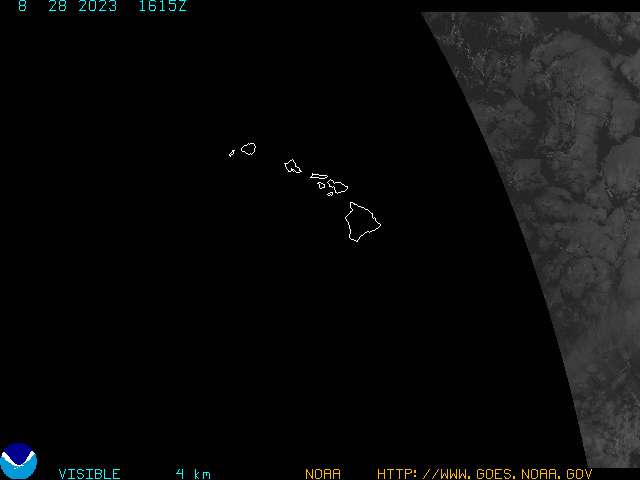
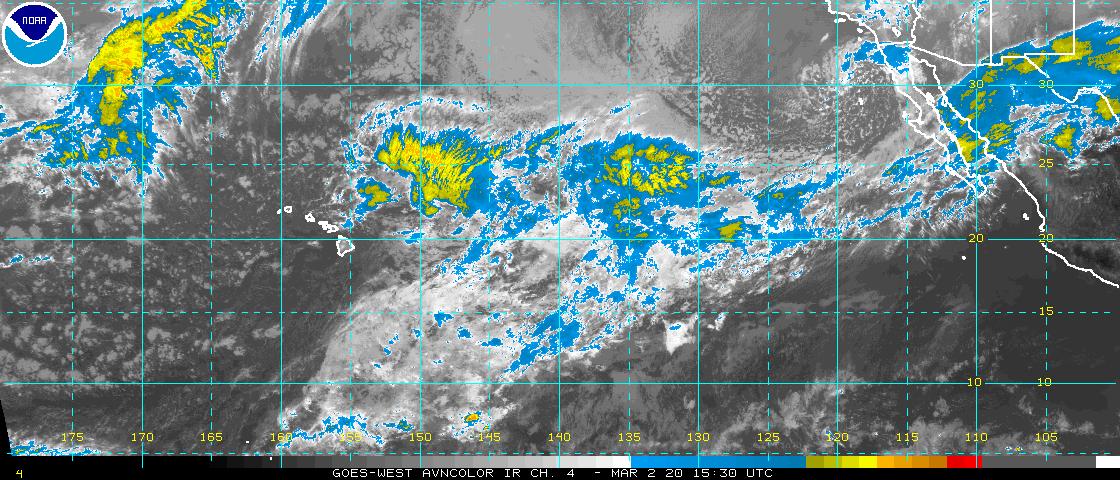
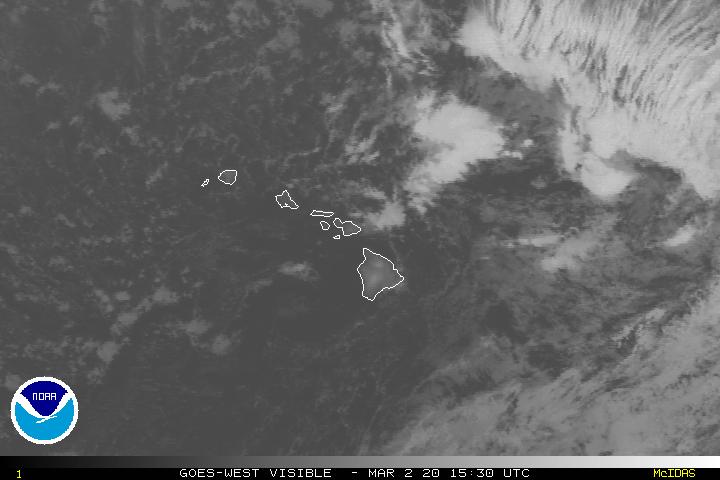
Satellite and Radar Images: To view the cloud conditions we have here in Hawaii, please use the following satellite links, starting off with this Infrared Satellite Image of the islands to see all the clouds around the state during the day and night. This next image is one that gives close images of the islands only during the daytime hours, and is referred to as a Close-up visible image. This next image shows a larger view of the Pacific…giving perspective to the wider ranging cloud patterns in the Pacific Ocean. Finally, here’s a Looping IR satellite image, making viewable the clouds around the islands 24 hours a day. To help you keep track of where any showers may be around the islands, here’s the latest animated radar image.
Hawaii’s Mountains – Here’s a link to the live webcam on the summit of near 14,000 foot Mauna Kea on the Big Island of Hawaii. The tallest peak on the island of Maui is the Haleakala Crater, which is near 10,000 feet in elevation. These two webcams are available during the daylight hours here in the islands…and when there’s a big moon rising just after sunset for an hour or two! Plus, during the nights and early mornings you will be able to see stars, and the sunrise too…depending upon weather conditions.
Tropical Cyclone activity in the eastern and central Pacific – Here’s the latest weather information coming out of the National Hurricane Center, covering the eastern north Pacific. You can find the latest tropical cyclone information for the central north Pacific (where Hawaii is located) by clicking on this link to the Central Pacific Hurricane Center. Here’s a tracking map covering both the eastern and central Pacific Ocean. A satellite image, which shows the entire ocean area between Hawaii and the Mexican coast…can be found here.
Aloha Paragraphs

Path to the beach…windward Oahu
Little change is expected in our local weather circumstances for the time being. The trade winds will be the main player in our
In the rainfall department, amounts have dropped off quite a bit, at least compared to what we saw this past weekend into Monday. Looking upstream of the islands, to the east-northeast in this case, we see the usual cumulus and stratocumulus clouds being carried our way on the trade wind flow. This IR satellite image shows an area of high cirrus clouds to the southeast of the Big Island as well, which doesn’t seem to be shifting northwest at this time. Back to the lower level clouds, this larger perspective satellite view shows patches of incoming trade wind moisture. The overlying atmosphere however is more stable now than it was just a few days ago. This in turn suggests that the generosity of the showers along our windward sides have trended back towards the drier side of the precipitation spectrum. There will continue to be off and on showers however, but just not so many. The gusty trade winds will try to carry a few showers over into the leeward sides of the islands…only on the smaller islands though.
It’s early Wednesday evening here in Kihei, Maui, as I begin writing this last paragraph of today’s narrative. The trade winds remained very active today, accompanied by those frequent windward biased showers that fell. Looking out the window before I take the drive back upcountry to Kula, I see lots of blue skies, although there are plenty of clouds around too. I’m sure that you’ve noticed how early the sun is setting these days, and we don’t even have daylight savings time (HST) here in the islands. I honestly don’t mind all that much, as there’s something about turning on the lights in my car before arriving home…that I enjoy somehow. I must admit, that it’s a little more difficult to drag myself out on the street to take my walk in the almost total dark though, before starting my dinner. This is why I’m leaving right now, so that I can do just that. I’ll be back early Thursday morning with your next new weather narrative, I hope you have a great Wednesday night until then! Aloha for now…Glenn.
Interesting: It is humanity’s oldest enemy. Despite all our science, a sixth of people in the developing world are chronically hungry. At a summit in Rome this week, world leaders reaffirmed a pledge to end hunger "at the earliest possible date". The UN Food and Agriculture Organization (FAO) wanted them to promise to end hunger by 2025, but the delegates declined.
They said instead that they would keep trying to meet their previous goal: to halve chronic hunger from 20 per cent of people in developing countries to 10 per cent by 2015. But can they? Based on their performance so far, the FAO considers it "unlikely". That, agricultural experts say, is because governments have broken their promises and slashed aid budgets for agriculture.
The hungry poor fell to 16 per cent in 2007, mainly thanks to Asia’s economic boom, but recession and soaring food prices pushed it back to 17 per cent in 2008. "Ending hunger by 2025 is not realistic," says Joachim von Braun of IFPRI, a food-policy institute in Washington DC. "Halving it might be, but it requires sustained action."
It gets worse: global population is set to grow to 9.1 billion by 2050, while global warming will have a serious impact on farming. What can be done? The FAO says feeding 9 billion people will require a near-doubling in food production. All nations will have to take part, but attention will be focused on poor countries, where there is most room for improvement and where better farming will give poor farmers income to buy food.
The FAO says farming investment in poor countries must grow from $142 billion per year to $209 billion. Agricultural research must also increase. The Consultative Group on International Agricultural Research (CGIAR) – the international, mainly government-funded labs that perform farm research for poor countries – says agricultural R&D spending for developing countries needs to grow from $5.1 billion to $16.4 billion per year by 2025. Its researchers say that in theory, given funds, they can boost agriculture enough to double food production, although global warming may make this impossible.
Interesting2: Water is in short supply around the world, and demand for water is growing at the rate of 6% per year. The increasing demand is due to growing populations and increased agricultural production to feed those hungry mouths. “Water’s getting a lot of attention, and it has everything to do with sustainability,” says Jeff Tjornehoj, senior research analyst with fund-tracking firm Lipper.
“There’s an expectation that critical water needs are not being met, and that it’s only going to get worse in future.” In fact, meeting water needs is getting a lot of attention from investors around the world. Big business conglomerates like Siemens and General Electric are getting into the potable water business, as are other less known businesses around the globe.
In fact, on a strictly financial basis, a growing number of mutual funds now specialize in water, having ballooned to $1.8 billion in total assets, up by 40 percent in size in the last six months. In terms of eco friendly technology, there is a lot being done on this front as well.
As more cities, businesses, and universities become "green" oriented, water saving measures are becoming increasingly targeted in building plans. Re-use of "gray" (runoff from sinks and showers) water for irrigating garden spaces is likely to become not just an option for LEED or ILBI certification, but a requirement.
Underground water storage systems are already awarded substantial points in the LEED certification system, while it is required in the ILBI certification system. Many states and local governments are also allowing tax credits and grant funding to install underground water storage systems for both home and commercial property construction and retrofits.
Areas that have an abundance of water are increasingly becoming more and more reluctant to pipe or aqua-duct their water supplies to over populated areas that do not have adequate rainfall for their water needs. This is not only big business for some big investors – it is green business that is likely to impact all our lives on an increasingly growing scale in the years to come.
Interesting3: The widespread use of genetically modified (GM) crops engineered to tolerate herbicides has led to a sharp increase in the use of agricultural chemicals in the U.S. This practice is creating herbicide-resistant "super weeds" and an increase in chemical residues in U.S. food, according to a new report released today by The Organic Center, the Union for Concerned Scientists, and the Center for Food Safety.
According to the report, entitled "Impacts of Genetically Engineered Crops on Pesticide Use in the United States: The First Thirteen Years," as more farmers have adopted variations of corn, soy beans, and cotton bred to tolerate weed killer in recent years, the use of herbicides has increased steadily, with herbicide use growing by 383 million pounds from 1996 to 2008, according to the report. Forty-six percent of that increase occurred during 2007 and 2008.
On the plus side, the report said the use of insecticides has actually decreased by 64 million pounds since 1996 because many genetically modified crops such as cotton and corn carry traits that make them resistant to insects. The most popular genetically modified crops are known as "Roundup Ready" for their ability to survive after being sprayed with the herbicide, Roundup.
Officials with the Biotechnology Industry Organization said herbicide-resistant crops initially made it easier for farmers to manage weed problems. Over time, however, an unfortunate consequence has been a growing epidemic of herbicide-resistant weeds. "The drastic increase in pesticide use with genetically engineered crops is due primarily to the rapid emergence of weeds resistant to glyphosate, the active ingredient in Monsanto’s Roundup herbicide," said Dr. Charles Benbrook, report author and chief scientist of The Organic Center.
"With glyphosate-resistant weeds now infesting millions of acres, farmers face rising costs coupled with sometimes major yield losses, and the environmental impact of weed management systems will surely rise." The resulting war between farmers and increasingly tough-to-kill weeds is "bad news for farmers, human health and the environment," said Bill Freese, science policy analyst for the Center for Food Safety.
Interesting4: In an effort to reduce automobile usage and greenhouse gas emissions, the Dutch cabinet has approved a driving tax that would charge motorists seven cents a mile. The plan, which must still be approved by parliament, would use GPS systems installed in each car to keep track of mileage and automatically bill drivers. Dutch officials said the driving tax, which would replace existing road taxes and duties on new car purchases, is designed to cut traffic by 15 percent and reduce emissions from transport by 10 percent.
Other European nations are considering similar driving taxes, and a driving tax experiment was recently tried in Oregon in the United States. The chances of a tax comparable to the Dutch tax being levied in the U.S. are slim, however, as that would more than triple the $260 a year that the average U.S. driver now pays in state and federal gasoline taxes.
Interesting5: Women bear the brunt of drought, rising seas, melting glaciers and other effects of climate change but are mostly ignored in the debate over how to halt it, the United Nations Population Fund (UNFPA) said today. In its 2009 state of the world population report, the agency said the world’s poor are the most vulnerable to climate change and the majority of the 1.5 billion people living on $1 a day or less are women.
"Poor women in poor countries are among the hardest hit by climate change, even though they contributed the least to it," said UNFPA executive director Thoraya Ahmed Obaid. World leaders are due to meet at a U.N. global warming summit in Copenhagen in December and the U.N. agency urged them to think about how much women are harmed by climate change and how much they could be engaged in the fight against it.
Interesting6: Scientists are reporting evidence that air pollution — a well-recognized problem at major airports — may pose an important but largely overlooked health concern for people living near smaller regional airports. Those airports are becoming an increasingly important component of global air transport systems. The study, one of only a handful to examine airborne pollutants near regional airports, suggests that officials should pay closer attention to these overlooked emissions, which could cause health problems for local residents.
In the new study, Suzanne Paulson and colleagues note that scientists have known for years that aircraft emissions from fuel burned during takeoffs and landings can have a serious impact on air quality near major airports. Aircraft exhaust includes pollutants linked to a variety of health problems. However, researchers know little about the impact of such emissions at general aviation or regional airports, which tend to be located closer to residential neighborhoods than major airports, the article notes.
The scientists measured a range of air pollutants near a general aviation airport for private planes and corporate jets in Southern California (Santa Monica Airport) in the spring and summer of 2008. They found that emissions of so-called ultrafine particles, which are less than 1/500th width of a human hair, were significantly elevated when compared to background pollution levels.
Levels of these pollutants were up to 10 times higher at a downwind distance from the airport equal to about one football field and as much as 2.5 times higher at distance equal to about six football fields. The study suggests that "current land-use practices of reduced buffer areas around local airports may be insufficient."
Interesting7: Germany could be home to as many as 17 million fewer people in 50 years’ time, official statistics showed today, laying bare the scale of the demographic crisis in Europe’s top economy. At the same time, Germans are greying rapidly, with one in three set to be over 65 by 2060, compared to one in five now, the federal statistics office said. One in seven will be over 80.
The total population, currently 82 million, will slump to between 65 and 70 million and neither immigration nor an increase in the birth rate – currently 1.4 children per woman – can do much to ease the crisis, the office added.
Like other advanced economies, Germany is facing a snowballing population crisis, leaving the country short of workers and adding to the strain on already stretched public coffers. On the other hand, the global population is set to rise to nine billion by about 2050, up from 6.8 billion now, with most of the increase coming from the developing world, where people are on average much younger than in the West.
 Email Glenn James: