











November 17-18, 2009
Air Temperatures – The following maximum temperatures were recorded across the state of Hawaii Tuesday afternoon:
Lihue, Kauai – 79
Honolulu, Oahu – 84
Kaneohe, Oahu – 81
Kaunakakai, Molokai – 81
Kahului, Maui – 82
Hilo, Hawaii – 79
Kailua-kona – 84
Air Temperatures ranged between these warmest and coolest spots near sea level around the state – and on the highest mountains…at 5pm Tuesday evening:
Kailua-kona – 81F
Lihue, Kauai – 72
Haleakala Crater – missing (near 10,000 feet on Maui)
Mauna Kea summit – missing (near 14,000 feet on the Big Island)
Precipitation Totals – The following numbers represent the largest precipitation totals (inches) during the last 24 hours on each of the major islands, as of Tuesday afternoon:
3.65 Mount Waialaele, Kauai
4.17 Oahu Forest NWR, Oahu
0.15 Molokai
0.00 Lanai
0.00 Kahoolawe
4.85 Puu Kukui, Maui
3.11 Waiakea Uka, Big Island
Marine Winds – Here’s the latest (automatically updated) weather map showing a 1022 millibar high pressure system far to the east-northeast, and a 1035 millibar high north-northwest of the islands. Winds will be locally strong and gusty from the trade wind direction.
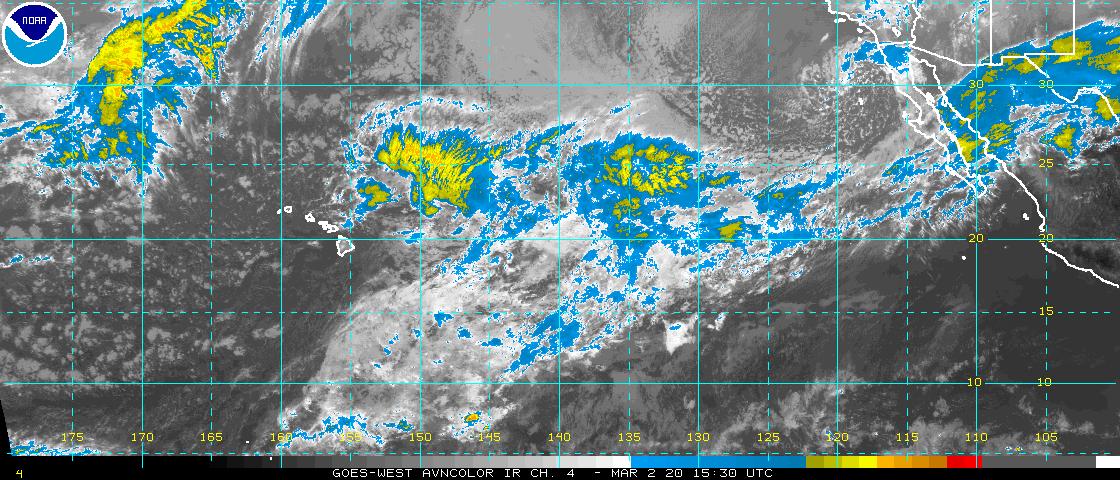
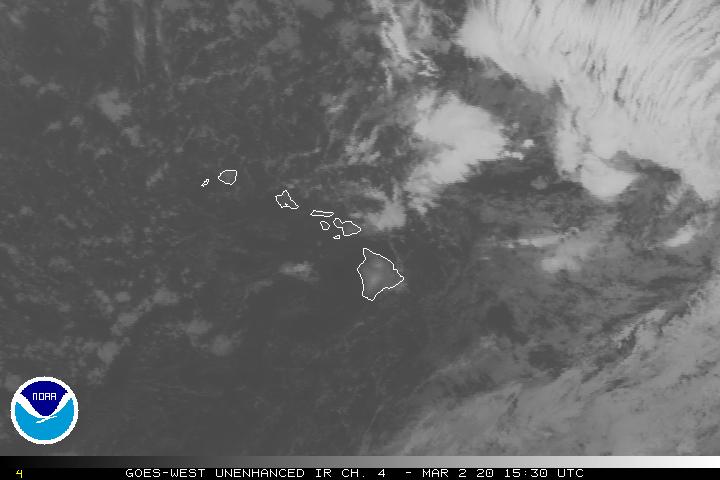
Satellite and Radar Images: To view the cloud conditions we have here in Hawaii, please use the following satellite links, starting off with this Infrared Satellite Image of the islands to see all the clouds around the state during the day and night. This next image is one that gives close images of the islands only during the daytime hours, and is referred to as a Close-up visible image. This next image shows a larger view of the Pacific…giving perspective to the wider ranging cloud patterns in the Pacific Ocean. Finally, here’s a Looping IR satellite image, making viewable the clouds around the islands 24 hours a day. To help you keep track of where any showers may be around the islands, here’s the latest animated radar image.
Hawaii’s Mountains – Here’s a link to the live webcam on the summit of near 14,000 foot Mauna Kea on the Big Island of Hawaii. The tallest peak on the island of Maui is the Haleakala Crater, which is near 10,000 feet in elevation. These two webcams are available during the daylight hours here in the islands…and when there’s a big moon rising just after sunset for an hour or two! Plus, during the nights and early mornings you will be able to see stars, and the sunrise too…depending upon weather conditions.
Tropical Cyclone activity in the eastern and central Pacific – Here’s the latest weather information coming out of the National Hurricane Center, covering the eastern north Pacific. You can find the latest tropical cyclone information for the central north Pacific (where Hawaii is located) by clicking on this link to the Central Pacific Hurricane Center. Here’s a tracking map covering both the eastern and central Pacific Ocean. A satellite image, which shows the entire ocean area between Hawaii and the Mexican coast…can be found here.
Aloha Paragraphs

Near Hana, Maui
The trade winds are picking up in strength now, and will remain blustery through the next several days, finally becoming somewhat lighter towards the weekend…and more so going into next week. Showers have remained active along the windward side of Kauai during the day, and will stay in the forecast for the other islands again tonight into Wednesday morning. This satellite image shows the shower band that is ticked Kauai, and another one getting ready to bring showers back to the Big Island Tuesday evening. A trough of low pressure, which has been enhancing the incoming showers as they move overhead…remains in place. Thus, partly cloudy conditions, with cloudy periods, will drop off and on windward biased showers. This looping radar image shows where those showers are falling.
Small craft wind advisories remain active Tuesday over all coastal and channel waters, as the trade winds peak in strength the next several days. High pressure to the east-northeast (1022 millibars) and north-northwest (1035 millibars), are the source of our gusty trade winds now. This weather map shows the positioning of these high pressure cells. All these gusty winds are making our ocean conditions choppy in many areas. Looking at the wind observations Tuesday evening, we see that the strongest gusts were over 30 mph at several places…with Maalaea Bay on Maui, and South Point on the Big Island, reporting 43 mph! The NWS office in Honolulu issued a wind advisory for those windiest areas from Oahu down through the Big Island late Tuesday morning…which will likely expire at some point Tuesday night.
In sum: windy with passing showers for the time being. Looking further ahead, there will be gradually diminishing trade wind speeds later this week. The latest computer forecast models suggest that next week will have even lighter trade winds blowing. These models go on to show considerably drier conditions then too. Speaking of dry, we have to remember that we are going into a strengthening El Nino phase, which often brings drier than normal weather to the islands. This doesn’t mean that we won’t have more storms, more rainy days, but perhaps somewhat fewer than what climatology would refer to as normal. Sometimes, when we have a dry winter and spring, the following summer can exhibit drought conditions…which have been known to become severe. Let’s hope it doesn’t go that way!
It’s early Tuesday evening here in Kihei, Maui, as I begin writing this last paragraph of today’s narrative. Looking out the window before I leave for the drive back upcountry, I see what looks to be a pretty typical late autumn evening, although the trade winds are cranking out there! The showers that we saw last night along the windward sides, will return tonight, although may not be quite so generous. Likely, Wednesday will look a lot like Tuesday’s weather conditions, although with perhaps a tad more sunshine along our leeward sides. ~~~ Today was a full on day of work, as the senior managers of the Pacific Disaster Center, huddled with Maui Counties mayor, along with her top officials. I was asked to give a weather briefing, and enjoyed that experience. I usually feel a little nervous about getting up in front of a large group of people, and then feel good when it’s finally over…as was the case today. ~~~ I’ve been getting home late the last few nights, so that it’s dark, or practically dark, by the time I get back to Kula. I’ve been missing my evening walk a few times, and I dislike doing that. Oh well, living life takes some flexibility doesn’t it! I’ll be back early Wednesday morning with your next new weather narrative, I hope you have a great Tuesday night until then! Aloha for now…Glenn.
Extra: Leopard Seal story!
Interesting: The U. S. Senate currently has an historic opportunity to take a major step toward improving food safety for all Americans. That is why a coalition of public health professionals, consumer organizations and groups representing victims of food borne illness is sending the message that it is time to "Make Our Food Safe."
Every year, millions of Americans are sickened from consuming contaminated food, hundreds of thousands are hospitalized and thousands die. Multiple outbreaks of food borne illness over the last several years — from spinach to peppers to peanut butter products — have demonstrated that these outbreaks are not random, unpreventable occurrences, but are due to widespread problems with food safety oversight in the United States.
This summer the U.S. House of Representatives passed its version of a sweeping food safety bill, which includes increased inspections of domestic food facilities and greater oversight of imports.
The Make Our Food Safe coalition believes the Senate can take a major step forward in protecting public health by passing legislation that gives the U.S. Food and Drug Administration (FDA) enhanced authority to oversee the safety of the nation’s food supply by the end of this year.
Interesting2: An upgrade to a Cray XT5 high-performance computing system deployed by the Department of Energy has made the "Jaguar" supercomputer the world’s fastest. Located at Oak Ridge National Laboratory, Jaguar is the scientific research community’s most powerful computational tool for exploring solutions to some of today’s most difficult problems.
The upgrade, funded with $19.9 million under the Recovery Act, will enable scientific simulations for exploring solutions to climate change and the development of new energy technologies. "Supercomputer modeling and simulation is changing the face of science and sharpening America’s competitive edge," said Secretary of Energy Steven Chu.
"Oak Ridge and other DOE national laboratories are helping address major energy and climate challenges and lead America toward a clean energy future." To net the number-one spot on the TOP500 list of the world’s fastest supercomputers, Jaguar’s Cray XT5 component was upgraded this fall from four-core to six-core processors and ran a benchmark program called High-Performance Linpack (HPL) at a speed of 1.759 petaflop/s (quadrillion floating point operations, or calculations, per second). The rankings were announced today in Portland at SC09, an international supercomputing conference.
Interesting3: Peter Fraenkel, Technical Director and co-founder of Marine Current Turbines, the UK-based company that designed and developed SeaGen, the world’s only commercial scale tidal stream turbine, announced at the Lisbon International Ocean Power Conference that he is "delighted with SeaGen’s performance. It is running reliably and delivering more energy than originally expected in an extremely aggressive environment."
The turbines are powered by a consistent tidal current that surges back and forth with every tide through the Strangford Narrows in Northern Ireland at speeds of up to 10 miles per hour. The generators typically produce enough energy to meet the average electricity needs for 1500 UK homes during each ebb and each flood tide. "We are getting more energy than expected mainly because the resource is more energetic than originally predicted during earlier surveys," added Fraenkel.
Interesting4: Recording hundreds of thousands of signals sent by satellite transmitters fitted on penguins, albatrosses, and marine mammals, the Wildlife Conservation Society (WCS) and Birdlife International have released the first atlas of South America’s Patagonian Sea. Called Atlas of the Patagonian Sea: Species and Spaces, the 300-page book was edited by Valeria Falabella and Claudio Campagna of WCS, and John Croxall of Birdlife International.
The atlas contains the most accurate maps ever assembled for this ecosystem and shows key migratory corridors spanning from coastlines to deep-sea feeding areas off the continental shelf hundreds of miles away. Data for the atlas was gathered by a team of 25 scientists working over a 10-year period.
The team tracked 16 species of marine animals, which produced some 280,000 uplinks of data over the Patagonian Sea, a huge area ranging from southern Brazil to southern Chile. The atlas will be used to help inform policy decisions in the region such as managing fisheries and charting transportation routes of oil tankers. This vast region is increasingly threatened by burgeoning development and overfishing.
Interesting5: A growing number of American consumers would like to tell President Obama to focus on the economy first before tackling environmental issues, according to research published today. The finding, part of the monthly Green Confidence Index, is that while significant numbers of Americans support the administration’s environmental stance, their principal concern remains focused on the economy.
The number of Americans preferring that the president "focus on the economy first" or "keep a balanced perspective" rose over the past month, while the number urging President Obama to "educate us about the issues" dropped.
The Green Confidence Index is a monthly snapshot of Americans’ attitudes about and confidence in their leaders and institutions, nationally and locally, on the subject of environmental responsibility, as well as in their own understanding of issues and their willingness to make green purchasing choices.
During October, the Index fell four points from a month earlier, from 103.6 to 99.5. The Index was set in July 2009 at 100.0. According to Chief Research Officer Amy Hebard of Earthsense, whose company creates the Index: "Should we worry about a four-point drop in the Index? Not yet.
Confusion in this market is broad and deep and, with the economy still in jitters, consumers’ confidence in going green will take time to build before we realize the pent-up demand we’ve seen. As we approach the holiday season, a key question will be whether or not the drop we saw in October is the start of a downward slide or just a one-month blip.
Interesting6:
Her name was Lady Rai. She was a nurse maid to an Egyptian queen who lived three centuries before the reign of Pharaoh Ramses I. And she suffered from heart disease. The evidence lies in a CT scan of Lady Rai’s mummified remains, researchers here said Tuesday. Using 21st-century science, they peered through her tattered wrappings and into her ancient arteries.
There, they found evidence of the same kind of plaque that doctors now diagnose every day. What’s more, they found it in someone who lived 3,500 years before fast food, sedentary living and cheap cigarettes. The research suggests that while modern risk factors may account for the current epidemic of heart disease, the ailment predates them.
"To me, it means we’re all susceptible," says researcher Randall Thompson of the Mid America Heart Institute in Kansas City, Mo., who presented the findings at an American Heart Association meeting. "To a certain extent, this may be a disease of being human." The images of Lady Rai are part of a series made in February by a team of cardiologists, imaging experts, Egyptologists and preservationists at the Museum of Antiquities in Cairo.
The team examined 22 mummies, dating from 1981 B.C. to A.D. 364. They found heart tissue or blood vessels in 13; in four, they found intact hearts. Three of the mummies had atherosclerosis, a buildup of fat, cholesterol and calcium inside their arteries. Another three had probable atherosclerosis. Calcified blockages were more common in mummies who were estimated to have died after the age of 45, researchers say.
The images of Lady Rai betrayed classic evidence of calcified plaque in the aorta, which appears as a bright spot on the CT image. "It’s just what you’d see in a living patient," Thompson says. "We don’t know whether she died of a heart attack or not, but we can tell that she had the disease process that leads to heart attacks." The most ancient mummy with evidence of heart disease died between 1530 B.C. and 1570 B.C., the researchers say.
The project got its start when senior author Gregory Thomas of the University of California-Irvine visited the museum with Egyptian cardiologist Adel Allam. When Allam, a devout Muslim, left the museum briefly to pray, he noticed a CT scanner in a trailer parked out back. The scanner had been used for other research. The idea for the project was born.
The project was funded by the National Bank of Egypt, the Mid America Heart Institute and scanner maker Siemens. Each of the mummies was slid intact into a donut-shaped, six-slice CT scanner for a sequence of X-rays. "We didn’t have to tell them to hold their breath," joked collaborator Samuel Wann of the Wisconsin Heart Hospital.
 Email Glenn James: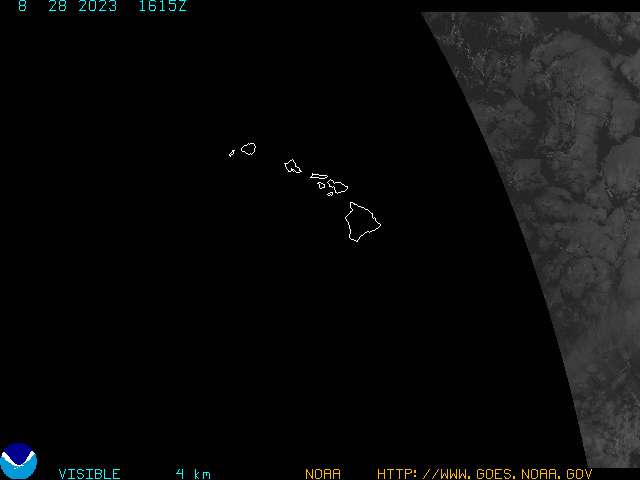


Gerry Ross Says:
Aloha Glenn
Regarding the Food Safety Act…yes people have become sick from contaminated food but this is a symptom and problem of our large industrialized food system. The pending legislation is designed to solve problems created by large farms and agribusiness but it will trickle down to the smallest commercial farmer who will have to comply. As a percent of total revenue the cost of compliance will be incrementally small for large farms; for those of us who are small farmers the incremental cost will be the end of our farms. I am among many other farmers both here and on the Mainland who are very very worried about the impacts of these bureacratic decisions which are not small farm friendly and are not common sense driven. Gerry in Kula (a small organic farmer) ~~~Hi Gerry, thanks for your well written comment! I don’t know the in’s and out’s of this issue, but can understand what you say. I eat just about exclusively organic, so I’m tending to side with you, and the other small farmers in general. Aloha, Glenn