











November 16-17, 2009
Air Temperatures – The following maximum temperatures were recorded across the state of Hawaii Monday afternoon:
Lihue, Kauai – 78
Honolulu, Oahu – 85
Kaneohe, Oahu – 80
Kaunakakai, Molokai – 81
Kahului, Maui – 79
Hilo, Hawaii – 72
Kailua-kona – 85
Air Temperatures ranged between these warmest and coolest spots near sea level around the state – and on the highest mountains…at 4pm Monday afternoon:
Honolulu, Oahu – 82F
Hilo, Hawaii – 71
Haleakala Crater – 48 (near 10,000 feet on Maui)
Mauna Kea summit – 34 (near 14,000 feet on the Big Island)
Precipitation Totals – The following numbers represent the largest precipitation totals (inches) during the last 24 hours on each of the major islands, as of Monday afternoon:
1.46 Mount Waialaele, Kauai
0.54 Oahu Forest NWR, Oahu
0.02 Molokai
0.00 Lanai
0.00 Kahoolawe
6.26 Puu Kukui, Maui
1.78 Piihonua, Big Island
Marine Winds – Here’s the latest (automatically updated) weather map showing a 1024 millibar high pressure system far to the northeast, and a 1035 millibar high northwest of the islands Monday night. Winds will be locally strong and gusty from the trade wind direction through at least the middle of the week…easing off towards the weekend.
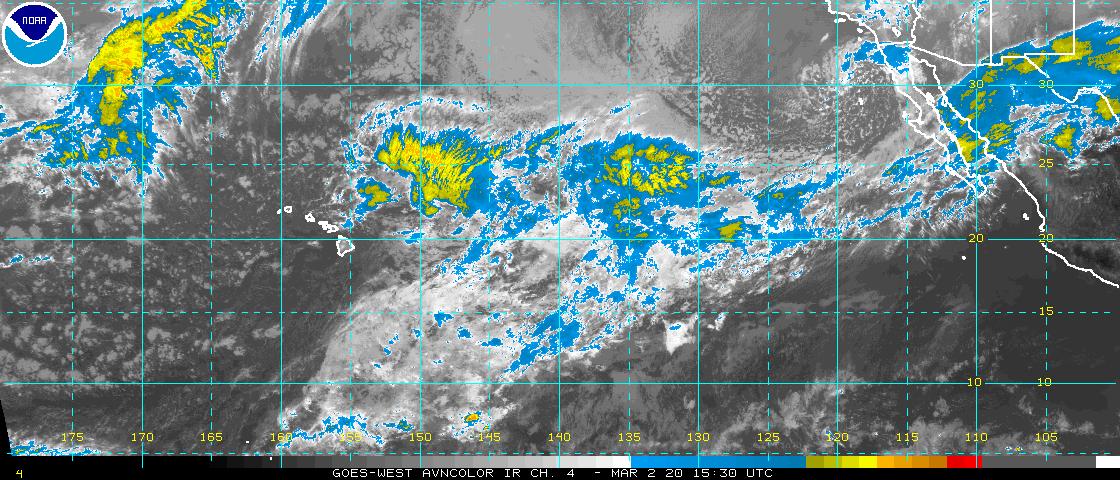
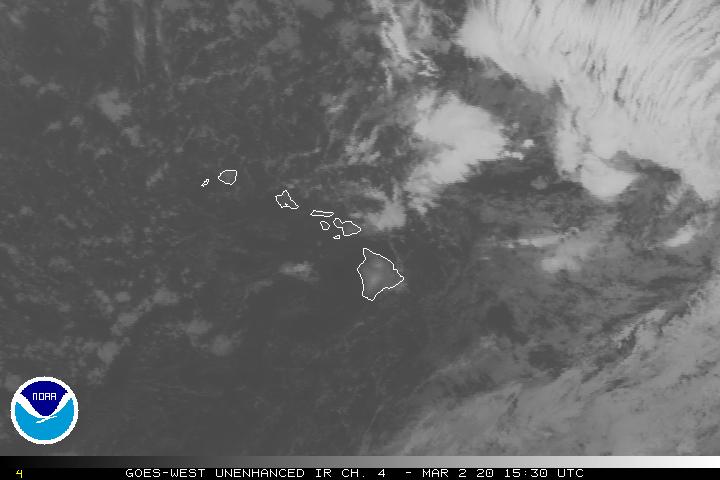
Satellite and Radar Images: To view the cloud conditions we have here in Hawaii, please use the following satellite links, starting off with this Infrared Satellite Image of the islands to see all the clouds around the state during the day and night. This next image is one that gives close images of the islands only during the daytime hours, and is referred to as a Close-up visible image. This next image shows a larger view of the Pacific…giving perspective to the wider ranging cloud patterns in the Pacific Ocean. Finally, here’s a Looping IR satellite image, making viewable the clouds around the islands 24 hours a day. To help you keep track of where any showers may be around the islands, here’s the latest animated radar image.
Hawaii’s Mountains – Here’s a link to the live webcam on the summit of near 14,000 foot Mauna Kea on the Big Island of Hawaii. The tallest peak on the island of Maui is the Haleakala Crater, which is near 10,000 feet in elevation. These two webcams are available during the daylight hours here in the islands…and when there’s a big moon rising just after sunset for an hour or two! Plus, during the nights and early mornings you will be able to see stars, and the sunrise too…depending upon weather conditions.
Tropical Cyclone activity in the eastern and central Pacific – Here’s the latest weather information coming out of the National Hurricane Center, covering the eastern north Pacific. You can find the latest tropical cyclone information for the central north Pacific (where Hawaii is located) by clicking on this link to the Central Pacific Hurricane Center. Here’s a tracking map covering both the eastern and central Pacific Ocean. A satellite image, which shows the entire ocean area between Hawaii and the Mexican coast…can be found here.
Aloha Paragraphs

Hawaiian Stilts
The fresh trade winds will carry off and on showers to the windward sides for the time being…with a few of these showery clouds sneaking over into the leeward sides here and there. Showers have remained active along those windward sides through the day, and will stay in the forecast as we move through most of this new work week. This satellite image shows abundant cloudiness upstream of the islands. The trough of low pressure, which was enhancing the incoming showers recently, is now pretty much out of the picture. Thus, partly cloudy conditions, with some cloudy periods, will drop frequent windward biased showers. This looping radar image shows where the showers are falling, most notably near the Big Island of Hawaii at this time of this writing.
Gusty trade winds will stay in place, and nudge up a little in strength Tuesday through Thursday…dropping back down some Friday into this coming weekend. High pressure to the northeast (1024 millibars) and northwest (1035 millibars), will be the source of our locally breezy trade winds now. This weather map shows the positioning of these high pressure cells. We have small craft wind advisories covering the entire state, with our ocean conditions choppy in most areas. Looking at the observations Monday evening, we see that the strongest gusts were reaching to 30-36 mph at those windiest spots around 5pm. The morning hours will find the lightest winds, which will increase in speed during the afternoon hours generally.
The surf will be an issue at times this week, which will be at times larger than normal. As the trade winds continue blowing, they will keep rough and choppy surf in place across our east facing beaches…gradually becoming less intense by the weekend. The north shores, which are known for their larger surf during the later autumn months, will have plenty of that. This week will begin small on those beaches, but then rise Tuesday through Thursday into Friday…with a second even larger NNW swell arriving later this coming weekend. The west sides will be small at first, but then rise along with the north shores beginning Tuesday. The south shores, which are usually small this time of year, will be larger than normal through the first half of this week, as an out of season south swell breaks.
Monday was an unusually cloudy day, with lots of passing showers along the north and east facing slopes…with even some showers flying over the south and west facing leeward areas at time too. Looking out the window here in Kihei, Maui, before I take the drive back upcountry to Kula, I see a nice looking rainbow. There are lots of clouds out there this evening, which should be the case again on Tuesday. The strong and gusty trade winds are teaming up with all the available moisture upstream of the islands…bringing it our way. ~~~ This evening, after having dinner at home, I’ll drive over to Haiku, on the windward side. I’m going back over to that same place I went this past Saturday morning, to attend a zen sitting session with the Maui Zendo folks. I may incorporate this into my regular weekly schedule, although it keeps me up a bit later than I’d prefer, considering the early rising I do during the week. ~~~ I’m trying to leave work a little early today, so I can fit in this evening activity. So, I’d better do just that, although I’ll be back again early Tuesday morning with your next new weather narrative. I hope you have a great Monday night until then! I’ll be getting up a bit earlier than usual Tuesday, so I can check out the meteors associated with the Leonid shower. Aloha for now…Glenn.
By the way: Meteor shower early Tuesday morning
Interesting: The illicit trade in ivory, which has been increasing in volume since 2004, moved sharply upward in 2009, according to the latest analysis of seizure data in the Elephant Trade Information System (ETIS). The remarkable surge in 2009 reflects a series of large-scale ivory seizure events that suggest an increased involvement of organized crime syndicates in the trade, connecting African source countries with Asian end-use markets.
The ETIS data indicate that such syndicates have become stronger and more active over the last decade. The ETIS analysis identifies Nigeria, the Democratic Republic of the Congo and Thailand as the three countries most heavily implicated in the global illicit ivory trade. Cameroon, Gabon and Mozambique in Africa and Hong Kong SAR, Malaysia, the Philippines, Singapore, Taiwan and Vietnam in Asia were also identified as important nodes in the illicit ivory trade.
Interesting2: It’s that time again! Time to renew our commitment to recycling. Take the pledge to learn more and recycle all you can. Find out what things can be recycled, spread the word about recycling, and help reduce waste going into landfills, improve our efficiency, and fight climate change.
Consider donating usable products such as bicycles to organizations like Pedals for Progress which can get used bicycles to people in developing countries where they can stimulate economic growth and help individuals make a better life for their families.
There are also organizations that can help find in the re-use of electronics and computers. America Recycles Day is November 15th this year. Are you looking for new opportunities to recycle throughout the year?
Keeping good recycling habits at home, work, and on the go can help with climate change. By reusing, recycling, and being smarter in the amounts and types of materials used, people can save energy, use fewer natural resources, and reduce greenhouse gas emissions.
America Recycles Day is the only nationally recognized day dedicated to encouraging Americans to recycle and to buy recycled products. Celebrating its 12th year, it has grown to include millions of Americans pledging to increase their recycling habits at home and work and to buy products made with recycled materials.
Through America Recycles Day, Keep America Beautiful, Inc. and the National Recycling Coalition support local communities and raises awareness by educating citizens about the benefits of recycling. Volunteer America Recycles Day coordinators are positioned throughout the country and work to organize recycling awareness events in their schools and communities, and in conjunction with their local municipalities.
Thousands of Americans across the country are making a difference, simply by keeping plastic bottles, paper, unwanted electronics, and other recyclable materials out of the waste stream.
The lifecycle energy savings of recycling rather than land filling one aluminum can is equivalent to the energy use of a laptop for 5 hours, a 60-watt incandescent light bulb for 4 hours, or a 60-watt compact fluorescent light bulb for 20 hours. America Recycles Day is a great time to think about our role in creating a sustainable environment by being responsible consumers.
Interesting3: Researchers in MIT’s Department of Civil and Environmental Engineering believe they have pinpointed a pathway by which arsenic may be contaminating the drinking water in Bangladesh, a phenomenon that has puzzled scientists, world health agencies and the Bangladeshi government for nearly 30 years. The research suggests that human alteration to the landscape, the construction of villages with ponds, and the adoption of irrigated agriculture are responsible for the current pattern of arsenic concentration underground.
The pervasive incidence of arsenic poisoning in Bangladesh and its link to drinking water were first identified in the scientific literature in the early 1980s, not long after the population began switching from surface water sources like rivers and ponds to groundwater from newly installed tube wells.
That national effort to decrease the incidence of bacterial illnesses caused by contaminated drinking water led almost immediately to severe and widespread arsenic poisoning, which manifests as sores on the skin and often leads to cancers of the skin, lung, liver, bladder and pancreas.
Since then, scientists have struggled to understand how the arsenic, which is naturally occurring in the underground sediment of the Ganges Delta, is being mobilized in the groundwater. By 2002, a research team led by Charles Harvey, the Doherty Associate Professor of Civil and Environmental Engineering at MIT, had determined that microbial metabolism of organic carbon was mobilizing the arsenic off the soils and sediments, and that crop irrigation was almost certainly playing a role in the process.
But the exact sources of the contaminated water have remained elusive, until now. In a paper appearing online in Nature Geoscience Nov. 15, Harvey, former graduate students Rebecca Neumann and Khandakar Ashfaque and co-authors explain that ponds excavated for the purpose of providing soil to build up villages for flood protection are the source of the organic carbon that presently mobilizes the arsenic in their 6-square-mile test site.
The carbon settles to the bottom of the ponds, then seeps underground where microbes metabolize it. This creates the chemical conditions that cause arsenic to dissolve off the sediments and soils and into the groundwater. The researchers also found that in their test area, which is flooded by annual monsoons, the rice fields irrigated with arsenic-laden water actually serve to filter out much of the arsenic from the water system.
Interesting4: Research at the Lund University Vision Group can now show that the color vision of birds stops working considerably earlier in the course of the day than was previously believed, in fact, in the twilight. Birds need between 5 and 20 times as much light as humans to see colors. It has long been known that birds have highly developed color vision that vastly surpasses that of humans.
Birds see both more colors and ultraviolet light. However, it was not known what amount of light is necessary for birds to see colors, which has limited the validity of all research on this color vision to bright sunlight only. "Using behavioral experiments we can now demonstrate that birds lose their color vision in the twilight and show just how much light is needed for birds to be able to interpret color signals," says Olle Lind, a doctoral candidate at the Department of Cell and Organism Biology.
For humans and horses, color vision ceases to work after dusk, at light intensities roughly corresponding to bright moonlight. However, the light threshold is not the same for all vertebrates. Geckos, for instance, can see colors at night. In the experiments performed by the Lund University Vision Group, the color vision of birds stopped working at light intensities corresponding to what prevails shortly after the sun goes down.
Birds need between 5 and 20 times as much light as humans to see colors. Among all the vertebrates tested thus far, birds are the first to lose their color vision in the twilight, even though they are the vertebrates that probably see colors best of all in the daylight.
Interesting5: The United States is using less water than during the peak years of 1975 and 1980, according to water use estimates for 2005. Despite a 30 percent population increase during the past 25 years, overall water use has remained fairly stable according to a new U.S. Geological Survey report. Assistant Secretary of the Interior Anne Castle announced the report, Estimated Use of Water in the United States in 2005, as part of her keynote speech on October 29 at the Atlantic Water Summit in the National Press Club.
The report shows that in 2005 Americans used 410 billion gallons per day, slightly less than in 2000. The declines are attributed to the increased use of more efficient irrigation systems and alternative technologies at power plants. Water withdrawals for public supply have increased steadily since 1950–when USGS began the series of five-year trend reports–along with the population that depends on these supplies.
"The importance of this type of data to the American public cannot be exaggerated," said Assistant Secretary for Water and Science Anne Castle. "The Department of the Interior provides the nation with the best source of information about national and regional trends in water withdrawals. This information is invaluable in ensuring future water supplies and finding new technologies and efficiencies to conserve water."
Nearly half (49 percent) of the 410 billion gallons per day used by Americans was for producing electricity at thermoelectric power plants. Irrigation accounted for 31 percent and public supply 11 percent of the total. The remaining 9 percent of the water was for self-supplied industrial, livestock, aquaculture, mining and rural domestic uses.
"Because electricity generation and irrigation together accounted for a massive 80 percent of our water use in 2005, the improvements in efficiency and technology give us hope for the future," Castle said. "The report also underscores the importance of recognizing the limits of the drinking water supplies on which our growing population depends. While public-supply withdrawals have continued to increase overall, per capita use has decreased in many States during recent decades.
"These are just a few examples of why, if we want to understand and address the nation’s current water issues and prepare to answer future water questions, we need the data provided in this report," Castle noted.
Interesting6: One key aspect of the discussion this week at the Transatlantic Media Dialog — part of the ongoing effort of climate and energy cooperation began earlier this years as the "Transatlantic Climate Bridge" was the issue of perception. Specifically how climate change and climate policy is perceived in the US and EU, as well as across the globe. David Catarious was one of the speakers at the conference this week. Catarious is a consultant for the Center for Naval Analysis (CNA),and was on the team that helped prepare an assessment report that considered the national security risks of climate change.
CNA brought together a Military Advisory Board chaired by former army Chief-of-Staff General Gordon Sullivan and consisting of 11 retired three and four-start admirals and generals. The group comprises a vast body of experience and unique perspective on world affairs. As on example, one board member, Admiral Richard Truly, is a former astronaut (shuttle pilot), Administrator of NASA, and former director of the National Renewable Energy Lab in Golden, Colorado.
The report was tasked with assessing the national security threat of projected climate change over the next thirty to forty years, encompassing the time frame for developing new military threats and capabilities. The report concludes that climate change is indeed a threat to America’s national security, and key to that finding is the conclusion that global warming is a "threat multiplier" for instability in some of the most volatile regions of the world, and that such volatility will reach even the most stable regions due to the tensions caused by climate change.
The report focuses on four key aspects of climate change risk that will likely lead to global instability and thus threaten national security:
1. Water
2. Food security
3. Health risks from vector borne diseases
4. Land loss and flooding
One of the first likely examples of climate-based instability is Darfur, where herders and farmers co-existed peacefully for many years. When the region became plagued with a prolonged drought, herders began moving their livestock on to their productive land that was rapidly becoming leas productive as a result of the draught. That situation led to ethnic conflict, which led to the genocide that we see today.
 Email Glenn James: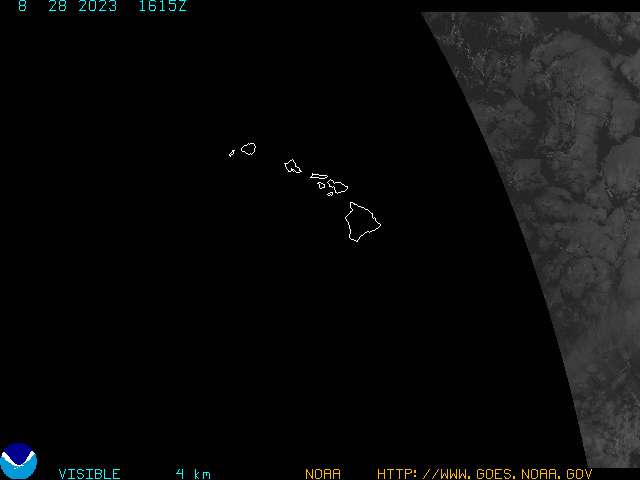



Amanda Says:
I’m so happy that this blustery, rainy, and chilly weather is here. I can finally bust out my sweaters and be happy in a pair of socks. The falling palm fronds scare the family dog, but I think it’s great.
I’m looking forward to more rain to keep things cool for Thanksgiving. I just wish your forecast held more rain for downtown as well as Windward Haleakala.~~~Hi Amanda, thanks for your note. I know what you mean, I appreciate the cooler weather too. I would imagine the Kahului area will get some showers too, although nothing like what’s been happening out along the true windward sides. I like to wear clothes my winter clothes too! Aloha, Glenn
mary Says:
Hi Glenn ~ for your info, lots and lots of rain out here in ulumalu/huelo area all day. Went to Kihei to get some sun
and found it mostly cloudy, but you already knew that.
Hope we get our sun back soon as it’s getting awfully soggy.~~~HI Mary, yes you are absolutely right, it was a cloudy day, with showers not only on the windward sides, but even the upcountry and downcountry leeward sides too. Hang in there, more showers for the time being. Aloha, Glenn
Buddhist Center - Maui Says:
Aloha Glenn!
First of all, many thanks to you and your wonderful weather updates on this page! I have been using this site for almost 10 years. I am a builder here on Maui, and love the accurate forecast you provide. 🙂 and also I appreciate your taste in cinema!
I noticed you occasionally attend some meditations… I am part of the Maui Diamond Way Buddhist Center (non-profit), and wanted to invite you to a lecture we are hosting this Friday. Lama Ole Nydahl will be giving a talk at The Studio Maui in Haiku, on Friday, Nov.20, at 7:30pm. Whether Zen or Tibetan is your preference, Lama Ole Nydahl is an interesting speaker and shares his experiences of being in the Dharma since the late 1960’s.
Anyways, just wanted to pass that along. 🙂
Thank you for all your work and time you devote to informing us all here on Maui !!!
Todd~~~Hi Todd, nice to hear from you, both by your kind acknowlegdement…and your invitation to hear the Lama. I will keep this date and time handy, but if I don’t make it for one reason or another, please let me know the next time the Lama speaks around Maui. Thanks very much for your interesting note! Aloha, Glenn