











November 14-15, 2009
Air Temperatures – The following maximum temperatures were recorded across the state of Hawaii Saturday afternoon:
Lihue, Kauai – 81
Honolulu, Oahu – 86
Kaneohe, Oahu – 86
Kaunakakai, Molokai – 87
Kahului, Maui – 85
Hilo, Hawaii – 78
Kailua-kona – 88
Air Temperatures ranged between these warmest and coolest spots near sea level around the state – and on the highest mountains…at 4pm Saturday afternoon:
Kailua-kona – 83F
Hilo, Hawaii – 72
Haleakala Crater – 48 (near 10,000 feet on Maui)
Mauna Kea summit – 34 (near 14,000 feet on the Big Island)
Precipitation Totals – The following numbers represent the largest precipitation totals (inches) during the last 24 hours on each of the major islands, as of Saturday afternoon:
15.16 Mount Waialaele, Kauai – wow!
3.91 Oahu Forest NWR, Oahu
0.06 Molokai
0.00 Lanai
0.00 Kahoolawe
2.14 West Wailuaiki, Maui
6.50 Pahoa, Big Island
Marine Winds – Here’s the latest (automatically updated) weather map showing a 1030 millibar high pressure system far to the northeast of the islands. Winds will be locally strong and gusty from the trade wind direction through the weekend…into the new week ahead.
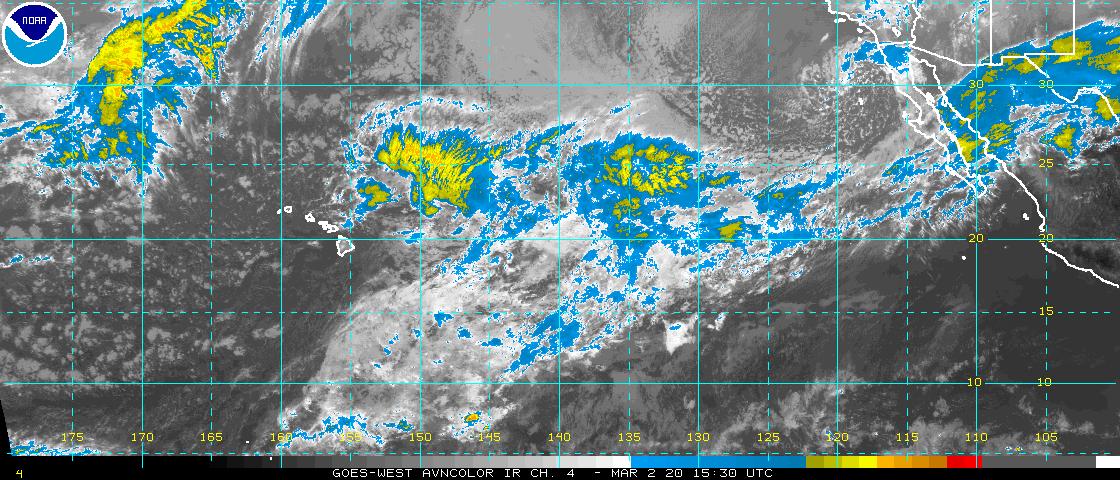
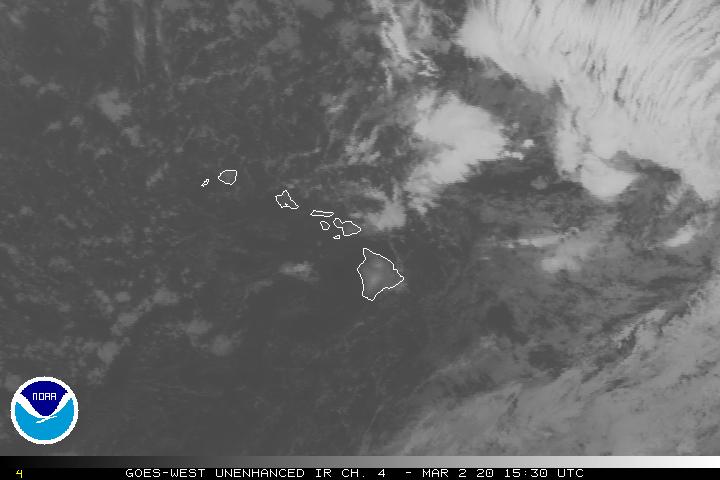
Satellite and Radar Images: To view the cloud conditions we have here in Hawaii, please use the following satellite links, starting off with this Infrared Satellite Image of the islands to see all the clouds around the state during the day and night. This next image is one that gives close images of the islands only during the daytime hours, and is referred to as a Close-up visible image. This next image shows a larger view of the Pacific…giving perspective to the wider ranging cloud patterns in the Pacific Ocean. Finally, here’s a Looping IR satellite image, making viewable the clouds around the islands 24 hours a day. To help you keep track of where any showers may be around the islands, here’s the latest animated radar image.
Hawaii’s Mountains – Here’s a link to the live webcam on the summit of near 14,000 foot Mauna Kea on the Big Island of Hawaii. The tallest peak on the island of Maui is the Haleakala Crater, which is near 10,000 feet in elevation. These two webcams are available during the daylight hours here in the islands…and when there’s a big moon rising just after sunset for an hour or two! Plus, during the nights and early mornings you will be able to see stars, and the sunrise too…depending upon weather conditions.
Tropical Cyclone activity in the eastern and central Pacific – Here’s the latest weather information coming out of the National Hurricane Center, covering the eastern north Pacific. You can find the latest tropical cyclone information for the central north Pacific (where Hawaii is located) by clicking on this link to the Central Pacific Hurricane Center. Here’s a tracking map covering both the eastern and central Pacific Ocean. A satellite image, which shows the entire ocean area between Hawaii and the Mexican coast…can be found here.
Aloha Paragraphs

Hanalei, Kauai
The atmosphere over the islands continues to have the threat of isolated heavy precipitation Saturday evening. There may continue to be thunderstorms, which keeps the threat of localized heavy showers in the forecast. Thunderstorms are produced when we have unusually cold air aloft, and warm moist air near the surface…which we call an unstable atmosphere. This instability has kept our local air mass shower prone through the last several days, and continues into Sunday night. This satellite image, with its very large and broad view of the Pacific Ocean, shows the long lasting area of rainy clouds is still evident over and around the
The cause of this cloudiness continues to be the presence of an upper level low pressure system to the west of Kauai. If we take a closer look at the clouds around the islands, with a tighter focus…we see that most of the rainiest clouds were near Kauai and the Big Island of Hawaii. This looping radar image confirms that showers remain generally over the ocean Saturday. It wouldn’t take much movement for those rain bearing clouds to move over many of the islands in the chain however. Thus, the NWS forecast office in Honolulu is keeping the flash flood watch active through Saturday night…with localized flash flood warnings at times.
Meanwhile, the trade winds are blowing, and will continue to do so into the new work week ahead. High pressure to the northeast, and a surface low pressure system to the west, is the reason our trade winds are so breezy now. As this weather map shows, the high pressure cell is weighing-in at 1030 millibars Saturday evening. We have small craft wind advisories covering most of our marine environment, with our ocean conditions choppy. Looking at the observations Saturday evening, we see that the strongest gusts were reaching 38 mph at both Maalaea Bay on Maui, and South Point on the Big Island. These trade winds are expected to accelerate even more going forward…remaining active into at least the first part of the upcoming new work week.
Friday evening after work I went to see the new Michael Jackson film called This Is It (2009). This was my second viewing of this great film, as I saw it in northern California just last week. I’ve always appreciated MJ’s dancing and singing abilities very much. I rarely see a film twice, but I really couldn’t pass up the opportunity to see his talent displayed on the big screen for a second time. Here’s a trailer for the film. ~~~ Saturday morning I attended what’s called a zazenkai, or a Zen sitting meditation in Haiku. I’ve had a long standing meditation practice, starting in the early 1970’s in college…when I took a class called Beginners Mind Zazen. I begin my week days at 430am by sitting quietly for 30 minutes. ~~~ This evening I’ll be going to a party in lower Kula, for dinner and dancing. This party will be at my old friend Julie Claire Holmes home, the friend who I lost this past summer. I’m sure there will be lots of people there, and I look forward to the chance to visit with old and new friends alike. I’m especially looking forward to the dancing part of the event, as I’m still charged up in that department, after the Michael Jackson film last night! ~~~ I’ll be back Sunday morning with all the new updates, and to let you know how the party turned out. I hope you have a great Saturday night until then! Aloha for now…Glenn.
Interesting: There is water on the Moon, scientists stated unequivocally on Friday, and considerable amounts of it. “Indeed yes, we found water,” Anthony Colaprete, the principal investigator for NASA’s Lunar Crater Observation and Sensing Satellite, said in a news conference. The confirmation of scientists’ suspicions is welcome news both to future explorers who might set up home on the lunar surface and to scientists who hope that the water, in the form of ice accumulated over billions of years, could hold a record of the solar system’s history.
The satellite, known as Lcross (pronounced L-cross), slammed into a crater near the Moon’s south pole a month ago. The impact carved out a hole 60- to 100-feet wide and kicked up at least 24 gallons of water. “We got more than just whiff,” said Peter H. Schultz, a professor of geological sciences at Brown University and a co-investigator of the mission. “We practically tasted it with the impact.”
For more than a decade, planetary scientists have seen tantalizing hints of water ice at the bottom of these cold craters where the sun never shines. The Lcross mission consisted of two pieces — an empty rocket stage to carve into the lunar surface and a small spacecraft to measure what was kicked up, but it too slammed into the surface.
For space enthusiasts who stayed up, or woke up early, to watch the impact on Oct. 9, the event was anticlimactic, even disappointing, as they failed to see the anticipated debris plume. But NASA later said that a plume was indeed photographed; the live video stream was not properly attuned to pick out the details. The water findings come from analysis of the slight shifts in color after the impact, showing telltale signs of water.
Interesting2: Is there such a thing as "weather" on Mars? There are some doubts, considering the planet’s atmosphere is only 1 percent as dense as that of the Earth. Mars, however, definitely has clouds, drastically low temperatures and out-of-this-world dust storms. Istvan Szunyogh, a Texas A&M professor of atmospheric sciences, was recently awarded a NASA grant to analyze and forecast Martian weather. Mars is the most Earth-like planet we know, but it is still quite different. For example, it is much colder on Mars.
The south pole of the Earth is covered by water ice, but the south pole of Mars wears a dry ice (frozen carbon dioxide) cap. In winter, the temperature at the poles can dip to -220 degrees Fahrenheit, which is so cold that even carbon dioxide freezes. "Planet-encircling Martian dust storms, which occur every two to four Mars years, can cover the whole planet with dust for months," notes Szunyogh, who is working with colleagues from the University of Maryland and the Geophysical Fluid Dynamics Laboratory in Princeton, N.J., to forecast Martian weather.
Why care about weather on Mars? After all, nobody lives, works or goes to school there. "Martian weather forecasts, in the short term, can drastically increase the safety of landing robotic exploration missions," comments colleague Mark Lemmon, a Texas A&M professor of atmospheric sciences who has led or participated in many Mars exploratory events. "In the long run, it is indispensible for the safe returning of astronauts in future manned explorations.
"The two rovers currently working on Mars are solar-powered, and their lives end when their batteries run out," Lemmon adds. "Dust storms block the sun and shorten their battery life, and winds, on the other hand, can clear their solar panels so their batteries recharge faster." Weather forecasting is not tossing dice. It must build on solid data.
"All weather forecasts, including those on TV, are based on model forecasts of the different physical parameters of the Earth’s atmosphere such as temperature, wind and pressure," Szunyogh says. "The main goal of our project is to explore the possibility of obtaining accurate quantitative estimates of these parameters of the Martian atmosphere. "These parameters will be obtained from the available remotely sensed Martian observations," he adds. "Then the data can be fed into Mars global circulation models, producing Martian weather forecasts like what we have for Earth."
Interesting3: Spurred by a warming climate, daily record high temperatures occurred twice as often as record lows over the last decade across the continental United States, new research shows. The ratio of record highs to lows is likely to increase dramatically in coming decades if emissions of greenhouse gases continue to climb. "Climate change is making itself felt in terms of day-to-day weather in the United States," says Gerald Meehl, the lead author and a senior scientist at the National Center for Atmospheric Research (NCAR). "The ways these records are being broken show how our climate is already shifting."
The study, by authors at NCAR, Climate Central, The Weather Channel, and the National Oceanic and Atmospheric Administration (NOAA), has been accepted for publication in Geophysical Research Letters. It was funded by the National Science Foundation, NCAR’s sponsor, the Department of Energy, and Climate Central.
If temperatures were not warming, the number of record daily highs and lows being set each year would be approximately even. Instead, for the period from January 1, 2000, to September 30, 2009, the continental United States set 291,237 record highs and 142,420 record lows, as the country experienced unusually mild winter weather and intense summer heat waves.
A record daily high means that temperatures were warmer on a given day than on that same date throughout a weather station’s history. The authors used a quality control process to ensure the reliability of data from thousands of weather stations across the country, while looking at data over the past six decades to capture longer-term trends. This decade’s warming was more pronounced in the western United States, where the ratio was more than two to one, than in the eastern United States, where the ratio was about one-and-a-half to one.
The study also found that the two-to-one ratio across the country as a whole could be attributed more to a comparatively small number of record lows than to a large number of record highs. This indicates that much of the nation’s warming is occurring at night, when temperatures are dipping less often to record lows. This finding is consistent with years of climate model research showing that higher overnight lows should be expected with climate change.
Interesting4: Volcanic eruptions were responsible for a deadly ice age 450 million years ago, as well as — in an ironic twist — a period of global warming that preceded it, a new study finds. The finding underscores the importance of carbon in Earth’s climate today, said study researcher Matthew Saltzman of Ohio State University. The ancient ice age featured glaciers that covered the South Pole on top of the supercontinent of Gondwana (which would eventually break apart to form the present-day continents of the southern hemisphere).
Two-thirds of all species perished in the frigid climate. Previously, Saltzman and his team linked this same ice age, which took place in the Ordovician period, to the rise of the Appalachian Mountains. As the exposed rock weathered, chemical reactions pulled carbon from Earth’s atmosphere, causing the deadly global cooling.
With models, the researchers have now pieced together the other half of the story: Giant volcanoes that formed during the closing of the proto-Atlantic Ocean — known as the Iapetus Ocean — set the stage for the rise of the Appalachians and the ice age that followed. "Our model shows that these Atlantic volcanoes were spewing carbon into the atmosphere at the same time the Appalachians were removing it," Saltzman said.
"For nearly 10 million years, the climate was at a stalemate. Then the eruptions abruptly stopped, and atmospheric carbon levels fell well below what they were in the time before volcanism. That kicked off the ice age." To figure out this geologic history, Saltzman and his colleagues used computer models to draw together measurements of isotopes of chemical elements from rocks in Nevada, Virginia and Pennsylvania with measurements of volcanic ash beds in the same locations.
They also factored in temperature models developed by other scientists. The ash deposits demonstrated when the volcanoes stopped erupting, and the isotope measurements pinpointed the Appalachians as the source of the volcanic rock. The new findings mesh well with what scientists know about these ancient proto-Atlantic volcanoes, which are thought to have produced the largest eruptions in Earth’s history.
They issued enough lava to form the Appalachians, enough ash to cover the far ends of the earth, and enough carbon to heat the globe. Atmospheric carbon levels grew to levels 20 times higher than they are today. This study shows that when those volcanoes stopped erupting, carbon levels dropped, and the climate swung dramatically back to cold. The timing coincides with today’s best estimates of temperature fluctuations in the Ordovician.
Interesting5: Tiny particles of pollution that are harmful to human health stick to tree leaves and leave a trace magnetism, a new study finds. More pollution is found stuck to leaves of trees near busy roadways than those in less trafficked areas. The pollution-trapping leaves could serve as an easy, inexpensive way to monitor pollutant levels, researchers say.
Scientists in Europe first noticed that a type of pollution called particulate matter was sticking to leaves in industrial areas. Particulate matter is created by the combustion of fuel and can include many different compounds. The ones these scientists detected were metallic pollutants — such as iron oxides from diesel exhaust — that left a magnetic trace on the leaves (though the leaves themselves don’t become magnets).
The bumpy, wavy surfaces on the leaves easily trap the floating particles of pollution, which either remain stuck to the leaves surface or can even grow right into the leaf. The leaves are "pretty efficient particle collectors," said geophysicist Bernie Housen, of Western Washington University in Bellingham, Wash. Housen set out to see if this magnetic pollution could be detected on Bellingham’s leaves as well, and if there was a different between leaves of trees in busy city areas than in more rural ones.
Housen and his colleague Luigi Jovane collected several leaves from 15 Bigleaf Maple trees (Acer macrophyllum) in and around Bellingham in late June. Five of the trees were next to roads with busy bus routes; five sat on parallel, but quieter streets; five were in a nearby rural area. The leaves along the bus routes showed two to eight times more magnetism than those from the nearby quieter streets and four to 10 times more magnetism than leaves from rural areas.
The findings, presented last weekend at the meeting of the Geological Society of America, suggest that leaves could act as a simple, cost effective way to monitor pollution, Housen said. Monitoring particulate matter is important because of the danger it poses to human health. The tinier the particles are, the deeper they can penetrate into lungs, with consequences to health that include breathing and heart problems.
 Email Glenn James: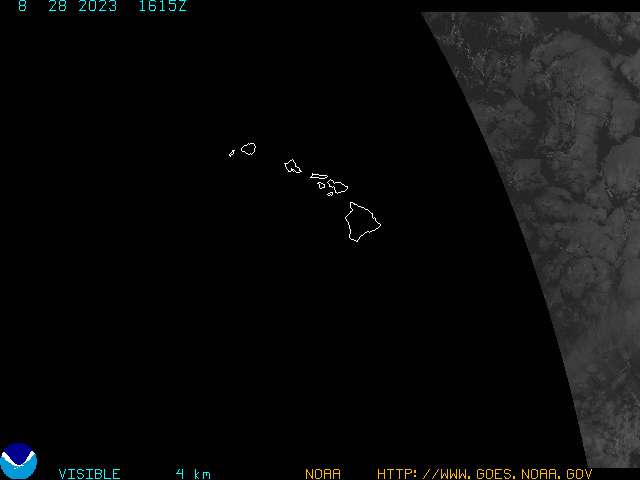


Cary Ritt Says:
Welcome back, Glenn. Spotted you at Baldwin right after your return this week, just in time for the “funky” weather we’re having, very entertaining w/ my favorite phenomenon, the “upper level low” generated on top of us, quite a show.
Please email the link for you cabin near Gualala,”Moon-something”, per your blog. We also love that area, got to spend some time there a couple years ago, Jenner and up the coast there to Mendocino.
Looks like “El Nino” is back, right?! More entertainment for sure…keep up the good work!~~~Hi Cary, always good to hear from you, thanks for your note. Moonstar was the name of the cabin, really a great place. I loved that unsettled weather too, especially the incredible lightning and thunder the other night. I’ll be sure to keep up the good work, and by the way, El Nino will be strengthening as we go into the winter season…which usually brings us drier than normal weather. Aloha, Glenn
Mike Says:
Thanks again for mentioning meditation practice. And, as always, the Aloha Paragraphs and Interesting notes are a wonderful help. / / / Michael Jackson? Do you think he had homosexual contact with minors? Does it matter? How about skin bleaching and plastic surgery? Yesterday, I saw a commemoration picture of him in an issue of the National Association for the Advancement of Colored People (NAACP) magazine “The Crisis,” and I was disappointed then also. May he rest in peace. Why celebrate him? Fred Astaire? Mister Bojangles? Sammy Davis, Jr.? Gene Kelley? Gregory Hines? Ginger Rogers?~~~Hi Mike, glad you like the website. I don’t know whether MJ had improper contact with anyone, that’s a matter for others to worry about. I just liked his music and dancing, that’s what drew me to him. I celebrate anyone who has good dancing talent, including my own Mother and Father! Aloha, Glenn