October 9-10, 2009
Air Temperatures – The following maximum temperatures were recorded across the state of Hawaii Friday afternoon:
Lihue, Kauai – 85
Honolulu, Oahu – 87
Kaneohe, Oahu – 85
Kahului, Maui – 88
Hilo, Hawaii – 85
Kailua-kona – 88
Air Temperatures ranged between these warmest and coolest spots near sea level around the state – and on the highest mountains…at 5 p.m. Friday evening:
Port Allen, Kauai – 90F
Lihue, Kauai – 79
Haleakala Crater – 54 (near 10,000 feet on Maui)
Mauna Kea summit – 43 (near 14,000 feet on the Big Island)
Precipitation Totals – The following numbers represent the largest precipitation totals (inches) during the last 24 hours on each of the major islands, as of Friday afternoon:
0.38 Opaekaa Stream, Kauai
0.25 Waipio, Oahu
0.00 Molokai
0.00 Lanai
0.00 Kahoolawe
0.05 Oheo Gulch, Maui
0.33 Glenwod, Big Island
Marine Winds – Here’s the latest (automatically updated) weather map showing a 1029 millibar high pressure system far to the northeast of the islands, with an approaching 1023 millibar high far to the northwest. A cold front to the north is being pushed southward towards the islands. Light to moderately strong trade winds will prevail this weekend.
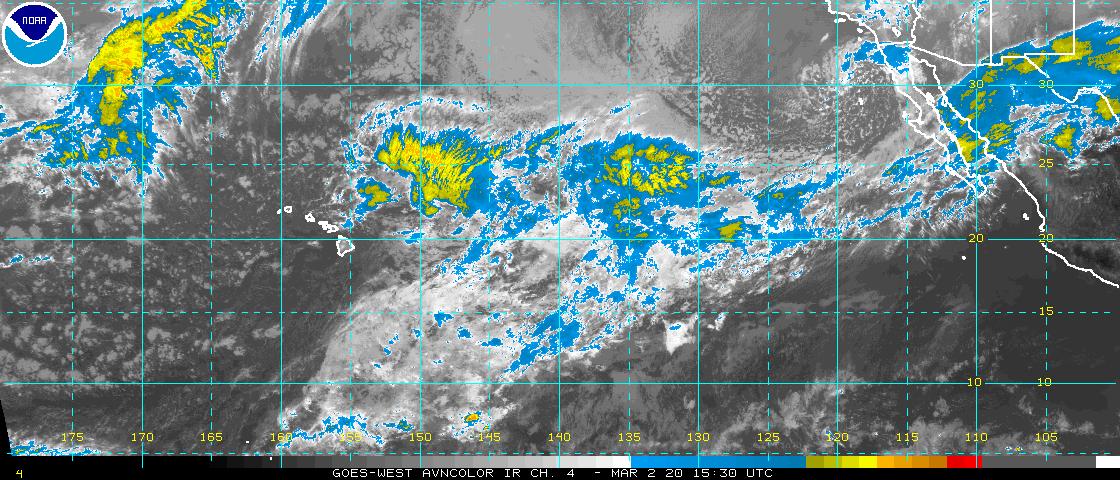
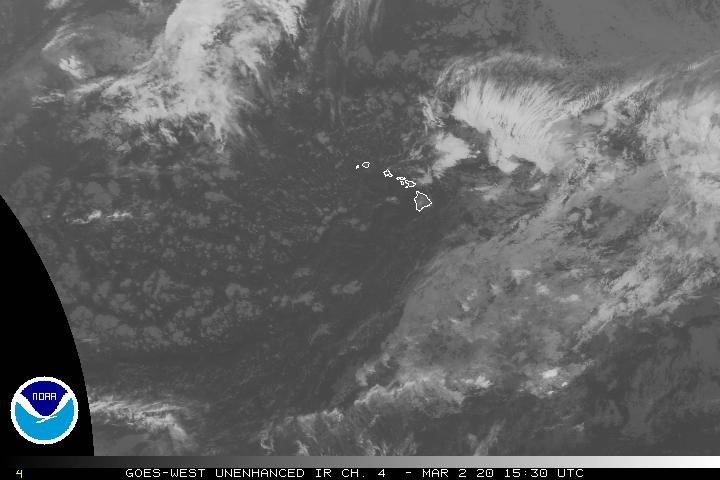
Satellite and Radar Images: To view the cloud conditions we have here in Hawaii, please use the following satellite links, starting off with this Infrared Satellite Image of the islands to see all the clouds around the state during the day and night. This next image is one that gives close images of the islands only during the daytime hours, and is referred to as a Close-up visible image. This next image shows a larger view of the Pacific…giving perspective to the wider ranging cloud patterns in the Pacific Ocean. Finally, here’s a Looping IR satellite image, making viewable the clouds around the islands 24 hours a day. To help you keep track of where any showers may be around the islands, here’s the latest animated radar image.
Hawaii’s Mountains – Here’s a link to the live webcam on the summit of near 14,000 foot Mauna Kea on the Big Island of Hawaii. The tallest peak on the island of Maui is the Haleakala Crater, which is near 10,000 feet in elevation. These two webcams are available during the daylight hours here in the islands…and when there’s a big moon rising just after sunset for an hour or two! Plus, during the nights and early mornings you will be able to see stars, and the sunrise too…depending upon weather conditions.
Tropical Cyclone activity in the eastern and central Pacific – Here’s the latest weather information coming out of the National Hurricane Center, covering the eastern north Pacific. You can find the latest tropical cyclone information for the central north Pacific (where Hawaii is located) by clicking on this link to the Central Pacific Hurricane Center. Here’s a tracking map covering both the eastern and central Pacific Ocean. A satellite image, which shows the entire ocean area between Hawaii and the Mexican coast…can be found here.
Aloha Paragraphs

Rising surf along north and west facing shores this weekend
Light to moderately strong trade winds returning this weekend. We have two high pressure systems, one far to the northwest, and another far to the northeast. At the same time, as we see on this latest weather map, a weakening cold front, pushing southward towards the islands. We’re definitely at the end of our near week long period of light winds…with the trade winds right around the corner. We should see these trade winds blowing, once they arrive during the day Saturday, in the light to moderately strong category.
Whatever haze has been around during the last several days, will be quickly ventilated down stream…blown there by the trade wind flow. This ventilating trade wind flow won’t last long though, hopefully for three or four days. This hazy weather will likely return to our Hawaiian Island weather picture, as yet another light wind event will arrive, as we move towards the middle of the new week ahead. Depending up just which way the blows are blowing then, we could begin to see volcanic emissions spreading up the island chain again then.
As the trade winds arrive, whatever showers that are around, will gravitate towards the windward sides. The aforementioned cold front, which is showing up on weather maps now, will likely be pushed down into the state, or even through the state Saturday night or on Sunday. This will probably add some increase in showers to the windward sides then…here’s a satellite image showing the cold front to the north of Kauai Friday night. Looking further ahead, the models are showing another cold front approaching during the new week ahead. Whether it will make it to Hawaii is still a question, but its approach will help to tamp down our winds again by mid-week.
It’s early Saturday evening here in Kihei, Maui, as I begin writing this last section of today’s narrative update. Since it’s Friday evening, I’m going to take in a new film, this one called Surrogates (2009)…starring Bruce Willis and Radha Mitchell, among others. The short synopsis is: "a cop must investigate a murder in a futuristic society where human interaction has been replaced by idealized robotic surrogates." The critics are giving this film a C+, while film goers are giving it a B. I have a couple of friends who have told me that they really liked it. Here’s a trailer if you’re interested in taking a sneak peek. ~~~ I’ll be back early Saturday morning with your next new weather narrative, I hope you have a great Friday night until then! Aloha for now…Glenn.
Interesting: When lobsters swarm up the beach and octopuses try to clamber up fishing lines to get out of the water, you know that something has gone badly wrong in the ocean. Oxygen-starved dead zones have been appearing with increasing frequency around the world, with some 400 identified so far. While most are caused by sewage or fertilizer leaching into the ocean, a possible new driver has appeared in the northwest Pacific: climate change.
Just as land animals need oxygen in the air to breathe, those in the sea need the oxygen dissolved in seawater. Dead zones cover up to 20,000 sq miles each and their borders shift according to wind, current and tide, killing all animal life that cannot escape in time. “Oregon is a little different,” said Jack Barth, of Oregon State University.
“We have an open coastline, so the ability to flush the coast is high and there are no rivers carrying fertilizer. All nutrients appear to come from natural sources.” But for the past four years Professor Barth has been using autonomous underwater robots to monitor worrying developments on a naturally occurring area of low oxygen off the northwest Pacific, on the border of Washington state and Oregon.
“We’ve seen various degrees of oxygen deficiency,” he said. “We’ve seen zero oxygen, known as anoxia.” Camera footage from remotely operated vehicles “showed us just piles of Dungeness crab, dead tube worms. None could flee”. Off South Africa and Namibia, lobsters swarm to the beach when anoxic waters close in. Professor Barth cites reports that octopuses have tried to climb fishing lines to escape.
Low-oxygen areas occur naturally on the west coast of all continents, where nutrient-rich waters well up to the sunlit surface, causing heavy productivity. The upper waters are well mixed by wind and waves but deeper down there is less opportunity to replenish oxygen. When dead plankton drift into this zone in a marine snowfall, they cause a secondary bloom in microscopic animal life that strips away the oxygen. If the oxygen-starved water does not reach the seabed, the effects are usually less severe.
If it does, the animals there are usually unable to escape. Usually winds push the de-oxygenated areas off Oregon out to sea but in recent years they have been coming ever closer to land and shallower water. Professor Barth said that climate-change models show coastal winds changing.
“The forecast is for stronger and less persistent winds and for deeper waters becoming less oxygenated as surface layers warm, isolating the deeper layers more. So it’s a double-whammy we’re seeing off Oregon.” Although Professor Barth does not yet have enough records to prove that climate change is affecting the winds, he is confident that they are not altering as a result of any natural cycles, such as the warm current El Niño.
Interesting2: In the past, the Chinese were insultingly referred to as the yellow peril, an alien breed whose weird ways might corrupt Western civilization and even bring it to its knees. Today the Chinese are looked on as a green peril, an over-productive people whose use of coal and other filthy fossil fuels might pollute Western society and put the whole world on the fast track to irreversible disaster.
The language has changed dramatically in the past 100 years, but there are striking similarities between how some people viewed the Chinese in the early 20th century and how some people view them in the early 21stcentury. The idea of the Chinese as people who – or their ideas or products – might cause harm to the Western world seems to have remained constant over the decades.
In the climate change debate, China is always depicted as being peculiarly dirty. Its monumental economic growth over the past 30 years is rarely discussed in terms of its vast benefits to humanity but is instead denounced for its destructive impact on nature. So we rarely hear the good news about China’s industrial leap forward.
For example, the fact that, where China had 193 cities in 1978, it now has a remarkable 655; or that where life expectancy in China was a paltry 36.5 years when the People’s Republic was established in 1949, it is now 73.4 years. In 1949, China had a population of 542million and only 117,000 students in higher education; today it has a population of 1.3billion and 20.2 million students in higher education – a figure close to the entire population of Australia.
Yet what are we most frequently told about China’s industrialization? That it is dangerous, both for the people of China and for everyone else across the world. An environmentalist writer in Britain says the upshot of China’s "economic miracle" has been "dust, waste and dirty water". Other Western greens tell us that China’s use of coal is turning the country into a "rapidly advancing dystopia where rivers run black". Even worse, China’s growth might end up killing us all.
We are frequently told that China is the world’s biggest emitter of carbon dioxide and, in the words of one green observer, is putting the world on "the fast track to irreversible disaster". Many environmentalists claim that the UN climate summit at Copenhagen in December is our "last chance to save the planet" and therefore we must get China to agree to sign up. This view of China as a peculiarly threatening nation has eerie echoes of the past.
In the late 19th and early 20th centuries, the movement of Chinese workers and goods to the US and other Western nations gave rise to fears of a polluting effect. In his book Orientals: Asian Americans in Popular Culture, Robert L.Gee says Chinese immigrants were seen as "racial, social and physical pollutants" who might provoke the "demise of Western civilization".
This view of the Chinese was revealling, says Lee: "Pollutants are anomalies in the symbolic structure of society, things that are out of place and create a sense of disorder." Today, in the lingo of environmentalism, the Chinese are seen as the harbingers of climatic disorder. According to the academic Monica Chui, the China-bashing dime-store novels of the late 19th century yellow peril era were also packed with images of the Chinese as "filth, pollutants and toxins".
In her book Fit to be Citizens: Public Health and Race in Los Angeles 1879-1939, Natalia Molina describes how some American public health officials depicted the Chinese as "carriers of diseases and pollutants", giving rise to a perception of Chinese people as "a literal as well as metaphorical threat to the health of the body politic".
One concern of the Yellow Peril era was that if Chinese people bred with white people, or even intoxicated them with their strange habits, then the intelligence levels of Western society would be lowered as a result. This idea was rehabilitated during the great Chinese toy scare of 2007.
When it was revealed that some Chinese toys had high levels of lead in them (though not high enough to cause serious harm to children), there were fears in the US that if American kids chewed on the toys for too long, it might harm their IQ levels (some experts believe that exposure to lead can damage children’s intellectual development).
Here, the old idea about strange items from the East damaging the intellectual resources of the West is given a new lease of life through the environmentalist outlook. This is not to argue that contemporary environmentalists are racists. There are vast differences between labeling a people as pollutants and discussing their behavior as polluting.
However, the persistence of the pollutant label in relation to China reveals much about the fin-de-siecle outlook that underpins contemporary climate fears. If we were to take a more humane view, then we would realize that Chinese growth has been vastly and historically beneficial both to the hundreds of millions of people who have been lifted out of absolute poverty, and to those Western societies that were bankrolled in recent years by Chinese credit.
 Email Glenn James: